Bluesun Solar Panel Buyer's Guide: How to Choose the Right Panel for Your System
By the PES Supply Editorial Team

Bluesun Solar panels occupy the value tier of the US module market: certified, vertically integrated, and priced $0.02–$0.05/W below the Tier 1 name brands. Whether that trade makes sense depends entirely on your project size, your installer, and who carries the warranty risk. This guide gives you the honest version — lineup, datasheet red flags, warranty reality, and exactly who should and should not buy them.
We distribute Bluesun alongside Trina, Canadian Solar, REC, and Mission Solar, so we have no brand commission to protect here — just 50,000+ SKUs and a preference for customers who buy the right tier the first time.
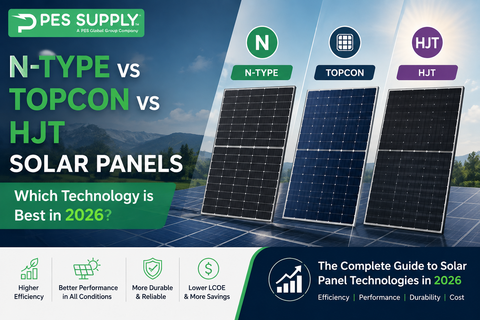
Bluesun Solar is a vertically integrated Chinese module manufacturer headquartered in Hefei, Anhui Province, producing cells and modules across mono PERC and N-type TOPCon lines. In the US market, Bluesun positions as a value-tier supplier: aggressive $/W pricing, broad wattage coverage from residential 400 W-class panels to 600 W+ commercial formats, and a growing warranty and certification stack that has matured considerably since the company's early export years.
Where Bluesun fits in a procurement strategy is the honest question this guide answers. They are not a premium-yield brand competing with REC's HJT line on temperature coefficient, and they are not a domestic-content play like Mission Solar. They are a legitimate, certified, cost-competitive option for budget-driven residential and commercial projects where the installer — not the brand — carries the quality risk. That last clause is doing real work, and we will come back to it.
Key Takeaways
- Bluesun is a value-tier, vertically integrated manufacturer with PERC and N-type TOPCon lines from ~400 W residential to 600 W+ commercial formats.
- Pricing typically lands $0.02–$0.05/W below Tier 1 name brands — meaningful on a 500 kW project, modest on a 10 kW rooftop.
- Certifications (IEC 61215/61730, UL listings on US-market SKUs) are in order; verify the listing on the exact SKU you are buying, not the brand generally.
- The installer carries more of the quality and warranty-execution risk than with Tier 1 brands — buy through a distributor with attic stock and RMA muscle.
- Best fit: budget-sensitive residential, commercial, and off-grid projects where $/W drives the decision and the installer knows the product.
Bluesun's US-facing lineup spans three broad families. Specs below are representative of the class by format — always confirm the exact SKU's datasheet before design, because value-tier manufacturers revise lines frequently and model numbers recycle.
| Family | Wattage Range | Cell Technology | Typical Efficiency | Format | Best Application |
|---|---|---|---|---|---|
| Residential half-cut mono | 400–450 W | Mono PERC, half-cut, multi-busbar | 20.5–21.5% | ~1,722 × 1,134 mm, 54/108-cell | Budget residential rooftops |
| N-type TOPCon residential/commercial | 430–480 W | N-type TOPCon, half-cut | 21.5–22.3% | ~1,762 × 1,134 mm | Value residential + small C&I |
| Large-format commercial | 550–615 W | Mono PERC or TOPCon, 210 mm-class cells | 21.0–21.8% | ~2,278–2,384 × 1,134 mm | C&I rooftops, ground mounts, carports |
The residential 400–450 W class is where we see the most Bluesun volume — installers building to a price point for the value-conscious homeowner who wants a legitimate, warranted panel without the Tier 1 premium. The N-type TOPCon line is the one to watch: it brings the temperature coefficient (−0.30%/°C class) and degradation profile of the modern cell architecture at pricing that used to buy you dated PERC.
Value-tier datasheets contain the same physics as premium ones — you just have to read them more carefully, because the spread between a good production run and a loose one is wider. Here is what we check on every Bluesun-class datasheet before quoting:
| Datasheet Line | Good Value for the Class | Red Flag |
|---|---|---|
| Power tolerance | 0 to +5 W (positive-only) | ±3% or negative tolerance — you may not receive nameplate watts |
| Temperature coefficient of Pmax | −0.34%/°C (PERC) or −0.30%/°C (TOPCon) | Worse than −0.36%/°C in a hot climate |
| Max system voltage | 1,500 V | 1,000 V only — limits commercial string lengths |
| Mechanical load (front/rear) | 5,400 / 2,400 Pa | Below 5,400 Pa front in snow country |
| First-year / annual degradation | ≤2% then 0.55%/yr (PERC); ≤1% then 0.40%/yr (TOPCon) | Warranty terms vaguer than this in writing |
| Certifications listed on the SKU | IEC 61215, IEC 61730, UL 61730 (US SKUs) | Certificates shown for a different model family |
String math follows the same NEC 690.7/690.8 discipline as any module: cold-corrected Voc against the inverter's input ceiling, and Isc × 1.56 for conductor and fuse sizing. A 450 W Bluesun-class module with Voc ≈ 49 V strings to 10 modules on a 600 V residential inverter with margin; the 615 W commercial format at Voc ≈ 55 V strings to about 17 on a 1,000 V system. Full tables are in our NEC ampacity chart and wire guide.
Bluesun's current US-market modules carry IEC 61215 (design qualification), IEC 61730 (safety), and UL 61730 listings on the SKUs intended for North America, plus ISO 9001 factory certification. That is the correct stack, and it means these panels pass the same qualification torture tests — thermal cycling, damp heat, mechanical load, hail — as the name brands. Certification answers "is the design sound?" It does not answer "will the company execute a warranty claim in year 9?"
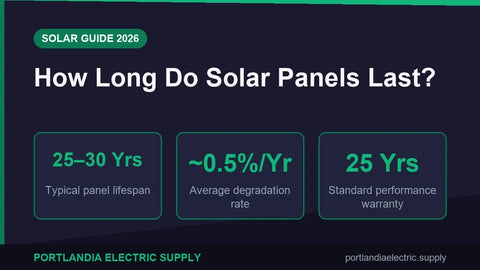
Standard warranty terms in the current lineup: 12-year product warranty and 25-year linear power warranty on PERC lines (80%+ retained at year 25), extending to 15-year product / 30-year power on the N-type TOPCon lines. Those terms match the Tier 1 baseline on paper. The difference is enforcement depth: a claim with a Tier 1 brand routes through an established US service organization; a claim with a value-tier brand routes through your distributor's relationship with the factory. This is exactly why the distributor choice matters more on value-tier product than anywhere else in the catalog — and it is the part of our own Bluesun listings we control directly: we stock attic replacements and process RMAs from our side.
| Attribute | Bluesun (value tier) | Tier 1 mid-range (Trina, JA Solar class) | Premium (REC, Mission Solar class) |
|---|---|---|---|
| Module price ($/W) | $0.22–$0.30 | $0.27–$0.36 | $0.45–$0.65 |
| Peak efficiency offered | ~22.3% (N-type) | 23.1–24.8% | 22.6–22.8% |
| Temperature coefficient | −0.30 to −0.35%/°C | −0.29 to −0.34%/°C | −0.24 to −0.26%/°C |
| Product warranty | 12–15 yr | 12–25 yr | 15–25 yr |
| Bankability (BNEF Tier 1) | Not consistently listed | Yes | Yes |
| US service/RMA depth | Distributor-dependent | Established US orgs | Established US orgs |
| Best use case | Budget residential, off-grid, price-driven C&I | Mainstream residential + C&I | Premium residential, hot climates, BABA projects |
One factor the table cannot show: tariff exposure. Value-tier import pricing floats with Section 201/301 policy and antidumping actions, which means the Bluesun quote you get in March may not survive to September. Tier 1 brands face the same policy, but their distribution depth cushions the swings. If your project timeline spans quarters, lock pricing in writing with an expiration date you can actually build against — we honor quoted pallet pricing for 30 days for exactly this reason. The same discipline applies to currency swings and shipping surcharges, which hit value-tier imports first and hardest.
The savings are real but scale-dependent. On a 10 kW rooftop, $0.04/W saves the homeowner $400 on modules — roughly 1.5% of the installed system price, and rarely worth the trade if the installer is not already confident in the product. On a 500 kW commercial project, the same delta is $20,000 — worth a serious conversation. Match the brand risk to the project size and to who carries the warranty-execution risk: your installer and your distributor, in that order.
Module efficiency differences look dramatic in marketing and small in production models. Run the numbers on a 10 kW residential system at 4.8 peak sun hours with an 0.80 performance ratio — about 14,000 kWh per year regardless of whether the nameplate efficiency is 21% or 22%, because system size in watts is what drives annual kWh, and both options fill the same inverter. What actually changes with panel choice is roof area consumed and 30-year degradation.
| Metric | Bluesun PERC (450 W class) | Bluesun TOPCon (460 W class) | Premium HJT (470 W class) |
|---|---|---|---|
| Modules for a 10 kW array | 23 | 22 | 22 |
| Roof area consumed | ~45 m² | ~44 m² | ~43 m² |
| Year-1 production (4.8 PSH, 0.80 PR) | ~14,000 kWh | ~14,000 kWh | ~14,000 kWh |
| Hot-climate production penalty (cell 60 °C vs 25 °C) | ~−12% | ~−10.5% | ~−8.4% |
| Year-25 retained output (warranted) | ~80–84% | ~87% | ~92% |
| Cumulative 25-yr production vs. premium | ~94% | ~97% | 100% (baseline) |
| Module cost delta vs. premium (10 kW) | −$1,900 to −$2,700 | −$1,500 to −$2,300 | Baseline |
The honest reading: over 25 years the premium module produces maybe 6% more energy and costs roughly $2,000 more up front on a 10 kW system. At $0.15/kWh, 6% of ~330,000 lifetime kWh is about $3,000 — so the premium can pencil, barely, in hot climates with high rates. In mild climates at average rates, the value tier wins the arithmetic. Neither answer is universal, which is why we show the math instead of the adjectives.
Off-grid buyers should run a different calculation entirely: there, the constraint is winter production and battery recharge rate, not $/W. Size the array with the battery sizing guide and the MPPT vs PWM guide before choosing modules.
7. Maintenance, Longevity, and What to Watch in Years 5–25

Value-tier modules do not demand special maintenance — the panel itself has no moving parts and no service schedule. What they demand is slightly more attentive ownership, because the monitoring signals that a premium brand's US service org would catch are yours to catch here:
- Baseline your production in month one. Log daily kWh on ten clear days. Every future problem is measured against that baseline; without it you have no early warning at all.
- Watch string-level data, not just system totals. A single degrading module shows up as a 5–15% string underperformance long before it shows up on your bill.
- Inspect annually from the ground. Discoloration, snail trails, delamination at the edges, and junction-box browning are all warranty-claim material — photograph them the day you notice, not the month.
- Keep the paperwork stack. Invoice, serial map, warranty document, and installer workmanship warranty in one folder. Claims are won with documentation, and the folder is free.
- Clean on condition, not on calendar. In most US climates rain does the work; if your monitoring shows a 5%+ seasonal sag that a cleaning reverses, set the cadence from that evidence.
Our system maintenance guide covers the storage side if your project includes batteries, and the wiring basics guide is worth a read before any DIY-adjacent install.
Bluesun modules install like every other framed module in their format class — standard rail systems, standard clamps in the marked clamp zones, MC4-compatible connectors. A few habits matter more on value-tier product:
- Inspect on delivery, not on the roof. Check every module for frame dings, glass chips, and junction-box seating before the pallet leaves the ground. Freight-damage claims are easy at the dock and painful from a scaffold.
- Flash-test suspicion is free. If one string underperforms its siblings by 3%+ in the first week, swap-suspect modules between strings before assuming inverter issues. Early-life module outliers exist in every brand; they are simply more common per thousand at value tier.
- Torque to the racking spec, not by feel. We have pulled more than one under-torqued mid-clamp off a value-tier frame where the installer blamed the panel. The frame was fine; the clamp was loose.
- Document serials at install. Photograph the serial labels per string. Warranty claims without serial mapping turn into archaeology.
Electrical integration is standard NEC 690 work: rapid shutdown per 690.12, disconnects and overcurrent protection per our NEC 690 guide, grounding per 690.43, and conductors per the ampacity tables. Nothing about a value-tier module changes the code — but everything about a value-tier project makes the paperwork more worth doing.
Panel choice comes after roof truth. Before any Bluesun order, run the standard assessment: structural condition and remaining shingle life (re-roofing under a 25-year array costs thousands in removal and reinstall), azimuth and tilt, shade mapping through the solstice, and rafter spacing for attachment layout. A value-tier panel on a ten-year-old roof is a fine decision; the same panel on a roof with five years of shingle life left is an expensive one.
| Roof Factor | What to Check | Rule of Thumb for the Layout |
|---|---|---|
| Orientation / tilt | Azimuth and pitch per face | South ±45° and 15–40° tilt loses under 10% vs. ideal; east-west splits flatten the curve (see our clipping guide) |
| Shade | Year-round shade map, solstice to solstice | Any face with meaningful 9am–3pm shade goes on MLPE or gets skipped |
| Structure | Rafter size/spacing, decking condition | Attachments into rafters, not decking; typical residential arrays add ~3 psf — verify, don't assume |
| Setbacks | Fire-code pathways per AHJ (IRC/IFC) | Commonly 18-inch ridge pathways and 3-foot perimeter on the egress side — layouts shrink fast, so measure usable area, not roof area |
| Remaining roof life | Shingle age and condition | Under ~10 years of shingle life: re-roof first, or price the future remove-and-reinstall into the project honestly |
On mounting hardware, Bluesun-class framed modules are rail-agnostic — IronRidge, Unirac, and the Sinclair-style ground systems all clamp them within the marked zones. For ground mounts and pole mounts, the pole-mount guide and racking overview cover the structural side. The one format-specific note: the 600 W+ large-format modules need two-person handling and wider rail spacing per the racking manufacturer's span tables — do not stretch residential spans to fit a commercial frame.
Value-tier purchasing rewards process discipline. When you are comparing Bluesun-based quotes — or any quote mixing tiers — normalize everything to the same skeleton:
1. Demand the exact SKU and datasheet
"Bluesun 450W" is not a spec. Get the full model number, the datasheet for that model, and the warranty document for that model. Quotes that resist this step are telling you something.
2. Separate module price from system price
A quote that is $0.30/W cheaper installed because it uses value-tier modules should show you roughly where the savings come from. If the module delta accounts for $0.04 and the quote dropped $0.30, the rest came from somewhere — labor assumptions, racking grade, or margin. Ask.
3. Verify who holds the warranty chain
Three documents should name names: the manufacturer's warranty, the installer's workmanship warranty (10 years is the healthy standard), and the distributor's RMA commitment. If any link is vague, it will be you holding the claim in year 7.
4. Price the alternatives on the same layout
Ask for one alternate quote in a Tier 1 mid-range module — same layout, same inverter. The honest delta on a 10 kW job is usually $400–$800. Seeing it in writing turns an abstract brand debate into a concrete, usually easy, decision.
On financing: value-tier modules are fully eligible for the federal ITC and every mainstream solar loan product we have seen — the lender cares about the install, not the module brand, until the loan exceeds 20 years, which is where bankability questions start. Keep loan terms at or under the warranty period and the tier question stays an economics question.
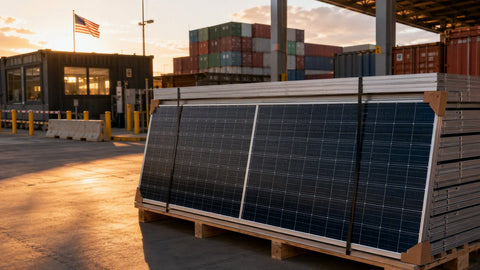
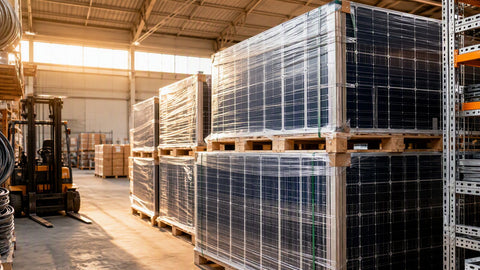
Our quotes include all four by default. Send the spec or the roof address through the contact page and we will return the SKU-level breakdown with current pallet pricing, lead time, and the warranty chain named in writing — the same paperwork we would want if we were the ones signing the check. Contractors ordering pallet quantities can also ask about consolidated freight with inverters and racking on the same truck — one delivery window, one liftgate, no stranded BOM lines waiting on a second carrier — the crew starts Monday with everything on site.
Good fit: the budget residential install
Homeowner wants legitimate, certified panels at the lowest defensible $/W, and the installer has Bluesun field experience and a distributor with attic stock. Savings of $300–$500 on a 10 kW job, with warranty terms in writing.
Good fit: off-grid and DIY-adjacent projects
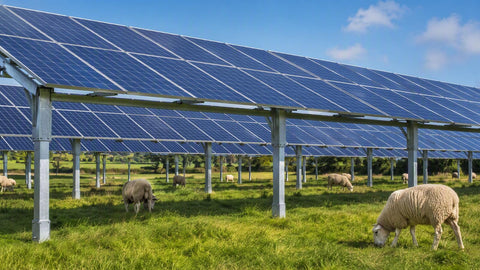
Ground mounts, cabins, agricultural pumping — applications where premium yield metrics matter less than watts per dollar and where the owner maintains the system. Pair with our off-grid inverters and charge controllers.
Good fit: price-driven commercial with strong EPC
A 500 kW carport where $20,000 of module savings is real money and the EPC's own workmanship warranty and O&M contract stand behind the array.
Poor fit: financed residential with a 25-year loan
When a lender's collateral depends on the array, premium bankability and the deepest warranty-execution channels are worth their cost. Spend the four cents.
Poor fit: BABA / domestic-content projects
Bluesun manufactures in China; these modules do not satisfy Buy America requirements. Use US-made panels for federally funded work.
Are Bluesun solar panels any good?
Bluesun panels are legitimate, IEC/UL-certified modules that pass the same design qualification testing as name brands, at pricing $0.02–$0.05/W below Tier 1. The trade-off is warranty-execution depth and bankability rather than basic product quality. They are a sound choice for budget-driven projects when purchased through a distributor that stocks replacements and processes RMAs.
Where are Bluesun solar panels made?
Bluesun Solar manufactures in Hefei, Anhui Province, China, with vertically integrated cell and module production. Their modules do not qualify for Buy America / BABA domestic-content requirements.
What warranty do Bluesun panels carry?
Current lines carry a 12-year product warranty and 25-year linear power warranty on PERC models (80%+ retained output at year 25), and 15-year product / 30-year power warranties on N-type TOPCon lines. Verify the terms on the exact SKU's warranty document before purchase.
How efficient are Bluesun panels?
Current Bluesun-class lines run roughly 20.5–21.5% efficiency on mono PERC residential formats and 21.5–22.3% on N-type TOPCon — competitive for the value tier, though a point or more below the premium flagships.
Can I use Bluesun panels with microinverters?
Yes, on the residential formats — verify the module's Imp against the microinverter's input current rating, and check that the module's Voc stays within limits at your design low temperature. The large-format 600 W+ commercial modules exceed most microinverter input ratings and belong on string inverters.
Are Bluesun panels Tier 1?
Bluesun has not been consistently listed as a BloombergNEF Tier 1 manufacturer — a bankability designation that matters for financed and commercial projects. For cash residential and off-grid work, Tier 1 status is a pricing input, not a quality guarantee; for lender-backed projects, it can be a requirement.
- IEC 61215 / IEC 61730 — Module design qualification and safety testing
- UL 61730 — North American module safety listing
- NEC 690 — Photovoltaic systems (string sizing, rapid shutdown, grounding)
- Bluesun manufacturer datasheets and warranty documents (current US-market SKUs)
Shop Bluesun at PES Supply
Value-tier panels with distributor-backed RMA support — pallet pricing available.
Browse Bluesun panels →Compare before you buy: best solar panels 2026, wholesale procurement guide, and the panel kits buyer's guide. Browse all solar panels, 400–459 W, monocrystalline, N-type, and pallet bundles. Sizing a system? Start with the system size calculator and inverter buyer's guide.
PES Supply (https://www.portlandiaelectric.supply) is a B2B electrical and solar distributor offering 50,000+ SKUs from 169 authorized brands. Verify all specifications against the manufacturer's current datasheet before final design.