22kW Generator Buying Guide: How to Choose the Right Power Solution
By the PES Supply Editorial Team

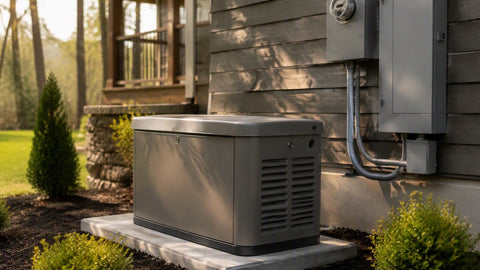
A 22 kW standby generator is the most popular whole-house backup size in North America for a simple reason: it is the smallest air-cooled unit that starts a 4-ton air conditioner while carrying the rest of the house. This guide is the version we wish every customer read before calling — real load math, real fuel consumption, NEC installation requirements, and the actual differences between the four brands that dominate this class.
As a distributor stocking 50,000+ SKUs from 169 authorized brands, including every major name in the 22 kW generator class, we watch which units come back for warranty and which ones just run for a decade. Everything below is written from that seat. For sizing fundamentals first, start with our generator sizing guide.
Twenty-two kilowatts is the sweet spot of the residential standby market, and it earned that position the honest way: it is the smallest air-cooled unit that can start and run a 4-ton central air conditioner while still carrying the rest of a typical 2,500–3,500 sq ft home. A 22 kW standby generator produces roughly 91.6 amps at 240 volts single-phase (22,000 W ÷ 240 V = 91.6 A), which is why nearly every unit in this class ships paired with a 100-amp or 200-amp automatic transfer switch.
Key Takeaways
- A 22 kW standby produces ~91.6 A at 240 V and carries a 3–4 ton central AC plus a full house, with load management for the dryer, range, and EV charger.
- Natural gas derates every unit in this class 8–12% — size against the NG rating, not the LP brochure number, and confirm your meter can deliver ~306 ft³/hr before install day.
- A 500-gal propane tank (400 gal usable) delivers roughly 111 hours at full load and over a week at realistic half-load duty.
- Feeder conductors follow NEC 445.13 at 115% of nameplate: 2 AWG copper (75 °C, NEC 310.16) is the standard pull for this class.
- Turnkey installed cost runs $9,900–$16,600 in 2026; the cheapest insurance in the whole system is a $120 battery replaced every 3–4 years.
We have sized hundreds of these for Gulf Coast and Midwest customers, and the pattern repeats: the homeowner who lost power for four days during the last ice storm does not want to choose between the AC and the well pump ever again. At 22 kW, they do not have to.
| Load | Running Watts (typical) | Starting Watts (typical) | Can a 22 kW unit carry it? |
|---|---|---|---|
| Central AC, 3-ton (36,000 BTU) | 3,000–3,500 W | 4,500–6,000 W (less with soft-start) | Yes, with headroom |
| Central AC, 4-ton (48,000 BTU) | 4,000–4,800 W | 6,000–8,000 W (less with soft-start) | Yes, managed |
| Electric water heater (4.5 kW element) | 4,500 W | 4,500 W (resistive) | Yes, with load management |
| Well pump, 3/4 HP | 1,000–1,500 W | 2,100–3,000 W | Yes |
| Refrigerator / freezer | 600–800 W | 1,800–2,400 W | Yes |
| Gas furnace blower, 1/2 HP | 600–900 W | 1,200–1,800 W | Yes |
| Sump pump, 1/2 HP | 800–1,050 W | 1,300–2,150 W | Yes |
| Electric range (one oven + burner) | 3,000–5,000 W | 3,000–5,000 W | Yes, with load management |
| Electric dryer | 4,500–5,500 W | 5,500–6,750 W | Conditional — usually shed |
| Level 2 EV charger (7.7 kW) | 7,700 W | 7,700 W | Conditional — usually shed |
The honest answer on that table: a 22 kW air-cooled standby carries everything in the first seven rows simultaneously with capacity to spare. The last two rows are where modern load-management modules earn their keep — the transfer switch sheds the dryer or EV charger for the few minutes the AC compressor and water heater happen to overlap, then restores them automatically.
Four manufacturers dominate this class in our order queue. Specs below are published nameplate figures; always confirm against the current spec sheet before quoting a job.
| Model | LP Output | NG Output | Engine | Enclosure / Sound | Warranty |
|---|---|---|---|---|---|
| Generac Guardian 22 kW (7043/7042) | 22,000 W | 19,500 W | 999 cc G-Force 1000 series | Aluminum / ~67 dB(A) at 23 ft | 5-yr limited |
| Champion 22 kW aXis (100837 class) | 22,000 W | 19,800 W | 999 cc Champion V-twin | Aluminum / ~67 dB(A) at 23 ft | 10-yr limited |
| Kohler 20 kW (20RCA) | 20,000 W | 18,000 W | 999 cc Kohler Command PRO | Aluminum / ~69 dB(A) at exercise | 5-yr / 2,000-hr |
| Cummins QuietConnect RS20A (20 kW) | 20,000 W | 18,000 W | 999 cc Cummins V-twin | Aluminum / ~65 dB(A) at 23 ft | 5-yr / 2,000-hr |
| Briggs & Stratton 20 kW PowerProtect | 20,000 W | 18,000 W | 993 cc Vanguard V-twin | Galvanneal steel / ~69 dB(A) | 6-yr limited |
Two things jump off that table in the field. First, natural gas derating is real — every air-cooled unit loses 8–12% of its output on NG versus propane because pipeline NG delivers fewer BTU per cubic foot. If your load calc lands at 20 kW on the nose and you are on natural gas, you are actually shopping the 24–26 kW class; see our complete guide to 26 kW generators before you commit. Second, Champion's 10-year warranty is not a typo — it is the longest standard coverage in the class and a genuine differentiator for homeowners who plan to stay put.
We stock the Champion 22 kW standby alongside 22 kW units from every major brand, and we tell customers the same thing we would tell a neighbor: buy on the service network in your zip code first, the spec sheet second.
Fuel choice decides more of your real-world experience than brand choice does. Here is the consumption math for a 22 kW-class air-cooled standby, using the published Generac 7043-class figures that the whole class clusters around:
| Fuel & Load | Consumption Rate | Supply Reality Check | Runtime / Endurance |
|---|---|---|---|
| Natural gas @ 50% load (~11 kW) | ~203 ft³/hr | Many residential meters deliver 250 ft³/hr total — a furnace + water heater + range can leave too little for the generator | Unlimited while utility gas flows |
| Natural gas @ 100% load (19.5 kW) | ~306 ft³/hr | Usually requires a gas utility meter/regulator upsize — schedule it before installation day | Unlimited while utility gas flows |
| Propane @ 50% load (~11 kW) | ~2.1 gal/hr (~92 ft³/hr) | 250-gal tank (200 gal usable) ≈ 95 hours at half load | ~4 days at half load on 250 gal |
| Propane @ 100% load (22 kW) | ~3.6 gal/hr (~157 ft³/hr) | 500-gal tank (400 gal usable) ≈ 111 hours at full load | ~4.6 days at full load on 500 gal |
The propane arithmetic is worth doing out loud once. Propane carries about 91,500 BTU per gallon. A 22 kW unit at full load burns roughly 3.6 gal/hr — call it 330,000 BTU/hr — so a code-filled 500-gallon tank (400 gallons usable at the 80% fill limit) yields 400 ÷ 3.6 ≈ 111 hours, or about 4.6 days of continuous full-load operation. At realistic outage duty cycles, where the unit idles along at 40–60% load most hours, that same tank stretches past a week. Tanks are only filled to 80% because liquid propane expands roughly 1.5% per 10 °F — the ullage space is a safety margin, not the supplier shorting you.
For natural gas, the constraint is rarely the generator — it is the meter. A standard residential meter and regulator set often tops out around 250 ft³/hr of deliverable capacity, and the generator alone wants ~306 ft³/hr at full load. We have had installs delayed two weeks because nobody called the gas utility for the meter upsize before the pad was poured. Call the utility first; the upsize is usually free or cheap, but it is never same-day.
NEC 220 and NEC 702 both point you at the same discipline: inventory the loads, account for starting surge, and size for the worst credible combination — not the average day. Our field rule for the 22 kW class: if your honest simultaneous load lands above 16 kW, step up to the 24–26 kW class rather than trusting load management to save you in a July heat wave.
| Sizing Step | What to Do | Worked Example (2,800 sq ft home) |
|---|---|---|
| 1. Inventory running loads | List every circuit you want live during an outage; use nameplate watts, not guesses | AC 3.5 kW + fridge 0.7 + freezer 0.6 + furnace blower 0.8 + lights/receptacles 1.5 + well pump 1.2 = 8.3 kW |
| 2. Add starting surge | Motors draw 2–3× running watts at start; sequence or soft-start the big ones | AC start +4.5 kW, well pump start +2.1 kW → peak ≈ 14.9 kW |
| 3. Apply fuel derating | NG units lose 8–12% vs. LP nameplate | 22 kW LP unit on NG = 19.5 kW available |
| 4. Keep 20–25% headroom | Continuous duty near nameplate shortens engine life and trips thermal protection | 14.9 kW peak vs. 19.5 kW available = 24% margin ✓ |
| 5. Decide on managed loads | Dryer, range, EV charger go on load-shed modules, not in the base calc | EV charger 7.7 kW shed during AC starts |
Want the interactive version? Our whole-house generator sizing guide and the 2026 sizing walkthrough both include worksheets, and the Spanish-language version lives at our guía de dimensionamiento en español.
Air-cooled 22 kW units land on a pre-cast composite or poured concrete pad, and every major manufacturer wants roughly the same geography: 18 inches minimum from the structure (5 feet from openings, windows, and vents is the safer standard most AHJs enforce), 3 feet of clearance at the front for service, and never under a deck or soffit overhang. NFPA 37 governs the siting distances; NFPA 70 (the NEC) governs everything electrical downstream.
| Code Item | Requirement (typical AHJ) | Field Note |
|---|---|---|
| Transfer equipment | NEC 702.5 — transfer switch must prevent interconnection of utility and generator | Service-rated ATS ahead of the main panel is the cleanest whole-house solution |
| Feeder sizing | NEC 445.13 — conductors sized ≥115% of generator nameplate | 22 kW @ 240 V = 91.6 A × 1.15 ≈ 105 A → 2 AWG Cu (75 °C, NEC 310.16) or 1/0 Al |
| Overcurrent protection | NEC 240.6 standard sizes; NEC 445.12/445.13 coordination | Most 22 kW units ship with a 100 A breaker on the unit — match the ATS rating to the feeder, not the other way around |
| Grounding | NEC 250.30/250.35 — separately derived vs. non-separately derived system | Whether to switch the neutral depends on the ATS type — get this wrong and ground-fault sensing goes haywire |
| Disconnect | NEC 445.18 — disconnecting means for the generator | The unit-mounted breaker usually satisfies this if within sight of the ATS |
| Fuel piping | NFPA 54 (NG) / NFPA 58 (LP) | LP tanks: 10 ft minimum from ignition sources for ASME tanks; verify regulator sizing for the ~330 kBTU/hr full-load demand |
Wire math worth keeping in your pocket: per NEC 310.16 (75 °C copper column), 4 AWG THHN is good for 85 A, 3 AWG for 100 A, and 2 AWG for 115 A. Since a 22 kW unit's 115% feeder requirement lands near 105 A, 2 AWG copper is the standard pull for runs of any length — and if the ATS is 150 feet from the pad, we upsize to 1 AWG or 1/0 to keep voltage drop under 3%. Our NEC wire sizing guide and wire ampacity chart have the full tables, and we stock THHN and service-entrance cable by the spool.
Permits are not optional and honestly not painful: electrical permit for the ATS and feeder, mechanical/plumbing permit for the gas line, and in most jurisdictions a final inspection with the unit running through a full transfer cycle. Budget $500–$1,500 for permitting and inspection fees depending on your county, and do not skip the utility notification — many utilities require it before any service-rated ATS goes in.
| Cost Component | Typical Range (2026) | Notes |
|---|---|---|
| 22 kW unit, equipment only | $5,200–$6,500 | Champion and Generac cluster at the low-middle; Kohler/Cummins price higher |
| Service-rated ATS (200 A) + load modules | $900–$1,600 | Often bundled with the unit |
| Pad, trenching, feeder wire, gas plumbing | $1,800–$4,000 | Long gas runs and meter upsizes push the top of the range |
| Labor + permits | $2,000–$4,500 | Varies hard by region and existing panel condition |
| Turnkey installed total | $9,900–$16,600 | Most real jobs we see land $11k–$14k |
| Annual maintenance (kit + service visit) | $200–$450/yr | Oil, filter, plugs, battery every 3–4 years |
| Fuel, 72-hr outage on LP @ 50% avg load | ~151 gal ≈ $380–$530 | 2.1 gal/hr × 72 hr; LP at $2.50–$3.50/gal |
Financing reality: most dealers offer 12–60 month terms on the installed package, and at typical rates a $12,000 turnkey job runs $225–$275 a month on a five-year note — less than many families spend on a single hotel week after a hurricane evacuation. Some homeowners-insurance carriers also discount premiums 2–5% for permanently installed standby power; ask your agent, because the discount rarely applies to portable units.
Over ten years, expect total cost of ownership in the $14,000–$21,000 band including maintenance and a few outage events' worth of fuel. Compare that against one spoiled basement from a dead sump pump or a week of hotel rooms with two kids and a dog, and the payback math is usually emotional before it is financial — which is fine. It is backup power; peace of mind is the product. And unlike most peace-of-mind purchases, this one also keeps the sump pump, the furnace blower, and the refrigerator running through the whole storm.
Every 22 kW-class unit self-exercises weekly (12 minutes is the common default) and logs its own faults. Your job as the owner is small but non-negotiable: keep 3 feet of clearance clear of mulch and leaves, glance at the status LED monthly, and treat the battery as a wear item — the number-one cause of "generator failed to start" service calls we see is a $120 battery that died quietly in year four.
- Every week (automatic): self-exercise cycle; verify green status light after.
- Every month: visual once-over — oil seep, rodent nesting, enclosure damage, clear exhaust path.
- Every 100 hours or annually: oil and filter (5W-30 synthetic is the common spec), air filter, spark plugs at 200–300 hours depending on model.
- Every 3–4 years: replace the starting battery proactively, load-bank or extended run test if the unit rarely carries real load.
- After any outage over 24 hours: check oil level; air-cooled engines consume a measurable amount on long runs.
Keep the paper trail, too: every oil change, every battery, every service visit logged with dates and run-hours. Manufacturers ask for maintenance records on any warranty claim beyond year one, and a folder of receipts turns a two-week claims argument into a two-day approval. The free apps each brand ships will store the run history automatically — use them.
One more field note: run it under real load at least once a season. An engine that only ever exercises unloaded can glaze its cylinders over years — wet stacking is a diesel term, but light-load boredom hurts gas engines too. Twenty minutes carrying the AC and water heater does more for longevity than any additive.
8. Warranty and Service Networks: The Deciding Factor
On paper the warranties span 5 to 10 years, and that gap is real money. But the warranty only matters if a certified tech can reach your driveway, so we tell every customer to make two phone calls before choosing a brand: call the two closest servicing dealers and ask their current callback time in an outage event. The brand with a 10-year warranty and a three-week service queue loses to the brand with a 5-year warranty and a tech twenty minutes away, every single time.
| Brand | Standard Warranty | Coverage Notes | Service Network Reality |
|---|---|---|---|
| Champion | 10-yr limited | Longest standard coverage in the class; parts and labor terms vary by year | Growing dealer network; strong in the Midwest and South |
| Generac | 5-yr limited | Extended warranties available at purchase | Largest service network in North America by a wide margin |
| Kohler | 5-yr / 2,000-hr | Hour cap rarely matters in residential duty | Strong dealer channel; parts pipeline is excellent |
| Cummins | 5-yr / 2,000-hr | Backed by the Cummins distributor network | Best-in-class in metro areas with a Cummins distributor |
| Briggs & Stratton | 6-yr limited | Solid middle ground on term | Good coverage through power-equipment dealers |
Two warranty gotchas we see bite people every year. First, every manufacturer requires professional commissioning and registration within a window (typically 30–90 days) — an unregistered unit can default to a shorter term. Second, "limited" means wear items (battery, plugs, oil, filters) and owner-maintenance failures are excluded, which is exactly why the maintenance calendar in the next section is not optional reading.
Every air-cooled 22 kW unit idles its weekly exercise somewhere in the low-60s dB(A) at 23 feet and runs a real outage at 65–69 dB(A) — call it central-AC loud. That number is measured in a free field, though. In a real side yard, sound reflects off the house wall and the neighbor's fence, and the perceived level at the property line is what your local noise ordinance cares about. Most residential codes set nighttime limits between 55 and 65 dB(A) at the property line, which a properly sited 22 kW unit meets — but "properly sited" is doing the work in that sentence.
Three field rules we give every installer: point the exhaust away from the neighbor's bedroom window even if it costs you ten extra feet of gas line; keep the unit off shared fence lines by at least five feet; and if the lot is tight, the Cummins QuietConnect's ~65 dB(A) rating is worth real money in goodwill. On emissions, air-cooled gas units in this class are EPA-certified and CARB-compliant in current production — no aftertreatment, no DEF, none of the diesel paperwork. Permitting departments mostly care about setbacks, gas line sizing, and the electrical inspection, in that order.
Every unit in this class now ships with Wi-Fi or LTE monitoring — Generac's Mobile Link, Champion's aXis platform, Kohler's OnCue Plus, Cummins' Cloud Connect. They all do the same three things well: push a notification when the unit exercises, fault, or runs an outage; show fuel and battery status; and let your dealer see the fault history before rolling a truck. The dealer-facing side is the part worth paying for — a unit that texts its own service provider when the battery voltage sags gets fixed before you need it.
What actually breaks, ranked by our warranty queue over the years: starting batteries (years 3–5, cheap and predictable), stepper motors on the fuel regulator, controller boards after lightning events (a $30 whole-house surge protector on the ATS feed is the cheapest insurance in this entire article), and rodent damage to wiring looms in rural installs. The engines themselves — the 999 cc V-twins every brand converged on — are boring in the best way. We rarely see a top-end failure under 1,000 hours, and 1,000 hours is forty years of average outage duty.
After enough warranty calls and enough callbacks, the failure patterns stop being random. These are the seven we would tattoo on the inside of every installer's eyelids:
Undersized gas supply
A 22 kW unit wants ~306 ft³/hr of natural gas at full load. If the meter, regulator, or 30-year-old half-inch branch line cannot deliver it, the generator runs fine during commissioning at light load and then surges and drops offline the first time the AC kicks on during a real outage. Pressure-test at full load before you leave the site.
Switching the neutral when you shouldn't
Whether the ATS switches the neutral determines whether the generator is a separately derived system under NEC 250.35. Get it wrong and ground-fault current takes paths the inspector — and the equipment — did not expect. Follow the ATS manufacturer's diagram exactly; this is not a place for improvisation.
Skipping the 115% feeder rule
NEC 445.13 wants conductors at 115% of generator nameplate. A 22 kW unit's 91.6 A becomes ~105 A, and 3 AWG copper (100 A at 75 °C) does not make it — 2 AWG does. We have seen failed inspections over exactly one wire size.
Pouring the pad under the soffit
Exhaust heat rises. Units set under eaves cook soffit vinyl, trip their own high-temp shutdowns, and fail inspection. NFPA 37 clearance rules exist because of fires, not paperwork.
No surge protection on the ATS feed
The controller board is the brain and the most expensive single component. A utility-side surge — common during the same storms that cause outages — can take it out through the sense wiring. A service-rated surge protector is a $30–$150 line item that protects a $900 board.
Letting the battery die of old age
Starting batteries fail quietly in years 3–5. The unit reports "ready" until the exact second it is told to crank. Proactive replacement every 3–4 years costs $120; an emergency call during an ice storm costs ten times that, if a tech can even reach you.
Sizing to the brochure, not the fuel
"22 kW" on the brochure is the propane number. On natural gas the same machine is a 19.5 kW machine. If your load calc used the LP rating and you are on NG, you bought a smaller generator than you think you did.
A 22 kW standby is not always the right answer, and we would rather lose a sale than take one back. Here is the straight comparison we walk customers through:
| Solution | Upfront Cost | Runtime | Best For | Honest Weakness |
|---|---|---|---|---|
| 22 kW standby (NG/LP) | $10k–$16k installed | Days to weeks | Whole house, medical loads, multi-day outages, well pumps | High upfront cost; needs gas service or tank |
| Portable inverter generator 7–9 kW | $1.5k–$4k | 8–14 hrs per fill | Essential circuits only, occasional short outages | Manual setup in the storm; gasoline storage and stability; no AC compressor |
| Home battery (13.5–20 kWh) | $11k–$20k installed | Hours, not days, at whole-house load | Short outages, solar pairing, silent operation, no permits for gas | A 13.5 kWh battery runs a 3-ton AC for maybe 90 minutes; multi-day outages need solar recharge or a generator anyway |
| Hybrid: battery + smaller generator | $18k–$30k | Indefinite with fuel | Customers who want silent nights and unlimited runtime | Complexity and cost; two systems to maintain |
The battery row surprises people, so run the math once: a 3-ton AC drawing 3.5 kW drains a 13.5 kWh battery (at ~90% usable) in about 3.5 hours — and that is with nothing else running. Batteries are excellent at what they do; powering central air through a three-day hurricane outage is not what they do. Our battery backup runtime calculator lets you run your own loads, and the 20-80 battery rule explains why usable capacity is never the nameplate number.
Where the 22 kW standby wins outright: medical equipment that cannot tolerate transfer gaps (ATS switches in about 10 seconds, unattended), well pumps and sump pumps during ice storms when roads are impassable, and any outage measured in days rather than hours. Where it loses: short outages in dense suburbs with small lots, and customers whose real goal is daily bill arbitrage — that is a battery and solar conversation, not a generator conversation.
The Gulf Coast retrofit
2,900 sq ft ranch outside Houston, 4-ton AC, well pump, NG service. Load calc peaked at 13.8 kW; the 22 kW LP-rated unit on NG (19.5 kW) carried it with 29% margin. The gas utility upsized the meter for free with a two-week lead time — scheduled before the pad pour, zero delay. Total job: $12,400.
The rural propane job
Farmhouse on well and septic, no gas service, 500-gal LP tank already on site. Full-load fuel math: 400 usable gallons ÷ 3.6 gal/hr ≈ 111 hours at full tilt, over a week at realistic duty. The owner added a second fridge in the shop building on a load module. Total job: $13,900 including the trench.
The one we talked out of it
1,400 sq ft condo, no AC compressor to start (mini-splits with inverter drives), outage history of 2–4 hours twice a year. A 22 kW standby was three times the machine the problem needed. We sold them a battery and a portable inverter for the fridge instead, and they will be back for solar.
A fourth scenario worth mentioning is the home-based business: a customer running a woodworking shop off a subpanel put the shop circuits on load-shed and the house on priority. During a two-day ice outage the generator carried the house continuously and gave him the shop in four-hour blocks each afternoon. The point is that a 22 kW unit with modern load management behaves less like a fixed ceiling and more like a budget you can spend where it matters each hour.
The pattern: the 22 kW class serves the 2,000–3,500 sq ft home with central AC and real outage exposure. Below that, battery or portable. Above that — 4,000+ sq ft, dual AC compressors, shops and pools — you are shopping the 24–28 kW class or liquid-cooled units, and our 26 kW guide picks up exactly where this one leaves off.
Step 1 — Do the load inventory
List every circuit you want backed up, with nameplate running and starting watts. If your honest simultaneous total exceeds 16 kW, step up to the 24–26 kW class instead of leaning on load shedding.
Step 2 — Pick your fuel
Natural gas if your meter can deliver ~310 ft³/hr (call the utility to confirm, and request the upsize early if needed). Propane if you are rural or want fuel independence — a 500-gal tank gives roughly a week of realistic outage runtime.
Step 3 — Choose the unit and ATS as a system
Service-rated 200 A ATS for whole-house coverage; load-management modules for the dryer, range, and EV charger. Match the brand to the strongest dealer/service network in your zip code.
Step 4 — Pull permits and schedule the utility
Electrical and gas permits, utility notification, and meter upsize if required. This is the step that stalls jobs — start it before the equipment ships.
Step 5 — Install: pad, set, wire, plumb
Pad with proper clearances per NFPA 37, 2 AWG copper feeder per NEC 445.13/310.16, gas line per NFPA 54/58 with a full-load pressure test.
Step 6 — Commission and calendar the maintenance
Full transfer-cycle test under load with the inspector if required, register the warranty, set the weekly exercise time for a quiet hour, and put the annual service on the calendar.
Is a 22 kW generator enough for a whole house?
For most homes up to roughly 3,500 sq ft, yes — a 22 kW standby carries a 3–4 ton central AC, well pump, refrigeration, furnace blower, and lighting simultaneously. Electric dryers, ranges, and EV chargers are typically handled with load-management modules rather than counted in the base load. If your calculated simultaneous load exceeds 16 kW, step up to the 24–26 kW class.
How long will a 22 kW generator run on a 500-gallon propane tank?
A 500-gallon propane tank is code-filled to 80% (400 usable gallons). At full load a 22 kW unit burns about 3.6 gal/hr, giving roughly 111 hours (~4.6 days). At a realistic average half-load duty cycle of ~2.1 gal/hr, the same tank stretches to about 190 hours — roughly eight days.
Does a 22 kW generator produce less power on natural gas?
Yes. Natural gas contains fewer BTU per cubic foot than propane, so air-cooled units derate 8–12%: a 22 kW LP-rated unit typically delivers 19.5–19.8 kW on natural gas. Always run your load calculation against the natural-gas rating if that is your fuel.
What size wire does a 22 kW generator need to the transfer switch?
A 22 kW unit produces about 91.6 amps at 240 V. NEC 445.13 requires conductors sized at 115% of nameplate — about 105 amps — which means 2 AWG copper (75 °C, NEC 310.16) or 1/0 aluminum for typical runs. Upsize for voltage drop on runs over ~100 feet.
How loud is a 22 kW standby generator?
Most units in this class measure 65–69 dB(A) at 23 feet during normal operation — comparable to a central air conditioner. Exercise cycles often run quieter at reduced RPM. Sound-attenuated enclosures and proper siting away from bedroom windows matter more than the spec-sheet decibel number.
How much does a 22 kW generator cost installed?
Turnkey installation typically runs $9,900–$16,600 in 2026, including the unit ($5,200–$6,500), a 200 A service-rated transfer switch, pad, wiring, gas plumbing, labor, and permits. Most real-world projects land between $11,000 and $14,000.
How often does a 22 kW generator need maintenance?
Weekly self-exercise is automatic. Plan on oil and filter changes every 100 run-hours or annually, spark plugs every 200–300 hours depending on model, and a proactive starting-battery replacement every 3–4 years — a dead battery is the most common cause of failure to start.
Can I install a 22 kW standby generator myself?
The pad and placement are DIY-feasible for a handy owner, but the electrical (service-rated ATS, NEC 702 transfer equipment, grounding per NEC 250) and gas work (NFPA 54/58) require licensed trades and permits in virtually every jurisdiction. Warranty terms from every major manufacturer also require professional commissioning.
- NEC 220 / 240.6 / 250 / 445 / 702 — Load calculations, overcurrent protection, grounding, generators, transfer equipment
- NEC 310.16 — Conductor ampacity (75 °C copper column)
- NFPA 37 / NFPA 54 / NFPA 58 — Generator siting, natural gas piping, LP-gas storage
- Manufacturer published specifications: Generac Guardian 7043, Champion aXis 22 kW, Kohler 20RCA, Cummins QuietConnect RS20A, Briggs & Stratton PowerProtect 20 kW
Shop 22 kW Generators at PES Supply
Contractor pricing on Champion, Generac, Cummins and more — ships nationwide via LTL freight.
Browse 22 kW generators →Compare against the next class up in our 26 kW generator guide and the companion piece what you need to know about 22 kW generators. Browse the collections: 20–28 kW standby generators, home backup generators, all standby generators, transfer switch kits, generator accessories, and cold-weather kits. Considering batteries instead or in addition? See the battery backup runtime calculator and our home battery bank sizing guide.
PES Supply (https://www.portlandiaelectric.supply) is a B2B electrical and solar distributor offering 50,000+ SKUs from 169 authorized brands. Verify all specifications against the manufacturer's current datasheet before final design.