Installing an EV charger at home is an electrical project wearing a tech gadget's clothes. The charger itself is the easy part — a box on the wall with a J1772 or NACS plug. The real job is the circuit behind it: a dedicated 240-volt run from your panel, sized under NEC Article 625, permitted, and inspected. We've helped hundreds of homeowners and their electricians source the gear, and the installations that go smoothly all follow the same sequence. This guide walks it from panel assessment to first charge.

Understanding EV Chargers
What Is an EV Charger?
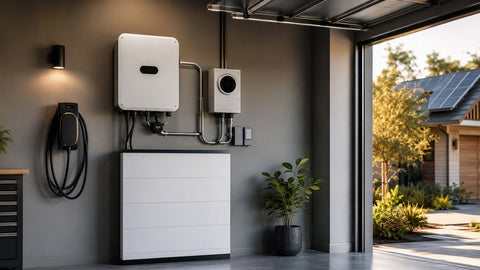
The box on your wall is technically an EVSE — Electric Vehicle Supply Equipment. It doesn't convert power; your car's onboard charger does that. The EVSE is a smart switch that negotiates amperage with the vehicle, monitors ground faults, and energizes the cable only when it's safely latched. Knowing this matters for one reason: the EVSE's rating, not your car's appetite, determines your circuit size.
Types of EV Chargers
| Charger Level | Voltage / Circuit | Power Output | Range Added per Hour | Best Use Case |
|---|---|---|---|---|
| Level 1 | 120V, standard outlet | 1.2–1.9 kW | 3–5 miles | PHEVs, low-mileage drivers, emergency backup |
| Level 2 (most common) | 240V, 40A or 50A dedicated circuit | 7.7–9.6 kW (32–40A) | 25–37 miles | Overnight full charge for any BEV; the sweet spot for most homes |
| Level 2 (high power) | 240V, 60–100A circuit | 11.5–19.2 kW (48–80A) | 44–70 miles | Large-battery trucks, dual-EV households, requires panel capacity |
| Level 3 / DC fast | 480V three-phase commercial | 50–350 kW | 3–20 miles per minute | Not residential — commercial sites only; see public EV charging stations |
I've never met an EV owner who regretted installing Level 2, and I've met plenty who spent six months nursing a Level 1 cord before giving in and calling an electrician anyway. If you drive more than 40 miles a day, skip straight to Level 2 — the math isn't close.
Benefits of Installing an EV Charger at Home
Home charging at an overnight residential rate of $0.10–0.14/kWh costs the equivalent of roughly $1.00–1.40 per gallon of gasoline. Public DC fast charging runs $0.35–0.55/kWh — closer to $4–5 per gallon equivalent. Beyond cost: you leave every morning with a full battery, you never detour to a charger, and a permitted Level 2 installation is a documented home improvement that appraisers increasingly recognize.
Planning Your EV Charger Installation

Assessing Your Home's Electrical System
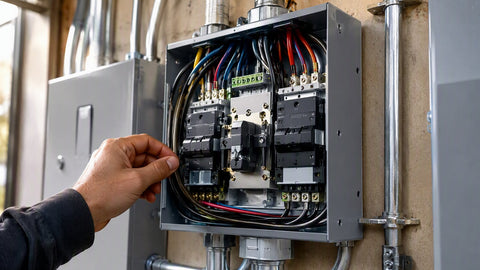
Open your panel door and read the main breaker: 100A, 150A, or 200A. A 200A service swallows a 60A EV circuit without blinking. A 100A service with electric heat, a range, a dryer, and a hot tub needs a NEC 220.83 load calculation before anyone promises anything — and that calculation, not a guess, is what the inspector will ask about. I've watched a homeowner buy a 48-amp charger, then discover their 100A panel could only spare 24 amps. Buy the circuit first, then the charger.
| Panel Service Size | Typical Available Capacity for EV | What Usually Fits | Watch Out For |
|---|---|---|---|
| 100A | 24–40A circuit (after load calc) | 19–32A charging (Level 2 entry) | Electric heat or hot tub may force load management |
| 150A | 40–50A circuit | 32–40A charging | Breaker space, not just amperage |
| 200A | 50–100A circuit | 40–80A charging, dual chargers possible | Still verify breaker spaces are free |
If the panel is full or undersized, options include a panel upgrade ($1,800–$4,000), a sub-panel near the garage, or a load management module that throttles charging when the range and dryer run simultaneously. Load management is the $400 answer to a $3,000 problem in a lot of 100A homes.
Choosing the Right EV Charging Station
Match the charger to the car's onboard limit first — many EVs cap AC charging at 32A or 40A regardless of the EVSE rating, so a 48A unit on a 32A car is money spent on nothing. Then decide: plug-in (NEMA 14-50 receptacle) or hardwired. Hardwired is cleaner, supports higher amperage, and avoids the GFCI-receptacle cost. Plug-in gives you portability and easier replacement. Browse EV chargers, 240V home fast chargers, and Level 2 chargers to compare current models, and grab any charging accessories — cable management, holsters, pedestal mounts — in the same order.
Understanding Installation Requirements
The governing rules live in NEC Article 625. The ones that shape your install: EV charging is a continuous load (NEC 625.42), so conductors and breakers size at 125% of charger rating — a 40A charger needs a 50A circuit, a 48A charger needs 60A. Outdoor installations need weatherproof enclosures and GFCI protection. And the disconnect/maintenance clearances of NEC 110.26 apply in front of the panel. Your electrician knows these; your job is to make sure an electrician, not a handyman, is doing the work.
| Charger Rating | Required Circuit (125% Rule) | Breaker Size (NEC 240.6) | Copper Wire (THHN, 75°C per NEC 310.16) |
|---|---|---|---|
| 16A (3.8 kW) | 20A | 20A double-pole | 12 AWG |
| 24A (5.8 kW) | 30A | 30A double-pole | 10 AWG |
| 32A (7.7 kW) | 40A | 40A double-pole | 8 AWG |
| 40A (9.6 kW) | 50A | 50A double-pole | 6 AWG |
| 48A (11.5 kW) | 60A | 60A double-pole | 6 AWG (55A) or 4 AWG for margin |
| 64A (15.4 kW) | 80A | 80A double-pole | 4 AWG |
| 80A (19.2 kW) | 100A | 100A double-pole | 3 AWG or 2 AWG |
Cost to Install an EV Charger
Factors Influencing the Cost of Installing
Distance from panel to parking spot is the number-one variable — every foot of wire, conduit, and drywall repair adds up. Panel condition is second. Everything else is small by comparison.
Average Cost to Install an EV Charger
| Item | Cost Range | Notes |
|---|---|---|
| Level 2 charger (EVSE hardware) | $350–$750 | Wi-Fi models land mid-range; commercial-grade higher |
| Simple install (panel in garage, <10 ft run) | $400–$800 | Half-day job, surface conduit |
| Typical install (25–50 ft run, finished walls) | $800–$1,800 | Most common real-world scenario |
| Complex install (long run, trenching, or detached garage) | $1,800–$4,000+ | Trenching alone can add $1,000+ |
| Panel upgrade (if needed) | $1,800–$4,000 | Includes new 200A panel, permit, utility coordination |
| Permit & inspection | $50–$300 | Varies by jurisdiction; never skip it |
All-in, most homeowners land between $1,200 and $2,500 including hardware. Anyone quoting $350 all-in is skipping the permit; anyone quoting $6,000 without a panel upgrade is padding. Get two or three itemized quotes, and make each bidder spell out whether trenching, drywall patching, and the permit fee are inside the number or extra — the spread between bids usually lives in those three lines, not the labor rate.
Potential Savings and Incentives
The federal Alternative Fuel Vehicle Refueling Property Credit covers 30% of hardware plus installation, up to $1,000, for qualifying homes (census-tract rules apply). Many utilities add $250–$1,000 rebates and some offer discounted overnight EV rates that pay back the install inside two years. Check current programs on our incentives by state page, and ask your utility directly — their EV program money is chronically under-claimed.
Steps for Installing a Home EV Charger
Obtaining Necessary Permits
Pull the permit. An EV circuit is a new dedicated branch circuit, and virtually every jurisdiction requires an electrical permit and inspection. The permit is $50–$300 and buys you two things: a second set of professional eyes on the work, and a paper trail your insurance company will want if anything ever goes wrong. Unpermitted 240V work is how home sales get complicated.
Hiring a Professional vs. DIY Installation
If you're a licensed electrician, you didn't need this paragraph. Everyone else: the NEC 125% continuous-load sizing, torque specs on breaker lugs (typically 35–45 in-lbs for residential breakers — check the label), and GFCI coordination are not YouTube territory. Hire a licensed, insured electrician with EV installs in their portfolio, ask for the permit number, and be home for the inspection. We sell the equipment; we always recommend the pro for the circuit. Our NEC code compliance guide explains why the code treats EV charging with unusual seriousness.
Installing a Level 2 Charger
The physical sequence, once the circuit exists: mount the EVSE at 36–48 inches to the handle per manufacturer spec, within reach of the vehicle's charge port with slack to spare. Hardwired units land the conductors on the unit's terminals torqued to spec; plug-in units need a quality NEMA 14-50R receptacle rated for continuous EV duty — the $15 big-box receptacle is a known failure point under nightly 40A loads, so spend the $60 on an industrial-grade one. Commission the Wi-Fi/app, set the charge schedule to your utility's off-peak window, and run a full first charge while you watch the breaker for heat.
Using Your Home EV Charger
How to Charge Your Electric Vehicle
Plug in, confirm the handshake light, walk away. Set the car or the EVSE app (not both — they fight) to charge during off-peak hours. For daily use, most EVs are happiest charging to 70–80%; save 100% for road trips. The 20-80 battery rule explains the chemistry behind that recommendation.
Maximizing Efficiency and Charging Speed
Charging speed at home is fixed by your circuit — but efficiency isn't. Keep the cable off the ground, don't daisy-chain extension cords (ever, under any circumstances), and in cold climates precondition the battery while still plugged in so grid power, not battery power, warms the pack. Households pairing solar with EV charging should look at solar EV charging options that can schedule charging against solar production.
Maintaining Your Home EV Charger
EVSEs are nearly maintenance-free: wipe the connector, inspect the cable jacket monthly for cuts or kinks, and check that the breaker and receptacle (if plug-in) stay cool to the touch after a long session. Firmware updates over Wi-Fi fix most quirks. A well-installed Level 2 unit should run 10+ years with nothing but an occasional reboot.
Two habits worth building from day one. First, holster the connector every time — a J1772 handle left on wet pavement collects grit that scores the vehicle's charge port pins, and a replacement port is a dealer visit you don't want. Second, test the GFCI monthly using the button on the unit or the breaker; it takes ten seconds and it's the device standing between a fault and a fire. We've replaced exactly zero properly-installed EVSEs for wear, but we've replaced several crushed cables and one connector that spent a winter under a pickup tire. The hardware is tough; the abuse is what gets it.
Related Products
- Electric Vehicle (EV) Chargers
- Wallbox Chargers
- Level 2 Chargers
- EV Charger Accessories
- Circuit Breakers