Bulk Solar Panel Orders: 500W to 720W+ Tier 1 Modules — The Complete 2026 Global Sourcing & Pricing Guide
Module technologies, brand-by-brand comparison, container logistics math, degradation economics, and procurement strategy for installers, EPCs, distributors, and developers.

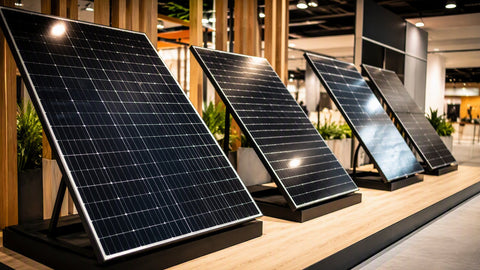
The utility and commercial solar market of 2026 runs on modules that would have seemed absurd five years ago: 600-watt panels as the commercial default, 720-watt bifacial giants winning utility bids, and n-type cell architectures that have pushed PERC — the reigning champion of the last decade — into legacy status. For anyone buying at volume, the opportunity is real and so are the traps. Container pricing that isn't actually wholesale. "Tier 1" claims that don't survive a bankability check. Modules with gorgeous nameplates and degradation curves that quietly eat your project's year-twenty yield.
We supply Tier 1 modules across the full 500W–720W+ range to installers, EPC firms, distributors, and municipal buyers, and I've personally reviewed enough flash-test reports and bills of lading to know what separates a genuine factory-direct channel from a relabeled gray-market pallet. This guide consolidates what volume buyers actually need: the current model landscape, the technology differences that matter, container and logistics mathematics, degradation economics with real warranty terms, and the procurement disciplines that protect a multi-container purchase.
Tier 1 is not a quality certification — a distinction that costs buyers money every quarter. The term originates with BloombergNEF's bankability classification, which measures whether projects using a manufacturer's modules have secured non-recourse debt financing from commercial banks. It's a financial-ecosystem verdict, not a lab test. A Tier 1 badge tells you banks trust the manufacturer to exist and honor warranties over 25–30 years; it does not, by itself, tell you the specific module on your pallet is well-made.
The practical procurement standard we apply combines three layers. First, bankability — the manufacturer appears on current Tier 1 lists or equivalent independent rankings. Second, product-level validation — IEC 61215/61730 certification as table stakes, plus independent reliability programs such as Kiwa PVEL's scorecard where available. Third, lot-level verification — flash-test data and electroluminescence (EL) imaging for the specific production lot you're buying, not a marketing datasheet from two product generations ago. Any supplier who can't produce lot-level documentation is asking you to take module quality on faith, and faith is not a procurement strategy.
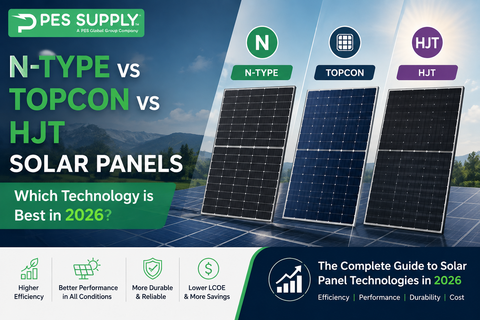
The technology transition defines this buying cycle. PERC, the p-type architecture that dominated the 2016–2023 era, has plateaued around 21–22% module efficiency and carries higher degradation; it's now the budget option, not the default. TOPCon (Tunnel Oxide Passivated Contact) is the n-type architecture that won the mainstream — it adds a thin oxide layer that slashes recombination losses, delivering 22.5–23.3% module efficiency, better low-light behavior, lower temperature coefficients, and materially lower annual degradation. HPBC and other back-contact designs push to the current efficiency frontier (~24.4%) by moving all metallization off the front surface. HJT (heterojunction) remains a premium niche with excellent temperature behavior.
For volume buyers the conclusion is straightforward: buy n-type unless a specific constraint (legacy inverter compatibility, extreme budget pressure on a short-payback project) argues otherwise. The price premium for TOPCon over PERC has compressed to the point where the lifetime energy harvest almost always wins the math — and the degradation section below shows why with numbers.
Here is the current competitive field across the brands we move at container scale. Model names matter at this level — the difference between a Tiger Neo 72HL4-BDV and an older Tiger Pro is a full technology generation:
| Brand | Series / Model | Wattage | Cell Technology | Efficiency | Best For |
|---|---|---|---|---|---|
| Jinko Solar | Tiger Neo JKM575-600N-72HL4-BDV | 575-600W | N-type TOPCon Bifacial | 22.84% | Commercial & Utility |
| Jinko Solar | Tiger Neo N-type TOPCon | 605-630W | N-type TOPCon Bifacial | 23.1% | Utility-Scale |
| LONGi | Hi-MO X6 Series | 535-585W | HPBC Mono Bifacial | 22.8% | Commercial & Industrial |
| LONGi | Hi-MO 9 / Hi-MO X10 LR7-72HYD | 625-665W | HPBC 2.0 Bifacial | 24.4% | Utility & Large C&I |
| JA Solar | DeepBlue 4.0 JAM72D40-LB | 575-600W | N-type Bifacial | 22.7% | All Applications |
| JA Solar | DeepBlue 4.0 Pro | 610-640W | N-type TOPCon | 23.0% | Commercial & Utility |
| Trina Solar | Vertex N TSM-NEG20C.20 | 630-655W | N-type i-TOPCon | 23.0% | Commercial & Utility |
| Trina Solar | Vertex N TSM-NEG21C.20 | 695-720W | N-type i-TOPCon | 23.3% | Mega Utility-Scale |
| Canadian Solar | TOPBiHiKu6 CS6W-TB-AG | 570-595W | N-type TOPCon Bifacial | 22.5% | Commercial & Utility |
| Canadian Solar | HiHero / BiHiKu7 | 620-660W | N-type HJT/TOPCon | 23.2% | Utility-Scale |
| QCells | Q.PEAK DUO BLK ML-G11S | 500-530W | Q.ANTUM DUO Z | 22.3% | Residential & C&I |
| & More | Risen, Astronergy, Phono, Seraphim, ZNShine | 500-700W+ | Various N-type & PERC | 21-23%+ | All Applications |
Bigger is not automatically better — the right wattage class is the one that matches your racking, your inverter voltage window, and your labor model:
| Wattage Class | Best Applications | Top Models | Peak Efficiency | Key Advantage |
|---|---|---|---|---|
| 500W - 560W | Residential, light C&I | QCells G11S, LONGi X6 | 22.8% | Compact size, residential inverter compatible |
| 570W - 630W | Commercial & industrial | Jinko Tiger Neo, JA DeepBlue 4.0, Canadian TOPBiHiKu6 | 23.1% | Best $/W ratio, maximum energy density |
| 630W - 665W | Large C&I, utility-scale | LONGi Hi-MO X10, Trina Vertex N 20C, JA DeepBlue Pro | 24.4% | Lowest LCOE per MW, fewer panels per MW |
| 695W - 720W+ | Mega utility-scale | Trina Vertex N 21C | 23.3% | Highest W/panel on market, wins utility bids |
The 570–630W band is where most of our commercial volume concentrates, and for good reason: it maximizes watts per square meter of roof while keeping module dimensions within what two installers can hand-set on a commercial racking system. The 695–720W+ giants make their case on utility-scale ground mounts, where every module eliminated from a megawatt of array is one less set of clamps, one less row of wiring, and one less truck position. Their dimensions — approaching 2.4 meters on the long side — make them genuinely awkward for rooftop work. Match the module to the install method, not to the biggest number on the datasheet.
Brand-by-Brand: The Honest Comparison

| Criteria | Jinko Solar | LONGi | JA Solar | Trina Solar | Canadian Solar | QCells |
|---|---|---|---|---|---|---|
| Max Wattage | 630W | 665W | 640W | 720W | 660W | 530W |
| Peak Efficiency | 23.1% | 24.4% | 23.0% | 23.3% | 23.2% | 22.3% |
| Core Technology | N-type TOPCon | HPBC 2.0 | N-type TOPCon | i-TOPCon | TOPCon / HJT | Q.ANTUM DUO Z |
| Bifacial | Yes (up to 70%) | Yes (up to 70%) | Yes | Yes (dual glass) | Yes | Select models |
| Linear Warranty | 30 years | 30 years | 30 years | 30 years | 30 years | 25 years |
| Best For | Volume C&I | Max efficiency | All-rounder | Mega-utility | Utility-scale | Premium resi |
How we read that table for buyers: Jinko is the volume workhorse — deepest production capacity, aggressive container pricing, the default answer for price-sensitive C&I. LONGi owns the efficiency crown this cycle with HPBC 2.0, and when roof area is the constraint, 24.4% modules can be the difference between a project penciling and not. Trina's 720W Vertex N is a utility-bid weapon. Canadian Solar pairs strong bankability with North American market fluency. QCells carries the premium residential reputation and U.S. manufacturing presence that matters for domestic-content strategies. None of these is a wrong answer at the right price; all of them are wrong answers at the wrong price.
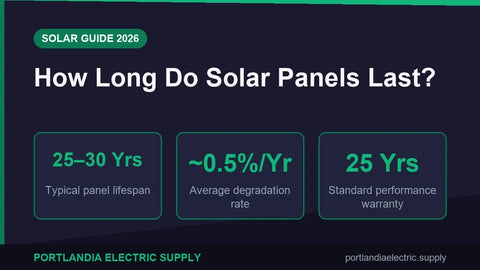
A module purchase is a 30-year energy contract denominated in kilowatt-hours, and the degradation schedule determines how many of those kilowatt-hours you actually collect. Typical published linear performance warranty terms for the current generation:
| Technology | First-Year Degradation | Annual Degradation Thereafter | Warranted Output at Year 25 | Warranted Output at Year 30 |
|---|---|---|---|---|
| N-type TOPCon (typical) | 1.0% | 0.40%/yr | ≥91.4% | ≥87.4% |
| Back-contact (HPBC, typical) | 1.0% | 0.35–0.40%/yr | ≥91.4–92.4% | ≥87.4–88.4% |
| PERC (legacy, typical) | 2.0% | 0.55%/yr | ≥84.8% | Not warranted (25-yr term) |
Run the yield math on a 1 MWp commercial array and the conclusion writes itself. At 1,400 kWh/kWp first-year specific yield, a PERC array warranted at 84.8% of nameplate in year 25 delivers a warranted floor of about 1,187 kWh/kWp that year; a TOPCon array at 91.4% delivers about 1,280 kWh/kWp — roughly 93 kWh/kWp more, or ~93,000 kWh across the 1 MWp plant in that single year. At a $0.12/kWh commercial rate, that's over $11,000 of year-25 energy value, per megawatt, from a specification most buyers never read. I've watched procurement teams negotiate a half-cent per watt for three weeks and then sign a degradation schedule that costs them ten times that over the asset life. Read the warranty table before the price table.
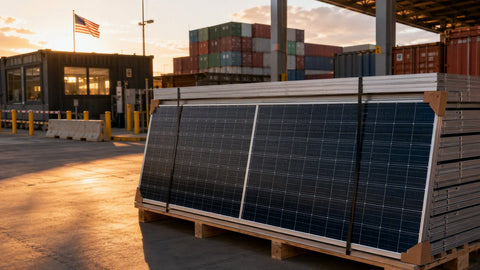
Module pricing only makes sense in container units. Packing density varies by module dimensions, so the same 40-foot high-cube container carries meaningfully different wattage depending on the class:
| Wattage Class | Panels per 40ft HC | kW per Container | Ideal Order Volume |
|---|---|---|---|
| 500W - 560W | ~1,200-1,400 | 600-784 kW | 1-5 containers |
| 570W - 630W | ~900-1,100 | 513-693 kW | 1-20 containers |
| 630W - 665W | ~800-950 | 504-631 kW | 5-50+ containers |
| 695W - 720W+ | ~720-850 | 500-612 kW | 10-100+ containers |
Worked example for an installer bidding a 500 kW commercial project: in the 570–630W class, one container at roughly 600kW covers the project with spares — about 950 modules at a representative 600W gives you 570kW on a single truck. Freight cost per watt drops sharply at full-container loads; a less-than-container shipment can carry double the per-watt freight and triple the damage risk of a floor-loaded FCL. This is why we push buyers toward container-quantity planning even when it means warehousing a project ahead — the logistics math usually beats the just-in-time instinct. Our 550–709W module category and 500W class inventory show current stock positions for domestic buyers who need speed over container economics.
The five-point lot verification checklist we run before releasing payment
- Flash-test reports for the actual production lot — every module's measured output, not the datasheet typical.
- EL imaging sampling — catches microcracks and cell defects invisible to the eye, especially after ocean freight.
- Serial-number traceability — module serials registered with the manufacturer so warranty claims attach to real units.
- Certification documents matched to model number — UL 61730 for U.S. installs; IEC 61215/61730 internationally; the cert must name the exact model string on your PO.
- Bill of lading and factory documentation chain — the paper trail that proves your modules came from the factory you paid for, not a broker's warehouse of unknown provenance.
Incoterms deserve a paragraph of their own because they quietly move thousands of dollars of risk. FOB port of origin means you own the risk from the ship's rail onward — freight, insurance, customs, drayage. CIF gets the goods to your port with insurance; DDP puts the seller on the hook all the way to your dock, duties paid. First-time importers should price DDP or work with a supplier (like us) who coordinates the whole chain; experienced importers with their own customs broker can save money at FOB or CIF. There's no universally right answer — only the answer that matches your logistics capability. Buyers exploring domestic-content incentives for IRA/ITC compliance should raise that requirement before quoting, not after, since qualifying supply chains are a subset of the overall market.
| Customer Type | How We Serve You | Typical Order Size |
|---|---|---|
| Solar Installers & Contractors | Per-project ordering or ongoing supply agreements with priority allocation. Residential, commercial, and industrial. | 1 pallet - 5 containers |
| EPC Firms & Utility-Scale Developers | Multi-MW procurement with competitive lead times, project-based pricing, and full logistics coordination. | 5 - 100+ containers |
| Distributors & Wholesalers | Expand your product catalog with the most bankable modules. We support white-label and co-branding programs. | 5 - 50+ containers |
| Government & Municipal Agencies | Community solar, public infrastructure, and rural electrification projects. IRA/ITC-eligible products available for U.S. buyers. | 1 - 20 containers |
| Property Developers & REITs | Add solar to new builds and retrofits at scale with volume pricing that pencils out. | 1 - 10 containers |
| International Buyers & Importers | Full export logistics including ocean freight, customs documentation, certificates of origin, and door-to-port delivery worldwide. | 1 - 50+ containers |
| What You Get | Details |
|---|---|
| Unbeatable Container Pricing | Real volume discounts from direct manufacturer channels. Not inflated list prices - genuine wholesale. |
| 100% Verified Tier 1 Modules | Every panel ships with full manufacturer warranty, datasheets, and international certifications (UL, IEC, TUV, CE, MCS). |
| Complete Wattage Range | 500W to 720W+. Residential to utility-scale. One supplier, every module you need. |
| Dedicated Account Management | A single point of contact who understands your market, your projects, and your timeline - wherever you are. |
| Flexible Order Sizes | From single pallets to multi-container shipments. We scale with your pipeline. |
| Fast Turnaround | Streamlined supply chain delivers on aggressive timelines. Transparent ETAs and real-time tracking for domestic and international orders. |
| Full Logistics Support | Ocean freight, air cargo, domestic trucking (FTL/LTL), customs brokerage, door-to-site delivery - we coordinate it all so you can focus on building. |
Electrical Integration: String Sizing Math Your AHJ Will Check

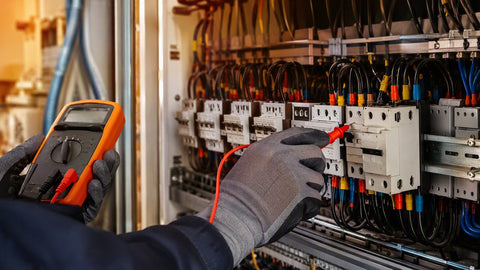
Module selection doesn't end at watts and dollars — the electrical design has to close, and on commercial projects the plan reviewer will check it. Two NEC calculations dominate. First, NEC 690.7 maximum system voltage: string open-circuit voltage corrected for the coldest expected temperature must never exceed the inverter's 1,000V or 1,500V window (or 600V where older rules apply). The correction uses the module's Voc temperature coefficient — typically around −0.24 to −0.29 %/°C for the n-type class. Second, NEC 690.8 circuit sizing: maximum circuit current is Isc × 1.25, and conductors and overcurrent devices are sized at 125% of that value — the familiar 1.56 × Isc continuous-duty multiplier.
| Worked Example (600W TOPCon Bifacial) | Representative Value | Rule Applied |
|---|---|---|
| Module Voc (STC) | ≈53.5 V (class-typical) | Datasheet value |
| Voc temp coefficient | ≈−0.25 %/°C | Datasheet value |
| Cold-corrected Voc @ −10°F (−23°C) | ≈53.5 × (1 + 0.0025 × 48) ≈ 59.9 V | NEC 690.7 correction |
| Max modules per 1,500V string | ⌊1,500 ÷ 59.9⌋ = 25 | Voltage window limit |
| String power (25 × 600W) | 15.0 kW per string | Array layout input |
| Design circuit current | Isc ≈ 14 A × 1.56 ≈ 21.8 A | NEC 690.8(A)/(B) |
Those values are class-representative, not a substitute for the exact datasheet of the module on your PO — the reason you request lot-level datasheets before design freeze rather than after. The bifacial wrinkle matters too: rear-side gain pushes operating current above the STC Isc, and NEC 690.8 handling of bifacial boost belongs in the conversation with your engineer of record. For deeper code reading, our guides on PV wire selection and NEC compliance and NEC 690 disconnect and overcurrent requirements cover the balance-of-system side, and the system size calculator handles the energy-estimation front end.
Ex-works module price is the number everyone quotes; landed cost per watt is the number your project actually pays. The stack looks like this for an international container purchase:
| Cost Layer | What's In It | Typical Weight in Landed Cost |
|---|---|---|
| Ex-works module price | The factory-gate per-watt quote | 70–80% |
| Ocean freight | 40ft HC port-to-port, index-driven | 5–12% |
| Insurance | Marine cargo coverage, CIF/DDP terms | ~1% |
| Duties & tariffs | Country-specific; U.S. Section 201/301 and AD/CVD exposure varies by origin | 0–15%+ (origin dependent) |
| Port, drayage & last-mile | Terminal handling, chassis, FTL/LTL to site | 3–8% |
| Damage/attrition reserve | Spares and replacement allowance | 1–2% |
Two lessons from watching buyers get burned. First, tariff exposure is an origin question, not a brand question — the same brand's module can carry wildly different duty treatment depending on which factory and which country's supply chain produced it, and the paperwork has to support the claimed origin. Second, the cheapest ex-works quote frequently loses to a slightly higher DDP quote once freight volatility and broker errors are priced in. When we quote containers, we quote landed terms with the layers itemized, because a buyer comparing our DDP number against a broker's ex-works number is comparing apples to a photograph of an orange. For smaller projects where container economics don't apply, the 400–459W residential class and kit-level options in our kits buyer's guide are the smarter path.
Module procurement doesn't happen in a vacuum anymore — most commercial and utility projects we supply are storage-attached, and the DC/AC ratio decision feeds back into module count. A 1.3–1.4 DC/AC ratio on a storage-backed plant means buying 30–40% more module capacity per inverter megawatt than a grid-tie-only design, which is exactly the kind of multiplier that turns a five-container order into a seven-container order. Coordinate the module buy with the inverter and battery buys so the electrical design, the delivery schedule, and the interconnection milestone all land in the same quarter. We stock the adjacent categories — commercial-scale inverters, hybrid options covered in our hybrid inverter guide, and battery storage across multiple chemistries — specifically so buyers can consolidate the supply chain instead of managing four vendors across three continents.
Theory is clean; freight is not. Across the inbound volume we handle, the real-world defect list is short but expensive when missed. Microcracks from container vibration and rough port handling — invisible to the eye, visible on EL imaging, and the reason we sample EL on arrival rather than trusting the factory's pre-ship set. Backsheet and glass damage from poor palletizing, usually on bottom rows — caught by unboxing inspection at the warehouse before modules go to site. Junction-box and connector faults — the cheap components on an expensive module, and the reason connector brand matching across a string matters more than most installers believe; mixing connector families on the same string is a genuine fire-risk decision, not a compatibility quibble. And documentation mismatches, where the serial range on the flash report doesn't match the serials on the pallets — the gray-market tell that every one of our receiving checks is designed to catch. None of this is exotic. All of it is skipped by suppliers who never physically touch their inventory.
Module pricing has a rhythm. Factory capacity allocations tighten ahead of the U.S. construction season and around year-end ITC-driven deadlines; ocean freight rates swing with global container indices; and currency moves between the dollar and the yuan can shift landed cost by several percent in a quarter. The practical strategy for buyers with predictable volume: lock quarterly supply agreements with price-adjustment windows rather than spot-buying each project, keep one project of buffer stock if you have warehouse space, and place utility-scale orders a full quarter ahead of the construction milestone. The buyers who get hurt are the ones who bid a project at January module prices and procure in June during a freight spike. We've supplied both kinds, and only one kind is still enjoying their margins.
For installers scaling from residential into commercial work, one more piece of sequencing advice: your first container is a learning experience, so make it a boring one. Standard wattage class, standard terms, a supplier who answers the phone when the truck arrives short two pallets. Save the exotic module formats and aggressive delivery terms for when you've got three containers of receiving experience under your belt. And document your receiving process from day one — photos of pallet condition before unwrapping, serial logs against the flash report, EL samples filed by project. The first time a warranty claim depends on that file, it pays for every single minute the process ever cost you, several times over.
What is the minimum order for bulk Tier 1 solar panels? We sell from a single pallet upward — a pallet of 31–36 modules depending on wattage class — but genuine wholesale economics start at a full 40ft container (roughly 500–780 kW depending on class). Installers with steady volume typically standardize on one or two SKUs and order container-quantity on a quarterly rhythm.
How much do Tier 1 solar panels cost per watt in bulk in 2026? Container-level pricing moves weekly with polysilicon, freight indices, and currency — any static number here would be stale by the time you read it. What we can say: genuine factory-channel container pricing for n-type Tier 1 modules has been running at a fraction of retail per-watt pricing, and the spread between a real wholesale channel and a re-badged middleman is obvious the moment you see both quotes. Request a current quote with your wattage class, quantity, and delivery terms and you'll have real numbers within a business day.
TOPCon vs PERC for a commercial project — which should I buy? TOPCon for almost every new purchase: roughly 1–1.5 percentage points higher module efficiency, a 30-year linear warranty with about 0.40%/yr degradation versus PERC's 0.55%/yr, and better high-temperature behavior. The lifetime energy yield advantage outweighs the modest per-watt premium in virtually every financial model we've reviewed.
Are 700W+ panels worth it for commercial rooftops? Usually not. The 695–720W+ class is optimized for utility-scale ground mounts where module count reduction drives labor savings. Their ~2.4 m dimensions are awkward and heavy for rooftop handling, and most commercial racking and inverter windows are better matched to the 570–630W class.
How do I verify modules are genuine Tier 1 and not gray market? Demand the lot-level documentation chain: flash-test reports, EL images, serial traceability registered with the manufacturer, and certifications that name the exact model string on your purchase order. Then verify the supplier's channel — genuine factory-direct or authorized distribution can evidence it. Our five-point checklist above is the exact process we run on our own inbound inventory.
Do you handle international shipping and customs? Yes — ocean freight, customs documentation, certificates of origin, and door-to-port or door-to-site delivery worldwide, with incoterms matched to your logistics capability. Domestic U.S. buyers get FTL/LTL trucking with real-time tracking.
Get a Container Quote With Real Numbers
Tell us your wattage class, quantity, destination, and delivery terms. We'll return current factory-channel pricing, verified lot documentation standards, and a lead time you can put in a project schedule.
Browse Commercial Modules