Finding EV charging station installers is easy. Finding one who will still answer the phone in year three of your uptime obligation is the actual task. The EV charging buildout has attracted everyone from master electricians with EVITP credentials to general contractors who watched a webinar, and the gap between those two shows up in your commissioning report, your permit timeline, and your maintenance bills. This guide is the vetting framework we use when customers ask us who to hire — the same questions, the same document requests, and the same red flags, whether you are installing two ports at an office or forty at a fleet depot.

One disclosure before the framework: we are an equipment supplier, not an installation company. We do not bid against the contractors this guide teaches you to vet — we stock the hardware they install, through the EV charger catalog and charging accessories categories, and we see every day which installer habits produce clean projects. That vantage point is what this guide is built from.
Why Professional Installation Is Non-Negotiable
EV charging equipment sits at an unusual intersection: continuous high-current electrical load, networked software, public-facing hardware, and — on funded projects — compliance obligations with clawback teeth. NEC Article 625 governs the electrical side with continuous-load rules that size breakers and conductors at 125% of charger rating; get that wrong and you have a thermal problem on a public-facing asset. The network side adds OCPP configuration, payment systems, and data reporting. And incentive-funded projects add documentation obligations that last five years. A general handyman can hang a charger on a wall. Everything after the wall-hanging is where professional installation earns its money.
The liability framing is blunt but real: an improperly installed EVSE circuit is a fire risk at the exact current level where margins matter, and the installer's insurance and license are what stand between the property owner and that risk. Vet accordingly.
The Credential Stack: What to Verify
Credentials come in layers, and each layer answers a different question:
| Credential layer | What it proves | How to verify |
|---|---|---|
| State electrical contractor license | Legal authority to perform the work; insurance and bonding prerequisites | State license board lookup — active status, classification, no discipline |
| General liability + workers' comp | You are not the insurer of their mistakes or their crew's injuries | Certificates of insurance naming you as certificate holder, verified with the carrier |
| EVITP (Electric Vehicle Infrastructure Training Program) | Crew-level EVSE-specific training: Article 625, load management, commissioning practice | EVITP certification lookup by technician name |
| Manufacturer certifications | Authorization to install and commission specific charger lines; often required to preserve warranty | Confirm with the manufacturer or distributor — ask which models they are certified on |
| Network commissioning experience | Ability to bring chargers online on the chosen network (OCPP configuration, payment setup, reporting) | References from projects on your chosen network platform |
| Prevailing-wage capability (funded projects) | Ability to run certified payroll where incentives require it | Ask directly; funded projects without it lose the 30C bonus tier |
Two habits from that table deserve emphasis. Verify the crew, not just the company: the contractor's EVITP number on the website means nothing if the two technicians who show up are uncertified apprentices working unsupervised. And verify insurance with the carrier, not the PDF — certificate fraud is rare but real, and a two-minute phone call eliminates it.
The Vetting Questions That Separate Professionals
Ask these in the first meeting. The answers reveal experience faster than any brochure:
- "Walk me through your load calculation process." You want to hear NEC 220 methodology, continuous-load treatment under 625, and a request for your utility bills or interval data. An installer who sizes service from a glance at the panel is guessing with your switchgear.
- "Which networks have you commissioned, and can I call those site owners?" Network commissioning is where inexperienced installers burn weeks. References on your specific platform matter.
- "How do you handle the utility process?" The right answer includes opening the utility conversation in week one, knowing the utility's EV program contacts, and honest lead-time expectations.
- "What does your commissioning checklist include?" Listen for torque verification, GFCI function tests, full-power session on every port, OCPP handshake verification, and as-builts. A five-item verbal answer is a red flag; a document they hand you is a green one.
- "Who handles permitting, and what is your first-pass approval rate in this AHJ?" Local plan-review experience is worth money. An installer who works regularly in your jurisdiction knows what that plan examiner flags.
- "What does your warranty cover and for how long — and who do I call at 9 p.m. when a port is down?" Workmanship warranty terms and after-hours support policy, in writing.
- "Show me a completed project packet." Permit card, inspection sign-offs, commissioning report, as-built, network screenshots. The packet is the product.
Mapping the Installation Process: What Good Looks Like
Understanding the professional sequence lets you spot when it is being skipped:
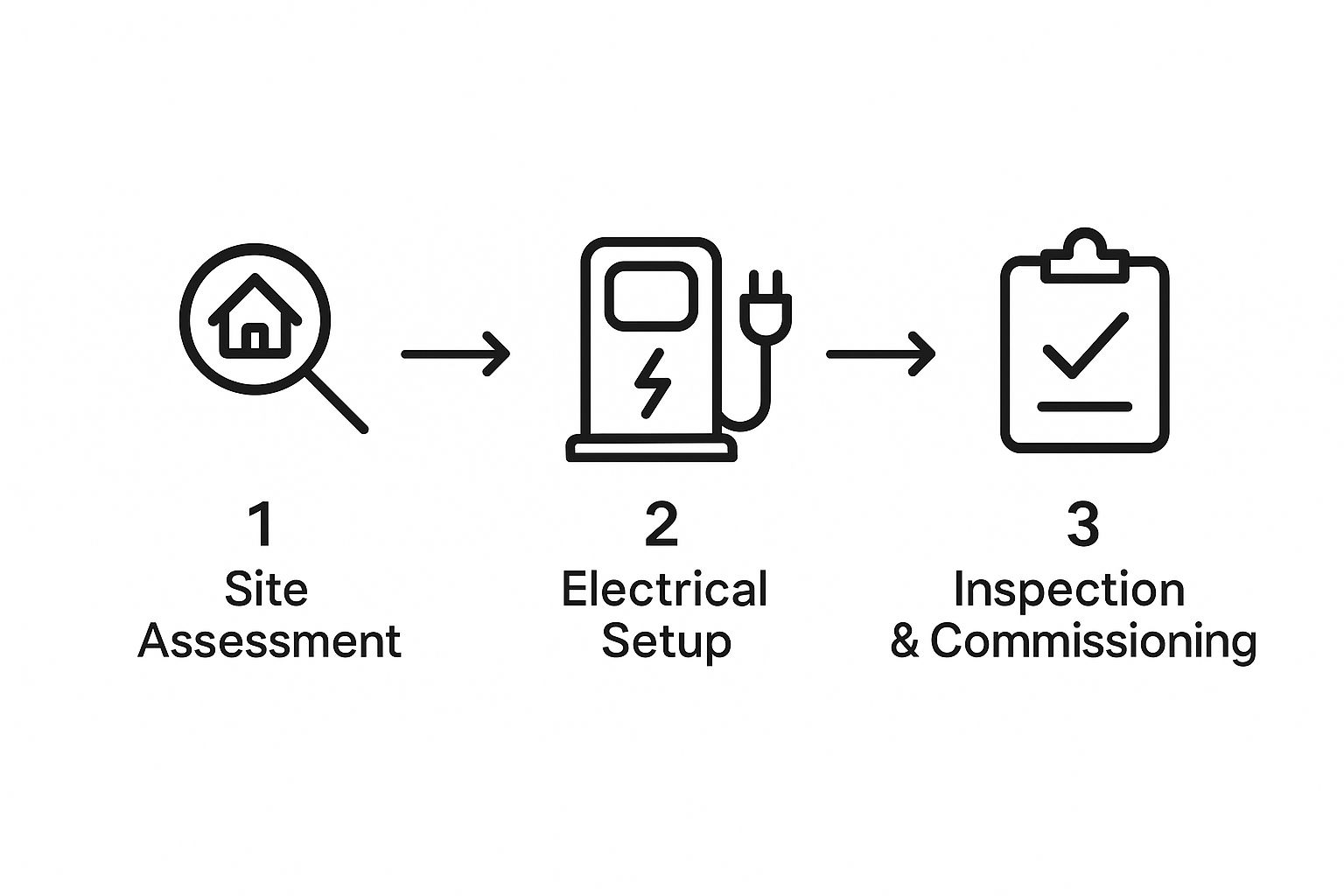
Stage 1: Site assessment and load calculation
Physical survey of the electrical room and proposed charger locations, service capacity documentation, NEC load calculation, and utility pre-contact. Deliverable: a written assessment with a capacity answer and a design recommendation. This stage should take one to three weeks and produce paper, not just a verbal quote.
Stage 2: Design and equipment selection
Single-line diagram, site plan with stall layout and ADA provisions, load management strategy, equipment schedule matched to your use case — the Level 2 versus DC fast charging decision belongs here, driven by dwell time and budget. Deliverable: a permit-ready design package. Our installation requirements guide is the reference for what that package must contain.
Stage 3: Permitting and utility coordination
AHJ submittal and plan-review management, utility service application, and incentive-program paperwork where applicable. The installer should own this stage entirely — if a proposal pushes permit responsibility onto you as the owner, ask why.
Stage 4: Construction and commissioning
Civil work, electrical installation, network configuration, and the documented commissioning sequence described in the vetting questions. Deliverable: the completed project packet, plus training for whoever will operate the system day to day.
Cost Structures and How to Read a Bid
Installer pricing follows the project's actual cost drivers. Representative ranges for professional installation:
| Project type | Typical installed cost per port | What drives the range |
|---|---|---|
| Single-family residential L2 | $800–$2,500 (labor + materials, charger separate) | Panel distance, panel capacity, permit fees |
| Commercial L2 (workplace/retail) | $4,000–$12,000 all-in | Trenching distance, civil restoration, networking |
| DC fast charging | $50,000–$150,000+ all-in | Service upgrades, transformer work, foundations, utility fees |
Reading bids: the cheap bid that excludes trench restoration, network configuration, or permitting is not cheap — it is partial. Normalize bids to the same scope before comparing, and treat "allowances" as the blank checks they are. Detailed per-component numbers live in our EV charging installation cost breakdown; use it to interrogate any line that looks light.
Red Flags That Should End the Conversation
Years of watching projects go right and wrong distill into this list:
- No site visit before quoting — a firm price quoted from a phone call is a guess with a signature line.
- No mention of load calculation, or dismissal of it as unnecessary paperwork.
- Cannot name the network platforms they have commissioned.
- Pushes permit responsibility to the owner without a stated reason.
- No written commissioning process — or confusion at the question.
- Dramatically below-market pricing on a lump-sum bid with vague scope.
- No certificate of insurance offered proactively.
- On funded projects: unfamiliarity with Buy America, qualified products lists, or prevailing wage — all three are table stakes for incentive work.
One flag might be a communication problem. Two flags is a pattern. Three is a different installer.
The Pre-Vetted Network Alternative
Property owners without the appetite for a full vetting process have two shortcuts. Manufacturer referral networks — most major charger brands maintain certified-installer directories, and certification at least guarantees training on the specific hardware. And supplier referral lists: we maintain informal knowledge of which contractors in our regions run clean EV projects, because we see their order patterns and their return rates. Ask your equipment supplier who they would hire — the answer comes with the accountability of an ongoing supply relationship behind it.
For multifamily and commercial owners planning incentive-funded projects, also read the incentives guide before selecting an installer — several programs require installer qualifications as an eligibility condition, and choosing the installer first can foreclose funding you did not know existed. The commercial installation guide covers the project sequence the installer should be managing for you.
After the Install: The Relationship That Matters
Charging infrastructure is a five-to-ten-year operating asset, and the installer's post-commissioning posture determines what ownership costs. Before signing, settle three things in writing: the workmanship warranty term (one year is standard; two is good), the maintenance and response-time agreement (who answers when a port faults, and how fast), and the reporting-support arrangement for incentive compliance. The best installers price a maintenance agreement at proposal time because they intend to be around to perform it. The ones who go quiet at the maintenance question are telling you something about year three.
Budget realistically for that relationship. Annual maintenance on a commercial Level 2 port — inspection, connector wear check, torque verification, firmware management — runs a few hundred dollars per port and prevents the majority of the failures we get called about. DC fast charging justifies a formal service contract with defined response times, both because the hardware is more complex and because uptime obligations on funded DCFC projects carry financial teeth. The installer who built the station is usually the right first call for that contract; they know where the conduit runs and which firmware version the network prefers.
Residential vs Commercial Vetting: Different Games
The vetting depth should match the project risk. For a residential Level 2 circuit — a 40–60 A branch circuit in a garage — the essential checks are license, insurance, permit practice, and reviews mentioning cleanliness and communication. The full credential stack above is overkill, though any installer who also holds EVITP credentials brings load-management knowledge that pays off the day you add a second EV. For commercial work, every layer applies, plus three additions: comparable project scale in the portfolio (a residential-heavy installer learning commercial networking on your six-figure project is a tuition payment), bonding capacity for larger contracts, and safety-program documentation (OSHA 30 supervision, NFPA 70E practices) for occupied commercial sites.
Multifamily adds one more filter: resident-relations experience. The installer on an occupied apartment property manages resident communication, parking disruption, and phasing — a crew that has only worked greenfield commercial sites will learn resident relations on your tenants. Ask for an occupied-property reference specifically.
The Project Timeline with a Good Installer
Use this as the sanity check against any proposed schedule:
| Milestone | Residential L2 | Commercial L2 (4–8 ports) | DCFC (2–4 ports) |
|---|---|---|---|
| Site assessment to proposal | 3–7 days | 1–3 weeks | 2–4 weeks |
| Design and permitting | 1–3 weeks | 3–8 weeks | 2–4 months |
| Utility process (if triggered) | Rarely triggered | 2–12 weeks, parallel | 2–6+ months, often critical path |
| Construction | 1 day | 1–3 weeks | 1–3 months |
| Inspection and commissioning | 1–3 days | 1 week | 2–4 weeks |
| End to end | 2–6 weeks | 8–20 weeks | 6–18 months |
An installer promising commercial L2 in four weeks total is either working in a remarkably fast jurisdiction or selling optimism. Ask which one.
The Bid Comparison Worksheet
When two or three proposals land on your desk, score them on the same grid before price enters the conversation:
| Scope line | Questions to answer from the bid |
|---|---|
| Electrical scope | Load calc included? Panel work itemized? Conductor and conduit specified by size and type? |
| Civil scope | Trenching, boring, restoration, striping, signage, bollards — included or excluded? |
| Equipment | Charger models named with network features? Pedestals and cable management included? |
| Network and commissioning | Configuration, payment setup, and a documented commissioning checklist in scope? |
| Permits and utility | Who owns the AHJ process and the utility application, in writing? |
| Warranty and maintenance | Workmanship term, response-time commitment, maintenance agreement priced? |
| Schedule | Milestone dates with utility dependencies identified, or a single optimistic date? |
The bid that answers every line without a follow-up call is usually not the cheapest one. It is usually the cheapest one to actually complete.
For Developers and GCs: Installers as Subcontractors
If you are hiring EV installation as a trade package rather than as an owner, add three subcontractor-specific checks. Prequalification financials: charging projects carry long-lead equipment, and the sub's ability to carry material cost until draw matters. Schedule reliability: EV scope sits at the end of the construction sequence and absorbs upstream delay — get their plan for compressed schedules in writing. And the closeout package: funded and LEED-adjacent projects need commissioning documentation and as-builts as deliverables, so specify the packet in the subcontract, not in a follow-up email. The installers who already operate this way will hand you a sample closeout binder at the interview. Hire those ones.
What an Installer's Supply Chain Tells You
A subtle but reliable signal: ask the installer where they buy equipment and how they handle lead times. The professional answer names distribution relationships, quotes current lead times from memory, and describes a substitution policy — what happens when the specified charger is sixteen weeks out and the project cannot wait. The amateur answer is "we'll get it online" or vague confidence. Equipment procurement is where commercial EV schedules currently live and die, and installers with real supply relationships — the ones we see ordering regularly through catalogs like ours — simply do not strand projects waiting on hardware the way spot buyers do. It is a two-minute question that reveals the depth of the operation behind the proposal.
Frequently Asked Questions
Can any licensed electrician install an EV charger?
Legally, in most jurisdictions, yes — a licensed electrician can perform the work. Practically, EVSE-specific training (EVITP or manufacturer certification) matters for load management configuration, network commissioning, and incentive compliance. For anything beyond a simple residential circuit, prefer the specialist.
How long does a typical installation take?
Residential Level 2: one day of field work plus permit time. Commercial Level 2: 8–20 weeks end to end including permitting and utility coordination. DC fast charging: 6–18 months when service upgrades are involved. The construction itself is rarely the long pole.
What certifications should an EV charging installer have?
At minimum: active state electrical contractor license, verified insurance, and EVITP or manufacturer certification for the equipment being installed. Funded projects add prevailing-wage capability and Buy America familiarity.
What are the biggest mistakes when hiring an installer?
Skipping the reference check on network commissioning, accepting a phone-quote price without a site visit, letting permit responsibility drift to the owner, and signing without a written commissioning and warranty scope.
Do I need a permit for EV charger installation?
In virtually all jurisdictions, yes — EVSE circuits are permitted electrical work. A professional installer pulls the permit as part of scope. An installer who suggests skipping the permit is suggesting you own uninspected continuous-load electrical work.
How do I verify an installer's past work?
Ask for two or three completed projects on your charger network with owner contacts, call them, and ask the only question that matters: "Did anything fail, and how did the installer respond?" Everyone has a project that hit a snag. The response to the snag is the reference.