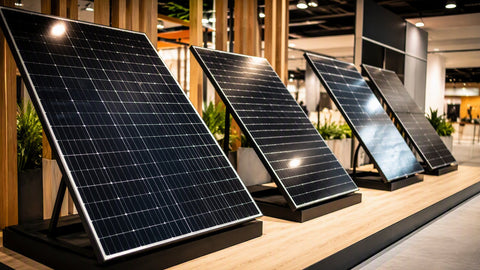
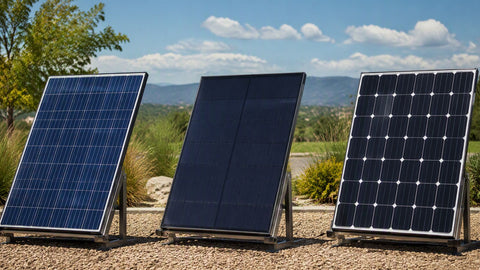
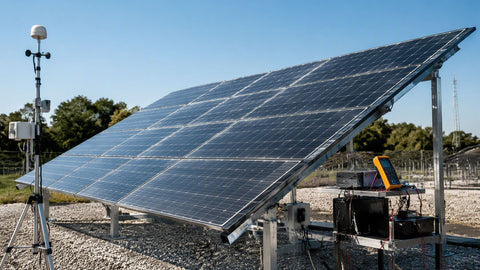
The ZNSHINE ZXM7-SH108-405/M is a 405W, 108-half-cell monocrystalline module in the black-on-black format that residential customers keep asking for by name. It sits squarely in the sweet spot of the current residential market: enough wattage to build a meaningful array on a constrained roof, compact enough for two installers to hand-set all day, and finished in the all-black aesthetic that passes HOA review without a fight. I've sold and spec'd this class of module on hundreds of residential roofs, and the 108-half-cell 400–410W format is where the value equation lives right now. This guide covers what the panel is, how its electrical numbers behave in real designs, where it fits, and how to buy it right.

What is the ZNSHINE 405W Black on Black 108 Half-Cell Mono Solar Panel?
The ZXM7-SH108-405/M is ZNSHINE Solar's residential-format module built on 108 half-cut monocrystalline cells — the layout that has become the residential standard across the industry. Half-cell architecture splits each cell in two, cutting internal current and resistive losses, which pushes module efficiency past 20% while improving shade tolerance and lowering operating temperature. The black-on-black finish pairs a black backsheet with a black frame and dark cells for a uniform rooftop appearance.
ZNSHINE is a long-standing Tier 1 manufacturer with a multi-gigawatt production track record, and we stock their line in our ZNSHINE Solar collection — including the ZXM7-SH108-405/M itself and its 410W sibling for buyers who want a few extra watts per panel on the same footprint.
Key Features and Benefits
1. High Power Output of 405W
At 405W, this module delivers enough per-panel punch that a 20-panel array reaches 8.1 kW — whole-home offset territory for an efficient house — while staying in the size class installers can move quickly. Wattage per panel drives balance-of-system economics: fewer panels for the same kW means fewer rails, clamps, flashings, and microinverters, and every one of those line items carries labor. Do the arithmetic on a 10 kW job: at 405W that's 25 panels; at 340W it's 30. Five extra attachments, five extra flashings, five extra wire management points — the higher-wattage module pays for its own premium in labor alone on most bids.
2. Black on Black Design for Aesthetic Appeal
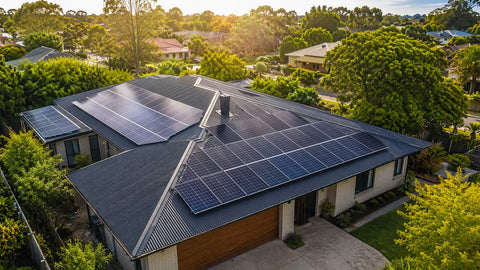
Aesthetics sell systems and satisfy HOAs. The uniform dark appearance reads as a clean plane on the roof rather than a silver-gridded add-on. On street-facing arrays — the ones neighbors and review boards actually see — black-on-black has become the default specification for a reason. Our all-black panel collection exists because this demand is consistent, and in our order history the all-black variants outsell silver-frame equivalents on residential work by a wide margin.
3. Monocrystalline Half-Cell Technology for Enhanced Efficiency
Half-cut cells halve the current in each cell string, and resistive losses scale with the square of current — so halving current quarters the resistive loss in the cell interconnects. That's not marketing language; it's the physics that makes 108-half-cell modules outperform their full-cell predecessors by a full efficiency class. Multi-busbar interconnects shorten current paths further, and the split junction-box layout gives the module three independent substrings, which matters when shade hits part of the panel. The half-cell design also runs cooler under load, and cooler cells produce more — a small but real dividend on every hot afternoon for the next three decades.
4. Durability and Longevity
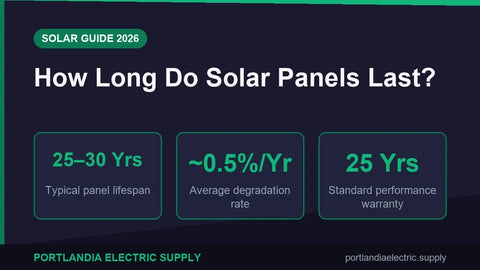
Residential-format Tier 1 modules in this class carry mechanical load ratings around 5400 Pa front / 2400 Pa rear (snow and wind), 25mm hail impact testing, and product warranties of 12–25 years with linear performance warranties running 25–30 years. Translation: the panel is engineered to outlive the roof under it in most climates, and the warranty structure reflects that.
5. Enhanced Performance Under Partial Shading
The three-substring layout with bypass diodes means shade on one third of the panel costs you roughly that third — not the whole module, and not the whole string. Pair half-cell modules with microinverters and per-module MPPT stacks the benefits: substring-level shade tolerance inside the panel, module-level optimization across the array. On the mixed-shade roofs that dominate real neighborhoods, that stacking is where the yield advantage over older full-cell designs stops being a spec-sheet claim and starts showing up on the monitoring graph.
6. Eco-Friendly and Sustainable Energy Solution
A 405W module in a 4.5-sun-hour region produces roughly 600–660 kWh per year. Over a 25-year warranted life with typical degradation, that's on the order of 14,000+ kWh from one panel — energy with zero operational emissions, generated on a roof that was already there.
Electrical Design with the ZXM7-SH108-405/M
Spec sheets are where designs succeed or fail, so let's work the numbers the way we do in-house. Using the representative electrical characteristics of this 108-half-cell class (always confirm against the exact datasheet revision for your lot):
| Parameter | Representative Value | Design Consequence |
|---|---|---|
| Pmax (STC) | 405W | 20 panels = 8.1 kW array |
| Voc | ~37.2V | Drives string length and cold-weather limits |
| Isc | ~13.9A | Drives conductor and OCPD sizing per NEC 690.8 |
| Vmp | ~31.0V | Operating voltage the inverter tracks |
| Imp | ~13.1A | Real production current at MPP |
| Voc temp coefficient | ~−0.28 %/°C | Cold-weather voltage rise factor |
| Module efficiency | ~20.7% | ~19.3 W per square foot |
String Sizing and NEC 690.7 Cold-Voltage Check
NEC 690.7 requires maximum system voltage calculated at the lowest expected temperature. For a string of 12 modules at a −10°C design condition, the correction factor for a −0.28 %/°C Voc coefficient is 1 + 0.0028 × 35 = 1.098, so string Voc = 12 × 37.2 × 1.098 = 490.1V — comfortably under the 600V residential ceiling and inside a typical 480–500V residential string inverter MPPT window. Push to 14 modules and you're at 571.8V cold — still legal, but with little margin and above some inverter maximums, which is why 10–13 modules per string is the practical residential range for this panel.
Conductor and Overcurrent Sizing per NEC 690.8 / 310.16 / 240.6
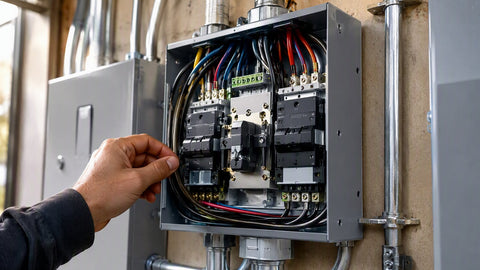
For a two-string array: combined Isc = 2 × 13.9A = 27.8A. NEC 690.8's 125% continuous multiplier gives 34.75A required ampacity. NEC 310.16 puts 8 AWG copper at 50A (75°C column), and NEC 240.6's standard sizes land the breaker at 35A or 40A depending on terminal ratings — check the inverter's specified OCPD. For three strings: 3 × 13.9 × 1.25 = 52.1A, which pushes you to 6 AWG copper (65A at 75°C) on a 60A breaker. This is the math your plan reviewer will run; our NEC wire sizing guide walks through it in full.
| Strings Combined | Combined Isc | × 1.25 Required Ampacity | Min Copper (75°C, NEC 310.16) | Standard Breaker (NEC 240.6) |
|---|---|---|---|---|
| 1 string | 13.9A | 17.4A | 12 AWG (25A) | 20A |
| 2 strings | 27.8A | 34.8A | 8 AWG (50A) | 35–40A |
| 3 strings | 41.7A | 52.1A | 6 AWG (65A) | 60A |
| 4 strings | 55.6A | 69.5A | 4 AWG (85A) | 70–80A |
Array Layout Math: How Many Panels Do You Need?
System sizing runs from consumption to panel count: daily kWh ÷ (peak sun hours × 0.82) = array kW, then ÷ 0.405 kW per panel. Here's the reference table we use when quoting:
| Daily Usage | Peak Sun Hours | Array Size Needed | Panels @ 405W | Roof Area @ ~21 sq ft/panel |
|---|---|---|---|---|
| 20 kWh/day | 5.0 | 4.88 kW | 13 | ~273 sq ft |
| 30 kWh/day | 4.5 | 8.13 kW | 21 | ~441 sq ft |
| 40 kWh/day | 4.5 | 10.8 kW | 27 | ~567 sq ft |
| 50 kWh/day | 5.5 | 11.1 kW | 28 | ~588 sq ft |
A pallet of 31 of these modules is 12.56 kW — enough for everything but the largest residential loads, with spares from the same production lot. Run your own scenario with the solar system calculator, and check long-term economics on the ROI calculator.
Real-World Performance: Temperature and Degradation
Nameplate wattage is measured at 25°C cell temperature, and roofs don't stay at 25°C. With a Pmax temperature coefficient around −0.34 %/°C, a module running 35°C above STC on a hot summer afternoon loses 0.0034 × 35 = 11.9% of nameplate power — your 405W panel is a ~357W panel at that moment. That's normal, it applies to every crystalline module, and it's why design tools derate arrays rather than size to nameplate. The flip side is winter: cold, clear days push voltage up (already covered in the string sizing math) and power up with it, which is why shoulder-season production often beats the model.
Over the long haul, degradation decides lifetime energy. Tier 1 mono modules in this class typically warrant 1–2% first-year loss and 0.4–0.55% per year thereafter. On a 21-panel, 8.5 kW array producing about 11,500 kWh in year one, the year-25 output projection looks like this:
| Year | Retention @ 0.55%/yr (2% first-year) | Est. Annual kWh (from 11,500 kWh yr-1) | Retention @ 0.40%/yr premium class |
|---|---|---|---|
| 1 | 98.0% | 11,270 | 98.0% — 11,270 |
| 5 | 95.8% | 11,017 | 96.4% — 11,086 |
| 10 | 93.1% | 10,702 | 94.4% — 10,856 |
| 15 | 90.3% | 10,386 | 92.4% — 10,626 |
| 20 | 87.6% | 10,070 | 90.4% — 10,396 |
| 25 | 84.8% | 9,754 | 88.4% — 10,166 |
Cumulative 25-year production lands near 260,000 kWh either way — the degradation-rate difference is roughly 10,000 kWh of lifetime energy, which is why the warranty percentage is worth reading before you buy, not after.
Racking, Attachment, and Roof Pairing
A module is only as good as what holds it. The ZXM7-SH108 format clamps to standard residential rail systems with mid and end clamps at the manufacturer's specified clamping zones, and the frame is rated for the mechanical loads noted above. Three pairing rules we enforce on every job:
- Match the racking engineering letter to the module. Rail spans and attachment spacing are certified per module dimensions and load ratings. Swapping module models mid-project without updating the racking calcs is a permit-revision headache you don't need.
- Respect the clamping zones. Clamping outside the specified frame zones voids the mechanical warranty and can crack glass under snow load. The datasheet's clamping diagram is not decorative.
- Plan wire management before panels go down. Module leads route under the array with clips; leave them dangling and you'll be back with new leads after the first rodent season. Our racking systems overview and the panel mounting guide cover attachment detail by roof type.
Procurement: Buying This Module Smart

The 405W black-on-black class is high-volume inventory, which is good news for buyers: stock depth, competitive pricing, and same-lot pallets. A few procurement notes from the distribution side:
- Buy by the pallet when the design allows. A 31-panel pallet is 12.56 kW, freight cost per panel drops by more than half versus parcel quantities, and every module comes from one production run.
- Order the spare. One or two extra modules from the same lot, stored flat indoors, are cheap insurance against a future handling crack or forklift incident.
- Confirm the datasheet revision at order time. Module families evolve; the electricals on your permit set must match the label on the pallet.
- Pair the BOM in one order. Modules, racking, and inverter from one purchase order means one freight plan and one compatibility review. For larger builds, our pallet deals and B2B procurement guide lay out the volume path.
Applications of the ZNSHINE 405W Black on Black Panel
1. Residential Solar Systems
This is the module's home turf: pitched asphalt-shingle roofs, 10–28 panel arrays, black-on-black aesthetics for street-facing planes. Paired with microinverters or a residential string inverter, it covers the full range of residential architectures. The 405W class also ages gracefully as a platform: when a homeowner adds panels five years in, current-production modules in the same format usually remain available at close electricals, keeping expansion painless. Browse complementary modules in our 400–459W class and monocrystalline collection.
2. Commercial and Industrial Installations
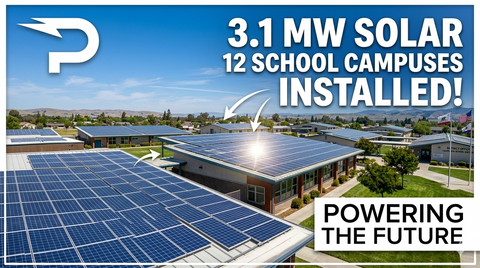
On commercial flat roofs the 405W format works well where roof access is constrained or walkways limit module size, though most large commercial builds step up to 540W+ formats like ZNSHINE's own 540W and 550W bifacial 144-cell modules to cut racking and labor per watt. Our commercial cost guide explains when each format wins.
3. Off-Grid and Remote Locations
For off-grid builds, the 405W format's manageability matters — one person can position it, and strings of 3–4 modules land nicely in the MPPT window of 48V-class charge controllers and hybrid inverters. A four-module string of these panels makes a ~1.6 kW array that meaningfully charges a 48V battery bank; eight of them across two strings is a serious cabin system. The off-grid cabin kits and the charge controller sizing guide cover the storage and charging sides of that design.
ZNSHINE 405W vs. Adjacent Modules in the Class
| Comparison Axis | ZNSHINE ZXM7-SH108-405/M | Typical Alternative |
|---|---|---|
| Format | 108 half-cell, black-on-black | Same class widely available |
| Wattage position | 405W, 410W sibling available | 400–460W band |
| Efficiency | ~20.7% | 20.3–21.5% in class |
| Best pairing | Microinverters or residential string | Same |
| Value angle | Tier 1 manufacturer at aggressive pricing | Premium brands cost more per watt |
If you're comparing brands at this wattage, our best solar panels of 2026 roundup puts the current field side by side — worth ten minutes before you lock a module for a 25-year commitment.
Comparing Against the Alternatives on the Same Roof
Customers often arrive cross-shopping two or three modules in the same wattage band, and the honest answer is that the top Tier 1 options are closer than the marketing suggests. What separates a good buy from a mediocre one is rarely the headline efficiency — it's the combination of degradation warranty, temperature coefficient, mechanical load rating, and the supplier's ability to deliver a matched pallet with intact warranty paperwork. I've replaced modules under warranty from half a dozen manufacturers, and the claim experience tracks the quality of the distributor relationship more than the brand on the label. Buy the module from someone who will still answer the phone in year nine.
Inverter Pairing for the 405W Format
The 405W module works with every mainstream residential architecture, but the pairing details differ:
- Microinverters. One unit per panel eliminates string math entirely. Confirm the micro's maximum input current exceeds the module's 13.9A Isc and that its MPPT voltage window brackets the module's ~31V Vmp across temperature. Modern high-power micros handle this class comfortably; older 250W-era units do not.
- String inverters. Strings of 10–13 modules land in the sweet spot of residential string MPPT windows, with the cold-weather Voc check done above. Mixed-orientation roofs want one MPPT input per roof face.
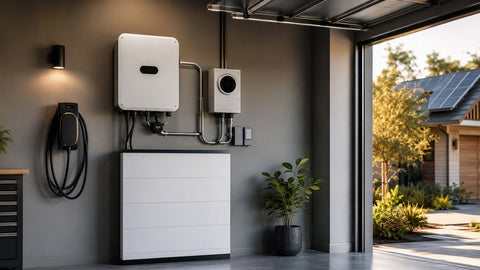
- Hybrid inverters with storage. The same string rules apply, plus the battery interface. Pairing this array class with a 48V hybrid inverter and a 10–20 kWh battery bank is the most common solar-plus-storage build we quote; the home battery bank sizing guide covers the storage half of that equation.
Whatever the architecture, the inverter buyer's guide and the module datasheet belong on the same desk before the order goes in.
Ordering Checklist for This Module
Before the purchase order goes in, walk this list — it's the same one our inside team uses:
- Confirm final panel count from the system sizing math, plus spares.
- Verify string lengths against NEC 690.7 for your design temperature, or microinverter compatibility per panel.
- Size conductors and OCPDs per NEC 690.8, 310.16, and 240.6 as tabled above.
- Match racking, clamps, and attachment hardware to the module dimensions and load ratings.
- Confirm datasheet revision, warranty documents, and serial-number capture plan for the pallet.
- Schedule freight with liftgate and delivery appointment, and plan same-day receiving inspection.
Do those six things and the install week is the easy part. Skip them and the install week finds out for you.
Why Choose the ZNSHINE 405W Black on Black Panel?
Three reasons, in order of how often they close the sale: the all-black aesthetic that keeps homeowners and HOAs happy, Tier 1 manufacturing pedigree at pricing that beats the premium brands on a per-watt basis, and a wattage class that maximizes array size within standard residential roof and racking constraints. I've walked customers off more expensive modules onto this one when the datasheets didn't justify the premium — buy the panel whose numbers fit your design, not the one with the biggest marketing budget. The fourth reason only shows up later: unglamorous reliability. Panels that just work, year after year, without a warranty saga, are what turn one project into a referral chain.
To price this module for your project, check live stock on the ZXM7-SH108-405/M product page or the full ZNSHINE collection, and reach out through Portlandia Electric Supply for pallet pricing — this module at volume is where its value story gets loud.
Frequently Asked Questions
How many ZNSHINE 405W panels do I need for my home?
Divide your daily kWh by (peak sun hours × 0.82), then by 0.405 kW per panel. A 30 kWh/day home in a 4.5-sun-hour region needs about 21 panels for an 8.5 kW array.
What does "black on black" mean for a solar panel?
Black cells, black backsheet, black frame — a uniform dark appearance on the roof. It costs a small amount of output versus a white-backsheet module (black backsheets run slightly warmer) but wins HOA approvals and street-facing aesthetics, which is why it dominates residential.
How many of these panels can go on one string?
Typically 10–13. With ~37.2V Voc and a −0.28 %/°C coefficient, a 12-module string at −10°C reaches about 490V — within residential 600V limits and most inverter windows. Always run the NEC 690.7 cold check against your local design temperature.
What wire size does a two-string array of these panels need?
Two strings at ~13.9A Isc: 2 × 13.9 × 1.25 = 34.8A required ampacity, so 8 AWG copper (50A at 75°C per NEC 310.16) with a 35–40A breaker per NEC 240.6. Verify against the inverter manufacturer's specified OCPD.
Is ZNSHINE a reliable brand?
ZNSHINE is an established Tier 1 manufacturer with multi-gigawatt annual capacity and a long shipment history into the North American market. The modules carry standard Tier 1 product and linear performance warranties.
Can these panels be mixed with other brands on the same roof?
Electrically, avoid mixing models within a string — mismatched Imp forces the string to the weakest module. Across separate strings or with microinverters (one per panel), mixing is workable, but same-model arrays are simpler to permit, monitor, and warranty.