If you have compared spec sheets lately, you have seen panels labeled 72-cell and others labeled 144-cell and wondered whether one is somehow twice as good as the other. The short answer: a 144-cell panel is a 72-cell panel with every cell laser-cut in half. Same silicon, same footprint class, different internal wiring — and the differences that creates are real but frequently misunderstood. This guide explains exactly what separates the two formats, with voltage, current, dimension, and string-sizing math you can check yourself.

I've installed both formats side by side on the same warehouse roof, and I can tell you the half-cut 144-cell format has effectively won the market for good engineering reasons — but "144" on the label does not automatically mean a better panel, and I'll show you where the older full-cell format still makes sense.
What "Cell Count" Actually Means
A solar cell is a square of silicon, currently about 182 mm (M10) or 210 mm (G12) on a side in modern formats. A full-cell 72-cell module arranges 72 of those squares in a 6 × 12 grid, wired in series. A 144-cell module uses the same 72 full-size squares, but each is sliced into two half-cells, and the 144 halves are wired as two parallel sections of 72 series-connected half-cells each.
That wiring detail is the whole story. Series connection adds voltage; parallel connection adds current. Because the 144 half-cells carry half the current of full cells (each half-cell has half the area), and the two halves are paralleled, the finished 144-cell module ends up with the same voltage as its 72-cell parent and roughly the same current at the terminals. What changes is inside the laminate:
| Attribute | 72-Cell (Full Cell) | 144-Cell (Half-Cut) | Why It Differs |
|---|---|---|---|
| Physical cells | 72 full cells (6 × 12) | 72 full cells cut into 144 half-cells (two 6 × 12 sections) | Laser slicing, same silicon area |
| Current per cell string | Full (~13 A class for M10) | Half (~6.5 A class) | Half the cell area = half the current |
| Internal resistive (I²R) loss | Baseline | ≈ 75% lower per string | Halving I quarters I²R loss |
| Typical Vmp | ~41–42 V | ~41–42 V | Same series count of silicon |
| Typical Voc | ~49–50 V | ~49–50 V | Voltage set by series cells, unchanged |
| Bypass diodes / junction box | 3 diodes, vertical cell strings | 3 diodes, split top/bottom sections | Different shade response geometry |
| Typical power class (M10) | 530–560 W | 540–590 W | Lower resistive loss + better shade behavior |
The Physics: Why Half-Cut Cells Gain Power
Resistive power loss in a conductor is P = I²R. Cut a cell in half and its current halves — from, say, 13 A to 6.5 A — while the path resistance roughly doubles (half the cross-section). Loss per string goes from 13² × R = 169R to 6.5² × 2R = 84.5R — exactly half, and there are two such strings in parallel, so total internal resistive loss is about half of the full-cell design... more precisely, industry measurements put the net module-level gain at 5 to 10 watts on a 550 W-class panel, roughly 1–2% of nameplate.
The arithmetic on a specific example. Take a 144 half-cell panel rated 550 W versus its 72 full-cell ancestor at 540 W on the same BOM:
| Metric | 72-Cell Full Cell | 144-Cell Half-Cut | Delta |
|---|---|---|---|
| Nameplate Pmax | 540 W | 550 W | +10 W (+1.9%) |
| Annual yield (4.5 sun-hrs/day, 0.8 derate) | 540 × 4.5 × 365 × 0.8 = 709 kWh | 550 × 4.5 × 365 × 0.8 = 722 kWh | +13 kWh/yr per panel |
| 20-panel array annual yield | 14,180 kWh | 14,440 kWh | +260 kWh/yr |
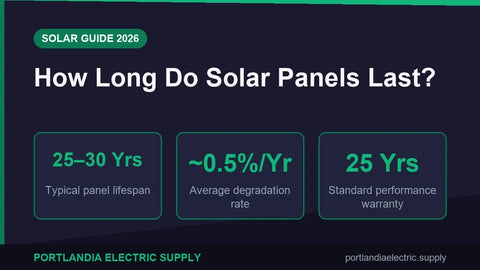
| 25-year lifetime delta (0.5%/yr degradation) | — | ≈ +5,900 kWh cumulative | ≈ $880 at $0.15/kWh |
The cumulative lifetime column uses a simple sum: average output over 25 years at 0.5%/yr linear degradation is about 93.75% of year-one, so 260 × 25 × 0.9375 ≈ 6,094 kWh; rounded conservatively in the table. The point stands: the half-cut advantage is small per panel and meaningful per array over decades.
Shade Tolerance: The Bigger Real-World Difference
The resistive gain is nice; the shade geometry is what I actually sell customers on. A full-cell 72-cell panel has three vertical cell strings, each with a bypass diode. Shade one vertical stripe — a vent pipe shadow, a chimney — and one-third of the panel drops out. A half-cut 144-cell panel is wired as two independent halves (top and bottom), each with three strings. Shade the bottom edge and the top half keeps producing at full tilt; you lose 50% instead of potentially cascading further, and long-edge shading (the most common kind on rows of roof-mounted panels) only touches one half.
| Shade Scenario | 72-Cell Full Cell Output | 144-Cell Half-Cut Output |
|---|---|---|
| Bottom row of cells shaded (eaves shadow) | ~0–33% (can trip multiple strings) | ~50% (top half unaffected) |
| One vertical stripe shaded (vent pipe) | ~67% (one of three strings bypassed) | ~67–83% depending on orientation |
| Corner cell shaded 10% | Disproportionate string loss | Loss confined to one half-section |
| No shade | 100% | 100% (+1–2% from lower I²R loss) |
Dimensions, Weight, and Handling
Both formats share the same footprint class because they use the same silicon. Modern M10 (182 mm) 72/144-format panels run about 2,279 × 1,134 mm (roughly 89.7 × 44.6 inches) and 27–32 kg. Older residential formats — 60-cell full cell and its 120 half-cell descendant — run about 1,755 × 1,038 mm. The format families in our catalog reflect this split: 400–459 W panels are mostly 108/120 half-cell residential format, while 550–709 W panels are the 144 half-cell commercial class.
| Format | Cell Format | Typical Dimensions | Typical Weight | Power Class | Typical Application |
|---|---|---|---|---|---|
| 60-cell / 120 half-cell | M10 or legacy M6 | ~1,755 × 1,038 mm | 20–23 kg | 350–420 W | Residential rooftops |
| 66-cell / 132 half-cell | G12 (210 mm) | ~2,384 × 1,303 mm | 32–35 kg | 640–700 W | Utility, large commercial |
| 72-cell / 144 half-cell | M10 (182 mm) | ~2,279 × 1,134 mm | 27–32 kg | 530–590 W | Commercial, ground mount, large residential |
| 78-cell / 156 half-cell | M10 (182 mm) | ~2,466 × 1,134 mm | 30–34 kg | 580–630 W | Utility scale |
String Sizing: The Math Is Identical for Both Formats
Because 144 half-cell modules keep the same Voc as 72 full-cell modules, string-sizing calculations do not change between formats. What matters is Voc, the coldest design temperature, and your inverter's maximum input voltage. Here is a worked example for both formats of a 550 W-class M10 panel with Voc = 49.6 V and a Voc temperature coefficient of -0.27%/°C, installed where the record low is -10°C:
Cold-weather Voc = 49.6 × [1 + 0.0027 × (25 − (−10))] = 49.6 × (1 + 0.0027 × 35) = 49.6 × 1.0945 = 54.3 V. On a 600 V residential inverter: 600 ÷ 54.3 = 11.0 → maximum 11 modules per string. On a 1,000 V commercial inverter: 1,000 ÷ 54.3 = 18.4 → maximum 18 modules per string, and NEC 690.7 governs the calculation either way.
| Design Low Temp | Cold Voc per Module | Max Modules on 600 V String | Max Modules on 1,000 V String | Max Modules on 1,500 V String |
|---|---|---|---|---|
| 0°C | 49.6 × 1.0675 = 52.9 V | 11 | 18 | 28 |
| -10°C | 49.6 × 1.0945 = 54.3 V | 11 | 18 | 27 |
| -20°C | 49.6 × 1.1215 = 55.6 V | 10 | 17 | 26 |
| -30°C | 49.6 × 1.1485 = 57.0 V | 10 | 17 | 26 |
For the wiring itself — conductor sizing, conduit fill, and NEC ampacity — follow our NEC wire ampacity chart, the NEC wire sizing guide, and our solar panel wiring basics article.
Which Format Should You Buy?
- Residential rooftop, limited area: you usually want the smaller 108/120 half-cell residential format for weight and fit — but the half-cut principle is identical. See residential solar panels and half-cut solar panels.
- Large roof, barn, or ground mount: 144 half-cell 550 W-class panels give the lowest cost per watt and fewest panels to clamp. Browse commercial solar panels and utility-scale panels.
- Any shaded site: half-cut wins, full stop. Pair with module-level electronics from our microinverters or power optimizers collections if shade is severe.
- Buying by the pallet: cost-per-watt on 144 half-cell commercial format is usually the best in the catalog — check panel pallet bundles and pallet deals.
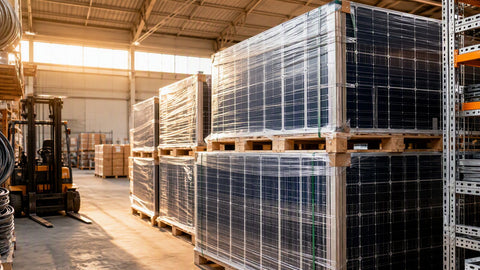
One practical note from the field: the 144 half-cell commercial panels are big — 89 inches tall and 60+ pounds. I never let a two-person crew take them up a residential ladder without a lift plan; if your roof is steep or tight, the smaller residential format is worth the extra panels purely on install labor. And always check your racking's clamp zones against the panel's datasheet before mixing formats on one array — our racking systems guide covers compatibility.
Need help matching panel format to inverter strings? Call Portlandia Electric Supply — we stock both formats across 410 W, 450 W, 550 W, and 600 W classes, plus complete complete solar kits with strings pre-engineered.
A Short History of Cell Formats

Cell counts follow wafer sizes, and wafer sizes keep growing. The residential standard of the 2010s was the 60-cell panel built on 156 mm (M2) wafers, rated 250–320 W. Its commercial sibling was the 72-cell panel on the same wafer, rated 300–400 W. Around 2019, half-cut architecture went mainstream, and the counts doubled on labels without the panels growing at all: 60 became 120 half-cells, 72 became 144 half-cells. Then the wafers themselves grew — M6 (166 mm), then M10 (182 mm), then G12 (210 mm) — and format labels multiplied again: 108, 120, 132, 144, 156 half-cells. Today, "144-cell" almost always means an M10 half-cut module in the 530–590 W class, while "72-cell" full-cell modules are legacy products you'll meet mostly on older roofs and in clearance inventory.
Inside the Junction Box: How the Two Formats Are Wired
Both formats carry three bypass diodes, but the geometry differs. A full-cell 72-cell panel is three vertical strings of 24 cells, each with one diode. A half-cut 144-cell panel is six strings of 24 half-cells arranged as three diode groups spanning both the top and bottom halves — the panel is split horizontally into two independent sub-modules wired in parallel at the junction box.
That horizontal split produces the shade behavior tabulated above, and one more subtle benefit: lower operating temperature in the cell interconnects. Halved current through the same ribbon cross-section means the ribbons run cooler, which reduces long-term thermomechanical stress on solder joints — one reason half-cut panels tend to show fewer interconnect failures in accelerated aging tests.
Current, Cable, and NEC Considerations
Module current drives wire and overcurrent sizing. An M10 144 half-cell 550 W panel has Isc around 14 A. Under NEC 690.8, string conductors must be sized at 156% of Isc (1.25 × 1.25): 14 × 1.56 = 21.8 A → 10 AWG copper (30–40 A depending on insulation and conditions) covers single strings with margin, which is why 10 AWG PV wire is the industry default. Our solar wire and cable guide covers PV wire versus USE-2 versus THHN selection, and the NEC 690 disconnect and overcurrent guide covers protection requirements.
| Configuration | Combined Isc | NEC 690.8 Design Current (×1.56) | Minimum Conductor (Cu, 90°C PV wire) |
|---|---|---|---|
| Single string | 14 A | 21.8 A | 12 AWG (30 A) |
| 2 parallel strings | 28 A | 43.7 A | 8 AWG (55 A) |
| 3 parallel strings | 42 A | 65.5 A | 6 AWG (75 A) |
| 4 parallel strings | 56 A | 87.4 A | 4 AWG (95 A) |
Parallel strings above two also trigger per-string overcurrent protection requirements under NEC 690.9 when module series fuse ratings are exceeded — another reason most residential designs keep to one or two strings per MPPT.
Mechanical Loads and Handling
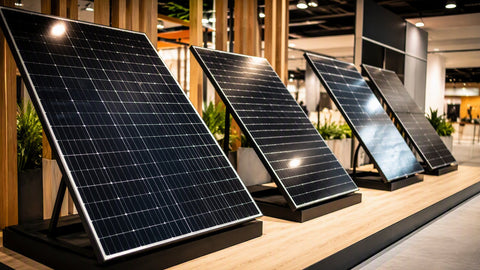
72-Cell Panel Dimensions
Full-cell and half-cut versions of the same format share dimensions, glass thickness, and frame, so load ratings are usually identical: 5,400 Pa front (snow) and 2,400 Pa rear (wind) is the common residential/commercial baseline, translating to roughly 112 psf snow and 50 psf wind. The practical handling difference is weight and flex: a 30 kg, 89-inch panel is a two-person lift with real flex if carried wrong — always carry large-format panels vertically by the long edges, never flat on one person's shoulder, because frame torque microcracks cells invisibly. Microcracks don't show on day one; they show up as hotspots and dead strings in year three.
Cost per Watt and Total Project Economics
Because half-cut 144-cell modules are the industry's volume product, they carry the lowest manufacturing cost per watt. A representative comparison at current wholesale levels:
| Format | Example Power | Typical $/W (panel only) | Panels for 11 kW | Panel Budget |
|---|---|---|---|---|
| 120 half-cell residential | 410 W | $0.38 | 11,000 ÷ 410 = 27 | 27 × 410 × 0.38 = $4,207 |
| 144 half-cell commercial | 550 W | $0.32 | 11,000 ÷ 550 = 20 | 20 × 550 × 0.32 = $3,520 |
| 72 full-cell (legacy) | 400 W | $0.35 | 11,000 ÷ 400 = 28 | 28 × 400 × 0.35 = $3,920 |
The 144 half-cell design saves $687 on panels versus the residential format for the same 11 kW — and seven fewer panels to clamp and wire. The trade-off is maneuverability on the roof. For ground mounts and commercial work the choice is obvious; for a cut-up residential roof with dormers, the smaller format's layout flexibility often wins despite the premium.
One last field note: whatever format you choose, order from the same production batch for a single array. Mixing batches of the same model is electrically fine, but slight color variation between batches shows on a roof, and customers notice. I batch-check pallet labels before anything goes up the ladder.
Troubleshooting and Field Behavior Differences
Years in, the formats age a little differently, and it shows in service calls. Full-cell panels concentrate thermal stress at full-cell interconnects; half-cut panels spread that stress across twice as many, smaller joints. In infrared scans of aging arrays, hotspots on full-cell modules tend to be larger and hotter because an entire full cell dissipates the blocked energy; on half-cut modules, a cracked half-cell dissipates half as much, so the same defect runs cooler and degrades slower. This is not a reason to panic about existing full-cell arrays — quality full-cell panels run for decades — but it is one more quiet argument for half-cut on a new build.
When you do troubleshoot either format, the diagnostic sequence is identical: measure string Voc in sunlight (compare against cold-corrected datasheet Voc), then string current under load, then thermal-scan for hotspots. A string reading 10–15% low on voltage with one module running 20°C hotter than its neighbors is a classic bypass-diode or cracked-cell signature, whatever the cell count on the label.
The Bottom Line
Choose 144 half-cell modules when you have the room and the crew for large-format panels — commercial roofs, ground mounts, big simple residential planes — because they deliver the best cost per watt, the best shade behavior, and the fewest panels to install per kilowatt. Choose the smaller residential half-cut formats when roof geometry, weight limits, or ladder access argue for it. And if you're maintaining or expanding a legacy 72 full-cell array, match electricals carefully or add the new panels on their own MPPT input. The label count matters far less than the datasheet behind it.
Common Buying Mistakes With These Formats
Three errors account for most of the regret I see. First, buying on cell count alone: "144 is bigger than 72, so it must be better" ignores that the silicon area is identical — compare watts, efficiency, and price per watt, not cell counts. Second, mismatching format to roof: ordering commercial-format panels for a cut-up residential roof forces layout compromises that can cost more production than the panel savings earned; sketch the layout first, then shop. Third, ignoring weight and access: a 144 half-cell panel is a two-person, 89-inch lift — if your install is a steep roof with ladder-only access, price the labor honestly before chasing the cheapest per-watt format. Get those three decisions right and either format will serve you for decades. Get them wrong and no datasheet advantage will rescue the project.
If you're still weighing formats for a specific project, send us your roof dimensions or site plan. Portlandia Electric Supply stocks both format families across every wattage class, and we'll quote the same array both ways — residential format versus commercial format — so you can see the panel count, racking, and cost-per-watt trade-off in actual dollars instead of theory. That comparison usually settles the question in one email.
Whatever you choose, verify the datasheet rather than the marketing label, and always lay out the full array on paper — panels, rails, walkways, and string runs — before you buy a single panel, rail, or foot of wire.
Frequently Asked Questions
Is a 144-cell panel more powerful than a 72-cell panel?
Slightly, but not because of the count. A 144-cell panel uses the same silicon as its 72-cell parent, cut in half. The half-cut wiring lowers internal resistive loss, gaining about 5–10 W (1–2%) on a 550 W-class module, and improves shade tolerance. The "144" itself is a wiring architecture, not extra silicon.
Can I mix 72-cell and 144-cell panels on the same string?
Only if their electrical characteristics match closely. Since 144 half-cell modules retain the same voltage as 72 full-cell modules, mixing is sometimes possible on paper — but check Vmp and Imp within 5% and confirm bypass diode behavior. In practice, use identical modules per string; put mixed formats on separate MPPT inputs.
Do 144-cell panels need different racking?
No new racking type, but check clamp zones and rail spans. The 144 half-cell format shares its footprint with the 72-cell format, so standard commercial racking works. Always verify the manufacturer's specified clamping zones against your rail layout, especially with dual-glass bifacial versions.
Why did the industry move from full cells to half-cut?
Physics and cost. Halving cell current cuts internal resistive losses roughly in half, shade behavior improves, and laser cutting adds almost nothing to manufacturing cost at scale. By the mid-2020s, half-cut had become the default architecture for essentially all new crystalline modules above the portable class.