SystemEdge 8kW FLEXpower Radian: Hybrid Solar & Energy Storage, Pre-Wired and Field-Proven
The OutBack Radian-based package that turns a pallet of components into a working off-grid or backup power plant — specs, battery math, NEC sizing, and install reality.

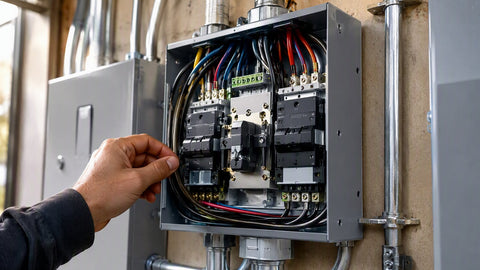
The SystemEdge 8kW FLEXpower Radian package solves the hardest part of hybrid and off-grid solar: not the components, but the integration. Anyone can buy an inverter, a charge controller, a battery rack, and a box of breakers. Turning that pile into a code-compliant system with correct disconnects, proper overcurrent protection on every conductor, a working battery monitor, and a bypass for service — that's where DIY builds and even professional installs burn weeks. The FLEXpower Radian approach ships that integration pre-wired on a backplate: the OutBack GS8048A inverter-charger, charge control, system display, DC shunt monitoring, and every breaker and busbar landed where the listing expects them. You supply the array, the battery bank, and the AC connections.
This guide covers what the package actually contains, the published GS8048A performance envelope, battery bank sizing with worked math, the NEC requirements that govern installation, and the field lessons our desk has collected across off-grid homesteads, backup-powered homes, and light commercial resilience builds. See the current package in our OutBack Power collection, and the broader OutBack Power brand guide for the full platform family.
The heart is the OutBack Radian GS8048A: a transformer-based, low-frequency inverter-charger delivering 8,000W continuous at 120/240VAC split-phase from a 48VDC battery bus. Transformer-based matters — it tolerates the brutal inrush of well pumps, air compressors, and motor loads that fold high-frequency inverters in half. The pre-wired assembly around it typically includes:
| Component | Function | Why It Matters in the Field |
|---|---|---|
| GS8048A inverter-charger | 8 kW inversion, ~115A battery charging | Runs the whole load panel; refills the bank from solar, generator, or grid |
| FLEXmax charge controller (FM80/FM100 class) | MPPT harvest from the PV array | 80–100A of charging capacity; the array's gateway to the DC bus |
| MATE3s system display | Programming and monitoring hub | Every setpoint in the system lives here — charge curves, grid behavior, generator support |
| FLEXnet DC monitor + shunts | Battery state-of-charge accounting | Counts amp-hours in and out; your fuel gauge for the bank |
| Pre-wired breaker panel | PV input, battery, and AC disconnects with OCPD | The listing-critical part: correct breakers on correct conductors, already landed |
| Bypass assembly | Grid/generator pass-through during service | Take the inverter down for maintenance without killing the house |
Published GS8048A performance numbers worth designing around (verify the current datasheet revision at order time): 8,000W continuous output, surge capability reaching roughly double nameplate for short-duration motor starting, ~115A DC charging capacity into the 48V bus, and stacking support for up to ten units — 16 kW split-phase with two, or three-phase configurations for commercial services. Idle draw is modest for a transformer unit but not zero; budget roughly 30–40W of tare loss in your night-load accounting.
An 8 kW inverter is only as capable as the bank behind it. Two constraints define the minimum: energy (kilowatt-hours for runtime) and current (amperage for full-power output).
Energy sizing. Work from your nightly and outage load list. A critical-loads household (refrigerator at 150W cycling, furnace blower at 600W intermittent, lighting and electronics at 200W) typically burns 6–10 kWh overnight. Whole-home coverage minus central AC runs 20–25 kWh per day. With 5.12 kWh LFP server-rack modules at 90% usable depth of discharge:
| Coverage Goal | Daily Load | Usable kWh Required* | 5.12 kWh Modules | Bank Nominal |
|---|---|---|---|---|
| Critical loads, one night | 8 kWh | 9.4 kWh | 2 | 10.2 kWh |
| Critical loads + kitchen, one night | 14 kWh | 16.4 kWh | 4 | 20.5 kWh |
| Whole home minus AC, 24 hours | 24 kWh | 28.1 kWh | 6 | 30.7 kWh |
| Off-grid, two days autonomy | 22 kWh/day × 2 | 51.5 kWh | 10 | 51.2 kWh |
*Usable kWh = daily load ÷ 0.90 DoD ÷ 0.95 inverter/round-trip efficiency. Run your own load list through the battery sizing calculator, and see our off-grid sizing worksheet for the multi-day math.
Current sizing. This is the constraint people miss. Pulling a full 8,000W from a 48V nominal bank: 8,000 ÷ 48V ÷ 0.93 efficiency = 179A continuous from the battery. A single 100Ah LFP module is typically rated for 100A continuous discharge — half of what full inverter output demands. Practical rule: one 100Ah-class module per 4 kW of intended continuous load, minimum two modules (200A capability) to unlock the GS8048A's full rating. A two-module bank runs the inverter at full power; a one-module bank silently caps you around 4.5 kW no matter what the inverter badge says.
Conductor sizing for the DC side. NEC 690.8's 125% continuous factor applied to 179A gives 224A — which lands on 4/0 copper (230A at 75°C per Table 310.16) for the battery-to-inverter run, with a 250A class-T or listed DC breaker at the battery. The pre-wired FLEXpower assembly handles this internally; if you extend battery cables beyond the factory leads, match the factory gauge and keep runs short — every foot of undersized DC cable is voltage sag the inverter reads as a dying battery.
The output side math for the 8 kW unit at 240V split-phase:
| Circuit | Continuous Current | NEC ×1.25 (690.8/215) | Breaker (240.6(A)) | Copper @75°C (310.16) |
|---|---|---|---|---|
| Inverter AC output to load panel | 8,000 ÷ 240 = 33.3A | 41.7A | 50A, 2-pole | 8 AWG |
| Grid/generator AC input (with charge mode) | 33.3A + share for 115A DC charging ≈ 55A total | 68.8A | 70A, 2-pole | 4 AWG |
| PV string to FM100 (13.1A Isc example) | 13.1A | 13.1 × 1.25 × 1.25 = 20.5A (690.8 double factor) | 25A DC-rated | 10 AWG |
The AC input row surprises people: the Radian is an inverter-charger, and when it's passing through grid or generator power while simultaneously charging at full rate, the input breaker sees both. Size the generator or grid feed for pass-through plus charging, or set a charge-current limit in the MATE3s to match the feed you actually have. On the PV side, NEC 690.7 cold-voltage correction still governs string design into the FM100's input window — apply the Table 690.7(A) factor for your design minimum (1.12 at −5°C, up to 1.25 at −40°C) to module Voc before finalizing series counts. Our NEC code compliance guide has both tables in permit-ready form.
The Radian platform's defining trick is that it doesn't force a choice between grid-interactive and off-grid behavior. In grid-tie backup mode, it passes utility power through to the loads, sells or zero-exports solar per your configuration, and transfers to battery in roughly a line-cycle when the grid fails — fast enough that computers and refrigerators don't notice. In off-grid mode, the AC input becomes a generator port: the inverter qualifies the generator's frequency and voltage, synchronizes, then carries the loads while charging the bank at up to 115A. Generator support mode even lets a small generator assist rather than replace the inverter — a 5 kW generator plus the 8 kW inverter covers 10 kW peaks while charging with whatever the loads don't use.
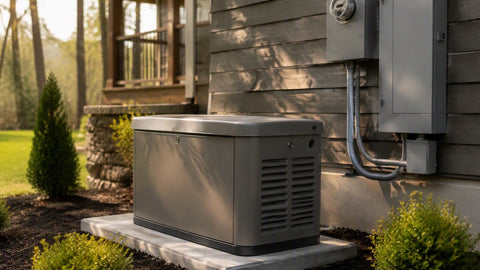
That generator pairing deserves a sizing note of its own: the ~115A DC charge rate at 48V is about 5.5 kW of charging load, so anything under a 7 kW generator will spend its entire output charging and pass nothing through. Match a 10–12 kW generator to this platform for comfortable headroom — our whole-house generator guide and the generator lineup cover the candidates, with fuel-consumption tables that translate runtime into gallons.
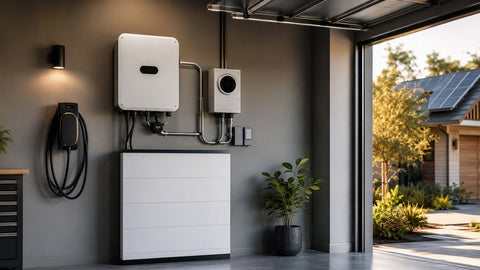
Where does this platform not fit? Homes that want invisible, app-polished, fully indoor battery aesthetics — the Radian is industrial equipment that belongs in a garage, shop, or mechanical room, humming audibly when it works hard. And pure grid-tie homes with no backup ambition should buy a simpler hybrid or string inverter and save the money; start that comparison with how hybrid inverters work.
| Configuration | PV Array | Battery Bank | Inverter Stack | Who It Serves |
|---|---|---|---|---|
| Backup Essential | 4–6 kW rooftop | 2 × 5.12 kWh (10.2 kWh) | Single GS8048A | Grid-tied homes wanting storm coverage for critical loads |
| Hybrid Whole-Home | 8–12 kW across two controllers | 5–6 × 5.12 kWh (25–31 kWh) | Single GS8048A, load-managed | Homes cutting bills and riding out multi-day outages |
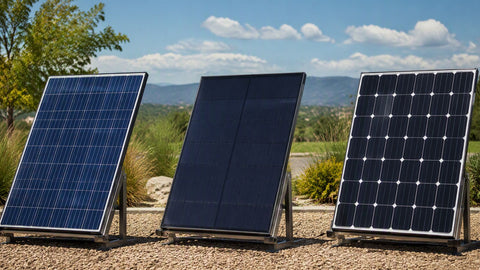
| Off-Grid Homestead | 12–16 kW ground mount | 8–10 × 5.12 kWh (41–51 kWh) | Two stacked units, 16 kW, plus 10–12 kW generator | Full-time off-grid with shop loads and deep-winter autonomy |
Each row scales from the same core: the pre-wired panel stays, controllers and modules multiply. The jump from Backup Essential to Hybrid Whole-Home is mostly battery and array; the jump to Off-Grid Homestead adds the second inverter and the generator integration covered above. Wherever you land, keep the array honest against the bank: a rough balance point is 1 kW of PV per 4–5 kWh of storage for daily-cycling systems, so the array can refill the bank by early afternoon even in shoulder seasons.
Battery Lifecycle and Warranty Math

LFP rack modules typically carry 10-year warranties rated to 6,000–8,000 cycles at 80% depth of discharge — numbers worth translating into years. One cycle per day at 6,000 cycles is 16.4 years of daily use before reaching the cycle rating; the calendar warranty at 10 years binds first for most residential duty. Capacity fade compounds gently: at a planning figure of roughly 2% capacity loss per year in the early years flattening with age, a 10.2 kWh bank delivers about 9.4 kWh of nameplate-equivalent capacity at year five and roughly 8.3 kWh at year ten — still above the 70–80% end-of-warranty threshold most manufacturers guarantee. The practical takeaway: oversize the day-one bank by 15–20% so the year-ten bank still meets the load list, because adding a module in year six is easy and living with an undersized bank is not. Chemistry behavior behind these curves is covered in our BMS explainer, including why the management system — not the cells — usually determines whether you reach those cycle ratings.
One warranty discipline that costs nothing: register every component (inverter, controllers, batteries) within the manufacturer's window, keep the serial list with your commissioning report, and save the MATE3s settings export to a file. Warranty claims live and die on serial numbers and documented configuration, and the ten minutes it takes at commissioning is the cheapest insurance on the whole system.
What We've Learned Shipping FLEXpower Systems
- I've commissioned Radian stacks where the pre-wired backplate saved a crew two full days versus a field-built panel — and every one of those days would have been spent doing exactly what the factory already did: landing breakers and torquing busbars.
- My standing rule on battery count: I never ship this package with fewer than two LFP modules, because a single 100Ah rack battery can't feed the inverter's full 179A appetite, and the customer will find that limit at the worst possible moment.
- On a mountain homestead last winter, generator support mode turned a sputtering 6.5 kW portable into a functional system — the inverter carried the well pump's inrush, the generator just kept the batteries fed; that flexibility is why I spec transformer-based units for motor-heavy off-grid loads.
- We photograph every MATE3s settings page before leaving site — six months later, when someone has "adjusted" the absorb voltage, those photos are the difference between a five-minute phone fix and a truck roll.
The MATE3s plus FLEXnet DC combination gives you the numbers that matter off-grid: state of charge counted in amp-hours (not guessed from voltage), days of autonomy at current consumption, per-controller harvest, and generator runtime totals. Remote monitoring comes through OutBack's OpticsRE platform, which lets us or your installer watch a struggling site without a site visit — genuinely useful when the system lives at the end of a gravel road two hours from the nearest electrician.
Set expectations honestly with this platform: it is professional-grade equipment that rewards professional-grade habits. The user interface is an engineer's interface, not a consumer app with confetti animations. Settings have consequences — an absorb voltage 0.4V too high will cook an LFP bank's BMS into protective shutdowns that look like random faults until someone reads the charge profile. None of this is a flaw; it's the price of a system that lets you control everything. Budget a real commissioning session with someone who has configured Radian systems before, keep the settings export backed up, and this platform will outlast two generations of prettier equipment. That trade — polish for durability — is exactly why the Radian keeps showing up in the systems that are still running fifteen years later.
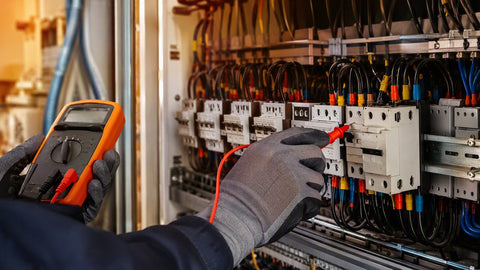
Physically, the backplate wants a flat, structural wall in a conditioned-ish space: garage, shop, or mechanical room, out of direct weather and within the battery cables' reach of the bank. Leave the clearance zones on the installation drawing intact — they're also your service access. Electrically, four connections complete the system: PV strings to the controller breakers, battery bank to the DC shunt and bus (observe polarity twice, torque once, verify with a meter before closing the breaker), AC input from grid or generator, and AC output to the backed-up load panel.
Commissioning on the MATE3s runs in this order: battery chemistry and charge profile first (use the LFP profile from your battery manufacturer's document, not a generic guess), then grid-mode behavior (sell, zero-export, or backup-only), then generator qualification limits if a genset is in the picture, and finally the FLEXnet DC shunt calibration so state-of-charge accounting starts truthful. Test the transfer: kill the AC input with a real load running and watch the switchover. Then charge the bank to full, run it down to 20% on house loads, and confirm the recharge curve matches the profile you set. A system that hasn't survived one full cycle before the crew leaves hasn't been commissioned — it's been assembled.
Maintenance afterward is light: quarterly visual inspection, annual termination torque check, monthly glance at the FLEXnet-reported state of charge against your expectations, and firmware updates applied deliberately with release notes read. The battery installation guide covers bank-side clearances and ventilation, and the grounding and bonding guide handles the part inspectors check first.
Can the SystemEdge 8kW FLEXpower Radian run a whole house?
It runs most houses with load management: 8,000W continuous covers refrigerators, freezers, lighting, electronics, well pumps, and even a managed mini-split. Central air conditioning, electric ranges, and electric water heaters simultaneously will exceed it — those loads get excluded, soft-started, or handled by stacking a second GS8048A for 16 kW.
How many batteries does the 8 kW Radian need?
Minimum two 100Ah-class 48V LFP modules (10.2 kWh) — not for runtime, but for current: full inverter output pulls roughly 179A from the 48V bus, and a single 100A-rated module can't deliver it. Size the bank beyond that minimum by your nightly kWh load: four modules covers critical loads plus kitchen, six covers a whole home minus central AC.
What size generator pairs with this system?
10–12 kW is the comfortable match. The Radian's charger alone can draw about 5.5 kW (115A at 48V), so smaller generators spend everything on charging with nothing left for pass-through loads. Generator support mode lets a smaller unit assist the inverter, but for regular deep-winter charging, 10 kW and up keeps charge times civilized.
What breaker and wire does the inverter output need?
At 240V, 8,000W is 33.3A continuous; the NEC 125% continuous factor (690.8/215) requires 41.7A capacity — a 50A two-pole breaker from the 240.6(A) standard ratings with 8 AWG copper at 75°C per Table 310.16. The AC input circuit must also carry charge-mode current and typically lands on a 70A breaker with 4 AWG.
Is the FLEXpower Radian suitable for off-grid living full-time?
Yes — it's one of the reference platforms for full-time off-grid: transformer-based surge handling for motors, generator integration with support mode, field-serviceable components, and stacking to 80 kW. Pair it with two days of battery autonomy, a properly sized generator, and a PV array sized for your worst month, not your best.
Can I expand the system later?
Yes, in both directions. Stack additional GS8048A units (up to ten) for more AC output, and add LFP rack modules to the 48V bus for more storage — verify your BMS supports mixed-age modules or add modules in matched batches. Add FLEXmax controllers for more PV; each controller handles its own sub-array independently.
- Battery Sizing Calculator
- Solar System Calculator
- Inverter Sizing Calculator
- OutBack Power Brand Guide
- What Is a Battery Energy Storage System?
- Solar Battery Sizing for Off-Grid Living
- MPPT vs PWM Charge Controllers
- How Hybrid Inverters Work
- Battery Installation Guide
- NEC Code Compliance Guide
- Grounding & Bonding Guide
PES Supply carries 80,000+ products from 300+ manufacturers. One PO, one invoice, every trade covered.
Need help sizing? Our team can calculate loads, select equipment, and source everything from one PO.
Call (502) 790-0600