When a customer tells me they "just want the power to stay on," what they're actually buying is a chain of equipment that has to work perfectly at 2 a.m. in an ice storm: engine, alternator, transfer switch, fuel supply. Briggs & Stratton has been building the first link in that chain for over a century, and their home standby line has become one of the workhorses we spec for whole-house backup. This guide covers how their generators fit the home-backup landscape, how to size one honestly, what installation really involves, and the ownership math that decides standby vs. portable vs. battery.

Briggs & Stratton: Why the Name Carries Weight
Briggs & Stratton built its reputation on small engines — the ones on half the lawn mowers in North America — and that engine-building depth is the core asset in their generator line. A standby generator is, at heart, an industrial-duty engine that must start after months of silence and then run for days. Companies that manufacture their own engines control the part most likely to matter in year eight.
Their home lineup spans two broad families:
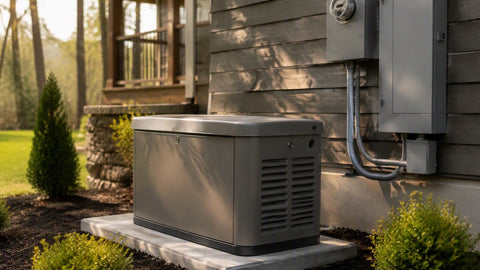
- Standby generators — permanently installed, automatic, natural gas or propane, in outputs from roughly 10 kW up through 26 kW+ for residential service.
- Portable and inverter units — gasoline or dual-fuel, for job sites, RVs, and manual backup.
Browse the current lineup in our Briggs & Stratton collection, and see the Briggs & Stratton generators overview for model-family notes.
Standby vs. Portable vs. Battery: Choosing the Category First
| Factor | Standby Generator | Portable Generator | Battery Backup |
|---|---|---|---|
| Response to outage | Automatic, ~10–30 seconds | Manual: deploy, fuel, connect | Instant, silent |
| Runtime | Days (NG supply) / tank-limited (LP) | Tank-limited; refuel every 8–12 hrs | Hours, unless solar-recharged |
| Fuel | Natural gas or propane | Gasoline, dual-fuel, propane | Stored charge |
| Installed cost (typical class) | $$$ — unit + pad + ATS + gas line + electrical | $ — unit + cords or interlock | $$–$$$ — capacity-dependent |
| Maintenance | Scheduled service, weekly self-test | Owner-maintained; fuel rotation | Nearly none |
| Noise | ~65 dBA class at 23 ft, outside | 60–78 dBA by type | Silent |
| Best for | Frequent/long outages, medical loads, unattended homes | Occasional outages, budget-first, job sites | Short outages, indoor-safe needs, pairing with solar |
The decision rule I give homeowners: if outages in your area run long (24+ hours), if anyone in the house depends on powered medical equipment, or if the home sits empty part of the year with a sump pump and pipes to protect — standby is the answer. If outages are short and rare and someone's always home to wheel a unit out, a portable with an interlock does the job for a third of the money. Battery belongs in the conversation when silence, indoor safety, or solar integration drives the requirement; the battery runtime calculator will tell you quickly whether your loads fit the chemistry.
Sizing a Standby Unit: Load Math, Not Square Footage
Sizing by square footage is how people buy a 26 kW generator to run 9 kW of loads. The correct method is a load calculation, and NEC 220.83 (optional method) or a measured peak-demand history from your utility gives a defensible number. The field version:
- List the must-run loads with actual wattage: furnace/air handler, AC compressor (the big one), well pump, sump pump, refrigerator, freezer, kitchen circuits, lighting, network gear, any medical equipment.
- Identify the largest motor — almost always central AC — and account for its locked-rotor starting current unless you fit a soft-starter. Modern load-management modules in quality ATS systems handle this by shedding and re-adding loads.
- Add them with diversity — everything rarely runs at once — then hold a 20% margin.
| Home Profile (Typical Loads) | Running Load Range | Suggested Standby Class |
|---|---|---|
| Essential circuits only: furnace, fridge, lights, network, sump | 4–7 kW | 10–14 kW — see 10–14 kW standby units |
| Whole house, gas heat, 3-ton AC with managed loads | 8–13 kW | 18–22 kW — the 22 kW class breakdown applies |
| Whole house, larger AC (4–5 ton), electric appliances, well pump | 13–18 kW | 24–26 kW — covered in the 26 kW guide |
| Large estate, multiple ACs, shop equipment | 18 kW+ | 30 kW+ or paralleled/light-commercial units |
The full methodology lives in our whole-home generator sizing guide and what size generator do I need. Two sizing notes from hard experience: first, a soft-start kit on the AC compressor (a few hundred dollars) can legitimately drop you one generator class by taming locked-rotor current. Second, natural gas meter capacity is a hidden constraint — a 22 kW unit on NG can demand 250+ cubic feet per hour at full load, and older meters sometimes can't deliver it without a utility upgrade. Check before you buy.
What Installation Actually Involves
A standby install is a four-trade job, and the quote should itemize all four:
| Scope Item | Who Does It | Code / Standard Notes |
|---|---|---|
| Concrete or composite pad, site prep | Installer/contractor | Manufacturer clearances from openings; local setbacks; flood elevation where relevant |
| Gas line (NG or LP) | Licensed plumber/gas fitter | Sized for full-load BTU at the available pressure; LP tanks sized for vaporization rate in cold weather |
| Electrical: feeder, ATS, bonding | Licensed electrician | NEC 702 (optional standby systems); ATS listed for the service; grounding per NEC 250 |
| Permits and inspection | Contractor + AHJ | Electrical and mechanical/gas permits in most jurisdictions; HOA review where applicable |
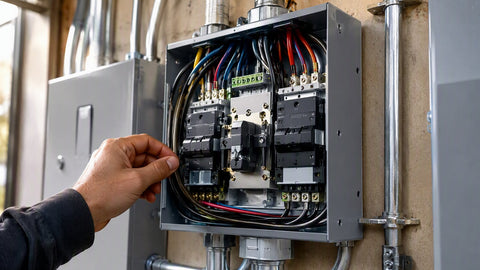
The automatic transfer switch is the brain of the install. Service-entrance-rated ATS units sit between the meter and your main panel and transfer the whole service; load-side ATS units feed a selected-circuits subpanel. Whole-service transfer with load management is the current best practice on Briggs & Stratton-class residential systems — the generator sees everything, and smart modules shed the water heater or range if capacity gets tight. Conductor sizing for the generator feeder follows NEC 310.16 ampacity with breakers from the 240.6(A) standard series; our NEC wire sizing guide has the tables your electrician will work from.
Fuel: Natural Gas vs. Propane for Standby Duty
| Factor | Natural Gas | Propane (LP) |
|---|---|---|
| Supply | Continuous from utility | On-site tank; runtime = tank size ÷ burn rate |
| Energy content | ~1,030 BTU/cu ft | ~91,500 BTU/gal |
| Full-load consumption (22 kW class, typical) | ~250–300 cu ft/hr | ~2.5–3.5 gal/hr |
| Output rating impact | Full rating | Full rating (some models derate slightly on LP — check spec sheet) |
| Outage independence | Depends on utility gas integrity (historically very reliable) | Fully independent; a 500-gal tank at 50% load runs roughly 5–7 days |
| Site requirements | Adequate meter capacity | Tank placement setbacks; winter vaporization sizing |
If you have natural gas at the street, take it — infinite runtime beats tank math. Propane is the answer for rural sites, and the tank-sizing question is straightforward: a 22 kW unit averaging half load burns roughly 1.5–2 gal/hr, so a 500-gallon tank (filled to 80%, ~400 usable gallons) carries about 8–11 days of continuous half-load operation. Most outages end long before the tank does.
Ownership: Maintenance and the Weekly Self-Test
Standby generators maintain themselves better than portables do — they exercise automatically (typically a 5–15 minute weekly self-test), monitor their own battery, and throw fault codes before small problems become no-start events. Owner responsibilities compress to: keep the unit clear of debris and snow, maintain oil and filter service per the hour-based schedule (usually annually or every 100–200 run hours for air-cooled residential units), keep the battery on its charger circuit healthy (replace every 3–4 years), and schedule a professional annual service. Air-cooled residential units are not continuous-duty machines — for outages stretching past a few days, follow the manual's cooldown and oil-check intervals. Our generator maintenance and service guide covers the shared service fundamentals in detail.
The Money Question: What Whole-House Backup Really Costs
All-in installed pricing for a turnkey 18–22 kW standby system — unit, pad, ATS, gas plumbing, electrical, permits — typically lands in the $9,000–15,000 range depending on region and site complexity, with 10–14 kW essential-circuit systems meaningfully below that and 26 kW+ systems above. Against that number, weigh: one avoided pipe-freeze catastrophe ($5,000–50,000), hotel costs across a week-long outage, food replacement, and the property-value preference buyers now show for backup-ready homes. For households where the math doesn't pencil, a quality portable with an interlock — see the portable generator guide — covers essentials for a fraction of the cost, with manual labor as the trade.
Briggs & Stratton Specifics Worth Knowing

Three brand-specific points from the field. First, their residential standby line has leaned into power-management flexibility — Symphony-style load management lets smaller units cover bigger houses by sequencing heavy loads, which directly attacks the oversizing problem. Second, their dealer and parts network is one of the deepest in North America; a carb kit or controller board is days away, not a container ship away. Third, their move into battery storage (the PHi battery line, e.g. the Briggs & Stratton PHi 3.8) means a Briggs standby generator and a Briggs battery can now share one ecosystem — generator for the long haul, battery for the instant transition and overnight silence.
Load Management in Practice: How a 20 kW Covers a 30 kW House
Load management is the most under-explained feature in residential standby power, and it's where a lot of smart money gets saved. The concept: your home's peak theoretical demand is not its real demand. The AC, water heater, range, and dryer almost never pull simultaneously at full draw. A managed transfer switch enforces that reality electronically — heavy loads get priority-ranked, and if the generator approaches capacity, lower-priority loads are shed and re-added automatically as headroom returns.
| Load | Typical Draw | Typical Priority Rank | Management Behavior |
|---|---|---|---|
| Furnace / air handler | 500–1,200 W | 1 (never shed) | Always on — heat is life-safety in winter |
| Refrigerator + freezer | 700–1,400 W combined | 2 | Always on; surges tolerated |
| Sump / well pump | 800–1,500 W | 3 | On; interlocked against AC where tight |
| Central AC (3–4 ton) | 3,500–5,000 W (LRA surge much higher) | 4 | First shed candidate; soft-start shrinks its cost to the system |
| Electric water heater | 4,500 W | 5 | Shed under any load pressure; tank holds heat for hours |
| Electric range / dryer | 3,000–6,000 W | 6 | Shed during outages unless capacity is abundant |
The practical effect: an all-electric home whose nameplate loads total 28 kW commonly runs fine on an 18–22 kW generator with management, because the managed system never lets the big loads stack. This is why two identical houses get quoted different generator sizes by different contractors — one quoted the nameplate, the other quoted the managed reality. Ask which method your quote used.
Five Installation Mistakes I Keep Getting Called to Fix
- Undersized gas line. A 22 kW unit at full load is a 250+ cu ft/hr gas appliance. A half-inch line run forty feet won't feed it, and the symptom — the generator stumbling or stalling exactly when the house needs it most — gets misdiagnosed as a generator fault for months. Size the line for full-load BTU at the actual delivered pressure, including everything else on the line.
- Pad too close to openings. Manufacturers and code both set minimum distances from doors, windows, and vents (commonly five feet). "It looked better there" is how exhaust ends up in bedrooms.
- No surge protection at the transfer switch. The ATS is full of electronics and sits in the surge path of every utility event. An SPD at the service is a $200 line item protecting a $2,000 switch.
- Skipping the load calculation. Sizing by "my neighbor has a 22" produces oversized units that wet-stack and under-load (diesels especially) or undersized units that stall on AC start. Run the numbers.
- Dead exercise battery at year three. The weekly self-test quietly stops happening when the battery dies, and nobody notices until the outage. Put the battery on a three-year replacement schedule regardless of apparent health.
Warranties and Service Plans: Read the Labor Line
Residential standby warranties in this class typically run 3–5 years parts-and-labor, with extended options to 7–10. The detail that matters isn't the term — it's whether labor and travel are covered through the whole term or only parts after year one. A failed controller board under a parts-only warranty still costs you a $400 service call. Likewise, dealer service plans (annual maintenance plus priority storm-season response) are worth pricing honestly: after a regional outage, every generator owner in the county calls at once, and plan holders go to the front of a very long line. I've watched that queue from the inside; it's the least fun week of the year, and priority status is worth every penny when your house is the one that's dark.
Generator Plus Battery: The Hybrid House
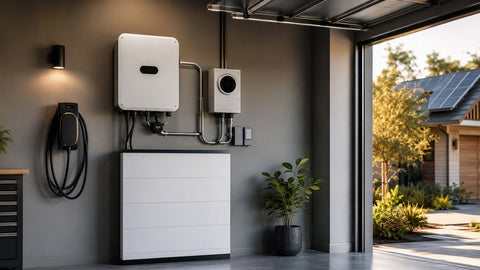
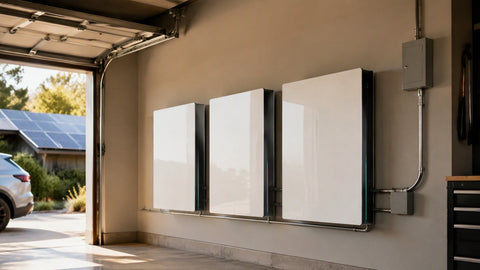
The most resilient residential design I build now pairs a standby generator with a modest battery bank: the battery carries the instant transfer, the overnight hours, and the short outages (which are 80%+ of all events), while the generator handles the long tail. Each technology covers the other's weakness — the battery is silent and instant but finite; the generator is loud and mechanical but runs for days. With Briggs & Stratton now building both sides of that pair (standby generators and the PHi battery line), single-ecosystem installs have become straightforward. If that architecture interests you, the battery bank sizing guide covers the storage half and our battery backup kits show current bundled options.
Permits, HOAs, and the Paperwork Nobody Warns You About
Two bureaucratic realities catch homeowners off guard. First, permits: nearly every jurisdiction requires electrical and mechanical (gas) permits for a standby install, and the inspection is your friend — it's a free second set of licensed eyes on the gas line sizing and transfer equipment. Second, HOAs and local noise ordinances: some associations regulate placement, screening, and even self-test scheduling (a weekly exercise at 2 p.m. Tuesday keeps peace better than 6 a.m. Sunday). Pull the HOA architectural guidelines before the pad is poured, not after; relocating a set generator is a four-figure lesson in reading documents first.
The First Outage: What Actually Happens
Owners who've never watched their standby system work tend to expect drama. Here's the real sequence. The grid drops; the ATS senses utility loss within seconds and signals the generator; the engine cranks (typically 5–15 seconds — cold weather stretches it); the generator stabilizes voltage and frequency; the transfer switch throws, and the house is back. Total elapsed time: usually 10–30 seconds. The fridge never warms, the computers on UPS units never blink, and the only evidence is the hum outside and, on managed systems, maybe the water heater waiting its turn. When utility power returns, the ATS waits a stabilization window (usually a minute or more — utilities flap during restoration), transfers back, and the generator runs a no-load cooldown before shutting down. The event log in the controller records the whole thing. I tell new owners to kill the main breaker on a quiet Saturday and watch it once — the fifteen minutes of rehearsal converts an unfamiliar machine into a trusted one, and it's the cheapest peace of mind in the whole system.
Resale Value: The Payback Nobody Models
Standby generators show up in home listings for a reason: buyers in outage-prone regions treat backup power as a feature worth paying for, and real estate agents in storm corridors will tell you a permitted standby system photographs like a renovated kitchen. I've had two customers sell homes within a year of installation, and both recovered a meaningful share of the install cost in the sale price — the transfer switch and gas line are permanent improvements that convey with the house. It shouldn't drive the decision, but it belongs in the spreadsheet: the true net cost of a standby system is the install price minus resale recovery minus every avoided outage loss along the way, and I've never seen that final number look bad for a household with real outage exposure.
Frequently Asked Questions
What size Briggs & Stratton generator do I need for my house? Size by load calculation, not square footage. Essential-circuit homes typically fit 10–14 kW; whole-house with gas heat and one AC typically needs 18–22 kW with load management; large all-electric homes may need 26 kW+. The sizing guide walks the math.
How long can a standby generator run continuously? On natural gas, effectively indefinitely with scheduled oil checks (air-cooled units typically need an oil check every 24–48 hours of continuous run and service at the manual's hour intervals). On propane, runtime is tank-limited — a 500-gallon tank typically carries 5–11 days depending on load.
Is a standby generator worth it if outages are rare? It depends on consequences, not frequency. If one outage means flooded basements, frozen pipes, spoiled insulin, or a home-based business going dark, the insurance value justifies the cost even at one event per decade. If an outage means candles and board games, a portable unit is the rational buy.
How loud is a home standby generator? Modern air-cooled residential units typically measure in the mid-60s dBA at 23 feet — comparable to a window air conditioner. Placement relative to bedroom windows and neighbors matters more than the spec-sheet number.
Who can install a standby generator? It takes a licensed electrician (NEC 702 transfer equipment) and a licensed gas fitter in most jurisdictions, plus permits and inspection. Some dealers offer turnkey install; whatever the structure, don't let the gas or transfer-switch work go unpermitted — insurance and resale both care.
Natural gas or propane — which is better? Natural gas if it's available at adequate meter capacity: continuous supply, no tank, full rating. Propane for rural sites: fully utility-independent, with runtime set by tank size. Check the model's spec sheet — a few units derate slightly on LP.
Power You Don't Have to Think About
A correctly sized, professionally installed Briggs & Stratton standby system is the closest thing residential backup has to a solved problem: it starts itself, manages its own loads, fuels itself from the street or a tank, and asks for one service visit a year. Start with the Briggs & Stratton lineup, size honestly with the whole-home sizing guide, and talk to our team about your load list before you commit to a kilowatt class.