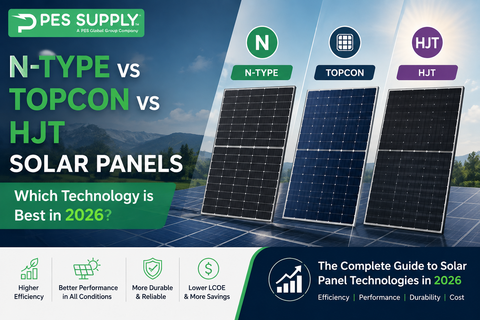
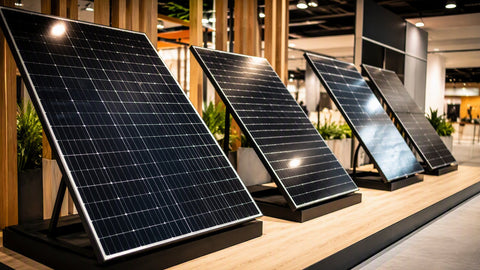
If you've opened a module datasheet any time in the last eighteen months, you've noticed the alphabet soup changed. PERC is gone from every Tier 1 lineup. TOPCon owns the volume. Back-contact panels are suddenly a real category instead of a trade-show curiosity, and the words "P-type" mostly show up now next to the words "clearance pricing." This guide explains why the industry flipped from P-type to N-type silicon, what the physics actually buys you on a roof or in a field, and how to spec the right module in August 2026 without paying for performance you'll never harvest.

We stock both sides of this transition and we've watched it happen pallet by pallet. Two years ago our PERC panel listings outsold everything else we carried. Today the N-type section moves ten units for every one P-type panel that leaves the warehouse, and the P-type panels that do sell are liquidation buys for repairs on existing arrays. That shift happened faster than anything I've seen in this trade since the move from poly to mono.
The 60-Second Answer
N-type and P-type describe how the silicon wafer is doped. P-type wafers are doped with boron, which creates an excess of positive charge carriers ("holes"). N-type wafers are doped with phosphorus, which creates an excess of free electrons. That one change at the atomic level cascades into everything a buyer cares about: N-type cells resist light-induced degradation, run more efficient, handle heat better, and degrade slower over the life of the array. P-type's only remaining advantage is a lower sticker price, and that advantage evaporated as TOPCon production scaled through 2024 and 2025.
The short version: in 2026, buy N-type unless you're matching an existing P-type array or buying distress-priced clearance stock for a budget off-grid project where every dollar matters more than every watt.
What the Doping Difference Actually Does
A solar cell is a P-N junction. One layer wants to donate electrons, the other wants to accept them, and photons knock electrons loose across that boundary to make current. For thirty years the industry built cells on P-type boron-doped wafers because boron silicon was what the semiconductor industry already made cheaply, and the PERC architecture squeezed excellent performance out of it. PERC hit its physical ceiling around 24.5% cell efficiency, and manufacturers spent years fighting for tenths of a percent.
The problem with boron-doped silicon is a defect called boron-oxygen light-induced degradation, usually shortened to LID. Boron and oxygen atoms in the wafer form a complex under sunlight that traps charge carriers. A fresh PERC panel loses roughly 1.5% to 2% of its output in its first weeks of sun exposure, permanently, before the normal annual degradation curve even starts. N-type phosphorus-doped wafers don't form that boron-oxygen complex, so LID essentially disappears. N-type cells also carry a higher minority-carrier lifetime, which is a lab way of saying electrons stay available to be collected longer, which is why N-type architectures — TOPCon, HJT, and back-contact — all convert more of the incoming light.
| Property | P-Type (PERC) | N-Type (TOPCon / HJT / BC) |
|---|---|---|
| Wafer dopant | Boron | Phosphorus |
| First-year light-induced degradation (LID) | 1.5–2.0% | ≤1.0% (TOPCon), near-zero on premium lines |
| Annual degradation after year one | 0.50–0.55%/yr | 0.40%/yr typical, 0.25–0.30%/yr premium |
| Mass-production cell efficiency ceiling | ~24.5% | 25.5%+ TOPCon, 26%+ BC (manufacturer claims), 26%+ HJT lab |
| Temperature coefficient (Pmax) | −0.35 to −0.39 %/°C | −0.29 to −0.32 %/°C (TOPCon), −0.24 %/°C (HJT) |
| Bifaciality factor | 70 ±5% | 80 ±5% (TOPCon), up to 90% (HJT) |
| LETID / PID resistance | Susceptible without process controls | Inherently stronger; standard on warranties |
| Production status, August 2026 | End-of-life; final inventory clearance | ~99% of new Tier 1 capacity |
The Market Flip: What 2026 Shipment Data Shows
This isn't a spec-sheet argument anymore — the shipment numbers settled it. InfoLink's first-half 2026 global module shipment ranking, published August 15, shows TOPCon at roughly 83% of shipments across the top eleven suppliers. Back-contact architectures, which are also built on N-type wafers, took about 16% — that's around 30 GW in a single half-year, which means BC is no longer a boutique product. Add HJT's slice and P-type's share of new production rounds to zero.
I've been ordering containers through this whole transition, and the paperwork tells the same story as the analyst reports. Quotes for PERC stopped arriving from our Tier 1 suppliers through 2025. When a factory retools a line, it retools to TOPCon or BC. The California Energy Commission's module list tells it from the regulatory side: new listings this year are dominated by 580W-and-up N-type bifacials, while P-type PERC models in the 300–400W class are being delisted or simply not renewed.
| Technology | Wafer Type | 1H26 Status | Flagship Products | Typical Power Class |
|---|---|---|---|---|
| TOPCon | N-type | Dominant — ~83% of top-11 supplier shipments (InfoLink 1H26) | Jinko Tiger Neo 3.0/5.0, Trina Vertex N Gen 3, JA DeepBlue 5.0, Canadian Solar TOPBiHiKu7 | 580–770W |
| Back-Contact (BC/ABC/HPBC) | N-type | Mainstreaming — ~16% of top-11 shipments (~30 GW in 1H26) | Aiko INFINITE Gen 3, LONGi Hi-MO X10, TCL C3 | 440–770W |
| HJT | N-type | Premium niche — no HJT maker in InfoLink 1H26 top 10 | REC Alpha Pure-RX, Risen Hyper-ion Pro, Huasun Himalaya | 470–740W |
| PERC | P-type | End-of-life — Tier 1 production ceased through 2025; 2026 is distress clearance | Legacy lines only | 300–450W |
Efficiency: Where N-Type's Advantage Lands on Your Roof
Datasheet efficiency is module-level, measured at standard test conditions: 1,000 W/m² of irradiance, 25°C cell temperature. Real roofs don't run at 25°C. On a July afternoon in Texas or Arizona, cell temperatures hit 60–70°C, and that's where the temperature coefficient stops being a footnote and starts being money. A PERC panel at −0.37 %/°C loses about 13% of its rated power at 60°C cell temperature. A TOPCon panel at −0.30 %/°C loses about 10.5%. HJT at −0.24 %/°C loses under 8.5%. Over a summer, that gap is real kilowatt-hours on the production meter.
The efficiency ladder in August 2026 looks like this: volume TOPCon modules run 22.5–24.0% (Jinko's Tiger Neo 3.0 sits at 24.0% in a 520W format). Premium back-contact leads the residential class — LONGi's Hi-MO X10 is rated 23.7–24.8% depending on format, and Aiko's INFINITE Gen 3 holds a certified 25.0% with a Kiwa PVEL 2026 Top Performer sweep across all seven test categories. Aiko's G4 Full-Screen Ultra claims up to 26.0% with mass delivery starting Q3 2026. HJT fills the premium tier at 22.6–23.8%. The best P-type PERC ever shipped topped out around 23.2% in lab-adjacent production, and the clearance stock actually available now runs 20.5–21.5%.
| Module (August 2026) | Cell Type | Efficiency | Power | Status |
|---|---|---|---|---|
| Aiko G4 Full-Screen Ultra | N-type ABC | up to 26.0% (mfr claim) | 690W | Mass delivery from Q3 2026 |
| Aiko INFINITE Gen 3 / Neostar | N-type ABC | 25.0% | 545W | Shipping; PVEL 2026 Top Performer, all 7 categories |
| LONGi Hi-MO X10 | N-type HPBC 2.0 | 23.7–24.8% | 475–670W | Shipping; 25.4% module record (Fraunhofer ISE) |
| Jinko Tiger Neo 3.0 | N-type TOPCon | 24.0% | 520W | Volume efficiency leader; 700W-class Tiger Neo 5.0 next |
| Canadian Solar 3rd-gen TOPCon | N-type TOPCon | 24.8% | 670W | Global mass production from August 2026 |
| Trina Vertex N Gen 3 | N-type TOPCon 3.0 | ~23.5%+ | 760W | Utility flagship |
| REC Alpha Pure-RX | N-type HJT | 22.6% | 470W | Premium residential; 25-yr product warranty |
| Legacy PERC clearance stock | P-type | 20.5–21.5% | 300–450W | Liquidate only; do not spec for new builds |
One caution from the field: Maxeon 7's IBC panels still post beautiful numbers — 24.1% at 440W with a 40-year warranty on paper — but the company entered judicial management in Singapore in April 2026, US Customs has detained shipments, and a warranty is only as good as the company standing behind it. We're steering customers who want premium residential toward REC, LONGi, or Silfab instead.
Degradation Math: What 0.40% vs 0.55% Actually Pays You
Warranty degradation numbers look small until you multiply them by twenty-five years and a whole array. Here's the math on a 10 kW system producing about 14,500 kWh in year one in a decent solar climate, comparing a legacy P-type PERC panel against a current N-type TOPCon with typical warranty terms.
| Year | P-Type PERC Output (kWh) — 2% yr 1, 0.55%/yr after | N-Type TOPCon Output (kWh) — 1% yr 1, 0.40%/yr after | Cumulative Gap (kWh) |
|---|---|---|---|
| 1 | 14,210 | 14,355 | 145 |
| 5 | 13,897 | 14,126 | ~980 |
| 10 | 13,506 | 13,841 | ~2,700 |
| 15 | 13,115 | 13,556 | ~4,700 |
| 20 | 12,724 | 13,271 | ~7,000 |
| 25 | 12,333 | 12,986 | ~9,600 |
At a $0.16/kWh retail rate, that cumulative gap is roughly $1,500 in avoided purchases over the warranty period — and that's before you count the hotter-climate bonus from the better temperature coefficient, which can add several percent more in the Southwest. Premium N-type lines with 0.25%/yr degradation widen the gap further. When a customer asks me whether the $0.02–0.04/W premium for a better N-type panel is worth it, this table is the answer. It pays for itself several times over; the higher-efficiency panel also buys you roof space back.
Bifaciality: N-Type's Quiet Multiplier
Most 2026 N-type modules are bifacial by default — dual-glass construction with an active rear side. The bifaciality factor tells you how efficient the rear is relative to the front, and it's another place N-type wins the physics: TOPCon runs about 80 ±5%, HJT reaches 90%, while old bifacial PERC managed 70%. On a ground mount over light gravel or a commercial TPO roof, rear-side gain of 5–15% is common, and N-type captures more of it. Our bifacial output simulator writeup walks through the geometry if you want to model your own site. If you're shopping the category, the bifacial collection is all N-type at this point — we couldn't stock a P-type bifacial even if someone asked.
What N-Type Costs in August 2026 (Tariff Reality Check)

Cell prices at the factory gate have never been lower — TOPCon cells were at RMB 0.36–0.38/W on the EnergyTrend spot index in mid-August, and Tier 1 modules FOB China run $0.085–0.095/W for budget 580–600W product. But US buyers don't pay FOB China. The August 2026 Section 232 proclamation replaced the expired Section 201 safeguard with a Minimum Import Price program: $0.38/W on modules, $0.22/W on cells, plus a 15% ad valorem duty, stacked on top of existing AD/CVD and Section 301 measures. Contracts signed before August 6, 2026 are exempt, but anything landing now reprices around that floor. Expect US-delivered Tier 1 module offers to climb through Q4 2026 from the $0.27–0.32/W range we saw earlier this year.
| Tier | Technology | FOB Price (Aug 2026) | Notes |
|---|---|---|---|
| Budget | TOPCon 580–600W | $0.085–0.095/W FOB China | Tier 3 clears near $0.065/W; US import floor is $0.38/W MIP |
| Mid-range | TOPCon 600–670W | $0.10–0.15/W | SE Asia FOB ~$0.098–0.11/W; AD/CVD applies by country |
| Premium | HJT / BC 470–670W | $0.14–0.20/W | HJT premium compressed to 2–8% over TOPCon (China FOB) |
| Ultra-premium | BC/ABC 440–520W residential | $0.30–0.50/W | Max efficiency per square foot; limited volume |
| Utility | TOPCon 700–770W, 1500V | $0.07–0.10/W container | G12 210mm format; check racking compatibility |
| Legacy clearance | P-type PERC 300–450W | Distress pricing, varies weekly | Fine for repairs and budget off-grid; never for new financed builds |
The practical takeaway: the price gap between P-type clearance and budget N-type has narrowed to the point where "saving" money on PERC usually costs you more in freight-per-watt, racking-per-watt, and labor-per-watt than the panel discount returns. When we quote jobs now, the P-type line item only survives if the customer is matching glass on an existing array.
How to Choose: N-Type by Application
Residential rooftop, space-constrained: Go premium back-contact or HJT. You want the most watts per square foot and the best heat behavior. Think Silfab Elite N-type TOPCon all-black for a US-assembled option, or Aiko/LONGi BC if your installer stocks them. Browse the all-black collection for the aesthetics-first jobs.
Standard residential and small commercial: Volume TOPCon in the 460–549W or 550–709W classes. Jinko, Trina, JA Solar, and Canadian Solar all ship bankable product here, and BloombergNEF's Q2 2026 Tier 1 list — now 42 manufacturers, with Vikram and Jolywood newly added — is the financing benchmark your lender will check.
Utility and ground-mount: 670–770W TOPCon bifacial, 1500V, G12 format. The 700W+ class became standard at Tier 1 after SNEC in June 2026. Tongwei's TNC 3.0 at 770W entered mass production at the end of Q2 2026.
Off-grid budget builds and repairs: This is the one place clearance PERC still makes sense — a hunting cabin, a battery-shed array, matching a 2021-vintage string. Our 300–399W section carries what's left, priced to move.
Whatever class you land in, pair the modules with the right balance-of-system. High-power N-type strings run at higher currents, so check your run against the NEC ampacity charts and our PV wire selection guide before you order cable, and make sure your string inverter or microinverter input windows actually accept the module's Voc and Isc at temperature. A 700W bifacial on an undersized optimizer is an expensive mistake we've seen more than once.
Inside the Three N-Type Architectures
TOPCon — Tunnel Oxide Passivated Contact — earned its dominance the boring way: it reuses most of the existing PERC production line. A TOPCon cell adds an ultra-thin silicon oxide layer, maybe two nanometers thick, capped with doped polysilicon on the rear of the wafer. That stack lets electrons tunnel through while blocking the recombination losses that capped PERC's efficiency. Because factories could retrofit rather than rebuild, TOPCon scaled faster than any cell technology in the industry's history — roughly 83% of top-supplier shipments in the first half of 2026. When you buy a Jinko Tiger Neo, a Trina Vertex N, or a JA Solar DeepBlue, this is what you're getting.
HJT — Heterojunction — sandwiches crystalline silicon between layers of amorphous silicon. The manufacturing is genuinely different: low-temperature processes, fewer steps, excellent passivation. The payoff is the best temperature coefficient in mass production (around −0.24 %/°C), bifaciality up to 90%, and superb low-light behavior. The cost is silver consumption and capex, which is why HJT stays premium: REC's Alpha Pure-RX at 22.6% and Risen's Hyper-ion Pro at 23.8% are the reference products. No HJT maker cracked InfoLink's top-ten shipment list in 1H26, which tells you where the volume economics sit. For a hot-climate residential roof where the customer wants the best and will pay for it, HJT is still a legitimate answer.
Back-contact moves every busbar and finger to the rear of the cell, leaving the front face as uninterrupted black silicon. No shading from metal means more active area, which is how Aiko's ABC cells and LONGi's HPBC lines post the highest module efficiencies shipping today — 25.0% certified on the INFINITE Gen 3, 23.7–24.8% on the Hi-MO X10. BC was a rounding error two years ago. In 1H26 it shipped about 30 GW across the top suppliers, roughly 16% of the ranked volume. JA Solar and GCL are shipping BC now too. The premium runs 12–15% over TOPCon at the factory gate, and for space-constrained residential roofs it's usually justified.
Warranties, Bankability, and What We Actually Check Before Stocking a Panel
Every serious N-type line now ships with a 25-year product warranty and a 30-year performance warranty — typically 87.4% to 88.85% retained output at year 30 for TOPCon, better on premium BC and HJT. Compare that to the 12-year product / 25-year performance terms that were standard on PERC just three years ago. The warranty gap alone tells you what manufacturers believe about their own degradation curves.
But a warranty is a promise from a balance sheet, so we check three independent signals before a line goes into our catalog. First, BloombergNEF Tier 1 — a bankability list, not a quality award, now covering 42 manufacturers as of Q2 2026. Second, Kiwa PVEL's Reliability Scorecard: the 2026 edition runs seven test categories including the new UVID sequence, and only a handful of models pass everything. AIKO swept all seven this year; LONGi made Top Performer for the ninth consecutive time. Third, CEC listing — no California Energy Commission listing, no sale into incentive markets, period. A panel that clears all three filters has earned its pallet space. One that fails any of them had better be very cheap.
A Field Note on Strings, Currents, and Why Your Wire Plan Changes
Here's something the marketing decks skip. Modern N-type modules in the 580W-plus class push short-circuit currents of 14 to 18 amps depending on format, and bifacial gain can add 10% on top of that on a bright ground-mount site. NEC 690.8 requires you to size conductors at 156% of Isc — that's the 125% continuous multiplier stacked on the 125% irradiance enhancement factor. Run the math on an 18A bifacial module with rear gain and you're designing around 28–30A per string. That's 10 AWG PV wire territory minimum, and on long runs you'll upsize for voltage drop anyway. We cover the full calculation in the wire ampacity chart, and the NEC 690 disconnect guide covers the protection side. I've seen more than one DIY job come back with warm connectors because someone designed around the 2021-era 10A modules their buddy used. The glass changed; the wire math has to change with it.
The Bottom Line
The P-type versus N-type debate ended the way technology debates usually end in this industry — not with a bang, but with a purchase order. Factories voted with their retooling budgets, and by mid-2026 there is no Tier 1 P-type production left to argue for. Your real decision now is which N-type flavor fits the job: volume TOPCon for value, back-contact for space-constrained premium roofs, HJT for heat and bifacial capture. Match the module to the inverter window, size the wire for the current these things actually make, and check the tariff math before you promise a customer a price. Do those three things and the panel itself will take care of you for the next thirty years.
Five Mistakes We See Buyers Make in the N-Type Era
1. Shopping by wattage alone. A 770W utility panel and a 470W residential panel are not the same product at different sizes. The big glass is G12-format, often over 2.4 meters long, 35mm-framed for ground mount, and frequently 1500V system voltage. It will not fit your roof, your racking, or your residential inverter. Match form factor to application first, wattage second.
2. Ignoring the temperature coefficient in hot climates. Two panels rated identically at STC can differ by 3–4% in real summer production between a −0.24 %/°C HJT and a −0.35 %/°C legacy design. In Phoenix or the Gulf Coast, that coefficient deserves as much attention as the headline efficiency number.
3. Assuming "bifacial" means free energy on any roof. Rear-side gain needs albedo — reflected light. A flush-mounted residential roof over dark shingles returns almost nothing to the back of the glass. Bifacial pays on ground mounts, carports, tilted commercial flat roofs over white membrane, and high-clearance racking. On a flush comp-shingle roof, buy the best front-side efficiency per dollar and don't pay extra for a rear you can't feed.
4. Buying clearance PERC for a financed build. The panel discount evaporates once you price freight, racking, and labor per watt instead of per panel — and you're installing yesterday's degradation curve under a 25-year loan. Clearance P-type is for repairs and cash off-grid projects, full stop.
5. Forgetting that tariffs, not factories, now set your price. With the Section 232 minimum import price at $0.38/W on modules, the FOB China spot price is trivia for US buyers. Get a delivered-price quote with a validity window and lock it. I've watched two projects this summer blow their pro formas because the buyer assumed quotes from April still held in September.
How to Read a 2026 Datasheet Without Getting Fooled
Three lines on the datasheet deserve your attention before the marketing graphics. First, the NOCT or NMOT rating, not just STC — a panel's output at realistic operating temperature is the honest number, and quality N-type modules now publish both. Second, the first-year degradation figure separated from the annual rate. A datasheet quoting "0.40% annual degradation" with 1% first-year loss is a different product than one quoting 0.40% from day one; do the multiplication across your expected hold period before comparing warranties. Third, the PVEL or independent test history. A manufacturer claim of 25% efficiency means one thing on a brochure; a Kiwa PVEL Top Performer result across TC, DH, MSS, PID, UVID, LETID, and hail means the module survives the abuse that actually kills panels in the field. Ask for the PAN file if you're modeling production — any serious manufacturer provides one, and the ones who hesitate are telling you something.
And verify the physical layer before the truck shows up: frame thickness and profile for your clamp zones, junction box IP rating, connector brand (genuine Stäubli MC4 versus lookalikes matters more than most buyers realize), and glass thickness on dual-glass modules. We inspect a sample panel off every new lot we receive. It's twenty minutes of work that has saved our customers more than one bad container.
Frequently Asked Questions
Are N-type solar panels worth the extra cost over P-type?
Yes in almost every new-build scenario. N-type panels deliver 1–3% more first-year energy by avoiding boron-oxygen LID, degrade 0.10–0.25 percentage points slower per year, and hold up better in heat. On a 10 kW residential system the lifetime energy gap is worth roughly $1,500 or more, while the upfront premium on volume TOPCon over clearance PERC is often under $300 once you account for racking and labor per watt.
Is PERC technology dead in 2026?
For new production, yes. Every Tier 1 manufacturer ended PERC line production through 2025, and 2026 inventory is distress-priced clearance. PERC panels remain serviceable for repairing existing arrays or for budget off-grid projects, but no financed new build should spec P-type modules today.
What is the difference between TOPCon, HJT, and BC panels?
All three are N-type cell architectures. TOPCon adds an ultra-thin tunnel oxide passivating contact and dominates volume production at roughly 83% of major-supplier shipments in the first half of 2026. HJT sandwiches amorphous silicon layers for the best temperature coefficient (around −0.24 %/°C) and bifaciality near 90%, at a small price premium. Back-contact (BC/ABC/HPBC) moves all metal contacts to the rear of the cell, enabling the highest efficiencies — up to 25–26% — and clean all-black aesthetics for premium residential roofs.
How much more efficient are N-type panels than P-type?
Current volume N-type TOPCon modules run 22.5–24.0% efficiency, premium back-contact reaches 24.8–26.0%, and HJT sits at 22.6–23.8%. The P-type PERC stock still available in 2026 runs 20.5–21.5%. In practical terms, the same roof fits roughly 10–15% more watts with N-type, and those watts degrade slower over the system's life.
Can I mix N-type panels with my existing P-type array?
Not on the same string or MPPT input. Panels with different voltage and current characteristics force the whole string down to the weakest link. If you're expanding a P-type array, add the N-type panels on their own string, their own inverter input, or their own microinverters. For single-panel replacements, match the original module's electrical specs as closely as possible.
Will N-type panel prices keep falling in late 2026?
Factory-gate prices in China remain near record lows, but US-delivered prices are moving the other direction. The August 2026 Section 232 Minimum Import Price program sets a $0.38/W floor on imported modules plus a 15% duty, stacked on existing AD/CVD and Section 301 tariffs. Expect US module offers to reprice upward through Q4 2026 rather than fall.
If you want a straight answer on a specific project — roof dimensions, shading, budget, timeline — call the shop. We quote this stuff every day, and we'll tell you honestly whether premium BC glass earns its keep on your roof or whether volume TOPCon is the smarter spend. You can also start with the 2026 best panels roundup, run your roof through the system size calculator, or browse the full N-type lineup and the monocrystalline collection to see live pricing.