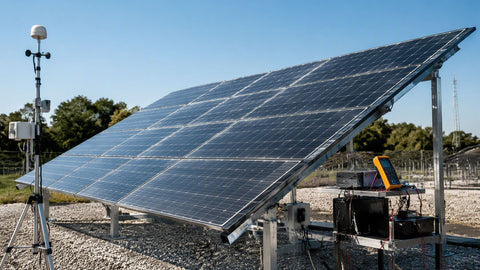
Morningstar Solar Charge Controllers: The 2026 Buyer's & Sizing Guide
Why three decades of over-engineering made Morningstar the default choice for off-grid, industrial, and remote power — and how to size one correctly.

There's a reason Morningstar charge controllers show up in places most electronics never survive: mountaintop telecom repeaters, offshore platforms, water pumping stations in the desert, and off-grid cabins that see -30°F winters. Since 1993, the Pennsylvania-based company has built a reputation on a simple premise — a charge controller is the one component in a battery-based solar system that absolutely cannot fail, because when it does, it takes the battery bank with it.
Millions of Morningstar units are in service worldwide, and the company still designs, tests, and supports its products in the United States. This guide covers what a charge controller actually does, the Morningstar lineup from the pocket-sized SunSaver to the 600-volt TriStar MPPT, the sizing math our tech desk walks customers through daily, and the NEC considerations that separate a code-compliant install from a future warranty claim.
A solar charge controller sits between the PV array and the battery bank, and its job description has four lines: regulate charging voltage and current so batteries reach full charge without overcharging, block reverse current flow from battery to panels at night, manage multi-stage charging (bulk, absorption, float, and equalization for lead-acid), and protect the system from faults on either side. Every other function — load control, lighting timers, diversion to a dump load, data logging — is a bonus built on top of those four.
The reason quality matters so much in this specific component is asymmetric risk. A failed panel costs you one panel's output. A failed controller can cook a $4,000 lithium bank in an afternoon, or freeze-protect it into an early grave by holding absorption voltage in January. We've seen both on our returns bench. The controller is the cheapest insurance policy in the system — which makes buying a cheap one an expensive decision.
Charge controllers come in two fundamental architectures, and Morningstar builds both:
PWM (Pulse Width Modulation) connects the array to the battery through a switched element, tapering current as the battery approaches full. The array runs at battery voltage, so a “12V” panel (Vmp around 17-18V) on a 12V battery at 14.4V absorption throws away the voltage headroom. PWM is simple, rugged, inexpensive, and exactly right for small systems where the array is matched to the battery voltage anyway.
MPPT (Maximum Power Point Tracking) is a DC-to-DC converter that decouples array voltage from battery voltage. It finds the array's maximum power point continuously — which moves with irradiance and temperature — and converts the excess voltage into additional charging current. In cold weather, when panel voltage rises, an MPPT harvests power a PWM physically cannot reach. Morningstar's TrakStar MPPT algorithm is one of the fastest and most accurate in the industry, with peak tracking efficiency around 99% and conversion efficiency up to 97-98%.
| Factor | PWM Controller | MPPT Controller |
|---|---|---|
| Array-to-battery voltage | Must match (12V array → 12V battery) | Array can be much higher voltage |
| Harvest efficiency | 70-80% typical (voltage mismatch losses) | 93-98% typical conversion |
| Cold-climate bonus | None — extra voltage is wasted | Captures winter voltage rise (10-25% more) |
| Wire sizing | Higher current, heavier wire from array | Higher array voltage = thinner, cheaper wire runs |
| Cost | $ | $$-$$$ |
| Best fit | ≤400W systems, matched panels, tight budgets | ≥400W, long wire runs, cold sites, growth plans |
For a deeper treatment of this decision, our MPPT vs PWM comparison guide walks through the crossover math in detail.
Morningstar's catalog is deliberately narrow — the company would rather perfect six platforms than ship sixty. Here is the current lineup with the specifications that matter for system design:
| Model Family | Type | Current Ratings | Battery Voltage | Max PV Input | Best Application |
|---|---|---|---|---|---|
| SunSaver | PWM | 6A / 10A / 20A | 12V or 24V | Matched-voltage arrays | Boats, RVs, lighting, small cabins |
| ProStar (Gen 3) | PWM | 15A / 30A | 12/24/48V auto | Matched-voltage arrays | Mid-size off-grid, industrial |
| ProStar MPPT | MPPT | 25A / 40A | 12/24/36/48V | 120V | Residential off-grid, telecom |
| TriStar | PWM (3-function) | 45A / 60A | 12/24/36/48V | Matched-voltage arrays | Charge, load, or diversion control |
| TriStar MPPT | MPPT | 30A / 45A / 60A | 12/24/36/48V | 150V | Serious off-grid homes & cabins |
| TriStar MPPT 600V | MPPT | 60A | 48V | 600V | Grid-tie modules repurposed off-grid, long wire runs |
A few lineup notes from the field. The SunSaver is fully epoxy-encapsulated and marine-rated — it's the controller we recommend for saltwater environments where nothing else survives. The TriStar is unique in the industry as a three-function device: the same hardware can be configured as a charge controller, a load controller, or a diversion controller for wind/hydro dump loads. And the TriStar MPPT 600V exists for a specific, increasingly common job: using inexpensive high-voltage residential grid-tie modules on an off-grid battery system, with array strings wired to several hundred volts so long runs from array to power shed stay on thin, inexpensive wire.
Browse the full range in our Morningstar charge controllers collection, or the broader Morningstar Corporation brand page.
Controller sizing has two constraints, and both must pass: the current the controller must handle, and the voltage the array can produce. NEC 690.8 drives the current side; NEC 690.7 drives the voltage side.
Current. NEC 690.8(A)(1) requires sizing for 125% of array short-circuit current, and 690.8(B) adds a second 125% for continuous operation — the combined 1.56× multiplier on Isc. The controller's rated charge current must meet or exceed that number.
Voltage. NEC 690.7 requires cold-temperature correction of array open-circuit voltage. An array with a nameplate Voc of 100V at STC can exceed 114V at -10°C (correction factor 1.14 from Table 690.7(A)). That corrected number must stay under the controller's maximum input voltage — 150V for a TriStar MPPT, 600V for the 600V model.
| Worked Example | Array Spec | Calculation | Controller Choice |
|---|---|---|---|
| RV / boat system | 2 × 200W, 12V nominal, Isc 11.1A each, parallel | 22.2A Isc × 1.56 = 34.6A | ProStar MPPT 40 (40A ≥ 34.6A) |
| Off-grid cabin | 6 × 300W as 3 parallel strings of 2, Isc 9.9A per string | 29.7A Isc × 1.56 = 46.3A | TriStar MPPT 60 (60A ≥ 46.3A) |
| 48V homestead | 3,000W array, strings of 3 × Voc 49V = 147V | 147V × 1.14 (-10°C) = 167.6V — exceeds 150V input | TriStar MPPT 600V (600V input) |
| Telecom repeater | 400W, 24V battery, Isc 11.5A | 11.5A × 1.56 = 17.9A | SunSaver 20 or ProStar MPPT 25 |
The 48V homestead row is the failure mode we see most: strings of three modern high-Voc panels look fine at STC (147V < 150V), then the first cold morning pushes Voc to 167V and the controller's input stage is over-volted. Either drop to strings of two, or step up to the 600V platform. Our controller sizing guide includes worksheets for both calculations.
One specification trips up first-time buyers: a 60A controller's maximum array wattage depends on battery voltage, because power is current times voltage. Morningstar publishes nominal maximum array ratings for each family; the TriStar MPPT 60 figures below show the pattern:
| Battery Bank Voltage | Max Recommended Array (TriStar MPPT 60) | Charging Current at Full Array | Typical System Size |
|---|---|---|---|
| 12V | ~800W | 60A | Large RV / small cabin |
| 24V | ~1,600W | 60A | Mid-size off-grid cabin |
| 48V | ~3,200W | 60A | Full-time off-grid home |
The lesson: if your array plans are growing, build the battery bank at 48V from day one. A 48V bank lets the same controller harvest four times the array wattage of a 12V bank, and it halves conductor sizes on the battery side for the same power. Pair it with a proper bank from our 48V battery collection or LiFePO4 batteries, and size the storage with the battery sizing calculator.
Battery Chemistry and Charge Profiles
Every Morningstar controller ships with DIP-switch or software-selectable charging profiles for flooded, sealed/AGM, and gel lead-acid batteries, plus custom setpoints programmable through the free MSView PC software or a MeterBus-connected display. That custom-programmability is what makes the line lithium-ready: LiFePO4 banks want no equalization, a controlled absorption window, and a float voltage that won't degrade the cells — typically 13.4-13.8V float and 14.2-14.6V absorption per 12V nominal, but always set to the battery manufacturer's specification.
Modern Morningstar MPPT models communicate over MeterBus and Modbus/RS-485, with Ethernet options for remote monitoring — the same protocol stack that made them the default in telecom and SCADA applications. For an off-grid home, that means your controller can talk to a system display or a gateway; for an industrial site, it means solar slots into existing monitoring infrastructure without a custom integration project.
I've specced Morningstar gear into jobs where a service call costs more than the entire power system — a weather station on a ridgeline, a pump controller two hours from the nearest paved road. In ten-plus years I can count the warranty claims we've processed on one hand. That's not marketing; that's our RMA log.
My favorite Morningstar story from our own customer base: a rancher running a TriStar as a diversion controller for a micro-hydro setup, dumping excess power into a stock-tank heater all winter. Same box, completely different job, five years running. The three-function TriStar design is the kind of over-engineering you only appreciate once you've used it.
The mistake I correct most often on the tech line is undersizing. Customers size for the array they have, then add two panels next summer and cook a 30A controller. Buy one size up. The price delta between a ProStar MPPT 25 and a 40 is trivial next to a replacement plus freight to a remote site.
We sell Morningstar alongside Victron Energy and MidNite Solar, so we have no incentive to oversell any of them. Here's how the choice actually breaks down on our sales floor:
Choose Morningstar when reliability is the spec: unattended sites, industrial and telecom jobs, marine environments, and customers who want to configure once and never think about the controller again. Morningstar's software ecosystem is functional rather than flashy, and its products carry the deepest certification stack in the category (UL 1741, IEC 62109, CE, FCC).
Choose Victron when connectivity and ecosystem integration lead the design: Bluetooth on everything, the VRM remote-monitoring portal, and tight integration with Victron inverters, BMS products, and monitoring displays. For connected residential off-grid systems where the owner wants an app, Victron is usually the right answer.
Choose MidNite when the job is a large North American off-grid build that needs the Classic's higher voltage and current ceilings, integrated arc-fault and ground-fault protection, and listed combiner integration in one enclosure conversation.
Plenty of our customers mix: a Morningstar TriStar handling diversion on a micro-hydro site, a Victron inverter/charger on the AC side, MidNite combiners at the array. The brands compete on paper and cooperate on real systems.
The 12V marine/RV build. Two 200W panels, SunSaver 20A or ProStar MPPT 25, and a pair of 100Ah batteries. PWM works here because the array matches the battery voltage; the MPPT upgrade earns its keep only in northern winter cruising. Total controller budget: under $200, and the SunSaver's epoxy potting shrugs off salt air.
The 24V cabin build. Six 300W panels as three series strings, TriStar MPPT 45, and 400Ah of 24V lithium from our EG4 battery line. The 150V input keeps string voltage up and wire gauge down on the 60-foot run from the array. This is the sweet spot of the Morningstar line and the build our off-grid cabin kits are engineered around.
The 48V full-time homestead. Three kilowatts of residential-format panels wired near 400V, a TriStar MPPT 600V, and a 10kWh+ 48V bank. The 600V input lets the array sit 200 feet from the power shed on 10 AWG PV wire without meaningful losses. Add a second controller in parallel when the array grows past 3.2kW — Morningstar units share a bank cleanly.
Each of these builds passes the NEC 690.7/690.8 math shown earlier, and each is sized one controller step above the minimum — the cheapest expansion insurance in off-grid power.
A few wiring details separate a compliant Morningstar install from a callback. On the battery side, treat the controller like any other continuous-load source circuit: conductors and overcurrent protection sized to 125% of rated output per NEC 240 and the 690.8 logic shown above, with a listed disconnect within sight of the equipment. On the PV side, high-voltage strings for the 600V platform are still Article 690 circuits — PV wire, proper strain relief, and rapid-shutdown considerations apply exactly as they would on a grid-tie roof.
Grounding deserves one sentence of its own: bond the controller chassis to the equipment grounding system, and never switch or fuse the grounded conductor unless the specific model manual says to — Morningstar manuals are unusually explicit here, and inspectors read them. Temperature matters too. Mount the controller where ambient stays within its rating, leave the clearances the manual specifies for convection cooling, and expect output to derate gracefully in heat rather than shut down — that thermal behavior is engineered in, and it has saved more than one August battery bank.
Step 1 — Fix the battery bank voltage. 12V for small mobile systems, 24V for cabins, 48V for anything powering a home. This decision caps your array size per controller, so make it first.
Step 2 — Total the array short-circuit current. Sum Isc across parallel strings from the module datasheet. Never use the power rating alone for this step.
Step 3 — Apply the NEC 690.8 multiplier. Array Isc × 1.56 is your minimum controller current rating. Round up to the next controller size — never down.
Step 4 — Check cold-corrected Voc. String Voc × the NEC Table 690.7(A) factor for your design temperature must stay below the controller's max input voltage (150V or 600V).
Step 5 — Pick the platform. PWM for small matched-voltage systems (SunSaver, ProStar), MPPT for everything else (ProStar MPPT, TriStar MPPT), 600V MPPT for high-voltage strings or long wire runs. Add a meter or remote display if the site is unattended.
If you'd rather have a human check the math, that's literally what our tech desk does all day — send the array and battery specs and we'll size it. For adjacent planning, our guides on charging a 12V 100Ah battery with 200W and off-grid battery sizing handle the storage side of the same design.
Are Morningstar charge controllers worth the premium price?
For anything beyond a weekend project, yes. A charge controller failure can destroy a battery bank worth ten times the controller's price, and Morningstar's design margin, conformal coating, thermal engineering, and 5-year warranty are specifically aimed at that failure mode. In remote and industrial applications where a service visit costs hundreds of dollars, the premium pays for itself the first time a cheaper unit would have failed.
What size Morningstar controller do I need for a 400-watt system?
On a 12V battery, 400W of matched-voltage panels produces roughly 25-30A of charging current, and NEC 690.8 sizing (Isc × 1.56) typically lands around 30-35A — so a ProStar MPPT 40 or TriStar 45 is the right call. On a 24V bank, the same array only needs about half that current, so a ProStar 30 PWM or ProStar MPPT 25 works. Always compute from actual module Isc, not the wattage sticker.
Can Morningstar controllers charge lithium (LiFePO4) batteries?
Yes. All current Morningstar controllers support custom charge setpoints, which is what LiFePO4 requires: no equalization, a controlled absorption window, and an appropriate float voltage. Program the setpoints through the free MSView software or a MeterBus display, using the battery manufacturer's specified voltages. Many modern LiFePO4 banks with built-in BMS work well on the sealed/AGM preset as a starting point.
What's the difference between the TriStar and the TriStar MPPT?
The TriStar is a PWM controller with a unique three-function design — it can be configured for solar charging, load control, or diversion control (dumping excess power to a load for wind or hydro systems). The TriStar MPPT is a maximum power point tracking controller that converts excess array voltage into charging current, accepting array voltages up to 150V (600V on the TriStar MPPT 600V). If your array voltage exceeds battery voltage, you need the MPPT version.
Why does the TriStar MPPT 600V exist?
It solves two problems at once. First, it lets off-grid systems use inexpensive high-voltage residential grid-tie modules, which cost far less per watt than traditional 12V-nominal battery-charging panels. Second, high-voltage strings mean lower current on the array wiring, so long runs from the array to the power building use thinner, cheaper cable with less voltage drop. For remote homesteads and industrial sites with arrays far from the batteries, it is often the only economical design.
About PES Supply: Portlandia Electric Supply is a national wholesale distributor of solar, storage, generator, and electrical equipment — an authorized stocking source for Morningstar Corporation with technical support from people who actually wire these systems. Compare options across our charge controllers catalog, including 60A controllers, 30A controllers, and 100A controllers, or start from the PES Supply homepage.
- MPPT vs PWM Charge Controllers: Which One Do You Need?
- Solar Charge Controller Sizing & Selection Guide 2026
- How Long to Charge a 12V 100Ah Battery with 200W
- Solar Battery Sizing for Off-Grid Living
- How Many Batteries for a 4,000W Solar System?
- Off-Grid Cabin Kits
- MidNite Solar (Alternative Controllers & Combiners)
- Victron Energy (Alternative Premium Line)
- Battery Sizing Calculator