Every week we get the same call: "I bought a 100 kVA generator, why does my 90 kW load keep tripping it?" The answer is power factor — and the caller just learned the most expensive lesson in power systems: kVA is what the equipment can carry, kW is what the load actually burns, and the difference between the two is money. This guide gives you the conversion formula, the full 1–1,000 kVA table at real-world power factors, and the sizing discipline we use when speccing generators, transformers, and UPS systems for customers.

If you also need the amps side of the math, pair this with kilowatt-hours to amps and our power consumption walkthrough. For generator shopping once the numbers are settled, jump to the generator sizing guide or browse generators by kW class.
Why kVA to kW Conversion Is Critical for Your Project
AC power comes in three flavors, and confusing them is the root of most sizing errors:
- Real power (kW) — the watts that do work: turning motors, heating elements, lighting LEDs. This is what your utility bills you for (as kWh) and what your loads actually consume.
- Reactive power (kVAR) — the power that sloshes back and forth building magnetic fields in motors and transformers. It does no work, but it occupies capacity.
- Apparent power (kVA) — the vector sum of the two. Generators, transformers, and UPS units are rated in kVA because their windings and cooling don't care whether the current is doing work — they feel all of it.
The relationship is one line: kW = kVA × PF, where PF (power factor) is the cosine of the phase angle between voltage and current. A 100 kVA transformer feeding a load at 0.8 PF delivers 80 kW of real work. The other 20 kVA of capacity is tied up in reactive sloshing — you're paying for copper and cooling you'll never use for work.
Where this bites in practice:
| Scenario | The Mistake | The Consequence |
|---|---|---|
| Generator sizing | Adding up load kW and buying a generator rated at that many kVA | At 0.8 PF, a "100 kVA" unit is an 80 kW unit. Overload trips under full load. |
| Transformer sizing | Sizing to kW of connected load without PF headroom | Transformer runs hot at partial apparent overload; insulation life halves for every ~10°C over rating. |
| UPS sizing | Summing server wattage and matching to UPS kVA | Modern IT loads run 0.9–0.99 PF, but the UPS kVA rating is the ceiling — a 10 kVA UPS at 0.9 PF delivers 9 kW, period. |
| Solar inverter output | Assuming a 10 kVA inverter always delivers 10 kW | Many inverters curtail real power when asked to supply reactive power for grid support — the kVA is the hard limit. |
| Utility demand billing | Ignoring PF penalties on commercial tariffs | Many utilities bill demand on kVA or penalize PF below 0.90–0.95; low PF is a recurring monthly cost, not a one-time sizing error. |
Understanding Power Factor for Accurate Conversions
Power factor is a property of the load, not the supply. Different equipment drags PF to different levels:
| Load Type | Typical Power Factor | Notes |
|---|---|---|
| Resistive heaters, incandescent lighting | 1.00 | The reference case — no reactive component |
| Modern IT / server PSUs (PFC-corrected) | 0.95–0.99 | Active power factor correction is standard in quality supplies |
| LED drivers (quality, commercial grade) | 0.90–0.97 | Cheap drivers can be far worse — check the datasheet |
| Induction motors, fully loaded | 0.80–0.90 | PF collapses at partial load — an idling motor can sit at 0.5 |
| Welding equipment (older transformer type) | 0.60–0.80 | Inverter-based welders are much better |
| HVAC compressors | 0.80–0.90 | Start current and PF both matter for generator sizing |
| Fluorescent lighting (magnetic ballasts) | 0.50–0.70 uncorrected | Electronic ballasts typically 0.9+ |
| Mixed commercial facility | 0.85–0.95 | Measure it; don't guess |
Two practical rules from the field. First: if you don't know the PF of a commercial load, use 0.8 for planning and measure before you buy — I've never regretted the headroom, and I've seen the alternative. Second: PF is not constant. A facility at 0.95 at full tilt can drift to 0.75 at 30% load because the motors are loafing. Size for the worst case you'll actually operate at, not the best.
Power factor correction deserves a mention: capacitor banks (or active correction) can push a facility from 0.8 to 0.95+, effectively freeing 15%+ of your transformer and feeder capacity without pulling new wire. On utility tariffs with PF penalties, correction equipment often pays for itself in 12–24 months.
The Step-by-Step kVA to kW Calculation
The formula never changes. The discipline is in the inputs:
kW = kVA × PF | kVA = kW ÷ PF
- Find the kVA rating — from the equipment nameplate (generator, transformer, UPS) or from voltage × amps: for three-phase, kVA = (V × A × 1.732) ÷ 1,000. For single-phase, kVA = (V × A) ÷ 1,000.
- Determine the power factor — from the load datasheet, a power quality meter reading, or the 0.8 planning default for mixed motor loads.
- Multiply. 150 kVA × 0.8 PF = 120 kW of usable real power.
- Check direction. Going the other way — sizing a source for a known load — divide: a 96 kW load at 0.8 PF needs 96 ÷ 0.8 = 120 kVA minimum, before any growth or motor-start margin.
Worked three-phase example: a 480V three-phase panel drawing 180A at 0.85 PF. kVA = (480 × 180 × 1.732) ÷ 1,000 = 149.7 kVA. Real power = 149.7 × 0.85 = 127.2 kW. If that panel feeds a generator, the generator must cover the apparent demand plus starting surges — see the scenario section below.
kVA to kW Conversion Table: 1–1,000 kVA at Common Power Factors
This is the table our estimators keep printed on the wall. kW values at the three power factors you'll actually encounter: 0.8 (generator industry standard), 0.9 (well-run modern facility), and 1.0 (purely resistive).
| Apparent Power | kW @ 0.8 PF (generators) | kW @ 0.9 PF (typical facility) | kW @ 1.0 PF (resistive) |
|---|---|---|---|
| 1 kVA | 0.8 kW | 0.9 kW | 1 kW |
| 5 kVA | 4 kW | 4.5 kW | 5 kW |
| 10 kVA | 8 kW | 9 kW | 10 kW |
| 15 kVA | 12 kW | 13.5 kW | 15 kW |
| 20 kVA | 16 kW | 18 kW | 20 kW |
| 25 kVA | 20 kW | 22.5 kW | 25 kW |
| 30 kVA | 24 kW | 27 kW | 30 kW |
| 50 kVA | 40 kW | 45 kW | 50 kW |
| 75 kVA | 60 kW | 67.5 kW | 75 kW |
| 100 kVA | 80 kW | 90 kW | 100 kW |
| 150 kVA | 120 kW | 135 kW | 150 kW |
| 200 kVA | 160 kW | 180 kW | 200 kW |
| 250 kVA | 200 kW | 225 kW | 250 kW |
| 300 kVA | 240 kW | 270 kW | 300 kW |
| 400 kVA | 320 kW | 360 kW | 400 kW |
| 500 kVA | 400 kW | 450 kW | 500 kW |
| 750 kVA | 600 kW | 675 kW | 750 kW |
| 1,000 kVA | 800 kW | 900 kW | 1,000 kW |
Why 0.8 is the generator industry's reference PF: standby and prime generator kVA ratings assume a 0.8 lagging load. A "150 kW" generator is almost always a 187.5 kVA machine quoted at 0.8. When your real load runs at 0.9 PF, you get a pleasant surprise; when your spec assumes 1.0, you get a service call.
Real-World Scenarios for Sizing Your Equipment
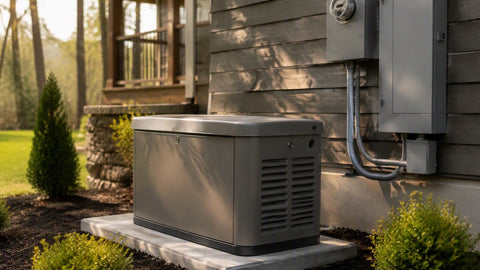
Scenario 1 — Whole-home standby generator. A 3,200 sq ft home has a calculated load (NEC 220) of about 19 kW with central air. At 0.9 PF for a modern residential load mix: 19 ÷ 0.9 = 21.1 kVA minimum — and motor starting (the AC compressor's locked-rotor surge) pushes real practice to a 22–26 kW unit. That's why the 20–28 kW standby class — units like the Generac 26 kW Guardian — is the volume seller for full-home coverage. More detail in our whole-home generator sizing guide and the 22 kW deep-dive.
Scenario 2 — Commercial transformer. A small warehouse has 180 kW of connected load at a measured 0.85 PF with 25% growth planned. Apparent power today: 180 ÷ 0.85 = 212 kVA. With growth: 265 kVA. Standard transformer sizes step 225 → 300 kVA — spec the 300 kVA unit. Buying the 225 kVA unit saves money on day one and buys a hot transformer on day 400.
Scenario 3 — UPS for a server room. Rack audit: 14 kW of IT load, PSU power factor 0.95, 20% headroom policy. Apparent: (14 × 1.2) ÷ 0.95 = 17.7 kVA → a 20 kVA UPS. Note the double margin: growth on the kW, then PF on the kVA.
Scenario 4 — Solar inverter and grid support. A commercial solar inverter rated 100 kVA running at full real power (100 kW) has zero kVA left for reactive support. When the utility requires volt-var ride-through at 0.9 PF, the inverter must curtail to 90 kW to free 43.6 kVAR. If your revenue model assumed 100 kW continuous, the interconnection agreement just changed your pro forma. This is exactly why we push customers toward the inverter sizing calculator before purchase.
| Application | Load (kW) | PF | Required kVA | Selected Equipment |
|---|---|---|---|---|
| Whole-home standby | 19 | 0.9 | 21.1 (plus motor-start margin) | 22–26 kW standby generator |
| Warehouse transformer | 180 + 25% growth | 0.85 | 265 | 300 kVA dry-type transformer |
| Server room UPS | 14 + 20% headroom | 0.95 | 17.7 | 20 kVA online double-conversion UPS |
| Small office backup | 12 | 0.8 | 15 | 15–20 kVA (≈15 kW class) generator |
| Commercial PV inverter | 90 (curtailed) | 0.9 grid requirement | 100 | 100 kVA string inverter |
Common Mistakes to Avoid in kVA and kW Calculations

After years of unwinding sizing errors, these are the repeat offenders:
- Treating kVA and kW as interchangeable. They coincide only at unity PF, which essentially never happens outside a heater bank. Every generator quoted in kW at 0.8 PF is a bigger kVA number underneath.
- Using nameplate FLA without measuring PF. Two identical 50 hp motors can present wildly different power factors at 40% load versus 90% load. A $400 power quality analyzer beats a guess every time.
- Forgetting motor starting. A motor's locked-rotor kVA runs 5–7× its running kVA. Generator sizing must accommodate the largest motor's start with everything else running — this is why sizing guides add surge capacity, not just running watts.
- Ignoring three-phase vs single-phase in the kVA formula. The 1.732 factor on three-phase is not optional. A 208V three-phase circuit at 100A is 36 kVA, not 20.8 kVA.
- Assuming PF correction is free capacity everywhere. Capacitor banks correct the facility's PF at the service, but downstream feeders still carry their local reactive current. Correction placement matters.
- Mixing up efficiency and power factor. A 95%-efficient motor at 0.85 PF draws kW_input = kW_shaft ÷ 0.95, and kVA = kW_input ÷ 0.85. Both losses stack; neither is optional in the math.
One war story: a customer paralleled a new 100 kW load onto a 150 kVA transformer that "had capacity" because the existing load was only 60 kW. What the spreadsheet missed was the existing load's 0.72 PF — the transformer was already carrying 83 kVA. The new load at 0.8 PF added 125 kVA. Total: 208 kVA on a 150 kVA unit. It ran for 11 days before the thermal trips started. The fix was a 300 kVA replacement and an awkward conversation about who checked the PF.
kVA, kW, and Your Equipment Shopping List
Once the math is settled, the shopping is straightforward. Generators are stocked by kW class — 10–14 kW, 14–17 kW, 17–20 kW, 20–28 kW, and commercial standby — from Generac, Kohler, Cummins, and Briggs & Stratton. Transformers live in our transformer category, and transfer equipment in transfer switches. For battery-based backup where kVA behaves differently (inverter VA ratings are usually quoted at 1.0 PF but with surge and thermal limits), start with the home battery bank sizing guide and battery sizing calculator.
Reference Table: kW Output at Five Power Factors
The 0.8/0.9/1.0 table covers the common cases, but real facilities land between the columns. Here's the interpolation chart for the mid-range power factors we actually measure in the field:
| Apparent Power | kW @ 0.70 PF | kW @ 0.75 PF | kW @ 0.80 PF | kW @ 0.85 PF | kW @ 0.90 PF | kW @ 0.95 PF |
|---|---|---|---|---|---|---|
| 25 kVA | 17.5 | 18.8 | 20 | 21.3 | 22.5 | 23.8 |
| 50 kVA | 35 | 37.5 | 40 | 42.5 | 45 | 47.5 |
| 100 kVA | 70 | 75 | 80 | 85 | 90 | 95 |
| 150 kVA | 105 | 112.5 | 120 | 127.5 | 135 | 142.5 |
| 200 kVA | 140 | 150 | 160 | 170 | 180 | 190 |
| 300 kVA | 210 | 225 | 240 | 255 | 270 | 285 |
| 500 kVA | 350 | 375 | 400 | 425 | 450 | 475 |
| 750 kVA | 525 | 562.5 | 600 | 637.5 | 675 | 712.5 |
| 1,000 kVA | 700 | 750 | 800 | 850 | 900 | 950 |
Read the 0.70 column carefully if you run older motor fleets or uncorrected fluorescent/legacy lighting: a 500 kVA service entrance feeding 0.70 PF loads tops out at 350 kW of real work. That's a third of your infrastructure spending its life circulating current that produces nothing. Two facility changes move that number: power factor correction equipment, and replacing chronic partial-load motors with right-sized or VFD-driven units.
Measuring Power Factor: A Field Procedure
You cannot manage what you haven't measured, and PF is a 15-minute measurement with the right instrument. Our procedure on customer sites:
- Instrument choice. A clamp-on power quality meter or a logging power analyzer that reports kW, kVA, kVAR, and PF simultaneously. A simple ammeter cannot give you PF — it sees only total current, which is precisely the trap.
- Measure at the point of common coupling first (the service or main feeder), then at major sub-feeders. The aggregate number hides problem branches; a facility-wide 0.88 can be one 0.65 motor room hiding behind a 0.98 office wing.
- Log across the operating cycle. A 24–72 hour capture beats a spot reading. PF collapses during light-load hours in motor-heavy facilities, and demand peaks rarely coincide with your walk-through.
- Record kW, kVA, and PF at peak kVA — that triple is your sizing input, not the average.
- Recheck after correction. Capacitor banks interact with harmonics (especially with VFDs above ~15% of load); verify the corrected PF under real conditions and watch for resonance heating in the correction equipment itself.
Motor Starting: Why kVA, Not kW, Decides Generator Survival
The single most common generator failure mode we troubleshoot is not overload — it's voltage collapse during motor starts. Across-the-line starting draws 5–7× the motor's running kVA. A 10 hp air compressor (running ~9 kVA) can demand 55+ kVA for the first second. If the generator can't source that surge without its voltage dipping below ~70%, contactors drop out, VFDs fault, and the generator's own protection may trip on the recovery swing.
| Motor Size (Across-the-Line Start) | Running kVA (approx.) | Starting kVA (5–7× rule) | Practical Generator Allowance |
|---|---|---|---|
| 2 hp | 2.4 | 12–17 | +15 kVA surge headroom |
| 5 hp | 5.9 | 30–41 | +35 kVA |
| 10 hp | 11.8 | 59–83 | +70 kVA |
| 25 hp | 29.5 | 148–207 | +175 kVA (or soft-start/VFD) |
| 50 hp | 59 | 295–413 | Soft-start or VFD strongly advised |
Mitigations that work: soft starters cut starting kVA to 2–3× running; VFDs to roughly 1.5×; and staggered starting logic prevents two compressors from kicking simultaneously. If the facility's largest motor exceeds about 25–30% of the generator's kVA rating, plan the start strategy before you finalize the generator — not after the first failed start during an outage.
Three-Phase Worked Examples: From Nameplate to Purchase Order
| Given | Calculation | Result | Purchasing Decision |
|---|---|---|---|
| 480V 3φ panel, 250A measured, PF 0.88 | (480 × 250 × 1.732) ÷ 1,000 = 207.8 kVA; × 0.88 | 182.9 kW real | Feeder and transformer sized for 208 kVA minimum, plus growth |
| 75 kW process load, PF 0.82, 20% growth | (75 × 1.2) ÷ 0.82 | 109.8 kVA required | 125 kVA generator minimum; 150 kVA preferred for motor starts |
| 208V 3φ UPS output, 60A design, PF 0.95 | (208 × 60 × 1.732) ÷ 1,000 = 21.6 kVA; × 0.95 | 20.5 kW supported | 30 kVA UPS frame for N+1 and battery runtime options |
| 240V 1φ shop, 100A service, PF 0.85 | (240 × 100) ÷ 1,000 = 24 kVA; × 0.85 | 20.4 kW usable | Continuous loads capped at 19.2 kVA (80% rule on the 100A service) |
| Legacy 150 kVA transformer, load measured at 0.72 PF | 150 × 0.72 | 108 kW max real delivery | PF correction to 0.95 frees ~34 kW of capacity without replacement |
That last row is the cheat code in this entire article. Before you spend $15,000 swapping a transformer, price the capacitor bank. We've watched a $3,500 correction install defer a $20,000 service upgrade by five years on a machine shop — the utility PF penalty alone was covering the correction's payment.
And one derating trap that crosses both units: generator kVA ratings assume sea-level, moderate-temperature conditions. Altitude costs roughly 3–4% of engine power per 1,000 feet above the rating's reference elevation (naturally aspirated engines suffer most; turbocharged units hold better), and high ambient temperatures shave further. A 100 kVA unit installed at 6,000 feet in a hot climate can be a 75–80 kVA machine in July. Check the manufacturer's derate curves against your site's worst-case summer afternoon — the outage that matters always arrives during the heat dome. The same physics applies to transformers (temperature rise limits are altitude-rated) and to UPS units, whose cooling and rectifier sections derate with elevation. The datasheet's fine-print altitude line is the one spec that never makes the sales brochure, and it's the spec that decides whether your 20% margin survives August. When in doubt, ask the manufacturer for the derate table by elevation and ambient temperature — every reputable generator and transformer maker publishes one, and a supplier who can't produce it for you hasn't read the unit's manual either. We keep derate tables on file for every generator and transformer line we sell — ask, and the answer comes back in an hour, not after the freight does.
kVA vs kW in Batteries and Inverter-Based Systems

Battery inverters flip the convention. Most quality hybrid inverters quote continuous output in kW at unity PF (the battery feeds DC; the inverter synthesizes PF as commanded), but their surge and thermal limits are effectively kVA limits. A 12 kW hybrid inverter like the class found in our hybrid inverter lineup will typically carry a 1.5–2× surge for seconds — enough for well pumps and compressor starts that would stall an equivalently "kW-rated" generator, because the inverter's surge is electronically controlled rather than alternator-limited. Read both numbers on the datasheet: continuous kW, surge kVA, and the time window at surge. Our solar inverter fundamentals piece and the inverter picks roundup break out the models that publish honest surge specs.
And if your project involves batteries at all, the runtime side of the equation lives in battery backup runtime math — kW tells you what you can run; kWh tells you for how long.
Demand Charges and PF Penalties: Where This Hits the Bill
Residential customers can ignore this section; commercial customers cannot. Most C&I tariffs bill demand in one of three ways, and the structure determines what PF costs you:
| Tariff Structure | How It Bills | What Poor PF Costs |
|---|---|---|
| kW demand | Peak 15–30 min average real power | Nothing directly — but many kW tariffs add a PF penalty clause below 0.90–0.95 |
| kVA demand | Peak apparent power | Directly: at 0.80 PF you pay for 25% more demand than the kW you used |
| kW with PF adjustment | kW demand adjusted by a formula (commonly kW × 0.95 ÷ actual PF) | A 0.80 PF facility pays ~19% above metered kW demand |
Worked example: a facility peaking at 400 kW with 0.82 PF on a kW-with-PF-adjustment tariff at $14/kW. Adjusted demand = 400 × 0.95 ÷ 0.82 = 463 kW → $6,487/month instead of $5,600. That's $10,600/year in pure penalty — against a one-time capacitor bank cost of $6,000–$10,000 installed. We see paybacks under 14 months routinely on penalized facilities.
Transformer Sizing Standards: The kVA Classes You'll Actually Buy
Distribution transformers come in standard kVA steps, and knowing them prevents the classic error of calculating 212 kVA and ordering exactly that:
| Class | Standard Sizes (kVA) | Typical Application |
|---|---|---|
| Single-phase dry-type | 3, 5, 7.5, 10, 15, 25, 37.5, 50, 75, 100, 167 | Residential/light commercial services, control power |
| Three-phase dry-type | 15, 30, 45, 75, 112.5, 150, 225, 300, 500, 750 | Commercial distribution, 480→208/120V step-down |
| Three-phase pad-mount (liquid) | 150, 300, 500, 750, 1,000, 1,500, 2,500 | Service transformers, industrial campuses |
Selection rule: calculate required kVA (load kW ÷ PF, plus growth margin), then select the next standard size up. Never round down into a calculated value — transformer thermal life is a function of loading, and a unit run at 95% nameplate continuously ages several times faster than one at 70%. If your number lands within 10% of a standard size, take the next size. The price difference between a 225 and a 300 kVA dry-type is trivial against one thermal-failure replacement plus the downtime to swap it. Browse available units in our transformer category.
kVA vs kW Checklist: Before You Sign Any Equipment PO
- Is the load measured or assumed? If assumed, is PF 0.8 conservative enough for this load mix?
- Did you convert in the right direction? Sources are kVA; loads are kW. kW ÷ PF = required source kVA.
- Single-phase or three-phase? Did the 1.732 factor make it into the kVA-from-amps math?
- Motor starts: does the largest motor's starting kVA fit inside the source's surge capacity with everything else running?
- Continuous loads: is the 125% factor applied to anything running 3+ hours (NEC 210.20/215.3)?
- Growth: is there a documented margin (we use 20–25% for commercial, 10% for residential)?
- Tariff: does the utility bill kVA demand or PF penalties, and did that enter the correction-vs-oversize decision?
- Nameplate cross-check: does the selected equipment's kVA × stated PF ≥ your required kW, with the rating conditions (altitude, temperature) matching the site?
Quick Reference: Amps per kVA at Common Voltages
The inverse calculation you'll run most in the field — what a kVA rating means in amps at the system voltage. Values at unity (the kVA ceiling), per the three-phase formula A = kVA × 1,000 ÷ (V × 1.732) and single-phase A = kVA × 1,000 ÷ V:
| kVA | Amps @ 208V 3φ | Amps @ 240V 1φ | Amps @ 480V 3φ | Amps @ 600V 3φ |
|---|---|---|---|---|
| 15 | 41.6 | 62.5 | 18.0 | 14.4 |
| 30 | 83.3 | 125 | 36.1 | 28.9 |
| 45 | 124.9 | 187.5 | 54.1 | 43.3 |
| 75 | 208.2 | 312.5 | 90.2 | 72.2 |
| 112.5 | 312.3 | — | 135.3 | 108.3 |
| 150 | 416.4 | — | 180.4 | 144.3 |
| 225 | 624.6 | — | 270.6 | 216.5 |
| 300 | 832.7 | — | 360.8 | 288.7 |
| 500 | 1,387.9 | — | 601.4 | 481.1 |
This table settles the breaker-and-wire conversation in one step: a 75 kVA transformer at 480V feeds a 90A full-load secondary — pair with the ampacity chart for conductor selection and NEC 240.6 for the next standard breaker size above your calculated protection point.
KVA to KW Conversion FAQs
How do you convert kVA to kW?
kW = kVA × PF. A 100 kVA machine at 0.8 PF delivers 80 kW. Reverse it with kVA = kW ÷ PF.
What's the actual difference between kVA and kW?
kW does work; kVA is everything the system carries, including the reactive component. Sources are rated in kVA; loads consume kW.
How many kW is 100 kVA?
80 kW at the generator-standard 0.8 PF; 90 kW at 0.9; 100 kW only at unity.
What PF should I plan with? 0.8 for mixed motor loads, 0.9 for modern corrected facilities, 1.0 for resistive only. Measure before you buy.
Why does my generator trip under its rated kW? Because the kW rating assumes 0.8 PF — a lower-PF load overloads the alternator in kVA terms, and motor starting surges can trip protection regardless.
How do I get kVA from volts and amps? Single-phase: V × A ÷ 1,000. Three-phase: V × A × 1.732 ÷ 1,000.
Does PF show up on my bill? On most commercial tariffs, yes — via kVA demand billing or explicit PF penalties below 0.90–0.95.
Let Our Experts Handle Your Project Sizing
Generator, transformer, or UPS — the sizing conversation takes fifteen minutes with real load data and saves the five-figure mistake. Send us your utility bills or load list and we'll spec the equipment. Start with the whole-home generator sizing guide for residential or browse standby generators and commercial standby units directly.
Sources & Standards
- IEEE and NEC guidance on power factor, demand calculations (NEC Article 220), and equipment ratings
- Generator manufacturer rating conventions: standby/prime kW at 0.8 lagging PF
- NEMA MG 1 — motor power factor and starting characteristics
- Utility tariff structures: kVA demand billing and PF penalty thresholds