The Jinko Eagle G4 was the last, best version of P-type PERC technology before the industry jumped to N-type. Built in the 2022–2023 era with Tiling Ribbon cell interconnection and efficiencies up to 20.96%, the G4 squeezed everything left out of the P-type platform. In 2026 it occupies a specific niche: budget-tier new installations, inventory-clearance pricing, and electrical matching for G4-era arrays. This guide covers the full specifications, NEC-checked string and conductor sizing, the real degradation math versus the G6, and the situations where buying G4 today is smart — and where it is not.

Product Status: Limited Availability | Budget Tier
Series Generation: Eagle G4 (2022–2023 Production Era)
Technology: P-Type Mono PERC with Tiling Ribbon (TR)
Predecessor: Eagle G2 | Successor: Eagle G6 (N-Type TOPCon)
What Changed From G2 to G4
The Eagle G4 was not a revolutionary redesign — it was a disciplined refinement that squeezed the remaining performance out of mature P-type PERC manufacturing. Two changes did the real work. First, Tiling Ribbon interconnection replaced conventional flat ribbon, overlapping cell edges slightly to eliminate the dead space between cells and reflect otherwise-lost light back onto the cell surface. Second, refined PERC passivation layers reduced rear-surface recombination, letting more of the absorbed photons become current instead of heat.
The result: module efficiency up to 20.96%, a +0.58 percentage point absolute gain over the G2's 20.38% ceiling. That sounds modest until you price a commercial roof by the square foot — on a space-constrained project, 2.8% more watts per square foot can be the difference between hitting an interconnection cap and missing it.
The G4 series also expanded the form-factor story. Where the G2 was primarily a 72-cell commercial panel, the G4 added 66-cell residential configurations at 380–400W sized for standard rooftop layouts — the configuration most G4 stock in the channel today. If you are browsing current inventory, the 400W panel category and 400–459W range show where G4-class products sit against newer stock.
Technical Specifications
| Eagle G4 66-Cell Residential Configuration | |
|---|---|
| Power Output | 380-400W (STC) |
| Cell Configuration | 132 half-cells (66-cell equivalent) |
| Cell Technology | Mono PERC with Tiling Ribbon |
| Module Efficiency | Up to 20.96% |
| Dimensions | 1855mm × 1029mm × 35mm (73.0" × 40.5" × 1.4") |
| Weight | Approximately 20-21 kg (44-46 lbs) |
| Electrical Characteristics (400W Model) | |
|---|---|
| Open Circuit Voltage (Voc) | ~49V |
| Short Circuit Current (Isc) | ~10.5A |
| Maximum System Voltage | 1000V/1500V DC (model dependent) |
| Power Tolerance | 0/+3% |
| Temperature Coefficient (Pmax) | -0.35%/°C |
| Environmental Ratings | |
|---|---|
| Operating Temperature | -40°C to +85°C |
| Snow Load | 5400 Pa |
| Wind Load | 2400 Pa |
| Salt Mist / Ammonia Resistance | Certified |
| Warranty Terms | |
|---|---|
| Product Warranty | 12 years |
| Linear Power Warranty | 25 years |
| First Year Degradation | ≤2% |
| Annual Degradation | ≤0.55% |
| Year 25 Output | ≥83.1% of rated power |
Where the G4 Makes Sense in 2026
I get asked weekly whether G4 inventory is "worth buying at a discount," and the answer depends entirely on the project. Three scenarios where I have recommended G4 in the last year:
Budget-Conscious Installations
Budget-conscious grid-tied installs. As distributors clear G4 inventory to make room for G6 and Tiger Neo stock, pricing gets genuinely attractive. For a straightforward grid-tied system without storage — where the customer cares about payback year more than 25-year optimization — a G4 at the right price beats a G6 at full price. I ran this math for a 12 kW residential customer last fall: the G4 quote saved enough upfront to cut the payback by eight months, and the long-run efficiency gap cost less than the interest on the price difference.
Matching G4-era arrays. Commercial installations designed around G4 electrical characteristics benefit from matched additions that keep string behavior consistent across the array. Mixing module classes on shared MPPTs is a silent production tax — the string performs to its weakest current profile, and a 400W P-type and a 450W N-type do not share a curve politely.
Ground-mounts with room to spare. The efficiency gap between G4 (20.96%) and G6 (22.53%) is roughly 7.5% more power per square foot for the G6 — meaningful on a tight roof, nearly irrelevant on a two-acre ground-mount where racking area is cheap. Spend the savings on better foundations instead.
Honest Limitations: What P-Type Cannot Do
Being a straight shooter about the G4's physics matters more than selling panels. Three limitations are structural to P-type PERC and no amount of Tiling Ribbon fixes them.
Light-Induced Degradation (LID)
Light-induced degradation. P-type cells doped with boron form boron-oxygen defects under sunlight, costing 2% first-year degradation versus 1% for N-type. That gap never recovers. It is baked into the chemistry, and it is the single largest technical argument for the G6 on long-hold projects.
Temperature Coefficient
Temperature coefficient. The G4 runs approximately -0.35%/°C versus the G6's -0.30%/°C. On a Phoenix rooftop where cells hit 70°C, that five-hundredths difference compounds across every summer afternoon for 25 years. Cold-climate customers can shrug this off; Sun Belt customers should not.
No Bifacial Option
No bifacial headroom. The G4 is a monofacial, backsheet-panel product. On elevated ground-mounts or carports where rear-side irradiance adds 5–15% to bifacial modules, the G4 simply cannot access that energy. If the site has albedo potential, the G4 is the wrong tool regardless of price.
Comparative Analysis: G4 vs. G6
| Specification | Eagle G4 (P-Type) | Eagle G6 (N-Type) | Advantage |
|---|---|---|---|
| Cell Technology | Mono PERC + TR | TOPCon | G6 — More advanced |
| Power Output | 380-400W | 425-450W | G6 — Higher wattage |
| Max Efficiency | 20.96% | 22.53% | G6 — +7.5% relative |
| Dimensions (mm) | 1855 × 1029 × 35 | 1762 × 1134 × 30 | Similar footprint |
| Dimensions (in) | 73.0" × 40.5" × 1.4" | 69.4" × 44.6" × 1.2" | Similar footprint |
| Weight per Panel | ~20-21 kg (44-46 lbs) | 21-23 kg (46-51 lbs) | Comparable |
| Units per Pallet | 31 panels | 36 panels | G6 — More per pallet |
| Pallet Weight | ~645 kg (1,422 lbs) | ~828 kg (1,825 lbs) | G4 — Lighter pallets |
| Units per 40' Container | ~682 panels | ~792 panels | G6 — More per container |
| Temp Coefficient | -0.35%/°C | -0.30%/°C | G6 — Better hot performance |
| First Year Degradation | ≤2.0% | ≤1.0% | G6 — Half the loss |
| Annual Degradation | 0.55% | 0.40% | G6 — Lower long-term loss |
| Year 25 Output | 83.1% | 87.4% | G6 — +4.3% at EOL |
| Bifacial Available | No | Yes (select models) | G6 — More versatile |
| Product Warranty | 12 years | 12-25 years | G6 — Better coverage |
| Typical Pricing | Lower | Standard | G4 — Budget advantage |
NEC-Checked String and Wire Sizing for the G4 400W
The 400W G4 residential module runs a Voc around 49V and Isc around 10.5A. Applying the same NEC discipline we use on every design:
| Design Step | NEC Reference | Calculation | Result |
|---|---|---|---|
| Cold-corrected Voc (-10°C) | 690.7, Table 690.7(A), factor 1.14 | 49V × 1.14 | 55.86V per module |
| Max string, 1,000V residential system | 690.7 | 1,000 ÷ 55.86 | 17.9 → 17 modules |
| Max string, 1,500V commercial system | 690.7 | 1,500 ÷ 55.86 | 26.8 → 26 modules |
| String circuit ampacity floor | 690.8(B) — 1.56 × Isc | 10.5A × 1.56 | 16.4A → 20A OCPD (240.6) |
| Conductor, 75°C termination | Table 310.16 | 16.4A required | 12 AWG Cu THWN-2 (25A) |
Cross-check those numbers against the NEC wire sizing guide and the ampacity chart, and confirm your AHJ's adopted NEC edition before finalizing — 690.7 correction factors moved from tables to engineering-method allowances in recent code cycles, and some jurisdictions still enforce the table. The NEC compliance guide tracks the common AHJ variations we see nationally.
Degradation Math: G4 vs. G6 Over 25 Years
The compounding difference between 2%/0.55% (G4) and 1%/0.40% (G6) degradation looks small annually and lands large at end of life. Checked math on a 10 kW array of each:
| Year | G4 10 kW Output | G6 10 kW Output | Gap |
|---|---|---|---|
| 1 | 9.80 kW (-2.0%) | 9.90 kW (-1.0%) | 0.10 kW |
| 5 | 9.58 kW | 9.74 kW | 0.16 kW |
| 10 | 9.31 kW | 9.54 kW | 0.23 kW |
| 15 | 9.04 kW | 9.34 kW | 0.30 kW |
| 20 | 8.76 kW | 9.14 kW | 0.38 kW |
| 25 | 8.31 kW (83.1% floor) | 8.74 kW (87.4%) | 0.43 kW |
That year-25 gap is 4.3 percentage points, and cumulative lifetime energy differs by roughly 5%. On a 10 kW system producing ~13,000 kWh in year one, 5% over 25 years is on the order of 15,000 kWh — real money, but small enough that a steep G4 discount can still win the payback race. Run your own scenario in the solar ROI calculator before deciding.
Installation Notes From the Field
Mounting Compatibility
The G4's 1855 × 1029 mm, 35 mm frame mounts cleanly on standard rail systems — see the racking overview and our racking catalog for compatible hardware. Two installation details I check on every G4 job: first, the 35 mm frame depth differs from legacy 40 mm modules, so confirm your mid-clamps are sized for it before the crew is on the roof; second, the Tiling Ribbon front is more visually uniform than older busbar designs, which customers love, but the darker appearance soaks marginally more heat — leave the manufacturer's specified rail gap for airflow.
One more from my own notebook: I watched a crew mix G4 380W and 400W variants on a single string because "same panel, same box." Same family, different current curves. The string ran 3% below model until we re-landed the variants on separate strings. Sort your pallets by bin before you start setting glass.
Production Status and the Path Forward

G4 production continues in limited quantities for distributor commitments and markets where N-type adoption lags, but the center of gravity has moved. For new installations without hard budget constraints, the Eagle G6's N-type TOPCon platform is the recommended path; for flagship performance, Tiger Neo 3.0 pushes to 24.8% efficiency and 670W utility formats. Browse the full current lineup in our Jinko collection, or compare options in the 2026 best panels guide and the panel kits buyer's guide.
My bottom line: the G4 is the right panel when price or matching drives the decision, and the wrong panel when 25-year yield per square foot drives it. Know which project you have before you call for pricing — and when you call, we will ask, because the honest answer saves everyone a change order.
What Tiling Ribbon Actually Does (and Why It Was the P-Type Endgame)
Tiling Ribbon deserves a proper explanation because it was the last major trick P-type PERC had left. Conventional cell interconnection uses flat copper ribbon bridging a visible gap between cells; that gap is dead area that reflects light away from the module. Tiling Ribbon replaces the flat span with a structured, triangular-profile ribbon and shingle-style overlapping cell edges, so nearly the full module face is active silicon. Jinko combined this with nine-busbar cell metallization on the G4 platform, shortening the distance electrons travel to the collection grid and trimming resistive loss a few more tenths of a percent.
The ceiling it hit is instructive. Even with perfect interconnection, P-type cells carry the boron-oxygen defect problem and a bulk-lifetime limit that caps practical module efficiency around 21%. N-type TOPCon moved that ceiling to 22.5% and beyond by changing the base doping and adding a passivated rear contact. The G4 was not a failure — it was the natural conclusion of its technology family, and understanding that helps you price it correctly today: you are buying the best of a finished generation, at a discount, for applications where the newest generation's advantages do not pay back.
Case Study: 40 kW Commercial Retrofit on G4 Inventory
A real example from our order book, details rounded for privacy: a light-industrial customer outside Columbus needed to expand a 2019-era commercial array by 40 kW. The existing plant used P-type 72-cell modules on a 1,000V string inverter with two open MPPT channels. Three options were priced: matched-class P-type modules at clearance pricing, G6 modules on the open MPPTs, and a full repower.
The matched-class option won on every axis that mattered to the owner: lowest capital cost, no racking modifications (same 2-meter-class footprint), no inverter changes, and production modeling within 2% of the N-type option because the site's generous ground-mount area made efficiency irrelevant. The G6 option made sense on paper for degradation but added cost without adding usable capacity under the interconnection cap. The repower was a solution in search of a problem. That is what good module selection looks like — the site and the interconnection agreement pick the panel, not the brochure.
Warranty Terms in Practice
The G4's 12-year product warranty and 25-year linear power warranty are backed by one of the largest module manufacturers on earth, which matters more than the paper terms. A warranty is only as good as the company standing behind it at year nine. On clearance purchases, verify two things before you sign: that the modules are new factory stock with full warranty eligibility (not grey-market transfers), and that the serial numbers register with the manufacturer. Both take one email. Skipping them is how contractors end up owning a pallet of orphan panels.
Also note the linear warranty structure: the 83.1% year-25 guarantee steps down predictably each year, which makes warranty claims checkable against monitoring data. If your year-8 production sits materially below the linear curve after weather normalization, you have a documented claim path — keep your monitoring exports.
G4 Against Other Budget Panels in the Channel
The G4 does not compete in a vacuum. At similar price points you will find Canadian Solar, Qcells, and Silfab product in the 395–410W P-type class — browse Canadian Solar panels, Qcells, and Silfab inventory to compare. The G4's edge in that bracket is the Tiling Ribbon efficiency and Jinko's Tier 1 bankability; its disadvantage is that every month the clearance channel drains, pricing discipline erodes and lead times stretch. If your project schedule is flexible, shop the bracket. If it is not, lock the pallet when you find it.
Procurement, Freight, and Pallet Math
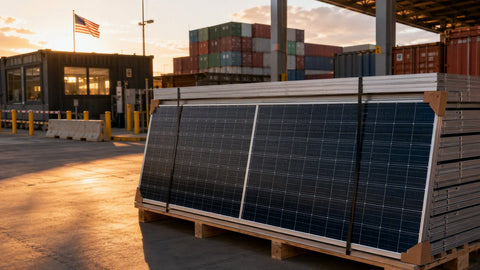
G4-class residential modules ship 31–33 per pallet depending on packaging revision, and a standard flatbed LTL load takes 22–26 pallets. Small orders — under five pallets — carry a per-panel freight penalty of real consequence; bundling racking, disconnects, and wire from the racking catalog and mounting parts into the same shipment dilutes that cost. Our Louisville warehouse consolidates mixed-SKU orders weekly, which is how most of our contractor customers buy: panels, balance-of-system, and system components on one truck.
Pairing the G4 With Inverters, Optimizers, and Storage
The G4's electrical window is friendly to everything in the current inverter ecosystem. On string inverters, the ~49V Voc and ~40V Vmpp land comfortably inside residential MPPT windows at 8–13 modules per string. On module-level power electronics, 400W-class P-type modules pair cleanly with modern microinverters rated for 350–450W input — see our microinverter category and the Enphase lineup for current pairing options, and always confirm the inverter's maximum input current against the module's ~10.5A Isc before committing.
For battery-coupled systems, the G4 works fine on both AC-coupled and DC-coupled architectures — the panel does not know or care where its energy goes. The sizing conversation lives downstream: our battery sizing calculator and the battery bank sizing guide handle that math. What the panel choice changes is recharge rate on short winter days, and there the G6's efficiency advantage shows up as meaningfully faster recovery from deep overnight discharge.
Mistakes to Avoid When Buying G4 in 2026
- Buying on watts-per-dollar alone. A G4 at a steep discount can still lose to a G6 once you price racking per module — fewer, larger modules need less steel. Run the full balance-of-system comparison.
- Ignoring the bin label. G4 shipped in multiple power bins (380/390/400W). Mixed bins on one string cost production; sort by bin before layout.
- Assuming 40 mm clamp hardware. The G4 residential frame is 35 mm. Order mid-clamps to match, or pay for the emergency hardware run.
- Forgetting degradation in the financial model. That 2% year-one hit belongs in year-one production numbers, not averaged away.
- Skipping serial registration. Unregistered clearance modules can carry orphaned warranties. Register at purchase, not at claim time.
None of these are exotic; every one has cost a contractor I know real money. An hour of planning beats a day of roof rework every single time.
The Residential vs. Commercial G4 Split
One last distinction that trips up buyers: the G4 series covers two physically different products. The 66-cell residential configuration (380–400W, 1855 × 1029 mm) fits standard rooftop rail spacing and two-person handling. The 72-cell commercial configuration runs larger and heavier with different Voc/Isc values, and it is what you want for carports and flat-roof ballasted systems where module count drives labor cost. Mixing the two on one project is legal electrically only if strings are segregated by configuration — the current curves differ enough that combined strings give up production. When you request a quote, specify which configuration the design assumes; "G4" alone is not a complete purchase order.
Freight-wise, the residential format is the forgiving one: it survives LTL handling better, stacks more per pallet position, and fits standard panel carts on the roof. The commercial format rewards planning — lift-gate delivery, two-person minimum handling, and a staging plan that keeps pallets out of the mud.
Frequently Asked Questions
- Is the Jinko Eagle G4 still being made?
- Yes, in limited quantities for distributor commitments and late N-type-adoption markets. Contact for current stock and lead times.
- What is the efficiency difference between G4 and G6?
- 20.96% (G4, P-type PERC + Tiling Ribbon) versus 22.53% (G6, N-type TOPCon) — about 7.5% more power per square foot for the G6.
- How does the G4 degrade over 25 years?
- 2% first-year LID plus 0.55% annually, landing at roughly 83.1% of rated power at year 25.
- How many G4 400W panels fit on a string?
- 17 on a 1,000V system and 26 on a 1,500V system using NEC 690.7 with a 1.14 cold-weather correction.
- When does buying G4 make sense today?
- Budget grid-tied installs, G4-array matching expansions, and ground-mounts with room to spare. Otherwise, buy G6.
- Is the Eagle G4 bifacial?
- No — it is a monofacial backsheet module. Use a bifacial N-type panel where rear-side gain is available.
Portlandia Electric Supply stocks the full Jinko lineup — legacy through flagship — with nationwide LTL freight from Louisville, KY. For G4 availability, G6 pricing, or matched-string help, contact our team.