HVAC is the largest energy load in most American homes — typically 40–50% of the utility bill in climates with real summers or real winters — which makes it the highest-leverage efficiency target in the building. The gains stack in a specific order: seal and insulate the shell, fix the ducts, right-size and upgrade the equipment, then control it intelligently. Do them in that order and total HVAC energy drops 30–50%; skip straight to equipment and you buy an efficient machine that heats your attic. I've crawled enough attics with a duct blaster report in hand to have strong opinions about that order, and this guide lays out the whole sequence with the math attached.

Where the Energy Actually Goes
Before optimizing, see the load. A typical 2,000 sq ft mixed-climate home breaks down roughly like this:
| End Use | Annual kWh (all-electric home) | Share |
|---|---|---|
| Space cooling (3-ton AC, SEER2 15, ~900 FLH) | ~2,160 | 15% |
| Space heating (heat pump, HSPF2 8.5) | ~4,300 | 30% |
| Water heating | ~4,000 | 28% |
| Appliances + refrigeration | ~2,000 | 14% |
| Lighting + electronics + misc. | ~1,900 | 13% |
| Total | ~14,400 | 100% |
Heating plus cooling alone is 45% — $1,100/yr at $0.17/kWh — before counting the fan energy hidden in every mode. That is the pile of money this article is about recovering. Note also what the table implies about solar sizing: a home running 14,400 kWh a year needs a meaningfully larger array than the same home trimmed to 11,000 — every section below is therefore also a solar-sizing section, whether or not a panel is ever mentioned. Track your own split with the power consumption calculator.
SEER2: The Rating That Prices Your Summers
SEER2 (Seasonal Energy Efficiency Ratio 2, the post-2023 test procedure) is cooling output in BTU divided by watt-hours consumed, averaged over a season. The conversion to power is direct: watts = BTU/h ÷ SEER2. A 3-ton (36,000 BTU/h) unit at SEER2 15 draws 2,400W; at SEER2 20 it draws 1,800W; at SEER2 26 (top variable-speed) it draws 1,385W.
| Unit Class | SEER2 | 3-Ton Running Watts | Season Cost (900 FLH @ $0.17/kWh) | 10-Year Cost |
|---|---|---|---|---|
| 2010-era single-stage | 13 | 2,769W | $424 | $4,240 |
| 2026 federal minimum (south) | 15 | 2,400W | $367 | $3,670 |
| Mid-tier two-stage | 18 | 2,000W | $306 | $3,060 |
| Variable-speed high-efficiency | 22 | 1,636W | $250 | $2,500 |
| Top variable-speed | 26 | 1,385W | $212 | $2,120 |
Check the 18-SEER2 row: 36,000 ÷ 18 = 2,000W; × 900 hours = 1,800 kWh; × $0.17 = $306. Moving from a 13 to a 22 saves $174/yr — real money, but note it is not the thousands the ad copy implies; the equipment upgrade alone rarely pays back fast, which is why the cheap wins below come first. Heat pump heating efficiency uses the parallel rating HSPF2 — same idea, BTU per watt-hour across a heating season. Browse equipment classes in HVAC systems and air conditioning.
Ducts: The 20–30% Loss Nobody Sees
DOE field studies keep finding the same thing: typical older duct systems leak 20–30% of conditioned air into attics and crawlspaces. You are cooling your attic at 3-ton rates. The fix hierarchy: mastic or foil tape on every accessible joint (never cloth "duct tape" — it fails in years), insulate attic ducts to R-8, and seal the boots where registers meet drywall. A $300 materials weekend on accessible ducts commonly recovers 10–15% of total HVAC energy — the single best ROI in this entire article, and the one most homeowners skip because attics are unpleasant. I've measured pre/post duct leakage on enough jobs to say it plainly: seal the ducts before you price a new condenser, because the "undersized" unit is often just feeding a sieve.
The Shell: Insulation and Air Sealing
Equipment fights the load; the shell sets the load. Attic insulation at R-38 to R-49 (climate-dependent), air sealing around penetrations and top plates, and weatherstripping typically cut heating and cooling loads 15–25% in pre-1990 housing. The building-science rule I follow on every project: reduce the load before sizing the equipment, or you will install a unit oversized for the improved house — and oversized equipment short-cycles, which is worse for comfort, humidity control, and equipment life than being slightly undersized.
Thermostats and Scheduling: The Free 10%
ENERGY STAR's long-standing estimate: proper setback scheduling saves about 8–10% of heating and cooling energy. A smart thermostat — ecobee, Nest, or the like — automates it: 7–10°F setbacks while you sleep and while the house is empty, geofencing so nobody has to remember, and runtime reports that make the savings visible. One caution I give every customer with a heat pump: deep winter setbacks on older single-stage heat pumps can trigger expensive resistance backup during recovery; smart stats with heat-pump balance logic (or 2–3°F gentler setbacks) avoid burning back the savings in auxiliary heat strips.
Right-Sizing: The Manual J Conversation
Rules of thumb ("500 sq ft per ton") oversize as often as they undersize, because windows, insulation, and orientation swing loads by 40% between identical floor plans. The honest method is a Manual J load calculation: room-by-room BTU requirements from measured construction. Oversized AC is the common sin — a 4-ton unit on a 2.5-ton load satisfies the thermostat in 8-minute bursts, never runs long enough to wring humidity from the air, and leaves the house cold and clammy while wearing out its compressor on short cycles. Variable-speed equipment forgives oversizing somewhat by throttling down; single-stage equipment punishes it daily. Size the tonnage with the AC tonnage calculator as a first pass, then demand the Manual J before signing an install contract — any contractor who refuses is telling you how they size equipment.
Mini-Splits: The Zoning Cheat Code
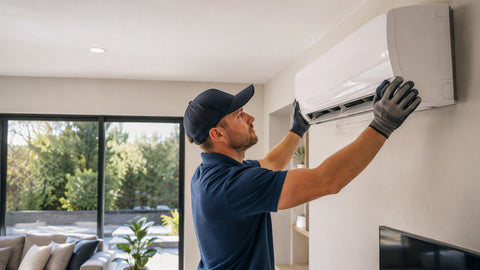
Ductless mini-splits attack the problem from a different angle: instead of one big machine conditioning the whole house through leaky ducts, small high-efficiency heads condition occupied zones directly, with inverter-driven compressors running at partial speed most of the time — the efficient regime. SEER2 ratings of 20–30+ are ordinary in the category, there are no ducts to leak, and room-by-room control ends the thermostat wars. The honest limits: multi-head whole-house systems get expensive fast, aesthetics divide households, and cold-climate models matter below 5°F (spec hyper-heat variants in the north). For additions, bonus rooms, garages, and homes without ducts, they are frequently the best answer we sell — the mini-split collection covers single- and multi-zone configurations.
Heat Pumps vs Furnaces: The 2026 Economics
| Comparison | Gas Furnace (96% AFUE) | Heat Pump (HSPF2 8.5) |
|---|---|---|
| Heat delivered per $1 of fuel* | ~81,000 BTU ($1.20/therm) | ~50,000 BTU ($0.17/kWh, COP 2.5 avg) |
| Cooling included? | No — separate AC | Yes — same machine reverses |
| Cold-weather behavior | Unaffected | Capacity drops below ~25°F; cold-climate models hold to −13°F |
| Carbon trajectory | Fixed fossil | Improves as the grid cleans up |
| Pairing with rooftop solar | None | Direct — sunshine heats the house |
*Math shown: a therm is 100,000 BTU; 96% AFUE delivers 96,000 BTU per $1.20, so $1 buys 80,000–81,000 BTU. A heat pump at seasonal COP 2.5 turns 1 kWh (3,412 BTU) into 8,530 BTU; $1 at $0.17/kWh buys 5.88 kWh × 8,530 ≈ 50,100 BTU... and this is exactly why local rates decide. At $0.12/kWh electricity the heat pump wins the $/BTU comparison; at $0.17/kWh with $1.20 gas, the furnace heats cheaper today — but the heat pump also replaces the air conditioner, so compare full-system costs, not fuel lines alone. Households with rooftop solar change the math again: every kWh the array makes at an effective 6–8¢ makes the heat pump the cheap heat. Size the solar side with the solar system calculator if that pairing is your plan.
Maintenance: The Efficiency You Already Paid For
A neglected system degrades measurably: a dirty filter adds static pressure and fan energy; a fouled evaporator coil can cost 5–15% of capacity; low refrigerant charge (a leak, not "usage") cuts capacity while raising runtime. The annual discipline is short: filters every 1–3 months (MERV 8–11 for most residential blowers — higher MERV without blower headroom costs airflow), a professional coil/charge/electrical check each spring for cooling or fall for heating, and two feet of clearance kept around the outdoor unit. A maintained 10-year-old system usually outperforms a neglected 5-year-old one; I have amp-clamped enough compressors to say that without blushing.
Stacking It: A Worked Whole-House Example

Take the 2,000 sq ft home from the first table, spending ~$1,100/yr on heating and cooling. Sequence the fixes: duct sealing and attic insulation cut the load 20% (−$220/yr, ~$1,800 invested). A smart thermostat trims 8% more (−$70/yr, ~$250). When the 15-year-old SEER-13-equivalent condenser dies — not before — replace with a SEER2 19 two-stage at the now-correct smaller tonnage: the remaining load runs ~25% cheaper (−$190/yr). Cumulative: HVAC spend falls from $1,100 to roughly $620/yr, a 44% reduction, with only the equipment line requiring a big check — and that line happened at failure time rather than as a panic purchase. Order of operations is the whole strategy.
Duct Design and Airflow: CFM Is a Budget
Even sealed ducts fail if they are undersized. The target is roughly 400 CFM per ton of cooling — a 3-ton system wants ~1,200 CFM total, split across supplies per room load. Undersized returns are the most common defect I find: the blower starves, static pressure climbs past 0.8" WC, airflow drops, coil temperature falls, and efficiency and comfort drop together while the blower wattage climbs. Flex duct makes it worse when installed with sags and sharp bends — every 90° kink behaves like several extra feet of run. The CFM duct-sizing calculator and the duct sizing calculator turn room loads into duct diameters; if your system has rooms that never quite reach temperature, the problem is usually here, not at the condenser.
Rebates and Tax Credits for HVAC Efficiency
The federal 25C energy-efficient home improvement credit covers 30% of qualifying heat pump cost up to $2,000 per year, plus 30% of insulation and air-sealing materials up to $1,200 — annual caps that reset, which makes phased projects smarter than one giant one. Many utilities stack $300–$1,500 rebates on high-SEER2 heat pumps, and some states add their own. The paperwork rule that saves money: get the rebate pre-approval before the install where the program requires it — retroactive applications are denied more often than they are paid. Between the credits, the rebates, and the operating savings, a heat-pump conversion's net cost in 2026 is routinely $3,000–$5,000 below the invoice price, which is the number that belongs in the payback math.
Smart Upgrades That Do Not Pencil (Yet)
Honesty about the weak plays saves real money. Whole-home ERVs are excellent for tight new construction and marginal for leaky existing homes — sealing first recovers most of the benefit cheaper. UV coil lights keep coils clean but the savings claim exceeds the measured effect in most field studies. "Smart vents" that close off rooms fight the duct system — closing supplies raises static pressure and can damage blowers; zone with equipment or dampers designed for it, not by strangling registers. Premium filters marketed at MERV 13+ improve air quality genuinely but cost fan energy on blowers not speced for them — check the blower table before upgrading filtration. None of these are scams; they are tools with specific correct applications, and the application is usually "after the fundamentals."
Pairing HVAC With Solar: Closing the Loop
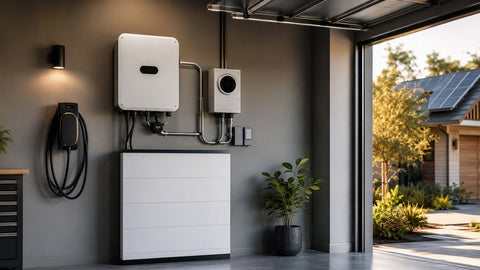
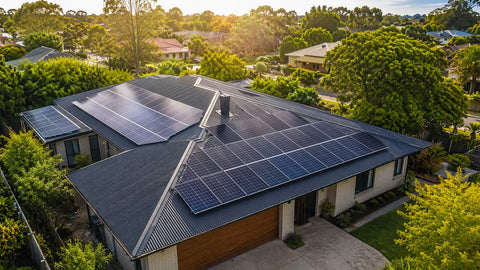
HVAC is half the bill; solar is how the other half of the strategy completes. The sequence that maximizes the combined project: reduce the HVAC load first (shell, ducts), right-size the efficient equipment second, then size the solar array against the reduced annual kWh — every kWh of load you eliminate is a kW of array you do not buy, and at $1.30–$1.80/W wholesale the efficiency work effectively prepays itself in avoided panels. A home that cuts consumption from 14,400 to 11,000 kWh/yr shrinks its required array by roughly 2.5kW in mid-sun country — $5,000–$7,500 of avoided turnkey cost, more than the whole duct-and-insulation budget. Efficiency and generation are one project with two invoices; treating them as separate decisions is the most expensive framing error in residential energy.
Frequently Asked Questions
How much can I save by upgrading my HVAC system?
Equipment alone (SEER2 13 → 22) saves roughly $170–$210/yr on a 3-ton system in average climates. The full stack — ducts, shell, controls, then equipment — cuts total HVAC energy 30–50%.
What SEER2 rating should I buy in 2026?
16–19 SEER2 is the value sweet spot for most climates; 22+ pays in hot climates with long cooling seasons or high electricity rates. Below the federal minimum is not sold; far above it rarely pays back.
Do smart thermostats really save money?
Yes — about 8–10% of heating and cooling energy with actual setbacks scheduled. Savings come from the schedule, not the gadget; a $30 programmable stat used diligently achieves the same.
Are mini-splits more efficient than central HVAC?
Typically yes: 20–30+ SEER2 ratings, no duct losses, and inverter compressors running at efficient partial load. Multi-zone whole-house coverage can cost more upfront than central replacements.
Should I replace working HVAC equipment to save energy?
Usually no. Efficiency gains on a working mid-life system rarely pay back before its natural end; seal ducts, insulate, and add controls now, then buy high-efficiency at failure time with a pre-written plan.
How do I know if my ducts leak?
Symptoms: rooms far from the air handler run hot/cold, dusty attic smell when the blower runs, high bills despite new equipment. A duct blaster test ($150–$400) quantifies it; mastic on accessible joints fixes most of it DIY.
The Seasonal Maintenance Calendar
| When | Task | Efficiency Stake |
|---|---|---|
| Monthly in season | Check/replace filter (MERV 8–11) | Dirty filter: +5–15% fan and compressor energy |
| Spring | Pro tune: coil clean, refrigerant charge, electrical | Restores 5–15% lost capacity |
| Spring | Clear 2 ft around condenser, gentle coil rinse | Airflow restoration, head pressure drop |
| Fall | Heating check: burners/elements, heat-pump defrost test | Catches aux-heat faults before January bills |
| Fall | Weatherstrip doors, check attic hatch seal | Infiltration is load; load is money |
| Annually | Review thermostat schedule vs. actual occupancy | Schedules drift; savings leak |
Total time investment: about four hours a year plus one professional visit. Total return: a system that holds its rated efficiency for its full 15–20 year life instead of decaying into a power-hungry version of itself by year seven.
The Cheap Wins Beyond the HVAC Box
Ceiling fans let you raise the cooling setpoint 3–4°F with equal comfort — each degree of setpoint is roughly 3% of cooling energy, so fans are a ~10% cooling discount for single-digit watts. Cellular shades on west and south windows cut solar heat gain meaningfully in the brutal afternoon hours — the same photons we harvest on the roof are the enemy through the glass. Whole-house fans in dry climates flush the house with 65°F evening air for pennies, pre-cooling the structure overnight. Cooking, dryers, and long showers add latent load the AC must then remove; venting them properly is efficiency too. None of this is glamorous; all of it shows up on the bill, and the BTU calculator quantifies how much each load source adds to the tonnage your equipment must serve. For the big-picture view of household watts, how many watts to power a home maps every major load.
Reading Your System's Vital Signs
Two measurements any homeowner can take with a $15 thermometer tell most of the diagnostic story. Temperature split: measure return air at the filter and supply air at the nearest register in cooling mode — a healthy system splits 16–22°F; below 14°F suggests low airflow or low charge, above 24°F suggests restricted airflow. Runtime behavior: on a design-temperature afternoon, a right-sized system runs nearly continuous cycles; 8-minute bursts signal oversizing, and never-satisfying runtime signals capacity or duct problems. These two numbers, plus the utility bill's kWh trend, catch most problems years before failure — the difference between a $180 refrigerant repair and a $2,800 compressor.
Water Heating: The Neighbor Load Worth Grabbing
Since the calendar already has you in the mechanical room: a standard 50-gallon electric water heater burns ~4,000 kWh/yr, second only to HVAC in most homes. A heat-pump water heater does the same job on 1,200–1,500 kWh by scavenging heat from the surrounding air — a 60%+ cut that pays back the $800–$1,200 price premium in about two years at $0.17/kWh, faster with the 25C credit applied. It also dehumidifies the garage or basement it sits in, a free bonus in humid climates. If the HVAC project is open and the water heater is past year eight, bundling the two is the cheapest efficiency you will ever buy, and it shrinks the solar array requirement one more notch.
Bottom Line
HVAC efficiency is a sequence, not a product: seal the ducts, fix the shell, schedule the thermostat, maintain what you own, right-size the replacement when the old equipment dies, and let the federal credits and utility rebates carry part of the invoice. Do it in that order and 30–50% reductions are normal, not aspirational. Then, with the load permanently smaller, size the solar array against the new number and finish the job. Our team stocks the equipment side of this — systems, mini-splits, thermostats — and we will happily tell you which rung of the ladder your house actually needs first, because selling a condenser to a house with leaky ducts is a sale we would rather not make — and one we see competitors make every single week of the cooling season, in every market we serve, from Portland to Phoenix and everywhere else in between, too — wherever the bill is real. Bring us your last twelve utility bills and a description of the equipment you own, and we will help you sequence the work so each dollar spent buys the next dollar's worth of savings — the only way efficiency projects reliably finish instead of stalling halfway up the ladder. The ladder metaphor is deliberate: every rung described in this guide is load-bearing, and skipping one does not save money so much as move the expense somewhere you cannot see it on a bill.