Calculating how much solar your home needs doesn't require an engineering degree or a sales appointment. It takes one utility bill, one map number, and simple multiplication — the kind you can check with the calculator on your phone. I've taught this exact five-step process to homeowners at our counter for years, and the result is always the same: people who do their own math buy the right system once, while people who skip it spend the install weekend wondering why the quote said 24 panels and the neighbor said 30. Here are the steps, in order, with the arithmetic shown so you can follow along with your own numbers.
Step 1: Read Your Utility Bill for the Only Number That Matters
Ignore the dollar amount — rates vary, tariffs change, and dollars don't size solar panels. The number you need is kilowatt-hours (kWh), your home's actual energy consumption. It's printed on every bill, usually beside a bar chart of recent months. Collect the last twelve months and add them up. If your utility offers an online portal, most will hand you the twelve-month total directly.
Why twelve months? Because your home has seasons. Air conditioning can double a summer bill; electric heat can triple a winter one. Sizing a system off your best month leaves you short; sizing off your worst wastes money. The twelve-month total is the truth. As a reference point, the average American household uses about 10,500 kWh per year — but your number is the only one that belongs in your calculation.
Worked example: a Denver-area home adds twelve bills and gets 9,600 kWh for the year. Divide by 12 for a monthly average of 800 kWh, or by 365 for a daily average of about 26 kWh. Write all three down — the steps ahead use them.
Step 2: Look Up Your Sun Hours
Solar panels are rated in watts, but what you buy them for is kilowatt-hours — and the bridge between the two is your location's peak sun hours (PSH). One peak sun hour is one hour of full-strength sunlight: 1,000 watts per square meter, the standard test condition. Your town's PSH is the year's sunlight re-expressed as full-power hours per day. Denver gets about 5.3; Phoenix gets 6.5; Seattle gets about 3.4. The free PVWatts tool from NREL gives an exact figure for your address in seconds, but this table is close enough for planning:
| Where you live | Peak sun hours (annual avg) | Planning note |
|---|---|---|
| Desert Southwest (Phoenix, Albuquerque, Las Vegas) | 6.0–6.5 | Best solar resource in the country |
| California, Texas, Florida | 5.0–5.8 | Excellent; watch summer heat derate |
| Mountain West, High Plains (Denver, Salt Lake) | 4.8–5.5 | Cool air helps; snow briefly covers arrays |
| Southeast, Mid-South (Atlanta, Nashville, Raleigh) | 4.3–4.8 | Humidity and clouds trim the total |
| Midwest, Mid-Atlantic (Columbus, Philadelphia) | 3.8–4.3 | Still solidly economic |
| Northeast, Pacific Northwest (Boston, Seattle) | 3.3–4.0 | Works fine; needs more panels for the same kWh |
One adjustment before moving on: these numbers assume a roof facing roughly south at a reasonable tilt. East- and west-facing roofs produce about 15 to 20 percent less; significant shade can cost more. If your roof is shaded or faces the wrong way, that doesn't end the project — it changes the design. Ground mounts and microinverter systems exist precisely for those roofs, and our mounting guide walks through the options.
Step 3: Do the Core Division (This Is the Whole Trick)
Here's the master formula, the one this entire article exists to teach:
System size (watts) = Daily kWh needed ÷ peak sun hours ÷ 0.8 × 1,000
The 0.8 is a real-world allowance for the losses every system has — heat, wiring, inverter efficiency, dust, and the gap between lab ratings and rooftop reality. Professionals call it a derate factor; 0.8 is the conservative planning value that keeps promises honest.
Denver example, continued: 26 kWh per day ÷ 5.3 sun hours = 4.9 kW of perfect-condition panels. ÷ 0.8 = 6.1 kW of real panels. That's the answer: this home needs roughly a 6 kW system — call it 6.1 kW before rounding to actual equipment.
Sanity-check it against the national ratio: a kilowatt of well-sited panels makes about 1,300 to 1,700 kWh a year in most of the country. At 9,600 kWh of annual usage, you'd expect 5.6 to 7.4 kW — and 6.1 sits right in the middle. When your two methods agree, you're done. When a quote disagrees with both, start asking questions.
| Your daily kWh | System needed @ 6.0 PSH (SW) | System needed @ 5.0 PSH (TX/CA/FL/CO) | System needed @ 4.0 PSH (Midwest/NE) |
|---|---|---|---|
| 15 kWh (small, efficient home) | 3.1 kW | 3.8 kW | 4.7 kW |
| 20 kWh | 4.2 kW | 5.0 kW | 6.3 kW |
| 25 kWh | 5.2 kW | 6.3 kW | 7.8 kW |
| 30 kWh (avg home, moderate AC) | 6.3 kW | 7.5 kW | 9.4 kW |
| 40 kWh (large or all-electric) | 8.3 kW | 10.0 kW | 12.5 kW |
| 50 kWh (large all-electric + EV) | 10.4 kW | 12.5 kW | 15.6 kW |
(Derate factor 0.80 applied. East/west roofs add ~15–20 percent; heavy shade needs a site-specific look.)
Bonus Step: Audit Your Appliances to Find the Watts
Want to understand where your kWh go — and shrink the system you need? Do a quick load audit. Every appliance's nameplate shows watts or amps; multiply watts by hours of daily use and you've got its daily energy. A week of attention usually finds 10 to 20 percent of consumption doing nobody any good:
| Appliance | Typical draw | Typical daily use | Monthly kWh |
|---|---|---|---|
| Central AC (3-ton) | 3,500 W | 4–8 hr (summer) | 420–840 |
| Electric water heater | 4,500 W | 2–3 hr equivalent | 270–400 |
| Refrigerator (modern, 20 cu ft) | 150 W avg | 24 hr cycling | ~110 |
| Clothes dryer | 5,000 W | 1 hr, 20 loads/mo | ~100 |
| Electric range/oven | 2,000–5,000 W | 1 hr/day avg | 60–150 |
| Dishwasher (heated dry) | 1,200 W | 1.5 hr/day | ~54 |
| EV charging (Level 2) | 7,200 W | 1.5 hr/day (~40 mi) | ~330 |
| Pool pump (single speed) | 1,500–2,500 W | 6–8 hr | 270–600 |
| Lighting, whole house (LED) | 300 W | 5 hr | ~45 |
| Standby/"vampire" loads | 50–100 W | 24 hr | 36–72 |
Two rows deserve action before you size anything. A heat pump water heater cuts the water-heating row by 60 to 70 percent — I put one in my own place before the solar went on the roof, and it shaved the array by two panels. And the vampire row is free money: smart strips and a little discipline recover 40 to 70 kWh a month in most homes, which is a panel you never have to buy. Efficiency first, solar second — the order matters because every avoided kWh shrinks the most expensive line item in the project.
Step 4: Turn Kilowatts Into Panels
Residential panels today run 400 to 470 watts each. Divide your system size by the panel you're considering and round up:
| System size | 400W panels | 440W panels | 470W panels |
|---|---|---|---|
| 5 kW | 13 | 12 | 11 |
| 6 kW | 15 | 14 | 13 |
| 8 kW | 20 | 18 | 17 |
| 10 kW | 25 | 23 | 21 |
| 12 kW | 30 | 27 | 26 |
Denver's 6.1 kW becomes 14 panels at 440 watts (6,160 watts actual — the small overage is free insurance against degradation and the odd cloudy stretch). Then check the roof: each panel needs about 21 square feet of its own plus shared spacing, so plan on roughly 25 square feet per panel — about 350 square feet of clear, sunny roof for 14 panels. A typical two-story home's south roof face carries that comfortably; smaller roofs can step up to higher-wattage panels to shrink the count, and detached garages and ground mounts open options when the main roof won't cooperate. Browse current wattage classes in our solar panel catalog and the panel comparison page; value-tier modules from JA Solar or Trina versus premium REC or Qcells is mostly a roof-space and warranty decision, and our brand head-to-head lays out the trade-offs honestly.
Step 5: Adjust for Your Plans, Not Just Your Past
The calculation sizes your home as it was. Size it for what it's becoming. The two additions that change the math most: an electric vehicle adds roughly 250 to 350 kWh per month (about 3,000 to 4,200 kWh a year at typical driving), which is a 25 to 40 percent system-size increase; and a heat pump water heater or heat pump HVAC conversion can add similar amounts. If either is in your two-year plan, add it to the consumption figure in Step 1 now — expanding a system later means new permitting, new labor, and often a different panel model, all at a worse price per watt than building it right the first time.
Conversely, if you're planning efficiency work — LED conversion, insulation, a smart thermostat — do that first and let the smaller number shrink the system. The cheapest kilowatt-hour is the one you never use, and every one you eliminate saves panel count.
What About Batteries?
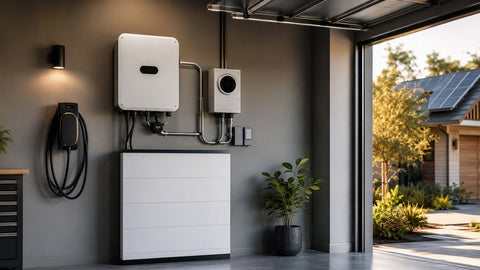
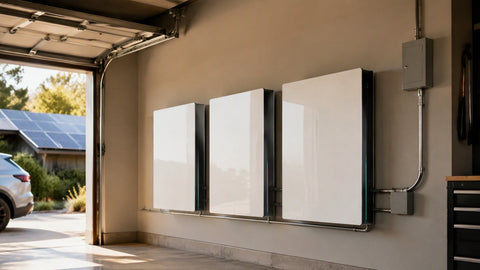
Storage sizing is a separate, simpler calculation: multiply your essential overnight load (most homes: 1.5 to 3 kW) by the hours of autonomy you want. Ten hours at 2 kW is 20 kWh of battery. If you're grid-tied with fair net metering, batteries are a resilience luxury; if you face time-of-use rates, export limits, or unreliable service, they're the point. The battery sizing calculator runs the numbers, the battery buyer's guide explains the chemistry choices, and EG4 vs. Powerwall compares the two most popular price points.
Putting It Together: The Denver Home, Fully Worked
Check Your Electricity Bills
Twelve bills: 9,600 kWh/year → 26 kWh/day. Denver sun: 5.3 PSH. Core division: 26 ÷ 5.3 ÷ 0.8 = 6.1 kW. Panels: 14 × 440W = 6.16 kW. Roof check: ~350 sq ft of south roof — fits with room. Future plans: an EV next year, so bump to 18 panels (7.9 kW) now rather than expanding later. At 2025–2026 pricing around $2.75–$3.50 per watt turnkey, that's a $22,000–$28,000 project before any remaining state or utility incentives — check the incentives by state page for what's live, noting the federal residential credit expired at the end of 2025. Verify your own scenario in minutes with our system calculator and ROI calculator. Five steps, twenty minutes, and you now know more about your solar needs than some of the people who will knock on your door. Run the same arithmetic for any scenario that tempts you — a bigger array, a battery, the EV you're eyeing — because the formula doesn't care how the inputs change; it just keeps telling the truth.
What the Calculation Can't Tell You
Honest math has honest limits, and three of them matter here. First, the formula gives you annual energy, not daily timing: a perfectly sized system still exports at noon and imports at midnight unless you add storage, and whether that trade is fair depends entirely on your utility's net-metering or export rules — read the tariff before you celebrate the number. Second, the calculation can't see your specific roof. It doesn't know about the oak tree on the southwest corner, the dormer that fragments your south face, or the 1962 panel box that will need an upgrade before anything backfeeds it. Those are site-visit questions, and they're why satellite-only quotes carry error bars nobody advertises. Third, it can't predict your rates. Electricity prices have climbed roughly 2 to 4 percent annually for two decades, which steadily improves a solar system's value — but the timing of your specific utility's next rate case is a forecast, not a fact. I've watched customers agonize over half a kilowatt of sizing while ignoring the export tariff that actually determined their payback; size carefully, then spend equal attention on the rate schedule your production will be paid under.
From Numbers to Installation: The Short Version
With your system size settled, the remaining path is mechanical. Get three quotes anchored to your number — installers respect a customer who says "I'm looking for 6 to 7 kW" far more than one who says "whatever you think." Verify the equipment on each quote: panel model and wattage, inverter architecture, racking brand, and the workmanship warranty in writing. Confirm who's handling permitting and interconnection paperwork and what the timeline looks like — two to eight weeks of utility processing is normal, and it's rarely the installer's bottleneck. If you're comparing equipment-first approaches against turnkey, our 5 kW kit page shows what transparent package pricing looks like as a benchmark. And schedule the install with the roof in mind: if your shingles have under ten years left, re-roof first — removing and reinstalling an array later costs more than any scheduling inconvenience now. One last habit worth forming: photograph your roof, your panel interior, and your meter before the first site visit. Installers quote faster and sharper when the homework arrives with you, and I've watched those three photos shave a week and several hundred dollars off more than one project.
Sizing for Off-Grid Is a Different Sport
Why Battery Storage Matters
Everything in this guide assumes the grid exists as your backup and balancer. Take the grid away and the sizing logic inverts: instead of annual averages, you design for the worst week of the year — the dark, cold stretch in December or January when solar production falls to a third of its summer peak right as heating loads climb. Off-grid sizing starts from daily loads in the worst month, multiplies by days of autonomy (two to four is typical), and then sizes the array to recharge the battery on the worst average day, not the annual one. The same 26-kWh-a-day Denver home that needs 6.1 kW grid-tied might need 10 to 14 kW of array and 40-plus kWh of storage off-grid, plus a generator for the stretches that beat the design. If off-grid is your actual goal, don't stretch grid-tied rules to cover it — the off-grid battery sizing guide and our off-grid cabin kit page are built for that calculation, and the off-grid system roundup shows complete architectures that work.
Where People Go Wrong With This Calculation
The math is simple, but three traps catch people anyway. The first is sizing from dollars instead of kWh: your bill's dollar figure mixes in fixed charges, tier penalties, and rate plans that solar can't erase — only the kilowatt-hours belong in the formula. The second trap is the one-month shortcut. I've had customers arrive proud of math built on a mild October bill, and the system they'd have bought would have covered barely two-thirds of their August air conditioning load. Twelve months or nothing. The third trap is skipping the derate factor because a sales brochure showed nameplate production: panels deliver their rated watts at 77°F cell temperature in laboratory light, and your roof in July is neither. The 0.8 factor isn't pessimism — it's fifteen years of field data distilled into one number. There's also a subtler fourth mistake worth naming: calculating carefully, then letting a quote talk you out of your own number without evidence. When a proposal differs from your math, the question isn't confrontational — "walk me through where your production estimate comes from" — and the answer sorts honest modelers from order-takers in one sentence.
A Final Word on Confidence
The point of this entire exercise was never to replace a professional design — it was to make you the person in the room who knows the answer before anyone quotes it. With your consumption, your sun hours, and one honest division, you can grade every proposal, catch every padded estimate, and buy exactly the system your home needs. That confidence is worth more than any single component discount, and it takes less time than one sales call.
Frequently Asked Questions
How do I find my daily energy use for solar sizing?
Add the kilowatt-hours from your last twelve electric bills and divide by 365. A 9,600 kWh year is 26 kWh per day. Never size from a single month — seasonal heating and cooling swings can be two-to-one, and the annual total is the only honest starting point.
What factors affect the size of a solar system?
Your annual consumption, your location's peak sun hours (3.3 in Seattle to 6.5 in Phoenix), real-world losses (use a 0.8 derate factor), roof orientation and shade, and planned future loads like an EV. The formula ties them together: daily kWh ÷ sun hours ÷ 0.8 = system size in kW.
How many solar panels do I need for my home?
Divide your system size by panel wattage — an 8 kW target with 440-watt panels takes 18 panels. Most U.S. homes land between 17 and 28 panels depending on location and usage. Each panel needs about 25 square feet of roof including spacing, so check your usable sunny roof area too.
Is it better to oversize or undersize a solar system?
Neither — size to your consumption plus near-term planned loads, with no more than 10–15 percent margin. Where your utility pays full retail for exports, slight oversizing is harmless. Where exports earn only a few cents, oversized production is sold back at a loss relative to its value, and a right-sized system wins.
Can I calculate solar needs if I'm building a new home with no bills?
Yes — estimate from comparable homes instead. A modern, efficient 2,000-square-foot home with gas heat typically uses 7,000 to 9,000 kWh a year; all-electric homes run 12,000 to 20,000 kWh with heat pumps, water heating, and an EV. Your builder's energy model, if one exists, is even better than either estimate.
From Arithmetic to Array
Bill, sun hours, one division, a panel count, a roof check — that's the entire calculation, and it's yours now. The next steps are equipment and paperwork: pick your hardware from our panels, inverters, and complete system kits; plan the project with the installation guide and NEC compliance guide; and if you'd like a professional check on your math before you spend a dollar, request a quote — verifying homeowner load calculations is our favorite kind of conversation, because those customers always end up with the right system.