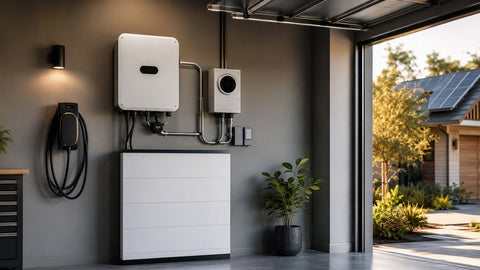
The EG4 Electronics 18kPV hybrid inverter has become the unit I reach for when a customer wants one box that runs the whole property: PV in, battery in, grid or generator in, and a full 120/240V split-phase panel out. I've hung six of these on shop walls and cabin service panels in the last year, and the pattern is always the same — people buy it for the all-in-one simplicity, then fall in love with the headroom. This guide walks through what the 18kPV actually does, how to pair it with EG4 batteries, how to size the conductors and breakers under the 2023 NEC, and where it fits against other hybrid inverters we stock.

What the EG4 18kPV Is — and What It Replaces
The 18kPV is a transformerless, all-in-one hybrid inverter. In a traditional off-grid build you'd buy a charge controller, a battery inverter, an automatic transfer switch, and a communications hub, then spend a weekend making them talk to each other. The 18kPV folds all four jobs into one chassis:
- Three independent MPPT trackers accepting high-voltage PV strings
- A 48V battery port with closed-loop communication to EG4's LiFePO4 line
- A grid/generator AC input with built-in transfer switching
- 120/240V split-phase output — no external stacking or autotransformer needed for standard residential panels
Because the AC input and the load output share one set of electronics, the unit can pass grid power through, blend grid with PV, charge batteries from either source, and island the house when the grid drops — all without a separate transfer switch for the backed-up loads panel. That integration is the whole pitch. Fewer boxes, fewer interconnection failure points, one monitoring app.
Core Specifications at a Glance
Verify every number against the current EG4 spec sheet before you pull a permit — EG4 revises firmware and ratings periodically — but these are the published values the design community works from:
| Parameter | EG4 18kPV (18kPV-12LV) | What It Means in Practice |
|---|---|---|
| Continuous AC output | 12,000 W | Runs a typical 3–4 ton heat pump plus household base load |
| Surge capacity | ≈2× continuous for motor starting | Starts well pumps and compressor loads most 8kW units can't |
| PV input capacity | Up to ~18 kW across 3 MPPTs | Oversize the array 1.5× for winter and morning harvest |
| MPPT voltage window | Up to 600 V DC per tracker | Strings of 9–12 modern residential modules per MPPT |
| Battery nominal voltage | 48 V (LiFePO4 recommended) | Pairs natively with EG4 server-rack and wall-mount batteries |
| AC output | 120/240 V split-phase, 60 Hz | Direct feed to a standard residential load center |
| Generator input | Supported, with charge control | Pairs with a standby generator for dark stretches |
| Certifications | UL 1741 / IEEE 1547 family | Accepted by most AHJs for grid-interactive use |
The honest headline: the "18" in the name refers to PV input class, not AC output. Plan your loads around 12 kW continuous. I've seen two separate customers order one expecting 18 kW of output, and that's a phone call nobody enjoys. Check the hybrid inverter basics guide if the input/output distinction is new territory.
Pairing the 18kPV with EG4 Batteries
Closed-loop communication is the reason to stay in the EG4 family on the storage side. With a supported battery — the LiFePower4 100Ah server-rack modules, the LL series, or the wall-mount units — the BMS tells the inverter exactly how hard it can charge and discharge, when to back off for temperature, and when to stop. You lose that protection layer running lead-acid or an unlisted lithium pack in open-loop mode.
The math that matters at design time:
| Battery Configuration | Nominal Energy | Usable @ 90% DoD | Runtime @ 4 kW Avg Load | Runtime @ 8 kW Avg Load |
|---|---|---|---|---|
| 2 × LiFePower4 5.12 kWh | 10.24 kWh | 9.22 kWh | 2.3 hours | 1.15 hours |
| 4 × LiFePower4 5.12 kWh | 20.48 kWh | 18.43 kWh | 4.6 hours | 2.3 hours |
| 6 × LiFePower4 5.12 kWh | 30.72 kWh | 27.65 kWh | 6.9 hours | 3.5 hours |
| 1 × EG4 WallMount Indoor 14.3 kWh | 14.34 kWh | 12.90 kWh | 3.2 hours | 1.6 hours |
| 2 × EG4 WallMount Indoor 14.3 kWh | 28.67 kWh | 25.80 kWh | 6.5 hours | 3.2 hours |
Runtime = usable kWh ÷ average load. 27.65 ÷ 4 = 6.9 hours. Real systems run 5–10% longer on cycling loads because "average" household draw dips below the design figure overnight.
My rule of thumb after a dozen of these installs: two server-rack modules is a grid-blip battery, four is an overnight battery, six is a storm-weekend battery. Use the battery sizing walkthrough or the home battery bank sizing guide to turn your own load list into a module count.
NEC Sizing: Breakers, Conductors, and PV Strings
This is where permitted installs live or die, so let's do the arithmetic out loud. All references are 2023 NEC.
AC output circuit (NEC 240.6 and 310.16)
12,000 W at 240 V is exactly 50 A continuous. Inverter output conductors get sized at 125% of continuous current: 50 A × 1.25 = 62.5 A. The next standard overcurrent device up from 62.5 A in NEC 240.6(A) is 70 A. From the 75°C copper column of Table 310.16, 4 AWG THHN/THWN-2 is good for 85 A — comfortably above the 70 A breaker rating. A 6 AWG conductor at 65 A would technically cover 62.5 A, but it leaves no room for the 70 A OCPD the math calls for, so 4 AWG copper is the spec.
| Design Step | Value | NEC Basis |
|---|---|---|
| Inverter continuous output current | 12,000 W ÷ 240 V = 50 A | Ohm's law on nameplate output |
| Continuous-load multiplier | 50 A × 1.25 = 62.5 A | NEC 690.8 / 215.2 continuous duty |
| Standard OCPD size | 70 A | NEC 240.6(A) next-size-up |
| Conductor, 75°C Cu | 4 AWG THHN (85 A) | NEC Table 310.16 |
| Conductor, 75°C Al (budget option) | 2 AWG (90 A) | NEC Table 310.16 |
Our NEC wire sizing guide and the ampacity chart reference have the full tables if you're working in a hot attic where derating changes the answer.
PV string voltage (NEC 690.7)
Cold mornings are when strings overvolt, so 690.7 makes you correct open-circuit voltage for the record low temperature. Take a common 450 W residential module with a 49.4 V Voc, ten in series on one MPPT, at a site with a −15°C design low (correction factor 1.14 from Table 690.7(A)):
| Calculation Step | Value |
|---|---|
| Module Voc at STC | 49.4 V |
| String Voc at STC (10 in series) | 10 × 49.4 = 494 V |
| Cold correction factor (−15°C) | × 1.14 |
| Corrected maximum system voltage | 494 × 1.14 = 563 V |
| 18kPV MPPT maximum | 600 V — passes with 6% margin |
Eleven modules would push the corrected value to 619 V — over the 600 V ceiling. So ten per string is the design limit with this module in a cold climate, and twelve works fine in a mild one. That single calculation is the most common string-length mistake I get called to fix after the fact.
PV circuit current (NEC 690.8)
Module Isc of 13.9 A: maximum circuit current is 1.25 × Isc = 17.4 A, and conductors get another 1.25 on top — 13.9 × 1.25 × 1.25 = 21.7 A minimum ampacity before derating. 12 AWG PV wire handles that with room to spare; 10 AWG is what I pull on roof runs over 75 feet to hold voltage drop under 2%. The PV wire vs USE-2 vs THHN guide covers insulation types, and the NEC 690 disconnect guide covers the required disconnecting means.
Real-World Load Planning: What 12 kW Actually Runs
Paper specs meet reality at the load center. Here's what I've verified on running systems, with typical nameplate draws:
| Load | Typical Running Watts | Starting Surge | 18kPV Handles It? |
|---|---|---|---|
| 3-ton central AC / heat pump | 3,500 W | 2–3× for <1 s (soft-starter recommended) | Yes, with soft starter |
| Electric water heater | 4,500 W | None (resistive) | Yes — put it on a load-shed relay |
| Well pump (1 HP) | 1,000–1,500 W | 3–4× momentary | Yes |
| Electric range (one oven + two burners) | 4,000–6,000 W | None | Yes, but watch total stacking |
| Level 2 EV charger at 40 A | 9,600 W | None | Only with careful load management |
| Refrigerator + freezer + lights + internet | 600–900 W | Minor | Trivially |
The EV charger line is the one to circle. 9.6 kW of charging eats 80% of the inverter's continuous rating. If the customer insists on charging off-grid, throttle the EVSE to 24 A (5.8 kW) or schedule charging for peak sun hours when PV carries it directly. Our whole-home wattage guide helps customers build an honest load list before they buy.
18kPV vs. the Alternatives
We stock the competitors too, so this comparison comes from selling all of them rather than defending one:
| Attribute | EG4 18kPV | EG4 FlexBOSS21 | Sol-Ark 15K |
|---|---|---|---|
| Continuous AC output | 12 kW | 16 kW class | 15 kW |
| MPPT count | 3 | 3 | 3 |
| Battery chemistry support | 48V LiFePO4, closed loop with EG4 | 48V, closed loop with EG4 | 48V, broad BMS support list |
| Split-phase without stacking | Yes | Yes | Yes |
| Grid sell-back | Yes (with approval) | Yes | Yes |
| Best fit | Off-grid homes, cabins, backup-first builds | Larger homes, light commercial | Whole-home grid-tied with backup |
If 12 kW isn't enough output, look at the FlexBOSS21 or parallel two 18kPVs — the units support parallel operation for exactly that case. Browse the full range in 13–18kW hybrid inverters. For a brand-agnostic look at the storage side, the EG4 vs Tesla Powerwall comparison is worth the read before committing.
Installation Notes From the Field

- Wall structure matters. The 18kPV is heavy enough that I refuse to hang one on bare drywall over studs. 3/4" plywood backer, lagged into framing, every time. The one install I skipped the backer on, I was back inside a month re-anchoring.
- Leave working clearance. NEC 110.26 wants 36 inches of working depth in front of the unit. Plan the battery rack location with that in mind — server-rack batteries plus inverter plus clearances eat a 6-foot wall run faster than people expect.
- Update firmware before commissioning. EG4 ships meaningful firmware updates. Five minutes on a laptop before first start saves the callback.
- Grounding is not optional homework. Follow the NEC 690.43/250 grounding guide — inspectors in our region check the equipment grounding conductor sizing on every single job.
Generator Integration: Sizing the Backup to the Backup
Most off-grid customers pair the 18kPV with a generator, and the sizing question comes up on every job. The inverter charges the battery bank from the generator while simultaneously powering the house, so the generator has to cover both. If the house pulls 3 kW and you want a 6 kW charge rate into the batteries, the generator sees 9 kW plus conversion losses — call it 10 kW of real demand.
| House Load While Charging | Desired Charge Rate | Total Generator Demand (+10% losses) | Recommended Generator Class |
|---|---|---|---|
| 2 kW | 4 kW | 6.6 kW | 8–10 kW |
| 3 kW | 6 kW | 9.9 kW | 12 kW |
| 4 kW | 8 kW | 13.2 kW | 15 kW |
| 5 kW | 10 kW | 16.5 kW | 18–22 kW |
Diesel and propane units in the 10–14kW standby class cover the middle two rows, which is where most off-grid homes land. The 17–20kW class handles the bottom row with headroom for a shop welder or a second dwelling. Undersizing here is the classic mistake: the generator bogs, voltage sags, the inverter drops the generator input, and the customer calls convinced the inverter is broken. It never is — it's always the generator.
Monitoring, Firmware, and the Part Nobody Reads in the Manual
The 18kPV reports over Wi-Fi or Ethernet to EG4's monitoring portal. Set up alerts on day one — battery low-voltage warnings and PV string underperformance notifications have caught two failing charge ports and one chewed-through PV cable across my installs before the owners noticed anything. A mouse had nested in a customer's combiner box; the app showed string two at half harvest, and that was the whole diagnosis.
Firmware discipline matters more with this unit than with most. EG4 ships updates that change battery communication behavior and occasionally grid-interactive settings. My practice: update before commissioning, then leave the unit alone unless there's a documented fix the customer needs. Chasing every release on a stable system creates problems that didn't exist.
Parallel Operation and Growth Paths
Two 18kPVs in parallel deliver roughly 24 kW of continuous output — enough for a large all-electric home or a small shop building. The design rules change when you parallel:
- Each inverter needs its own battery bank capacity to share — plan at least 20 kWh per unit so neither one starves during surge events.
- PV arrays stay segregated by inverter; you can't share one array across both units' MPPTs.
- The AC output conductors still follow the same 125% continuous rule — 24 kW at 240 V is 100 A, times 1.25 is 125 A, which lands on a 125 A breaker and 1 AWG copper at 75°C (130 A in Table 310.16). That math is in the tables above; the method doesn't change, only the numbers.
- Communication cables between paralleled units are short and fussy about routing. Keep them away from AC conductors in the gutter — induced noise on the sync cable shows up as phantom faults that eat afternoons.
Customers often ask whether to buy one 18kPV now and add a second later, or start with a bigger single unit. My answer: if the load list already says you need more than 12 kW continuous, buy the bigger unit — a single larger inverter or the FlexBOSS21. Parallel adds wiring, a second set of clearances, and double the firmware surface area. Parallel makes sense for redundancy and phased builds, not as a way to cheap out of buying the right size the first time.
Maintenance Reality Check
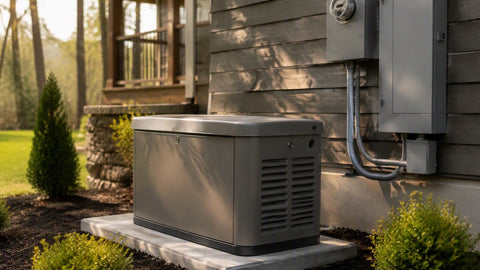
The 18kPV itself wants almost nothing: keep the intake vents clear, blow the dust out annually if it's in a shop environment, and check terminal torque at the one-year mark. The batteries are similarly uneventful — LiFePO4 in closed loop with the inverter mostly manages itself. What actually drifts over time is the system around the electronics: roof penetrations age, MC4 connections loosen with thermal cycling, and generator exercise schedules get forgotten. Put the whole system on an annual walk-through, the same way you'd service a home backup generator. An hour a year is the entire maintenance budget for a well-installed system, and skipping it is how small problems become expensive ones.
Who Should Buy the 18kPV — and Who Shouldn't
After selling and servicing these for a while, the fit questions have honest answers.
Buy it if: you're building an off-grid home or cabin and want one vendor's ecosystem end to end; you need grid-interactive backup with serious PV input capacity; you value closed-loop battery communication and one app for everything; your continuous load budget is honestly under 12 kW.
Look elsewhere if: you need 208V three-phase commercial service — this is a split-phase residential unit, and no amount of wishing changes that; your continuous loads genuinely exceed 12 kW and you don't want to manage them; you're already invested in a different battery ecosystem with its own closed-loop requirements and can't mix cleanly.
The most satisfied 18kPV owners I know share one trait: they did the load math before they bought, not after. The least satisfied skipped that step and discovered the difference between PV input watts and output watts the hard way. Everything you need for that math is on this page — the runtime table, the load table, and the NEC sizing section. Thirty minutes with a notepad now beats a return freight bill later.
Cost and Payback Context
A complete 18kPV system — inverter, four to six server-rack batteries, racking, wire, and protection hardware — typically lands in the $15,000–$25,000 range before labor depending on battery count and array size. Against a grid-tied-only build, the storage premium buys outage protection and the ability to time-shift PV into evening rates where utilities allow it. Against a generator-only backup plan, the math runs on fuel: a propane standby unit burns roughly 2–3 gallons per hour at half load, so a week-long outage costs $400–$700 in fuel alone at recent propane prices. The battery bank carries that same week silently if the sun cooperates, and the generator becomes the exception rather than the plan. Use the solar ROI calculator to run your own rates and usage against the equipment cost.
Frequently Asked Questions
Can the EG4 18kPV run a house with no grid connection at all?
Yes. It was designed as an off-grid-first inverter. With a properly sized battery bank and array, it runs fully islanded. Many owners keep a dual-fuel generator on the AC input for extended cloudy stretches rather than oversizing the battery bank for a once-a-year event.
How many EG4 batteries can one 18kPV support?
Closed-loop communication supports large parallel banks — well beyond the 6-module configuration most homes install. The practical limit is your wall space, budget, and the battery charge current budget, not the inverter's address space.
Does the 18kPV qualify for the federal tax credit?
When installed as part of a qualifying solar or storage system, the inverter and batteries generally fall under the residential clean energy credit. Rules change — confirm with a tax professional and check our solar incentives by state page for current programs.
What happens when both grid and sun are gone?
The inverter draws from the battery bank down to its configured cutoff. If a generator is connected and auto-start is configured, it will request the generator before the batteries hit empty.
Is 12 kW of output enough for a 2,500 sq ft home?
For most homes with gas or propane heat and water heat, comfortably yes. All-electric homes need load management — a soft starter on the AC and a timer or relay on the water heater solve 90% of conflicts.
Can I install it myself?
Physically, a competent DIYer can. Legally, most jurisdictions require a permit and many require a licensed electrician for the AC connections. Off-grid cabins are the common DIY exception. Either way, the NEC sizing tables above still apply.