Distributed Energy Resource Management — DER management, and the DERMS platforms that do it — is the discipline of coordinating thousands of small, customer-owned energy assets so they behave like one well-run power plant. Rooftop solar arrays, home and commercial batteries, EV chargers, standby generators, smart thermostats, and controllable loads have proliferated to the point where they are collectively a grid-scale resource. The question is no longer whether distributed energy resources matter; it is whether they are managed, and by whom, and for whose benefit. This guide covers the full stack: what a DERMS actually is, the architecture that makes it work, the standards that govern it, the revenue it unlocks, and the practical path from a pile of equipment to a coordinated, income-producing portfolio.
I have watched this transition from the equipment side for years. In 2018, a battery sale ended when the pallet left the dock. Today, the same sale increasingly includes the conversation about which aggregator's platform the battery will enroll in, what telemetry it will share, and what grid-services revenue it will earn back. The hardware did not change. Everything around it did.
What counts as a DER — and what counts as management
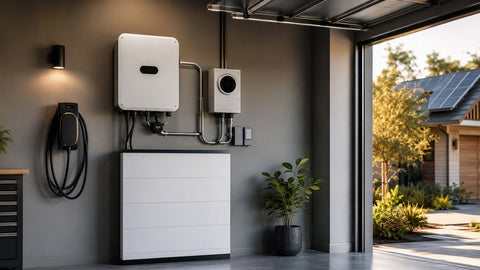
A distributed energy resource is any power-producing, power-storing, or power-flexing asset connected at the distribution level rather than the transmission level. The four dominant categories and their management concerns:
| DER class | Grid function | Core management challenge | Key standard / protocol |
|---|---|---|---|
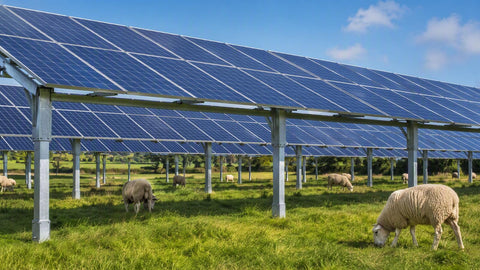
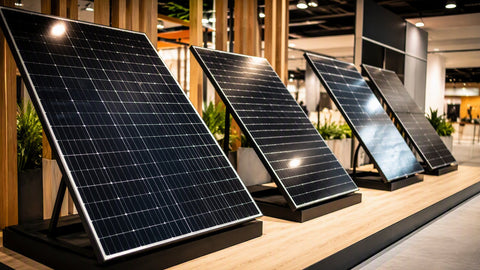
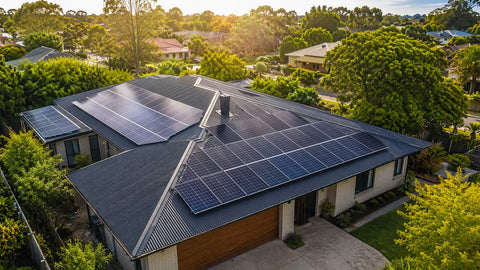
| Solar PV systems | Variable daytime generation | Interconnection compliance, voltage ride-through, curtailment response | IEEE 1547-2018, UL 1741 SB, SunSpec Modbus |
| Battery storage (ESS) | Dispatchable energy and capacity | State-of-charge orchestration, warranty-safe cycling, backup reserve floors | IEEE 1547, IEEE 2030.5, OCPP-adjacent APIs |
| EV chargers | Large flexible load | Peak avoidance, charge scheduling, bidirectional (V2G) readiness | OCPP 1.6/2.0.1, ISO 15118 |
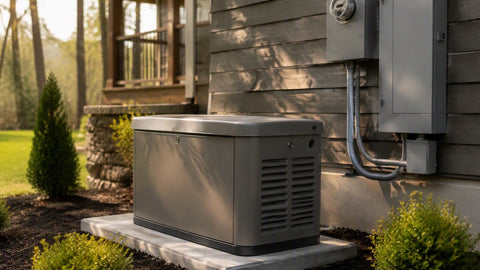
| Standby generators | Emergency capacity | Emissions limits on non-emergency dispatch, exercise scheduling | EPA Tier rules, NFPA 110 |
| Smart loads (thermostats, water heaters) | Demand flexibility | Customer comfort constraints, rebound effects | OpenADR, CTA-2045 |
Management means four functions performed continuously: visibility (telemetry from every asset), forecasting (what each asset will do tomorrow), optimization (what each asset should do, given tariffs, weather, and grid signals), and control (securely issuing those instructions). A spreadsheet and a thermostat schedule is not DER management. A platform that re-optimizes ten thousand batteries every five minutes against live market prices is.
The architecture of a modern DERMS platform
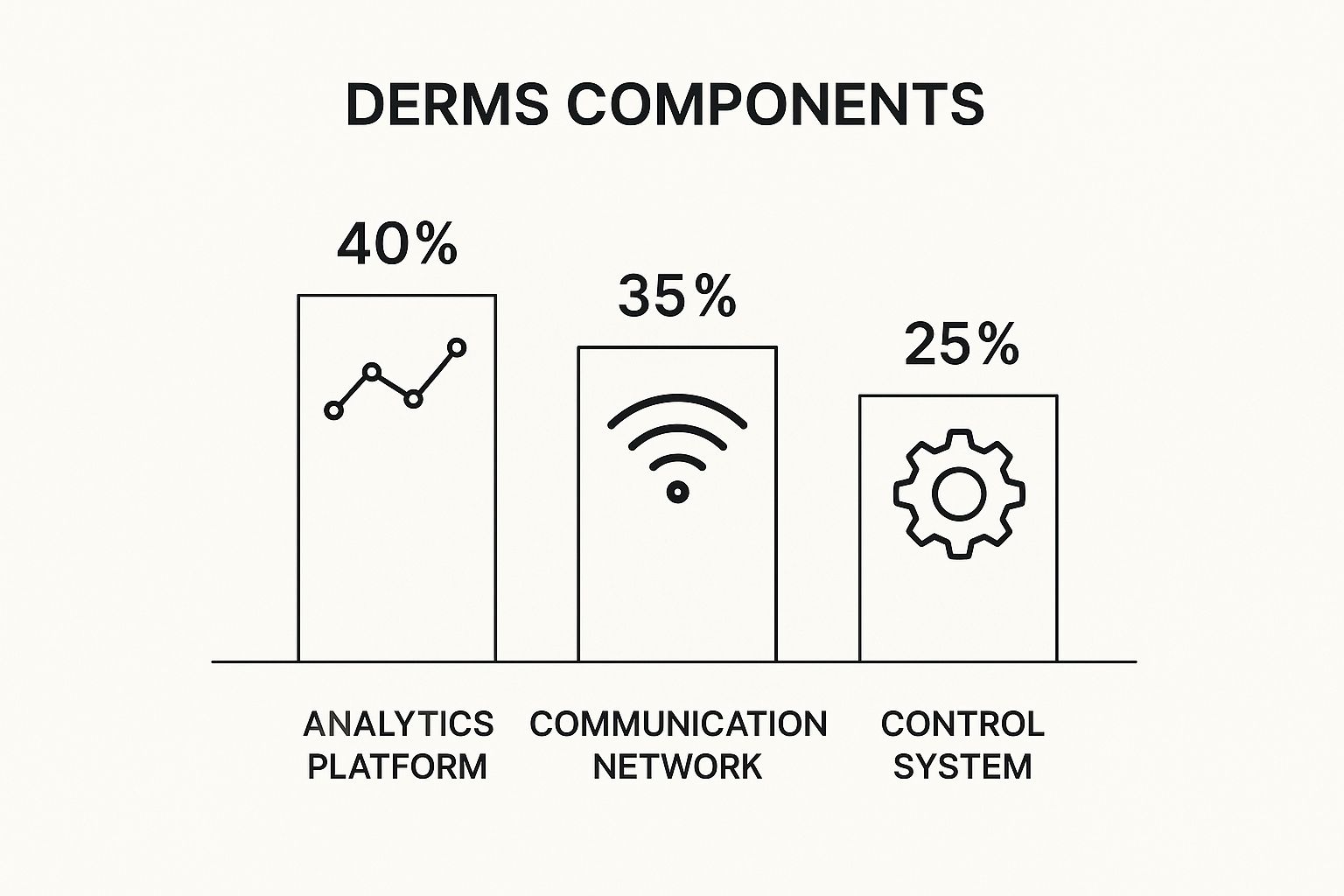
Every serious DERMS, whatever the vendor badge, has the same three-layer anatomy. Understanding the layers tells you where projects succeed and where they quietly fail.
The Hardware Layer at the Grid Edge
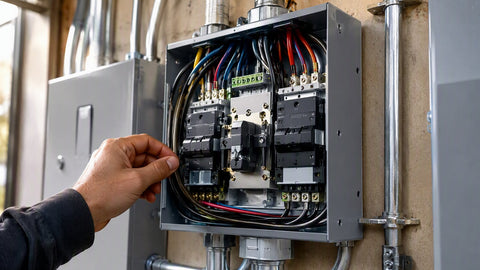
The edge layer lives at the asset: inverter gateways, battery controllers, EVSE firmware, and site-level energy management systems. This layer speaks the hardware's native dialects — SunSpec Modbus for most inverters, vendor APIs for batteries, OCPP for chargers — and it is where reliability is won or lost. A cloud platform with brilliant algorithms and a flaky edge gateway is a weather app, not a control system. In commissioning work I insist on one test above all others: pull the site's internet connection for ten minutes and watch what the edge layer does. The correct answer is "keeps running its last safe schedule locally." Anything else is a design flaw wearing a dashboard.
The aggregation layer normalizes thousands of edge devices into a single dispatchable portfolio: state-of-charge totals, available up/down capacity, locational constraints on the feeder map. This is the layer utilities and market operators actually talk to, and it is where the forecasting models live — solar production against weather, load against calendar, battery availability against warranty budgets.
The market and operations layer turns the portfolio into money and grid services: bids into wholesale markets, dispatch under utility demand-response programs, peak shaving against a facility's tariff, and the settlement-grade metering that proves what was delivered. This layer is why DERMS exists commercially at all.
The compliance spine: IEEE 1547 and its children
No DERMS strategy survives contact with the interconnection process unless the underlying equipment meets the current standards stack. The load-bearing standards:
| Standard | Scope | Why DERMS cares |
|---|---|---|
| IEEE 1547-2018 | Interconnection and interoperability of DERs with the grid | Defines the voltage/frequency ride-through and the communication interface utilities may require |
| UL 1741 SB | Certification of inverters to IEEE 1547-2018 | The listing that makes smart-inverter functions — and thus DERMS control — legal to interconnect |
| IEEE 2030.5 | Smart energy profile communications | The utility-preferred DER control protocol in California and spreading nationally |
| SunSpec Modbus | Inverter telemetry and control data models | The de facto edge-layer language most DERMS platforms read |
| Rule 21 (CA) / Rule 14H (HI) | State interconnection tariffs | The procedural reality that smart-inverter settings are a permit requirement, not an option |
The practical consequence for buyers: an inverter or battery without UL 1741 SB listing is increasingly unconnectable in the markets where DERMS revenue is richest. We steer customers away from bargain hardware without the listing for exactly this reason — a few hundred dollars saved at purchase becomes a stranded asset at the interconnection desk.
Where the money is: DERMS revenue streams
DER management pays through four channels, and a credible business case names which channels a given portfolio can actually access:
| Revenue channel | Mechanism | Typical value range | Who captures it |
|---|---|---|---|
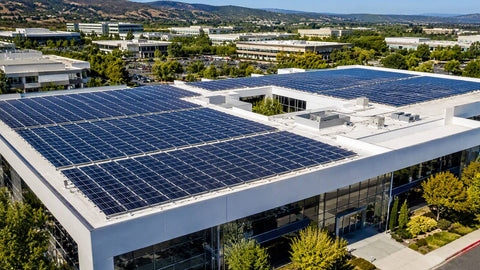
| Demand-charge management | Battery/load dispatch against the facility's 15-minute peak | 30–60% of demand charges ($8–$25/kW-month) | C&I facility owner |
| TOU arbitrage | Charge off-peak, discharge on-peak | $0.10–$0.35/kWh spread where tariffs support it | Residential & C&I |
| Utility demand-response programs | Aggregated load reduction during grid events | $50–$200/kW-year (program-dependent) | Aggregator shares with asset owner |
| Wholesale market participation (VPP) | Capacity, energy, and ancillary services bids | Highly variable; FERC Order 2222 markets opening | Aggregators and large portfolios |
The residential virtual power plant programs make the value concrete: enrolled home batteries dispatched during grid emergencies have paid participating homeowners hundreds of dollars per year in the mature programs, while commercial demand-response routinely returns five figures annually on mid-size facilities. The catch that honest analysis always includes: cycling a battery for revenue consumes cycle life, and the dispatch strategy must be warranty-aware. A program paying $300 a year that burns $500 of battery life is a bad trade, and the DERMS platform's job is precisely to know the difference — the good ones carry per-asset degradation models and refuse dispatches that lose money on a lifecycle basis.
A worked facility example
Take a 24-hour cold-storage facility: 600 kW average load, 780 kW monthly peak set by compressor staging, on a tariff with $14/kW demand charges and a $0.06/kWh on/off-peak spread. The unmanaged demand bill alone is 780 × $14 = $10,920 per month. Add a 500 kWh / 250 kW battery under DERMS control with three orders of business: cap the meter at 550 kW (demand savings of 230 kW × $14 = $3,220/month), shift 400 kWh per night from peak to off-peak (400 × $0.06 × 30 = $720/month), and enroll in the utility's demand-response program at $100/kW-year on 200 committed kW ($20,000/year, or ~$1,670/month). Total managed value: roughly $5,600/month against a battery system whose net cost after the 30% ITC lands near $190,000 — a payback under three years before resilience value enters at all. That arithmetic, with real tariff sheets, is what a DERMS business case looks like when it is done properly.
The implementation path that actually works
Successful DER programs, from a single facility to a thousand-home VPP, follow the same sequence, and the shortcuts all fail in predictable places.
Step 1 — Instrument before you optimize. Fifteen-minute interval data on every significant load and asset for at least one billing cycle, ideally a season. You cannot shave a peak you have never measured, and I have seen more demand-management projects miss their savings targets from bad baselines than from bad batteries.
Step 2 — Verify the standards stack at purchase. UL 1741 SB on the inverters, IEEE 2030.5 or documented API access on the batteries, OCPP on the chargers. The interconnection application is not the time to discover a protocol gap.
Step 3 — Commission the edge layer like it matters. Local fallback schedules, connectivity loss tests, time-sync verification. The grid event the platform exists for will happen at the worst possible connectivity moment — plan for it.
Step 4 — Start with tariff optimization, add market revenue second. Demand and TOU savings are deterministic and measurable on next month's bill; market revenue is probabilistic and settles quarterly. Build confidence on the deterministic layer.
Step 5 — Instrument the outcomes. Settlement-grade submetering on the managed assets, compared against the baseline monthly. The programs that survive budget season are the ones with verified savings, not projected ones.
Security and the trust problem
A DERMS platform holds the keys to thousands of grid-connected assets, which makes it critical infrastructure by any honest definition. The procurement checklist that matters: end-to-end encrypted command channels with certificate-based device identity, signed firmware with rollback protection, role-based access with audit logs, and a vendor willing to document their incident-response process rather than gesture at it. NERC CIP applies to the utility side; the customer side has no equivalent mandate, which means the discipline is voluntary and therefore rare. Ask the awkward security questions in procurement. The vendors who answer them fluently are the ones still standing after their first real incident.
DERMS for utilities versus DERMS for customers: two products wearing one name
The acronym hides a fork in the road that buyers must recognize early, because the products diverge completely. A utility DERMS is grid-operations software: it sits beside the SCADA and ADMS systems, manages feeder-level constraints, dispatches portfolios to relieve congestion, and answers to regulators and reliability coordinators. Its buyer is a utility engineering department, its sales cycle is measured in years, and its success metric is load-shape change on specific feeders. A customer-side DERMS — often branded as an energy management system, an aggregator platform, or a VPP operating system — serves the asset owner's economics: tariff optimization first, program revenue second, grid citizenship as a byproduct. The two increasingly interoperate through IEEE 2030.5 and OpenADR, and the mature end-state is coordination rather than conflict: the utility signals the constraint, the customer-side platform solves it profitably. Confusing the two products in procurement is a classic six-figure mistake — I have watched a commercial campus evaluate utility-grade software for a job that a $40,000 facility EMS would have done better.
The forecasting problem at the heart of the platform
Optimization is only as good as the forecast it optimizes against, and DER forecasting is genuinely hard for a structural reason: the assets live behind customer meters, in weather that varies street by street, attached to human behavior that defies modeling. Solar production forecasting at fleet scale has matured — satellite-derived irradiance nowcasts plus per-site performance models routinely achieve day-ahead errors under 10% across a diversified portfolio, even when individual sites miss by 30%. Load forecasting is harder: a portfolio of houses contains birthday parties, new EVs, and heat waves, and the honest platforms report confidence intervals rather than point estimates. Battery availability forecasting is where the warranty-awareness lives — the platform must know not just the current state of charge but the cycle budget remaining this month and the backup reserve the owner will not surrender. When you evaluate platforms, ask to see their forecast error distributions across their actual fleet, not a demo dashboard. The vendors with real fleets have the distributions. The others have screenshots.
Interoperability: navigating the brand maze
A DER portfolio in the real world is never single-vendor. The solar came from one procurement, the battery from another, the EV chargers arrived with the fleet contract, and the generator predates everyone. The DERMS platform's first commercial test is therefore its device library: which inverter families, battery controllers, and charger models it speaks natively, and — more important — what it does with the ones it does not. The pragmatic hierarchy: native API integration is best, SunSpec Modbus over TCP is the reliable workhorse for inverters, IEEE 2030.5 is growing on the utility-directed side, and OCPP has genuinely standardized the charger layer. For the stragglers, site-level gateways that translate proprietary protocols into something the platform can read are the industry duct tape — functional, but one more box to fail at the worst moment. My standing advice to portfolio builders: every procurement specification from today forward should name its control interface in the purchase order. Retrofitting interoperability is always possible and never free.
Residential VPP economics, worked honestly
The home-battery VPP proposition deserves the same arithmetic rigor as the commercial case. Take a 13.5 kWh battery enrolled in a mature utility VPP program: the program reserves the right to dispatch, say, 5 kW for up to 3 hours per event, up to 60 events per year, paying $150 per kW-year on the committed 5 kW — $750 per year gross. Realistic event utilization runs 60–75%, so call it $450–$560 actually earned. Against that, stack the costs: roughly 90 kWh of additional annual throughput per kW committed at high discharge rates (negligible against a 13.5 kWh battery's 37 MWh lifetime warranty throughput), the platform's revenue share (commonly 20–30%), and the owner's retained backup-reserve constraint, which is the real price — a battery committed to the grid at 4 PM is not fully yours until midnight. Net to the homeowner: typically $300–$450 per year in mature programs, on top of the battery's TOU and resilience value. That will not retire anyone, but it converts a resilience purchase into a revenue asset, and at portfolio scale — ten thousand enrolled batteries — it is a 50 MW power plant that nobody had to permit. That last sentence is the entire reason utilities now fund these programs.
| VPP program element | Typical terms (mature programs) | Owner consideration |
|---|---|---|
| Committed capacity | 3–7 kW per home battery | Must not consume the backup reserve floor |
| Event profile | 2–4 hours, 30–80 events/year | Evening events align with owner TOU goals |
| Compensation | $100–$200/kW-year committed | Net after aggregator share of 20–30% |
| Battery throughput cost | ~90 kWh/yr per committed kW | Minor against modern warranty budgets |
| Opt-out rights | Per-event opt-out standard | Read the storm-day fine print before enrolling |
The failure modes we see from the field
DERMS projects fail in patterns, and naming them is cheaper than joining them. Connectivity rot: cellular gateways lose signal as carriers refarm spectrum, and portfolios quietly bleed assets offline at 2–4% per year without a monitoring discipline — the fix is heartbeat alerting on the edge fleet, not annual site visits. Baseline decay: demand-management savings calculated against a baseline from three summers ago become fiction as the facility's operations change; re-baseline annually or the savings report becomes a bedtime story. Protocol drift: firmware updates on either side of an API integration break telemetry in silence; pin the firmware versions in commissioning and treat updates as change-managed events. And the organizational failure that underlies all the technical ones: DER management with no owner. The facility engineer assumed the aggregator was watching; the aggregator assumed the facility was; the battery sat at 40% charge through the highest-demand month of the year. Assign a human, give them the dashboard, and review the numbers monthly. The platforms are good. They are not self-driving.
Where this is all heading
Three trends will define the next five years of DER management. FERC Order 2222 implementation keeps prying wholesale markets open to aggregated DERs, converting program revenue into market revenue with real price discovery. Bidirectional EVs turn the largest battery most households will ever own into a dispatchable asset — a 100 kWh truck dwarfs a 13.5 kWh wall unit, and ISO 15118 is the standard that makes it controllable. And the interconnection queue crisis is pushing utilities toward flexible interconnection — connect now, agree to DERMS-mediated curtailment during constrained hours — which transforms DERMS from an optimization luxury into the literal condition of interconnection in congested territories. The equipment buyers who standardize on controllable, standards-listed hardware today are buying tickets to all three of those futures. The ones who buy stranded-protocol bargains are buying tomorrow's replacement cycle.
Commissioning and verification: the discipline that makes it real
The Commissioning and Verification Phase
A DERMS deployment is not done when the dashboard lights up; it is done when a witnessed test proves the control loop end to end. The commissioning sequence we hold customers to: verify telemetry accuracy against a calibrated meter at the site — a platform reading 4% optimistic is a savings model built on sand. Execute a live dispatch test at partial power with the owner's staff watching, so the organization learns what a grid event feels like before one arrives unannounced. Run the connectivity-loss test and document the local fallback behavior. Confirm the backup-reserve floor by attempting a dispatch that would violate it — the platform's refusal is the feature being tested. And record baseline meter readings the day control goes live, because every future savings claim traces back to that photograph of the meter. Verification then repeats on a cadence: quarterly dispatch drills, annual baseline reviews, and a full re-test after any major firmware change. It sounds ceremonial until the first real emergency event arrives and the portfolio performs exactly as rehearsed — at which point it looks like what it is: engineering.
Frequently asked questions
What is distributed energy resource management (DERMS)?
DERMS is the software-and-communications discipline that monitors, forecasts, optimizes, and controls distributed assets — solar, batteries, EV chargers, generators, and flexible loads — so they operate as a coordinated grid resource rather than isolated equipment.
What is the difference between a DERMS and a virtual power plant?
A DERMS is the management platform; a VPP is the commercial construct it enables — an aggregated portfolio of customer assets bid into utility programs or wholesale markets as if it were a single power plant.
Which standards govern DER interconnection and control? IEEE 1547-2018 defines interconnection behavior, UL 1741 SB certifies inverters to it, IEEE 2030.5 and SunSpec Modbus handle utility and device communications, and OCPP governs EV charging. Interconnection tariffs like California's Rule 21 make the smart-inverter functions mandatory.
How do DER owners earn revenue? Four channels: demand-charge reduction, time-of-use arbitrage, utility demand-response program payments, and wholesale market participation through aggregators. Value ranges from hundreds of dollars per year for a home battery to five figures annually for mid-size commercial facilities.
Does grid-services dispatch hurt battery life? It can. Every cycle consumes warrantied throughput. Competent DERMS platforms model per-asset degradation and reject dispatches whose revenue is below the lifecycle cost of the cycle — the platforms that do not are spending the owner's battery.
What should a facility do first? Instrument: collect 15-minute interval data across loads and assets for at least one billing cycle, verify the equipment's standards listings, and baseline the demand profile before buying anything. Optimization without measurement is guesswork with invoices.
The procurement checklist that separates platforms from pitch decks
After watching DERMS selections succeed and fail across residential aggregations and C&I portfolios, the evaluation criteria that actually predict outcomes compress into a short list. Device library depth: demand the specific integration list for your exact hardware SKUs, in writing, including firmware-version caveats. Forecast transparency: require documented fleet-level forecast error metrics, not demonstrations. Edge resilience: the platform must define and demonstrate local fallback behavior for connectivity loss, with the disconnect test performed at commissioning. Settlement quality: savings and revenue reporting must reconcile to the utility bill or the market settlement statement, not to the platform's own optimism. Exit terms: your telemetry history and your dispatch rights survive contract termination, portable and documented — a platform that holds your data hostage is a landlord, not a vendor. And total cost honesty: gateway hardware, cellular plans, per-asset SaaS fees, aggregator revenue shares, and integration engineering all belong in the same spreadsheet before signature. The vendors who welcome this checklist are the shortlist. The ones who wave it off have just answered your question.
The bottom line
Distributed energy resource management is where the energy transition becomes operational: thousands of customer-owned assets coordinated into something a grid operator can depend on and an asset owner can bank on. The technology is proven, the standards are published, and the revenue channels are real — but the difference between a DER portfolio and a pile of equipment is disciplined implementation: measured baselines, listed hardware, a trustworthy edge layer, and verified outcomes. Build those four things and the DERs manage themselves. Skip them and you own expensive scenery — connected, dashboarded, and quietly worthless scenery that dispatches nothing, earns nothing, and proves nothing at budget review — the worst kind of capital expenditure, the kind that looks alive until someone asks for the settlement statement.
Portlandia Electric Supply equips DER projects at every scale: hybrid inverters, 100–200 kWh C&I batteries, EV chargers, monitoring and communications, solar panels, and utility-scale storage. Explore our solution pages: microgrid solutions, virtual power stations, smart energy management, commercial & industrial solutions, renewable energy for utilities, and what is an energy storage system.