Canadian Solar Solar Panels Buyer's Guide: How to Choose the Right Panels for Your Home or Business
By the PES Supply Editorial Team

Canadian Solar is one of the most-shipped module brands on earth — a Tier 1 manufacturer whose HiKu, BiHiKu, HiHero, and TOPBiHiKu families cover everything from budget residential rooftops to 750 W utility blocks. This guide breaks down the four families, the PERC/TOPCon/HJT technology trade-offs, climate performance, string sizing, warranty terms, and the projects where Canadian Solar is the right call — and where it is not.
We distribute Canadian Solar alongside a dozen competing module brands, so this guide is written from the procurement desk, not the marketing deck: real pricing bands, real warranty terms, and the domestic-content caveat that trips up more buyers than any spec on the sheet. Browse live inventory in our Canadian Solar collection.
Canadian Solar Inc. — founded in Guelph, Ontario in 2001 and now operating one of the largest module manufacturing footprints on earth — is a BloombergNEF Tier 1 manufacturer with more than 100 GW of modules shipped. Despite the name, most module production is in China and Southeast Asia, with North American assembly operations added in recent years; that distinction matters for Buy America projects, and we will cover it squarely below.
The lineup US buyers actually encounter in 2026 spans four families: HiKu6 (PERC, the volume workhorse), BiHiKu6/7 (bifacial PERC and TOPCon), HiHero (HJT, the premium play), and TOPBiHiKu7 (N-type TOPCon large format). Residential rooftops mostly see the HiKu6/HiKu7 classes; commercial and utility projects draw from BiHiKu and TOPBiHiKu.
Key Takeaways
- Canadian Solar is a Tier 1 manufacturer with four live families: HiKu (PERC), BiHiKu (bifacial), HiHero (HJT), and TOPBiHiKu7 (N-type TOPCon).
- Module pricing runs $0.27–$0.40/W depending on family and volume — mid-range, between value-tier imports and premium domestic/HJT brands.
- Efficiency tops out at 23.9% on the HiHero HJT; the volume HiKu6 class runs 21.2–21.6%.
- Warranties: 12-year product / 25-year power on PERC, up to 15-year product / 30-year power on N-type lines.
- Not Buy America-compliant for most SKUs — confirm the assembly origin of your exact model if the project has domestic-content requirements.
Framework to decide: Mono/PERC vs HiKu vs BiHiKu
Step 2: Narrow to model families (Mono/PERC, HiKu, BiHiKu)
| Model | Watts | Cell Tech | Efficiency | Dimensions | Warranty | Price Range |
|---|---|---|---|---|---|---|
| HiKu6 (CS6W-540) | 520–540 W | Mono PERC | 21.2–21.6% | 2266 × 1134 × 35 mm | 12-yr product / 25-yr power | $0.27–$0.32/W |
| BiHiKu6 (CS6Y-MB-AG) | 565–585 W | PERC bifacial | 21.5–22.0% | 2450 × 1135 × 35 mm | 12-yr product / 30-yr power | $0.28–$0.34/W |
| HiHero (CS6.2-66HB-HP) | 620–645 W | HJT bifacial | 23.0–23.9% | 2382 × 1134 × 35 mm | 12-yr product / 30-yr power | $0.32–$0.40/W |
| TOPBiHiKu7 (CS7N-TB) | 695–750 W | N-type TOPCon | 22.5–23.3% | 2384 × 1134 × 35 mm | 15-yr product / 30-yr power | $0.30–$0.38/W |
Prices are contractor estimates at pallet-to-container volumes and vary with market conditions, technology, and documentation requirements. Confirm current pricing and the exact SKU's datasheet before quoting a job.
How to read the family tree: HiKu6 is the safe, cheap, everywhere option — the module equivalent of a fleet pickup. BiHiKu adds a transparent back and rear-side gain for ground mounts, carports, and bright-surface commercial roofs. HiHero is Canadian Solar's answer to REC's Alpha — heterojunction cells with a superior temperature coefficient and the highest efficiency in the catalog. TOPBiHiKu7 is the volume N-type TOPCon platform for C&I and utility, where the industry has decisively moved.
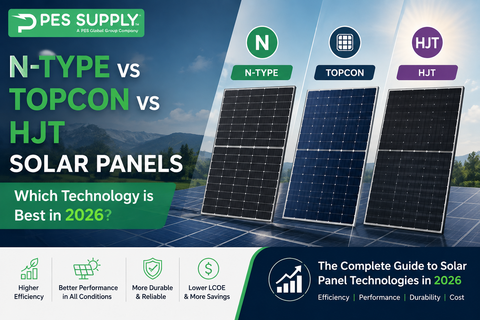
Spec-sheet technology names translate into three field behaviors: hot-day output, aging rate, and low-light performance. Monocrystalline PERC — the HiKu6 backbone — is the mature baseline: proven, cheap, with a temperature coefficient around −0.34%/°C and first-year degradation near 2%. N-type TOPCon (TOPBiHiKu7) improves every one of those numbers: coefficient near −0.30%/°C, first-year degradation around 1%, then ~0.40%/year. HJT (HiHero) goes further still — coefficient in the −0.24 to −0.26%/°C class and the slowest degradation of the three.
The arithmetic is worth doing on one hot day. At a cell temperature of 60 °C — normal on a summer roof — a PERC module gives up about 12% of nameplate to heat, TOPCon about 10.5%, and HJT about 8.8%. On a 400 kW commercial array, that spread between PERC and HJT is roughly 13 kW of real midday capacity. Over a 30-year life in a hot climate, the premium cell technologies earn their premium; in cool northern climates the gap narrows and PERC's price advantage holds up better.
| Attribute | PERC (HiKu6) | N-type TOPCon (TOPBiHiKu7) | HJT (HiHero) |
|---|---|---|---|
| Peak module efficiency | ~21.6% | ~23.3% | ~23.9% |
| Temp coefficient (Pmax) | ~−0.34%/°C | ~−0.30%/°C | ~−0.24 to −0.26%/°C |
| First-year degradation | ~2% | ~1% | ~1% |
| Annual degradation after yr 1 | ~0.55% | ~0.40% | ~0.25–0.35% |
| Bifaciality (bifacial variants) | ~70% | ~80% | ~90% |
| Product warranty | 12 yr | 15 yr | 12 yr |
| Relative module price | Baseline | +$0.03–$0.06/W | +$0.05–$0.08/W |
Canadian Solar's Canadian name confuses exactly one group: buyers who assume the panels are optimized for cold. The physics works in their favor anyway — all silicon modules gain voltage as temperature drops, and a HiKu6 array on a bright January day at −10 °F will produce 10–15% above STC nameplate in bursts. Your inverter must survive it: size strings so cold-corrected Voc stays under the input ceiling per NEC 690.7. On a 1,000 V commercial inverter with a 54 V-class Voc module and β ≈ −0.28%/°C, that correction caps strings around 15–16 modules at −10 °F design temperature — the worksheet matters more than the rule of thumb.
Snow behavior depends more on frame and glass than on brand: framed modules shed from the bottom edge as the glass warms, and bifacial BiHiKu arrays on ground mounts keep producing from the rear face even with the front partially covered. In heavy-snow country, spec the 5,400 Pa front-load variants and keep the bottom edge of ground-mount arrays above the local snow-drift line.
Humidity and salt deserve a mention for coastal buyers: current Canadian Solar lines carry IEC 61701 salt-mist certification options on commercial SKUs — specify it explicitly for Gulf and coastal installs, because the standard SKU and the salt-mist variant are different order codes. Ammonia resistance (IEC 62716) matters the same way on agricultural buildings. Both are checkbox items at order time and expensive regrets afterward.
Heat is where the technology choice in the previous section pays: Phoenix and Dallas installers should weight the temperature coefficient heavily; Seattle and Minneapolis installers can buy on price. Our crews in the Southeast have watched TOPCon arrays hold 2–3% more summer output than the PERC arrays they replaced, on the same racking, same inverter, same month.
Canadian Solar modules are electrically conventional — standard MC4-compatible connectors, standard 1,000/1,500 V system ratings, no exotic grounding requirements beyond NEC 690.43. The integration decisions are the same three you make on any modern array:
| Decision | Residential (HiKu6/7 class) | Commercial (BiHiKu / TOPBiHiKu7) |
|---|---|---|
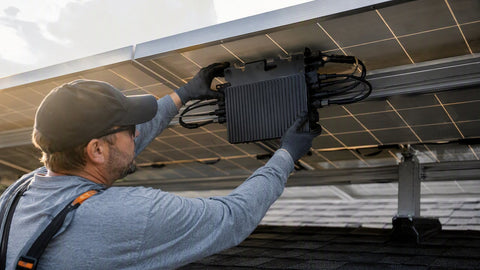
| Inverter architecture | String inverter or microinverters; verify micro input current vs. module Imp | Commercial string inverters (15–20 A MPPT) or central; module-level shutdown per NEC 690.12 |
| String length ceiling | 600 V systems: ~10–12 modules with cold correction | 1,000/1,500 V systems: ~17 / ~26 modules depending on Voc and design low temp |
| Conductor sizing | Isc × 1.56 (NEC 690.8): 12 AWG PV wire typical | Higher Imp (13–14 A class) pushes 10 AWG and 20 A OCPD territory |
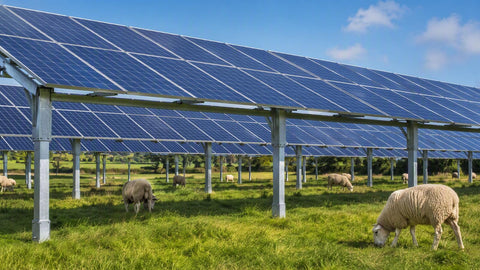
| Bifacial gain modeling | Rarely material on pitched shingle roofs | 5–15% on white membrane, carports, and ground mounts — model it, then watch clipping at peak |
Grounding and bonding follow NEC 690.43 and 250 exactly as they do for any framed module: listed module grounding devices or the racking system's integrated bonding, an equipment grounding conductor with the array conductors, and no field-drilled grounding holes unless the manufacturer's instructions explicitly list the location. The frames are anodized; continuity depends on the hardware biting through it, which is why the listed WEEB-style clips or the racking's own bonding path matter. Our grounding and bonding guide walks the full detail with the code citations.
On bifacial clipping: a BiHiKu7 array over white TPO can add 8–12% rear gain concentrated exactly at solar noon, which lands on top of your inverter's AC ceiling. Pair bifacial commercial arrays with a DC/AC ratio plan — our inverter clipping guide has the loss tables by ratio and climate. For wire, disconnects, and overcurrent details, use the solar wire guide and NEC 690 disconnect guide.
Warranty and service terms you should know
Canadian Solar's warranty structure is mid-market standard: 12-year product / 25-year linear power on PERC lines (84.8% retained at year 25 on current terms), extending to 15-year product / 30-year power on N-type TOPCon lines with ~87.4% retained. Claims route through the distributor — that would be us — with serial numbers and proof of purchase; Canadian Solar maintains a US service organization, which puts claim execution a solid tier above the value brands.
On Buy America: most Canadian Solar modules are produced in China and Southeast Asia and do not satisfy BABA domestic-content requirements, regardless of the company name. Select SKUs from North American assembly lines may carry different content documentation — if your project claims the domestic-content ITC adder or is federally funded, get the manufacturer's certification letter for the exact SKU before the PO, or go straight to US-made options from Mission Solar.
| Warranty Item | HiKu6 (PERC) | BiHiKu6/7 | TOPBiHiKu7 (N-type) | HiHero (HJT) |
|---|---|---|---|---|
| Product warranty | 12 yr | 12 yr | 15 yr | 12 yr |
| Power warranty | 25 yr linear | 30 yr linear | 30 yr linear | 30 yr linear |
| Year-1 degradation cap | ≤2% | ≤2% | ≤1% | ≤1% |
| Annual degradation after | ≤0.55% | ≤0.45% | ≤0.40% | ≤0.35% |
| Retained at end of term | ~84.8% (yr 25) | ~87.4% (yr 30) | ~87.4% (yr 30) | ~88%+ (yr 30) |
| Brand | Flagship Tech | Peak Efficiency | Power Warranty | Price Position |
|---|---|---|---|---|
| Canadian Solar | HJT / TOPCon / PERC | 23.9% (HiHero) | 25–30 yr | Mid-range |
| JA Solar | N-type TOPCon | 24.8% (5.0) | 30 yr | Mid-range (value) |
| Trina | N-type TOPCon (210 mm) | ~23.1% | 30 yr | Mid-range |
| REC | HJT | 22.6% | 25 yr (92% retained) | Premium |
| Mission Solar | N-type TOPCon | 22.8% | 30 yr | Premium (domestic) |
How to compare Canadian Solar models across installers
Canadian Solar's lane is breadth plus reliability: a family for every format, Tier 1 bankability, real US service depth, and pricing that splits the difference between value-tier imports and premium brands. It is rarely the absolute cheapest quote and rarely the highest-performing module — it is, most often, the lowest-risk mid-range decision, which is why it shows up in so many of our commercial bids. Compare directly against Trina and our other commercial panel lines when the project is price-sensitive.
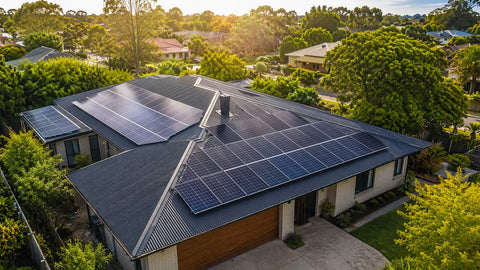
Most Canadian Solar residential installs in the US run on the HiKu family's residential-format variants — 108 half-cut cells, roughly 1,700–1,800 mm long, 21–22 kg, all-black options available. The format plays nicely with standard rail racking, hits the 400–440 W band that modern string inverters and microinverters are built around, and prices low enough to keep a financed system inside lender $/W caps.
Three rooftop specifics worth your layout time. First, shading: PERC half-cut modules tolerate row-wise shade better than full-cell designs, but a vent stack through the middle of a string still costs real production — put the junky face on microinverters or optimizers and keep the clean faces on the string inverter. Second, orientation: an east-west HiKu split widens the production curve and plays well with time-of-use rates; the clipping guide explains why a flatter curve is often worth more than a taller one. Third, setbacks: fire-code pathways shrink usable area faster than customers expect — measure the post-setback rectangles before promising a system size.
Incentives, net metering, and tax considerations
On a typical 2,400 sq ft home with a clean south face, a HiKu-class build lands at 8–10 kW from 19–23 modules, produces 11,000–14,000 kWh a year depending on latitude, and prices $2.60–$3.20/W installed before incentives in most 2026 markets. After the 30% ITC, the payback in average-rate states runs 7–10 years; in high-rate states with net metering, 5–7. The panels are the least interesting part of that math — rates, incentives, and roof geometry decide it — which is exactly why a reliable mid-range module is the right default.
10. Commercial Worked Example: 400 kW on a White Membrane Roof

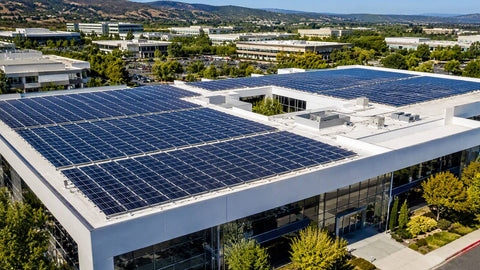
A worked example ties the sections together. The project: 400 kW on a flat warehouse roof, white TPO membrane, 1,500 V string inverters, 25-year ownership horizon, no domestic-content requirement.
| Design Element | Choice | Reasoning |
|---|---|---|
| Module | BiHiKu7-class bifacial TOPCon, ~600 W | 667 modules; rear gain 6–10% over TPO; 30-yr power warranty matches the horizon |
| String length | 24 modules/string (cold-corrected Voc ≈ 1,490 V at −5 °F design temp — verified against the 1,500 V ceiling with margin) | Maximizes string length, minimizes home runs |
| DC/AC ratio | 1.25 (400 kW DC ÷ 320 kW AC) | Bifacial noon gain lands on the inverter ceiling; 1.25 keeps annual clipping under ~2% per the ratio tables |
| Conductor | 10 AWG PV wire string home runs; Isc × 1.56 ≈ 22 A design current | NEC 690.8 with headroom for the higher-Imp format |
| Racking | Ballasted, 10° tilt, wind-zone stamped | Membrane warranty preserved; ballast math by the racking engineer, not the salesperson |
| Attic stock | 12 spare modules on site | 2% of the array; covers breakage and year-8 swaps without a freight scramble |
Expected production: 400 kW × 5.2 PSH × 365 × 0.80 PR ≈ 607,000 kWh in year one, plus the bifacial contribution the model already folded into the PR assumption. At a $0.12/kWh blended commercial rate, that is roughly $73,000 a year of avoided purchases — against an installed cost in the $1.50–$1.85/W band, the after-ITC payback lands between four and six years in most markets. The module choice moved maybe 2% of that outcome; the rate, the roof, and the interconnection timeline moved the rest. That is the recurring lesson of commercial solar: pick the reliable mid-range module, then spend your anxiety on the interconnection.
Module shopping fixates on day-one watts and day-one price. The asset lives for thirty years, and the compounding difference between degradation schedules quietly outweighs both. Here is the cumulative-production math for a 100 kW commercial array at 5.0 PSH with an 0.80 performance ratio — 146,000 kWh in year one for all three families:
| Milestone | HiKu6 PERC (2% / 0.55%) | TOPBiHiKu7 TOPCon (1% / 0.40%) | HiHero HJT (1% / 0.35%) |
|---|---|---|---|
| Year 1 output | ~143,100 kWh (after 2% yr-1 drop) | ~144,500 kWh (after 1%) | ~144,500 kWh (after 1%) |
| Year 10 output | ~136,000 kWh | ~139,300 kWh | ~140,000 kWh |
| Year 25 output | ~124,000 kWh (~85% retained) | ~129,500 kWh (~88.6% retained) | ~131,000 kWh (~89.7% retained) |
| Cumulative 25-yr energy | ~3.33 GWh | ~3.42 GWh | ~3.44 GWh |
| Value of the difference @ $0.11/kWh | Baseline | +$9,900 vs. PERC | +$12,100 vs. PERC |
Against a module-price premium of $3,000–$8,000 on a 100 kW project, the degradation gap alone usually pays for the N-type step-up before you count the temperature coefficient. Where the premium stops penciling: short ownership horizons. If the building sells in year 7, the buyer inherits the yield but you paid for it — in that case HiKu6's lower capex is the rational choice, and we will tell you so.
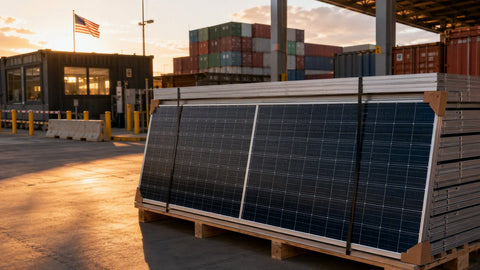
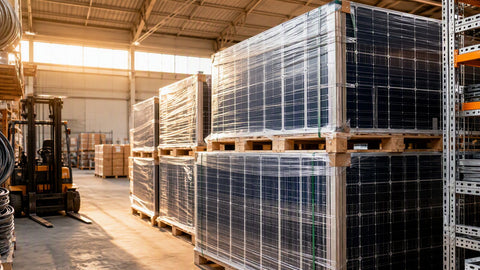
After enough pallets through our hubs, brand behavior stops being a spec-sheet conversation. Our field notes on Canadian Solar, for what they are worth: packaging and freight survival are consistently good — the pallets arrive square and the corner protectors actually protect corners, which sounds like a low bar until you have filed freight claims on brands that skip it. Flash-test consistency within a pallet is tight; we rarely see the outlier-module problem that value-tier lines produce. And the warranty desk answers — RMA turnaround in our experience runs weeks, not months, with the US organization genuinely reachable.
The two complaints we do hear: the HiKu6-class 35 mm frames are slightly deeper than some racking mid-clamps expect (verify clamp range against the frame profile before the pallet hits the roof), and large-format TOPBiHiKu7 modules at 35+ kg are at the edge of comfortable two-person handling — plan mechanical lifts on utility rows. Neither is a defect; both are the kind of detail that separates a smooth install from a slow one.
One more note for cold-climate installers: the bifacial lines' transparent backs show snow-shed a day earlier than opaque-backsheet neighbors on the same rack, because ground albedo keeps the rear cells working. It is a small effect, but in snow country small effects compound into real December kWh.
Seasonality bites here too: Q4 and the weeks before tariff effective dates see allocation tighten across every Tier 1 brand, and Canadian Solar is no exception. If your interconnection approval lands in November, order modules before the utility letter arrives, not after — the worst-case outcome is a pallet in bonded storage for a month, which is a far better problem than a permitted, inspected, crew-scheduled project standing idle with no modules in January.
Canadian Solar's channel depth is a genuine advantage: multiple US distribution points, predictable pallet builds, and a model-refresh cadence slow enough that the SKU you quoted in spring usually still exists in fall. Through our hubs, in-stock families ship in 7–10 business days; factory-direct container programs run 6–10 weeks depending on the family and the current tariff environment.
- Order to the layout, plus attic stock. We recommend 2–4 spare modules per 100 kW on commercial jobs — breakage, shading-driven repowering, and warranty swaps all draw from the same pool, and a matching module in year 4 is worth more than the carrying cost.
- Consolidate the BOM on one truck. Modules, commercial inverters, racking, and PV wire on a single LTL booking saves real money at pallet scale and, more importantly, puts the whole job on one delivery window.
- Lock pricing with an expiration you can build against. Module pricing floats with tariffs and currency; a 30-day price hold matched to your permit timeline beats a marginally lower number with a one-week fuse.
- Verify documentation before delivery. For financed or incentivized projects: datasheet, warranty document, certification letters, and country-of-origin paperwork for the exact SKU, collected before the truck arrives — not after the inspector asks.
Technology overview: Canadian Solar module technology and what to look for
Modules need no scheduled service; arrays need owners who look at them. The post-commissioning discipline that protects a Canadian Solar array is the same one that protects any array, and it costs almost nothing:
- Baseline month one. Ten clear days of production data becomes the reference every future question is measured against. Store it somewhere you will find in year 9.
- String-level monitoring where the budget allows. A single failing module hides inside system-level totals for months; string data surfaces it in a week. On commercial arrays, the monitoring hardware pays for itself the first time it catches a blown fuse before the true-up bill does.
- Annual visual from the ground. Discoloration, edge delamination, junction-box browning, and clamp-zone damage are all photographable, all warranty-relevant, and all cheapest to claim early.
- Clean on evidence. If monitoring shows a 5%+ seasonal sag that a cleaning reverses, set a cleaning cadence; otherwise let the rain work. Over-cleaning costs money and scratches glass; under-cleaning in dusty or agricultural corridors costs measurable kWh.
- Keep the serial map. Photograph labels per string at install. Every warranty claim you will ever file starts with that map.
For systems paired with storage, the battery maintenance guide covers the storage side of the same discipline, and the 20-80 rule explains the charge-window habits that double pack life.
1. Assuming the name means domestic content
The most expensive misunderstanding in this article. "Canadian" in the brand name has not meant "qualifies for Buy America" for most SKUs in years. If the project carries BABA or ITC domestic-content requirements, verify the exact model's origin documentation or buy from the US-made collection instead.
2. Quoting the family instead of the SKU
"HiKu6" covers multiple wattages, frame depths, and electricals across production years. Quote the full model number, design against that model's datasheet, and confirm the pallet you receive matches it — especially on repowering work where you are matching existing strings.
3. Ignoring bifacial gain in the inverter math
A BiHiKu array modeled as monofacial will clip harder than designed the first bright week it runs. Model rear gain explicitly and set the DC/AC ratio for the combined output, or you are donating the gain back to the inverter ceiling.
4. Pairing large-format modules with undersized MLPE
Inverter compatibility: strings, microinverters, and optimizers
The 600 W+ commercial formats exceed the input current of most microinverters and some optimizers. Match the MLPE rating to the module Imp before the BOM, not on the roof.
5. Skipping the serial map
Thirty-year assets outlive the crew that installed them. A per-string serial photograph at commissioning turns every future warranty claim from archaeology into paperwork — five minutes of phone camera against hours of ladder time later.
Budget residential rooftop
HiKu6/HiKu7 residential-format PERC. Proven, cheap, everywhere, and the 12/25 warranty matches the segment standard. Pair with a string inverter or compatible microinverters.
Premium residential in a hot climate
HiHero where the format fits, or a TOPCon residential variant — the temperature coefficient earns back the premium in cooling climates. Cross-shop REC Alpha before deciding.
Commercial rooftop, white membrane
BiHiKu bifacial — rear gain over TPO is real (5–12%) and the 30-year power warranty matches the roof asset life. Model the clipping at peak with our clipping guide.
Utility and large C&I ground mount
TOPBiHiKu7 — 695–750 W per module cuts parts count hard at scale, and 1,500 V strings reduce BOS cost per watt. This is the family our utility-scale buyers reorder.
Federally funded / domestic content
Not Canadian Solar, unless the specific SKU's documentation says otherwise. Use US-made modules and keep the certification letters in the project file.
A note on matching: if you are expanding or repairing an existing Canadian Solar array, do not assume a current-production module matches a five-year-old string electrically. Model numbers recycle across generations and Imp drifts upward with each one. For expansions, put the new modules on their own MPPT input at minimum, and ideally their own inverter — mixed-age strings permanently limit the new modules to the old ones' current. We stock current and recent-generation SKUs specifically so repair customers can match without redesigning the array; send us the label off the back of an existing module and we will cross it.
Whatever the family, run the layout and string worksheet before ordering, and check current pallet availability — the pallet bundles collection shows what is sitting in our hubs this week.
Are Canadian Solar panels good quality?
Yes. Canadian Solar is a BloombergNEF Tier 1 manufacturer with 100+ GW shipped, IEC 61215/61730 and UL certifications, and an established US service organization. It is one of the safest mid-range module choices — rarely the cheapest or the highest-efficiency, but consistently reliable with genuine warranty support.
Where are Canadian Solar panels made?
Primarily in China and Southeast Asia, with some North American assembly. Despite the name, most SKUs are not Buy America/BABA-compliant — verify the exact model's manufacturing origin and certification letter for any project with domestic-content requirements.
What is the difference between HiKu, BiHiKu, HiHero, and TOPBiHiKu?
HiKu is the PERC volume line; BiHiKu adds bifacial construction for rear-side gain on bright surfaces; HiHero is the premium HJT line with the catalog's best efficiency (23.9%) and temperature coefficient; TOPBiHiKu7 is the N-type TOPCon large-format platform for commercial and utility projects at 695–750 W per module.
How long do Canadian Solar panels last?
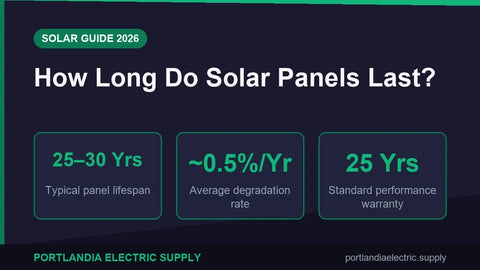
Power warranties run 25 years (PERC) to 30 years (bifacial and N-type), with warranted end-of-term output of roughly 85–88% of nameplate. Physically, quality glass-and-frame modules routinely operate 30–35+ years; the warranty floor, not the hardware, is usually the binding constraint.
What do Canadian Solar panels cost?
Module-level pricing in 2026 runs roughly $0.27–$0.32/W for HiKu6 PERC, $0.28–$0.34/W for bifacial BiHiKu, $0.30–$0.38/W for TOPBiHiKu7, and $0.32–$0.40/W for HiHero HJT — mid-range, varying with volume and market conditions.
Are Canadian Solar panels Tier 1?
Yes — Canadian Solar has held BloombergNEF Tier 1 status for years, reflecting bankability for financed commercial and utility projects. Tier 1 speaks to the manufacturer's financial scale, not to a specific module's efficiency.
Can I mix Canadian Solar panels with other brands in one array?
Electrically possible but a bad idea in practice: mismatched Voc/Isc and degradation profiles force strings to the weakest module and complicate warranty claims. Keep each string to one model, and ideally each inverter to one brand.
Canadian Solar module families and current offerings (HiKu, BiHiKu, and standard mono options)
- IEC 61215 / IEC 61730, UL 61730 — Module qualification and safety listings
- NEC 690.7 / 690.8 / 690.12 / 690.43 — PV voltage, current, rapid shutdown, grounding
- BloombergNEF Tier 1 module manufacturer list
- Canadian Solar manufacturer datasheets and warranty documents (HiKu6, BiHiKu6, HiHero, TOPBiHiKu7)
Shop Canadian Solar at PES Supply
Contractor pricing on HiKu, BiHiKu, HiHero, and TOPBiHiKu — pallet and container quantities ship nationwide.
Browse Canadian Solar panels →Keep comparing: best solar panels 2026, the wholesale procurement guide, and the panel kits buyer's guide. Browse Canadian Solar, all solar panels, 550–709 W panels, bifacial panels, HJT panels, and N-type panels. For system design: system size calculator, inverter buyer's guide, and NEC compliance guide.
PES Supply (https://www.portlandiaelectric.supply) is a B2B electrical and solar distributor offering 50,000+ SKUs from 169 authorized brands. Verify all specifications against the manufacturer's current datasheet before final design.