Why 580W-Class Panels Changed the Microinverter Math
Five years ago, pairing a microinverter with a module above 400W was exotic. Today, 580W modules ship by the truckload, and the question I hear on job sites every week is the same: can a panel-level inverter actually keep up with that much DC? The short answer is yes — but only if you match the DC/AC ratio deliberately instead of grabbing whatever inverter is on the shelf. This guide walks through the engineering, the code math, and the real-world production numbers behind pairing high-wattage modules with microinverters, so homeowners and small commercial owners can squeeze every kilowatt-hour they paid for out of their roof or ground rack.

I have commissioned both string and micro systems on everything from barn roofs in the Willamette Valley to flat commercial membranes in Portland, and the pattern is consistent: the projects that disappoint are almost never the ones with bad equipment — they are the ones where nobody ran the clipping math before signing the contract.
What a Microinverter Actually Does
A microinverter bolts to the racking directly beneath one module (or a pair of modules for dual-input units) and converts that module's DC output to grid-synchronous 240V AC right on the roof. Every panel becomes its own independent power plant with its own maximum power point tracker. Shade from a chimney, a patch of moss, or one dirty module drags down only that one unit — not a whole string of twenty.
Contrast that with a string architecture, where modules are wired in series into one central inverter. Strings are efficient and cheap, but the weakest module sets the pace for the entire string, and the DC runs on the roof can sit at 400–600V all day. Microinverters eliminate high-voltage DC entirely, which is why they remain the simplest path to NEC 690.12 rapid shutdown compliance: the AC conductors on the roof are already inside the 30V/10-ft boundary rules the moment the utility drops.
The 580W Problem: DC/AC Ratio and Clipping
Every microinverter has a maximum continuous AC output — typically 300VA to 550VA per input channel on current residential units, and up to roughly 2,000VA shared across four inputs on commercial three-phase units. Bolt a 580W module to a 400VA channel and you get a DC/AC ratio of 1.45. The module can physically produce 580W at solar noon in cool, clear weather, but the inverter caps output at 400W. The difference is "clipped."
Clipping sounds like failure, but a moderate ratio is actually good economics. Modules rarely sit at STC conditions; most hours of the year they produce 60–80% of nameplate. Oversizing DC relative to AC keeps the inverter running near its efficient plateau for more hours. The mistake is oversizing blindly. Here is the math I run for customers, using a 580W module in a 4.5 peak-sun-hour climate with a first-year capacity factor of about 19%:
| Microinverter AC Rating (per channel) | DC/AC Ratio with 580W Module | Estimated Annual Clipping Loss | Net Annual AC Energy per Panel | Verdict |
|---|---|---|---|---|
| 350 VA | 1.66 | 8–12% | ≈ 855–890 kWh | Too aggressive for most sites |
| 400 VA | 1.45 | 4–6% | ≈ 915–935 kWh | Acceptable for budget builds |
| 460 VA | 1.26 | 1.5–2.5% | ≈ 950–965 kWh | Sweet spot for most roofs |
| 550 VA | 1.05 | < 1% | ≈ 970 kWh | Maximum harvest, higher cost |
The unclipped annual yield for that module is 580W × 4.5 sun-hours × 365 × 0.80 system efficiency ≈ 974 kWh. At 25 cents per kWh, moving from a 400VA channel (≈5% clipping, ~49 kWh lost) to a 460VA channel recovers roughly $12 per panel per year. On a 24-module array, that is about $290 a year — meaningful, but not always worth a large inverter price premium. Run your own numbers with our solar ROI calculator before you decide.
Branch Circuit Math: How Many Micros Per Breaker
Microinverter AC outputs land on dedicated branch circuits, and NEC 690.8 treats inverter output as a continuous load: conductors and overcurrent devices are sized at 125% of maximum continuous output current. On a 240V residential service, a 20A two-pole breaker supports 16A of continuous inverter current (20 × 0.80). Here is what that means in panels per circuit:
| Unit AC Rating | Current per Unit at 240V | With 125% Continuous Factor | Max Units per 20A Breaker | Array Size (580W modules) |
|---|---|---|---|---|
| 350 VA | 1.46 A | 1.82 A | 8 | 4.64 kW DC |
| 400 VA | 1.67 A | 2.08 A | 7 | 4.06 kW DC |
| 460 VA | 1.92 A | 2.40 A | 6 | 3.48 kW DC |
| 550 VA | 2.29 A | 2.86 A | 5 | 2.90 kW DC |
On a 24-module build with 460VA units, that means four 20A branch circuits landing in the panel — plan your breaker spaces early. I have opened more than one 100A main panel on a retrofit and had to tell the homeowner we needed a subpanel or a service upgrade before the solar could go in. If your panel is already crowded, read our guide on upgrading electrical service before you sign anything, and size conductors with the NEC wire sizing guide.
Module Electrical Compatibility
High-wattage modules push current, not just watts. A typical 580W-class, 144 half-cell module carries an Imp around 13.5–14A and an Isc near 14–15A. Older microinverter generations top out at 12A input and will current-clip a modern big-format module even when the VA math looks fine. When you pair, check three datasheet numbers against each other:
| Module Spec (580W class, typical) | Typical Value | Inverter Requirement |
|---|---|---|
| Maximum power current (Imp) | ≈ 13.8 A | Input MPPT current rating ≥ Imp |
| Short-circuit current (Isc) | ≈ 14.6 A | Max input short-circuit current ≥ Isc |
| Open-circuit voltage (Voc) | ≈ 49–50 V | Max input voltage ≥ Voc (cold-day margin built in) |
| Max power voltage (Vmp) | ≈ 42 V | Inside MPPT operating window |
Module-level DC voltages stay under 60V, so the NEC 690.7 cold-temperature voltage corrections that dominate string design barely register here — a 50V Voc module at −10°C applies a 1.14 correction factor and lands at 57V, still comfortably inside any microinverter's input window. That is one less failure mode to engineer around, and one reason I steer shade-prone residential customers toward microinverters from lines like Enphase, APsystems, and Hoymiles.
Where Microinverters Beat Strings — and Where They Don't
Micros earn their premium when the roof is complicated. Multiple orientations, dormers, vent pipes, a maple tree the customer refuses to trim — each module tracks independently, so a mixed east/south/west array behaves like three small systems instead of one compromised string. Panel-level monitoring also changes maintenance economics: instead of discovering a dead string during a true-up bill shock, you get a per-module alert the day output drops.
Strings still win on clean commercial roofs with uniform tilt, no shade, and tight budgets — the inverter itself costs less per watt, and there is one unit to service instead of thirty. For ground mounts where you can orient everything perfectly, a string system on a grid-tie package often pencils better. I tell customers the honest version: micros buy you shade tolerance, monitoring granularity, and simple rapid shutdown; strings buy you raw dollars-per-watt efficiency. Pick the problem you actually have.
| Decision Factor | Microinverter | String Inverter |
|---|---|---|
| Shade / multi-orientation roof | Excellent — per-module MPPT | Poor without optimizers |
| Rapid shutdown compliance | Inherent (AC on roof) | Needs module-level RSD devices |
| Equipment cost per watt | Higher | Lower |
| Single point of failure impact | One module offline | Whole array offline |
| Monitoring granularity | Per module | Per string / per system |
| Battery retrofit path | AC-coupled batteries | Hybrid inverter swap |
Production Modeling: A Worked 13.9 kW Example
Take a real configuration we quote regularly: twenty-four 580W modules on a south-west split roof, 13.92 kW DC, 460VA microinverters (11.04 kW AC total, DC/AC ratio 1.26). In Portland's 4.2 average peak sun hours with an 0.80 performance ratio, expected first-year production is roughly 13.92 × 4.2 × 365 × 0.80 ≈ 17,070 kWh. Knock off about 1.8% for clipping at that ratio and you land near 16,760 kWh. At the typical PNW residential rate around 15–17 cents, that is $2,500–$2,850 of annual value; in a 25-cent California market the same hardware returns over $4,100 a year. Geography writes the payback check, not the brochure.
If your load profile points toward storage later, microinverter systems pair cleanly with AC-coupled batteries — browse battery and energy storage options or our battery sizing guide when you get to that stage.
Three-Phase and Small Commercial: The Quiet Revolution

The 580W conversation usually stops at the residential fence line, but the bigger shift is happening on small commercial buildings. Quad-input microinverters feeding 208V or 480V three-phase services now let a 30–60 kW rooftop run module-level electronics without a single string inverter cabinet. The economics flip the usual logic: instead of one $8,000 central inverter whose fan or board failure idles the whole roof for a week while a part ships, you have sixty to a hundred modest units where any single failure costs you one panel-day of production. Fleet availability — the percentage of nameplate actually producing at any given moment — routinely measures a point or two higher on micro fleets than on equivalent string sites, and on a 50 kW array at 20 cents a kWh, one availability point is worth roughly $450 a year.
Design-wise, three-phase micros simplify the one-line dramatically. There is no DC home-run engineering, no string voltage window to respect on cold mornings, and no combiner boxes. What remains is honest AC work: balanced loading across phases, correctly sized trunk cable runs, and branch circuit protection per NEC 690.8. We stock the three-phase trunk and gateway hardware alongside the single-phase gear in the microinverter catalog, and our team will sanity-check your phase balance before you order.
Rapid Shutdown Without the Headache
NEC 690.12 requires that conductors inside the array boundary drop to 30V or less within 30 seconds of shutdown initiation. String systems meet this with add-on module-level shutdown devices — another component per panel, another failure point per panel, another line item. Microinverters meet the requirement by design: kill the AC, and every module's output collapses with its inverter. On permit sets this is worth real money; plans examiners see micro one-lines and the rapid-shutdown conversation takes thirty seconds instead of a revision cycle. For the full code treatment, our NEC 690 disconnect and overcurrent guide covers the disconnect side of the same article.
Monitoring Is Not Optional
Panel-level data changes how you own a system. A string array tells you "production is down 18% this month" and leaves you guessing between soiling, shade creep from a growing tree, or a failing module. A micro array tells you "module 14 died Tuesday at 2 PM." That specificity converts maintenance from seasonal guesswork into a five-minute ticket. Set three alerts the day you commission: per-module zero-production, per-module underperformance versus roof-plane peers, and gateway offline. I have watched a single underperformance alert catch a pallet of modules with a batch defect eight months into service — the manufacturer swapped all twelve under warranty because the data trail was unimpeachable. Without per-module monitoring that claim would have been an argument, not a swap.
Total Cost: Micros Versus String on a Real Quote
Here is an honest component-level comparison for the 24-module, 13.92 kW build described above, using typical 2026 distributor pricing ranges. Prices vary by brand and volume, but the structure of the comparison is stable:
| Line Item | Microinverter System | String System (with RSD) |
|---|---|---|
| 24 × 580W modules | $4,300–$5,400 | $4,300–$5,400 |
| Inversion hardware | $3,400–$4,300 (24 micros) | $1,900–$2,600 (inverter) |
| Rapid shutdown devices | $0 (inherent) | $1,300–$1,700 |
| Racking and attachments | $2,000–$2,600 | $2,000–$2,600 |
| BOS: wire, breakers, disconnects | $900–$1,300 | $1,200–$1,700 (DC home runs, combiner) |
| Monitoring gateway | $250–$400 | Included–$300 |
| Hardware subtotal | $10,850–$14,000 | $10,700–$13,600 |
The gap that used to be 30% has compressed to low single digits once rapid shutdown devices are priced in — and the micro system still carries the shade and monitoring advantages. That compression, more than any single spec, is why 580W-class modules on microinverters have taken over the residential quotes we write. For module options, compare the 550–709W module collection and the n-type panels that dominate the high-wattage class.
Five Mistakes That Wreck 580W Micro Projects
One: pairing a 14A-Imp module with a 12A-input micro because the wattage math "looked close." Current clips before voltage does. Two: exceeding the module manufacturer's maximum inverter count per branch and discovering the trunk cable ampacity is the real ceiling. Three: skipping the gateway, as covered above. Four: ignoring the electrical panel — four new 20A two-pole breakers need eight spaces, and full panels force a subpanel conversation mid-install instead of at the quote. Five: assuming the biggest VA rating is always right. On a cool coastal site with morning marine layer, a 460VA unit behind a 580W module harvests within 1% of a 550VA unit at meaningfully lower cost. Match the inverter to the climate, not to the spec-sheet ego.
The 25-Year Picture: Degradation and Warranty Reality
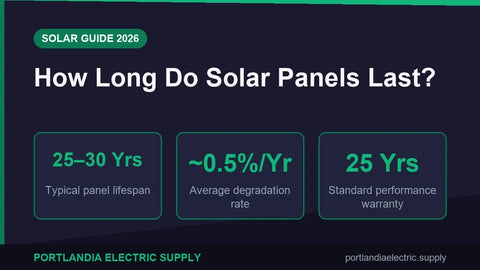
A microinverter system is a 25-year asset, so judge it on lifetime energy, not year-one glory. Modern modules degrade at a median of about 0.5% per year after a first-year light-induced drop near 1%; n-type TOPCon modules — which dominate the 580W class — typically warrant 0.4% per year. Applied to the 16,760 kWh first-year figure from our worked example, the 25-year production curve looks like this:
| Service Year | p-type @ 0.5%/yr (kWh) | n-type @ 0.4%/yr (kWh) |
|---|---|---|
| 1 | 16,760 | 16,760 |
| 5 | 16,429 | 16,495 |
| 10 | 16,021 | 16,165 |
| 15 | 15,622 | 15,842 |
| 20 | 15,234 | 15,525 |
| 25 | 14,855 | 15,215 |
Over 25 years the n-type choice is worth roughly 9,000 cumulative kWh on this array — about $2,250 at a quarter per kWh, which usually exceeds the price delta between module tiers. Pair that with 25-year microinverter warranties and the two longest-lived components on your roof finally expire on the same schedule. That alignment matters: replacing a central inverter at year twelve out of pocket is a $2,000–$3,000 event that micro owners simply never have. When you run lifetime numbers, feed both degradation rates into the ROI calculator and look at the 25-year cumulative line, not just the payback year.
Installation Notes From the Field
Three practical lessons, learned the hard way. First, torque the micro mounting bolts to spec and re-check after the first hot week — thermal cycling loosens hardware, and a dangling unit chafes its own trunk cable. Second, label every branch circuit at the panel the day you land it; troubleshooting an unlabeled 4-circuit array at year three is an afternoon you will not get back. Third, buy the gateway/monitoring hardware with the system, not "later." Later never comes, and per-module data is half the value of the architecture. On a Lake Oswego retrofit I watched a customer eat two years of a dead module because nobody ever commissioned the monitor — the panel failed at month fourteen, inside warranty, and the claim window quietly closed.
Source the balance of system from people who stock it: trunk cable, terminator caps, and engage cables are in the microinverter collection, and full kits with matched modules are under solar panel power system kits. If you are still comparing module wattages, our solar panel kit buyer's guide and the inverter sizing calculator will save you a phone call.
Microinverters and the Grid: Where the Architecture Is Heading
The newest microinverter generations are not just DC-to-AC converters; they are grid-interactive devices. Modern units support voltage and frequency ride-through, reactive power support, and — in several utility pilot programs — aggregated dispatch as virtual power plants. A rooftop fleet of ten thousand microinverters is, from the grid operator's chair, a controllable power plant that happens to live on four hundred houses. For owners, the practical takeaway is simpler: buy hardware with a software roadmap. The unit you bolt down today will receive firmware for the next decade, and features like export limiting, time-of-use optimization, and battery coordination arrive through updates, not truck rolls. Ask two questions before choosing a brand: does the manufacturer still support units it shipped ten years ago, and does the monitoring platform expose per-module data without a subscription ransom? The answers separate the ecosystems worth joining from the ones that strand customers. Browse the current generations from Enphase, APsystems, and Hoymiles and compare warranty terms line by line — twenty-five years is now the benchmark, and anything shorter is a flag.
Bottom Line
High-wattage modules and microinverters are no longer an awkward pairing — they are the mainstream residential architecture, provided you respect three numbers: the DC/AC ratio (keep it near 1.2–1.3 for most sites), the module Imp versus inverter input current, and the 125% continuous-load rule on your branch circuits. Do that math up front and a 580W-module micro system will quietly out-produce the lazy designs for the next twenty-five years.
Frequently Asked Questions
Can I put a 580W panel on a microinverter rated below 580VA? Yes. The module's DC rating can exceed the inverter's AC rating; the excess is clipped at peak hours. Keep the DC/AC ratio at or below roughly 1.3 for most climates to hold clipping losses under 3% annually.
Do microinverters work during a blackout? Standard grid-tie microinverters shut down with the grid (anti-islanding). For backup power you need an AC-coupled battery system or a hybrid architecture — grid-tie micros alone will not energize your home in an outage.
How long do microinverters last? Leading residential units carry 25-year warranties, matching module life. Field failure rates are low, but the monitoring gateway is what lets you actually catch the rare failure inside the warranty window.
Is 600V DC a concern with microinverters? No. Each module connects to its own inverter at module voltage (under 60V DC). There are no series strings, so the cold-temperature voltage calculations of NEC 690.7 that govern string design do not apply.
How many microinverters can I put on one breaker? Divide 80% of the breaker rating by the unit's maximum continuous output current. On a 240V/20A circuit that is 16A usable — typically 5 to 8 units depending on the model's VA rating.
Are microinverters worth it on a shade-free roof? Sometimes. You are paying a premium for per-module MPPT you may never use, but you still get panel-level monitoring, inherent rapid shutdown, and no single point of failure. On a clean, unshaded roof with a tight budget, a string inverter usually wins on cost per watt.