The first time you land a 480V three-phase feeder, torque the lugs, and watch a 50-horsepower rooftop unit spin up without a flicker, single-phase starts to feel like a toy. We've pulled thousands of feet of 3/0 through EMT on commercial roofs, and the reason three-phase dominates everything bigger than a house isn't tradition — it's arithmetic. Three conductors carrying phase-shifted AC deliver more power with less copper, smoother motor torque, and smaller, cheaper equipment than any single-phase arrangement of the same capacity. This guide is the working version: the math you'll actually use, the configurations you'll actually meet in the field, and the NEC tables you'll size against.
What Three-Phase Power Actually Is
A three-phase system carries three AC waveforms on three conductors, each offset by 120 electrical degrees. That offset is the whole trick. In single-phase power, the instantaneous power delivered pulses — twice per cycle it passes through zero. Every motor, compressor, and transformer on single-phase feels that pulse as vibration and torque ripple. In three-phase, the three waves' peaks are staggered so that total instantaneous power is essentially constant. No pulses, no dead spots. A three-phase motor runs smoother, starts under load without capacitors, and delivers about 1.73× the power of a comparably sized single-phase machine.
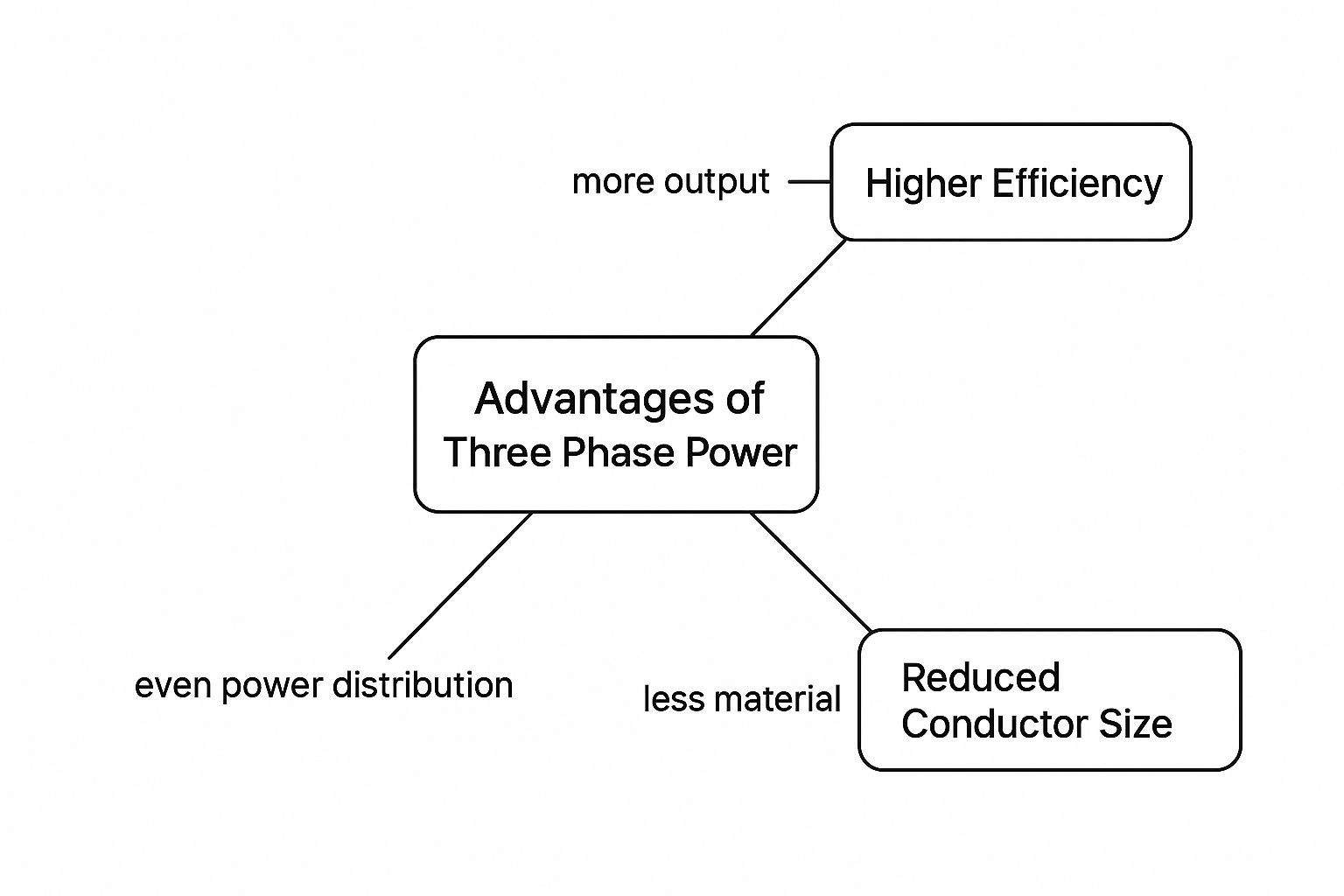
The constant-power property also shrinks the wire. Delivering a given amount of three-phase power takes roughly 75% of the conductor metal of the equivalent single-phase job — the same reason transmission lines, service drops to commercial buildings, and every industrial facility on earth run three-phase. When a building's load grows past what 240V single-phase can economically feed — typically around 100–200A of continuous commercial load — the utility's answer is a three-phase service, and the building's electrical infrastructure changes character from that day forward.
The Math You'll Actually Use
One formula runs the whole three-phase world:
P (watts) = √3 × Vline-to-line × I × power factor, where √3 ≈ 1.732.
Rearranged for the question we answer most often — "what size breaker and wire does this load need?" — current is I = P ÷ (√3 × V × PF). Worked examples at unity-ish power factor (0.95, typical for modern motor loads with decent correction):
| Load | Voltage | Calculation | Full-load current | Continuous-sized breaker (125%) |
|---|---|---|---|---|
| 10 kW | 208V 3φ | 10,000 ÷ (1.732 × 208 × 0.95) | 29.2A | 40A (36.5A rounds up per NEC 240.6) |
| 10 kW | 480V 3φ | 10,000 ÷ (1.732 × 480 × 0.95) | 12.7A | 20A |
| 25 kW | 208V 3φ | 25,000 ÷ (1.732 × 208 × 0.95) | 73.1A | 100A |
| 25 kW | 480V 3φ | 25,000 ÷ (1.732 × 480 × 0.95) | 31.7A | 40A |
| 50 kW | 480V 3φ | 50,000 ÷ (1.732 × 480 × 0.95) | 63.3A | 80A |
| 100 kW | 480V 3φ | 100,000 ÷ (1.732 × 480 × 0.95) | 126.6A | 175A |
| 200 kW | 480V 3φ | 200,000 ÷ (1.732 × 480 × 0.95) | 253A | 350A (with conductor ampacity check) |
Notice the 208V rows: the same load at 208V draws 2.3× the current it draws at 480V, which means heavier wire, bigger conduit, more voltage drop, and more heat. That's why commercial buildings standardize on 480Y/277V for distribution and step down locally — and why a 100 kW load that needs 350A-class gear at 480V would need 800A-class gear at 208V. Voltage is the cheapest ampacity you'll ever buy.
For quick conversions in the other direction — nameplate amps to kilowatts — our amps-to-watts calculator handles both single- and three-phase math, and it's faster than digging out the formula on a lift.
Wye vs. Delta: The Configurations You'll Actually Meet
| Configuration | Voltages available | Neutral? | Where you'll find it | Field notes |
|---|---|---|---|---|
| 208Y/120V | 208V L-L, 120V L-N | Yes | Offices, schools, smaller commercial | Most common light-commercial service; receptacles at 120V, motors at 208V |
| 480Y/277V | 480V L-L, 277V L-N | Yes | Large commercial, industrial, big solar interconnections | 277V lighting, 480V motors; step-down transformers feed 120V panels |
| 240V Delta | 240V L-L | No (or high-leg) | Older industrial, some rural services | Watch for the high-leg variant below |
| 240V High-Leg Delta | 240V L-L, 120V L-N on two legs, 208V to neutral on the "wild" leg | Yes, center-tapped | Older mixed-use buildings | The B-phase to neutral reads ~208V — land no 120V loads on it; NEC 408.3(E) requires it marked orange |
| 480V Delta | 480V L-L | No | Older industrial plants | Corner-grounded variants exist; verify before touching anything |
The high-leg delta deserves its own warning because it bites someone new every month: on a 240V high-leg system, two of the three phases read 120V to neutral and the third — the high or "wild" leg — reads about 208V to neutral. Land a 120V circuit on that leg and you'll cook whatever's plugged in. The code requires the high leg to be identified with orange marking, but in panels from the 1970s you'll find it identified with nothing at all. Meter every leg to neutral before you terminate anything. Every time. We've seen a trainee take out a strip of brand-new LED drivers in one afternoon this way — a $900 lesson in thirty seconds of meter work not done.
Single-Phase vs. Three-Phase: The Honest Comparison
| Dimension | Single-phase (120/240V) | Three-phase (208Y/480Y) |
|---|---|---|
| Power delivery | Pulsing (passes through zero 120×/sec) | Essentially constant |
| Motor starting | Needs capacitors/start windings | Self-starting, full torque |
| Copper for same power | 100% | ~75% |
| Typical service sizes | 100–400A residential/light | 200A–4000A+ commercial/industrial |
| Equipment size for same HP | Larger, heavier, pricier per kW | Smaller, lighter, cheaper per kW |
| Efficiency at scale | Lower | Higher (motors 2–5 points better) |
| Where it's standard | Homes, small shops | Everything commercial/industrial |
Why Motors and Heavy Loads Demand It
Open any commercial mechanical room and count: rooftop HVAC units, pumps, compressors, air handlers, elevators. Past about 5 HP, the equipment world assumes three-phase. A 10 HP single-phase motor exists, but it's a boat anchor — physically large, expensive, and hard to start. The same 10 HP in three-phase is a catalog item that starts across the line without drama. The constant-torque property also shows up on the utility bill in the form of efficiency: three-phase motors typically run two to five efficiency points better than single-phase equivalents, and across a building full of motors, that difference is real money every month for decades. There's a reliability angle too: with no start winding or centrifugal switch to fail, a three-phase motor's weak points reduce to bearings and insulation. Maintenance teams that migrate a plant from single-phase machines to three-phase routinely watch motor-related downtime fall by half — fewer parts, less heat, less vibration, longer life.
Variable frequency drives complicate the picture usefully: a VFD synthesizes three-phase from single-phase input for smaller motors (typically up to 3–5 HP, some larger), which is how rural shops run three-phase equipment on single-phase service. A VFD isn't a substitute for a three-phase service at building scale, but for a single machine it's often the economical answer — and as a bonus it soft-starts the motor and trims energy at partial load. Two VFD cautions from the field: output wiring between drive and motor belongs in shielded or conduit-run cable kept away from control wiring, because the drive's fast-switching output couples noise into everything nearby; and long motor leads (past ~100 feet, sooner on 480V) can need dV/dt filters to protect motor insulation from reflected-wave voltage spikes. Skip the filter on a 300-foot run to a rooftop fan and you'll be replacing that motor's bearings and windings on a schedule, not a failure basis.
Where You'll Meet Three-Phase in 2026 Projects
- Commercial solar: C&I arrays interconnect at 208Y/120 or 480Y/277 three-phase almost universally. The newest commercial microinverters — Enphase's IQ9N-3P, GaN-based, 480Y/277V native, 97.5% efficiency, shipping since December 2025 — exist precisely because the commercial roof is a three-phase world. String inverters for C&I have been three-phase for two decades. See our commercial panels and inverter inventory for current options.
- EV fast charging: DC fast chargers and even 19.2 kW AC Level 2 units are three-phase loads; a bank of four DCFC stalls is a megawatt-class three-phase service conversation.
- Standby generation: commercial generators are specified in three-phase for exactly these services — a 150 kW standby unit at 480V 3φ delivers about 225A, manageable with 4/0 copper; at 240V single-phase it would need over 700A of conductor, which is absurd.
- Battery storage at commercial scale: PCS (power conversion systems) for C&I storage interconnect three-phase; residential-style single-phase batteries give way to three-phase cabinets above roughly 30 kW. Browse energy storage systems for the current line-up.
- Manufacturing and process loads: CNC, compressors, welders — the entire industrial base.
Sizing Conductors: The NEC Tables You Size Against
Conductor sizing starts at NEC Table 310.16 (2023 edition numbering; the 2026 cycle keeps the same table structure). The 75°C copper column governs most terminations, since equipment lugs are typically rated 75°C:
| Copper AWG/kcmil | Ampacity @ 60°C | Ampacity @ 75°C (typical lug rating) | Ampacity @ 90°C (derating base) |
|---|---|---|---|
| 14 | 15 | 20 | 25 |
| 12 | 20 | 25 | 30 |
| 10 | 30 | 35 | 40 |
| 8 | 40 | 50 | 55 |
| 6 | 55 | 65 | 75 |
| 4 | 70 | 85 | 95 |
| 3 | 85 | 100 | 115 |
| 2 | 95 | 115 | 130 |
| 1 | 110 | 130 | 145 |
| 1/0 | 125 | 150 | 170 |
| 2/0 | 145 | 175 | 195 |
| 3/0 | 165 | 200 | 225 |
| 4/0 | 195 | 230 | 260 |
| 250 kcmil | 215 | 255 | 290 |
| 350 kcmil | 260 | 310 | 350 |
| 500 kcmil | 320 | 380 | 430 |
Worked example from the load table above: the 100 kW, 480V load draws 126.6A. Sized continuous at 125%, that's 158A of conductor ampacity required. From the 75°C column: 2/0 copper at 175A covers it, paired with a 175A breaker — wait, check the breaker math: 126.6 × 1.25 = 158.3A, and NEC 240.6(A) standard sizes go 150, 175 — so 175A it is, and 2/0 at 175A ampacity matches cleanly. If that run is 300 feet from the switchgear, though, voltage drop enters the chat (next section), and you'll likely bump to 3/0 or 4/0 for drop rather than ampacity. That's the normal order of operations: ampacity first, voltage drop second, conduit fill third.
Standard overcurrent device sizes per NEC 240.6(A): 15, 20, 25, 30, 35, 40, 45, 50, 60, 70, 80, 90, 100, 110, 125, 150, 175, 200, 225, 250, 300, 350, 400, 450, 500, 600, 700, 800, 1000, 1200, 1600, 2000, 2500, 3000, 4000, 5000, 6000. When your calculated size lands between standards, you generally round up to the next standard size (with the conductor protected accordingly per 240.4(B) for 800A and below). Our NEC compliance guide and the bus bar sizing article go deeper on the panelboard side.
Voltage Drop on Long Three-Phase Runs
The field rule: keep feeder voltage drop under 3%, branch plus feeder under 5% (NEC 210.19 and 215.2 informational notes — not mandates, but the design standard everyone inspects against). The three-phase drop formula:
Vdrop = √3 × I × L × (R·cosφ + X·sinφ) ÷ 1000 — with L in feet and conductor R/X per NEC Chapter 9, Table 9.
Quick sanity math on the 100 kW example: 126.6A over 300 feet of 2/0 copper in steel conduit. Chapter 9 Table 9 gives 2/0 copper R ≈ 0.062 Ω/1000 ft (75°C, approximate). Vdrop ≈ 1.732 × 126.6 × 300 × 0.062 ÷ 1000 ≈ 4.08V — that's 0.85% on a 480V system. Comfortable. The same load at 208V (277A, needing 350 kcmil for ampacity) over the same 300 feet drops roughly 1.732 × 277 × 300 × 0.035 ÷ 1000 ≈ 5.0V, or 2.4% — still legal, but you're burning margin and paying for 350 kcmil copper instead of 2/0. This is the entire economic case for 480V distribution, written in ohms.
Field Practice: What the Textbooks Skip
- Identify before you terminate. Meter line-to-line and line-to-neutral on all three legs before you land anything. High-leg deltas, corner-grounded deltas, and mislabeled panels are all more common than code classes suggest.
- Phase rotation matters for motors. Swap any two legs and a three-phase motor runs backward. On a new service or after utility work, check rotation before energizing compressors and pumps — a scroll compressor running backward fails quietly and expensively.
- Balance the single-phase loads. On a 208Y/120 panel, spread 120V circuits across phases; a badly balanced panel shows up as a hot neutral and nuisance voltage complaints. We aim for within 10% phase-to-phase at design.
- Harmonics are a modern problem. LED drivers, VFDs, and EV chargers pile triplen harmonics onto the neutral in wye systems. K-rated transformers and oversized neutrals exist for a reason — count the non-linear load before reusing an old neutral.
- Arc flash is the real hazard. 480V three-phase services routinely carry incident energy levels that demand PPE categories you can't buy at a home store. If you haven't had the arc-flash conversation with the one-line diagram in hand, have it before the cover comes off.
- Grounding and bonding discipline — separately derived systems, service grounds, and the difference between the two — is its own subject; our grounding and bonding guide covers it with the NEC references.
Three-Phase and Solar: The Interconnection Side
For solar contractors, three-phase matters at the point of interconnection. A 50 kW commercial array on a 480Y/277 service backfeeds at 480V three-phase — the inverter's three current-carrying conductors land on a three-pole breaker, sized per NEC 705.12 like any backfeed, with the 120% rule applied to the panelboard bus. Utilities care about phase balance on larger systems and will specify it in the interconnection agreement. On the equipment side, three-phase string inverters and the new 480V-native microinverters have eliminated the old step-up-transformer kludges on 480V services. When you're sizing the backfeed, the inverter sizing calculator plus the load math above gets you to a breaker and conductor callout the plans examiner will accept on the first pass — which, as anyone who's been through commercial plan review knows, is the whole game.
Service Sizing and Demand Calculations
How big a three-phase service does a building need? The NEC load calculation (Article 220) is the legal answer, but the field shorthand starts with connected load and applies demand factors. A worked example — a 30,000 sq ft light-industrial tenant improvement:
| Load group | Connected load | Demand factor applied | Demand load |
|---|---|---|---|
| Lighting (LED, 277V) | 24 kW | 100% (continuous) | 24 kW |
| Receptacles & misc (120V) | 18 kW | First 10 kVA @ 100%, remainder @ 50% | 14 kW |
| HVAC (3 rooftop units, 480V) | 66 kW | 100% (largest + coincidence per 220.60) | 66 kW |
| Process equipment | 80 kW | 75% observed diversity | 60 kW |
| EV charging (4 × 19.2 kW) | 76.8 kW | Per 220.57 / managed charging | 58 kW |
| Total | 264.8 kW connected | — | 222 kW demand |
222 kW at 480V three-phase, 0.95 PF: 222,000 ÷ (1.732 × 480 × 0.95) ≈ 281A. Continuous portions sized at 125% push the design toward a 400A service — and a 400A, 480Y/277V switchboard with a 100 kW solar backfeed later fits comfortably under the 120% rule (400A bus × 1.2 − 400A main = 80A of backfeed headroom, about 66 kW AC; plan the solar interconnection before you order the gear, not after). That's the kind of sentence we wish someone had said to a dozen of our customers before their switchgear was on a 40-week boat.
Transformers: The Local Step-Down
Any 480V building with 120V loads owns transformers — typically dry-type 480Δ:208Y/120 units from 15 to 75 kVA tucked into electrical rooms. Sizing follows the same math: a 45 kVA three-phase transformer delivers 45,000 ÷ (1.732 × 208) ≈ 125A on the secondary, feeding a 125A panel. Two field notes. First, inrush: energizing a dry-type transformer draws a momentary 8–12× rated current, which is why primary protection follows NEC 450.3's allowed upsizing, and why a correctly-protected transformer still occasionally trips on energization at 6 a.m. on a Monday. Second, heat: a 75 kVA dry-type at 80% load dissipates roughly 2–3 kW of heat into the room; the electrical room's cooling load is a real design input, not an afterthought. And on the K-rating point from the field section: if the secondary feeds mostly LED drivers and computer loads, specify K-13 rather than standard — the extra cost is trivial against a cooked neutral.
Power Factor: The Silent Line Item
Motors, transformers, and older fluorescent/LED drivers draw reactive current that does no work but still heats conductors and inflates utility bills — many commercial tariffs carry power factor penalties below 0.90 or 0.95. The correction toolkit is capacitor banks at the service or at large motors, sized in kVAR. A representative correction table for a 480V service:
| Real load | Measured PF | Apparent power | Correction to 0.95 | Annual penalty avoided (typ. tariff) |
|---|---|---|---|---|
| 150 kW | 0.82 | 183 kVA | ≈60 kVAR | $2,400–4,000 |
| 300 kW | 0.78 | 385 kVA | ≈155 kVAR | $6,000–9,500 |
| 500 kW | 0.85 | 588 kVA | ≈205 kVAR | $8,000–13,000 |
Capacitor banks pay back in one to three years on penalized services — one of the best ROIs in the electrical room. One caution: automatically switched banks, not fixed, for services with big solar backfeeds. An exporting PV array inverts the service's power flow, and fixed capacitance sized for the pre-solar load can push the service leading and create resonance headaches with the inverters. We learned that one on a 600 kW rooftop job; the fix cost a service call and a switched bank, and the lesson cost nothing because we write these guides.
A Day on a 400A Service Change
For readers who spec but don't swing tools, here's what the physical work looks like. The utility kills the service at the transformer; lockout/tagout and absence-of-voltage verification come first, always, no exceptions for "it's definitely off." The old switchboard comes out — 400A of 480V gear is two to four techs and a lift gate. New gear lands on its housekeeping pad, gets leveled and anchored to seismic spec where applicable, feeders get pulled (this is where you appreciate having specced 500 kcmil aluminum instead of 350 copper, or vice versa, per the actual budget), lugs get torqued to the manufacturer value with a calibrated wrench and witnessed, and every termination gets marked with its torque witness paint. The utility reinspects, re-energizes, and then the slow part: load transfer, circuit by circuit, with rotation checked on every motor and the high-leg question settled by meter before any 120V load lands. A clean 400A change is a long day for four people. A messy one is a week, and the difference is entirely in the pre-work: verified one-line, confirmed utility appointment, gear on site, torque values printed on the job card.
Metering and Monitoring: Trust but Instrument

Revenue-grade metering on three-phase services has become cheap enough that we now recommend it on any commercial project with solar or storage: per-phase current and voltage, kW/kVAR/kWh, and power factor by phase, logged at 15-minute intervals. What it catches in practice: imbalance from a failed single-phase load cluster, a capacitor step stuck on, a rooftop unit short-cycling, and — our favorite — the utility billing meter drifting against the building's actual consumption. The data also feeds demand-charge management, which for many C&I customers is where storage and solar generate half their value: shaving the 15-minute peak that sets the demand charge beats shaving total kWh on most commercial tariffs. Size that analysis before you size the battery; the battery sizing calculator plus fifteen minutes of interval data beats a salesperson's rule of thumb every time.
Safety: The Part That Isn't Optional
Single-phase residential work injures people. Three-phase commercial work kills them — the available fault current on a 480V service can exceed 30,000A, and an arcing fault at that level is an explosion, not a spark. The non-negotiables: an arc-flash and shock risk assessment before the cover comes off (NFPA 70E, not optional), PPE matched to the incident energy label, absence-of-voltage testing with a meter verified on a known live source before and after (live-dead-live), and an honest answer to "is this work justifiable energized at all?" Most of the time it isn't. De-energize, lock it, tag it, verify it. The schedule pressure that tempts people past these steps is real, and it is not worth a funeral.
The Utility Side: Services, CTs, and Demand Charges
Commercial three-phase billing runs through CT (current transformer) meters, and the tariff almost always has two components: energy (kWh) and demand (kW, set by your highest 15- or 30-minute average in the billing cycle). Demand charges routinely run $8–20 per kW — a facility that peaks at 250 kW pays $2,000–5,000 monthly in demand charges alone, before a single kilowatt-hour is billed. This is the arithmetic that makes commercial solar-plus-storage pencil in 2026 even after the credit reset: solar shaves the energy component, storage shaves the demand peak, and a well-instrumented building can attack both. It also explains why utilities care about your phase balance and power factor — an unbalanced, low-PF service costs them transformer capacity they can't bill for. When the utility engineer on your interconnection asks about expected PF and balance, they're protecting their transformer; answer with data from your monitoring, and the conversation goes noticeably better.
Troubleshooting Three-Phase Power Quality
When a building calls with "weird electrical problems," the three-phase suspects, in the order we check them:
- Single-phasing. A blown fuse or failed contact drops one leg; three-phase motors keep trying to run on two phases, draw ~1.7× current on the remaining legs, and cook themselves. Motor protection that trips on phase loss is cheap insurance; motors without it are how we learned this.
- Voltage imbalance. More than about 2% phase-to-phase imbalance derates motors hard — a 3.5% imbalance can force a 25% motor derate per NEMA MG-1. Measure at the load, not the panel, under operating conditions.
- Neutral overheating on wye systems. Triplen harmonics from LED drivers and switch-mode supplies add arithmetically in the neutral; a neutral carrying 130% of phase current is a harmonics signature, not a wiring error.
- Loose terminations. Thermal cycling walks lugs loose; an annual infrared scan of switchgear under load finds the hot spots before they find you. Torque-mark at install so the scan has a baseline.
- Capacitor interactions. Failed capacitor cans bulge and blow fuses singly; a bank with one dead cell unbalances the correction and can worsen PF instead of fixing it.
Half of these present identically at the panel — "motors keep failing" — which is why the meter work precedes the parts cannon. Ninety minutes with a power quality analyzer beats three motor replacements and a callback every single time.
Standby Power on Three-Phase Services
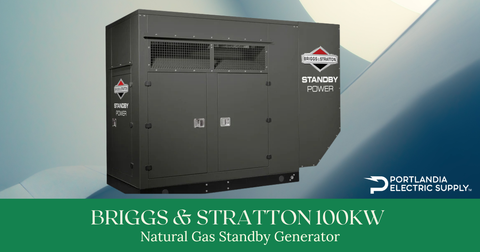
Pairing a generator with a three-phase service adds a layer residential backup never sees: the transfer switch must carry all three phases plus neutral switching decisions (separately derived vs. non-separately derived systems — whether the generator's neutral bonds at the genset or the service), and the generator itself must be specified three-phase from the start. A 100 kW three-phase standby unit at 480V delivers about 150A — comfortable on 1/0 copper. The same kW at single-phase would demand 480A-class conductors and a generator winding configuration most manufacturers don't even offer at that size, which is why commercial backup is three-phase by default. On the switching side, service-rated ATS units handle the whole building; sub-ATS arrangements split critical loads onto their own transfer scheme. The details belong to NEC 700/701/702 territory depending on whether loads are emergency, legally required, or optional standby — the classification drives everything from wiring methods to the 10-second start requirement, and misclassifying a load is a plan-review rejection at best. Our transfer switch inventory and the standby generator lines cover both the residential and the three-phase commercial ends of this, and the 26 kW generator guide is a good orientation read for the air-cooled end of the market.
Equipment and Supply for Three-Phase Projects
Supply-side, three-phase work leans on exactly the categories we stock deepest: panels, breakers, disconnects, and wire from electrical supplies; three-phase string inverters and hybrids from the inverter line and solar inverters; commercial modules from commercial solar panels; and standby power from standby generators. For residential-scale single-phase work that touches three-phase topics (service upgrades ahead of solar, generator interlocks, and the like), the installation guide and permitting guide cover the process end. If you're speccing a service or a backfeed and want a second set of eyes on the load math, send it over — checking ampacity arithmetic is about the most fun we have all week.
Common Questions From the Field
Can I get three-phase at my house? Usually no — residential services are single-phase by utility standard, and requesting three-phase residential is expensive where it's available at all. A VFD solves the "three-phase machine in a home shop" problem for single motors.
Is 208V "the same as" 240V? No, and the difference matters: 208V comes from two legs of a 208Y/120 wye (120V × √3 = 207.8V), while 240V is a single-phase center-tapped service. Equipment rated 240V running on 208V delivers about 25% less heat/wattage ((208/240)² = 0.75) — the classic commercial-kitchen complaint.
Why does my panel show 277V? That's a 480Y/277V system: 277V is the phase-to-neutral voltage (480 ÷ √3 = 277.1V), used for lighting. A 277V shock is every bit as dangerous as it sounds — treat lighting circuits in commercial buildings with the same respect as the 480V gear.
Frequently Asked Questions
What is three-phase power in simple terms?
Three AC waveforms on three conductors, offset by 120 degrees, delivering essentially constant power instead of the pulsing power of single-phase. That constant delivery lets motors run smoother and stronger and lets the same power flow over about 25% less conductor metal — which is why everything commercial and industrial runs on it.
How do I calculate amps for a three-phase load?
I = P ÷ (√3 × V × power factor). A 25 kW load at 480V three-phase and 0.95 PF draws 25,000 ÷ (1.732 × 480 × 0.95) ≈ 31.7 amps. For continuous loads, size the breaker and conductors at 125% of that figure per NEC 210.20/215.3 and the 240.6(A) standard sizes.
What is the difference between 208V and 480V three-phase?
Both are common wye configurations: 208Y/120V serves light commercial (120V receptacles, 208V motors), while 480Y/277V serves larger buildings (277V lighting, 480V motors, step-down transformers for 120V). The same load draws 2.3× more current at 208V than 480V, so bigger buildings distribute at 480V to save copper and voltage drop.
What is a high-leg delta and why does it matter?
A 240V delta service with a center-tapped transformer winding, giving 120V to neutral on two legs but about 208V to neutral on the third "wild" leg. Land a 120V load on the wild leg and you'll destroy it. Code requires the high leg marked orange (NEC 408.3(E)); in older panels, verify with a meter before terminating anything.
Can single-phase equipment run on three-phase power?
Yes — single-phase loads simply connect between one phase and neutral (on wye systems) or between two phases. The building's job is balancing those loads across all three phases. The reverse — three-phase equipment on single-phase service — requires a VFD or phase converter for smaller motors.
Why do commercial solar systems use three-phase inverters?
Because commercial services are three-phase. C&I arrays interconnect at 208Y/120 or 480Y/277, and three-phase string inverters (plus the newer 480V-native three-phase microinverters like the IQ9N-3P) backfeed all three phases evenly, satisfying utility balance requirements and NEC 705.12 backfeed rules without step-up transformers.