"Tier 1" gets thrown around in solar sales decks like a quality grade, and it isn't one. It's a bankability classification — a statement about whether a manufacturer's financial position lets banks lend against projects using their panels. That distinction sounds academic until the week your module maker files for judicial management and your 30-year performance warranty becomes a line item in a creditor queue. We've watched that movie more than once in this industry, most recently in April 2026.

This guide is the current, August-2026 version of the Tier 1 landscape: what the classification actually measures, who's on the list right now, the technology hierarchy that's reshuffling it, and — the part sales decks skip — how to pair Tier 1 bankability with actual quality signals like PVEL scorecards and warranty terms. If you're an installer writing BOMs, an EPC qualifying suppliers, or a developer defending equipment choices to a lender, this is the reference we use internally.
What "Tier 1" Actually Means


The Tier 1 classification comes from BloombergNEF's bankability assessment. A manufacturer earns it by demonstrating that its own-brand, own-manufactured modules have been financed by multiple banks in multiple non-recourse (or limited-recourse) project financings above a threshold size. Note what's absent from that definition: efficiency, reliability test results, warranty terms, build quality. Tier 1 answers one question — "will a bank lend against this brand?" — and it answers it well. It says nothing directly about whether the panels are good.
| What Tier 1 measures | What Tier 1 does NOT measure |
|---|---|
| Track record of bank-financed projects using own-manufactured modules | Module efficiency or technology class |
| Manufacturer financial scale and lender confidence | Reliability test performance (that's PVEL's job) |
| Ongoing manufacturing viability as lenders perceive it | Warranty terms or claims-handling speed |
| Own-brand, own-factory production (not rebadged OEM) | Degradation rates, temperature coefficients, or field failure rates |
The practical read: Tier 1 is a floor, not a ceiling. Every credible commercial BOM starts with Tier 1 suppliers, because lenders require it and because scale correlates with a manufacturer being around to honor a warranty. But two Tier 1 modules can differ enormously in quality, degradation behavior, and real-world output — which is why the selection framework later in this guide layers quality signals on top of bankability. Keep one more caveat in your pocket: the list is quarterly. A manufacturer can ride it for a decade and disappear from it in a single quarter, as 2026 just demonstrated, so the date on whatever Tier 1 screenshot lives in your proposal template matters more than most people realize.
The Q2 2026 Tier 1 List: Who's On, Who's Off
The Q2 2026 BloombergNEF list carries 42 manufacturers, up from 40 in Q1. The moves that matter:
- New entrants: Vikram Solar and Jolywood — both riding the N-type volume wave and India's and China's manufacturing expansions respectively.
- Removed: Maxeon. Q1's grouped "TCL/Maxeon/TZE" entry now reads "TCL Zhonghuan/TZE" only. Maxeon filed for judicial management in Singapore in April 2026, US Customs detained modules, and warranty backing is genuinely uncertain. If you hold Maxeon inventory or specs, treat counterparty risk as a live issue, not a theoretical one.
- Notable absence: REC Group is not on the list — a premium brand with low project-finance volume. That's a bankability datapoint, not a quality signal; REC's Alpha Pure-RX remains a PVEL-respected residential module with a 25-year product warranty. Absence from Tier 1 means "lenders don't finance utility projects with it," not "avoid it on a roof."
Confirmed bankability status across the majors: Jinko, LONGi, Trina, JA Solar, Tongwei, Canadian Solar, Risen, Astronergy, Aiko, TCL Zhonghuan, GCL, DMEGC, Yingli, First Solar, Waaree, Boviet, and Hanwha Qcells, among others. LONGi separately holds PV Tech's ModuleTech AAA rating for more than 25 consecutive quarters and Wood Mackenzie's 2026 Grade A — the strongest combined bankability signal in the industry.
The 1H26 Shipment Ranking: Volume Tells Its Own Story
InfoLink's first-half-2026 shipment ranking (published August 15, 2026) shows where volume actually flowed. Ranked suppliers shipped about 181.4 GW in 1H26, with top-10 combined shipments down 31% year over year — a demand dip driven largely by China's export tax-rebate change. Non-China markets took 60.1% of top-11 shipments, up 18 points, and the top four manufacturers hold about 59% of ranked volume.
| Rank (1H26) | Manufacturer | Core technology | Flagship series | Note |
|---|---|---|---|---|
| 1 (tie) | JinkoSolar | TOPCon | Tiger Neo 3.0; Tiger Neo 5.0 (700W class, SNEC June 2026) | Volume efficiency leader |
| 1 (tie) | LONGi | HPBC / TOPCon | Hi-MO X10 (24.8% commercial, 670W); Hi-MO 9 | 25.4% module record (Fraunhofer ISE) |
| 3 | Trina Solar | TOPCon 3.0 / THBC | Vertex N Gen 3, up to 760W | Utility-scale flagship |
| 4 | JA Solar | TOPCon / BC | DeepBlue 4.0 Pro / 5.0 | Deep US distribution |
| 5 | Tongwei | TOPCon | TNC 3.0: 670W in production; 770W from end-Q2 2026 | Aggressive power escalation |
| 6 | Astronergy | TOPCon | ASTRO N7 Pro / N8 Pro (825W reserve shown at SNEC) | Rising fast |
| 7 | Yingli | N-type TOPCon | — | Re-entered the top tier in 1H26 |
| 8 (tie) | DMEGC, AIKO, TCL Solar, GCL | TOPCon / ABC / BC | Aiko INFINITE Gen 3; TCL figure consolidates HuanSheng, SunPower, Maxeon, DAS Solar | AIKO is the efficiency story of 2026 |
Two absences stand out: Canadian Solar and Risen both fell out of the ranked top 11 in 1H26 after years in it. Volume ranking isn't bankability — both remain Tier 1 — but it tracks where distributor pricing pressure and availability sit, and it moves faster than the BloombergNEF list does. Note also how much of this volume is now made in America: Illuminate USA (LONGi), Jinko Solar US, T1 Energy (Trina), and American Panel Solutions/Corning (JA) all contribute to these totals from US plants.
The Technology Hierarchy: TOPCon Ate the Market
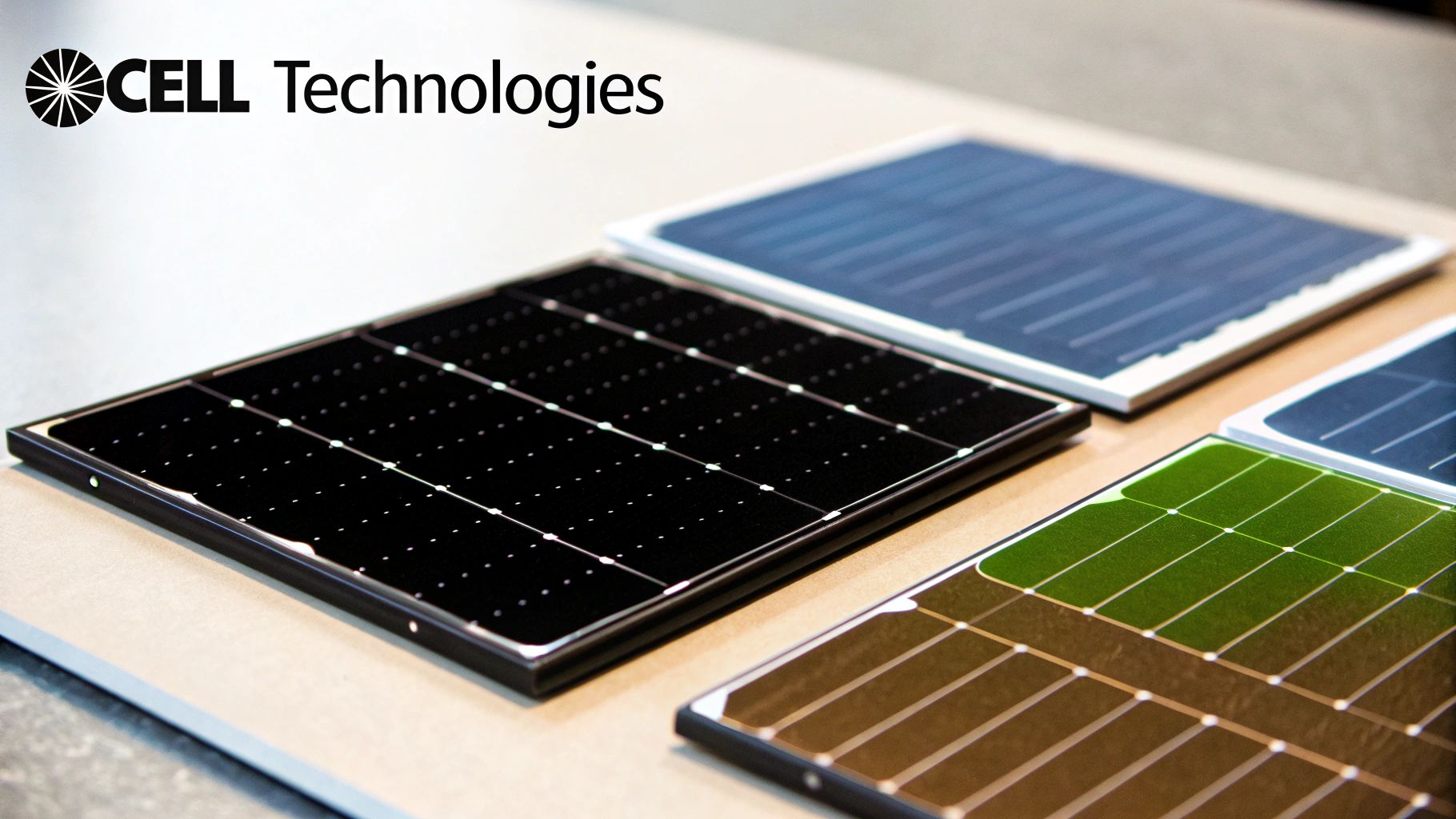
The cell-technology story of 2026 is consolidation. PERC is dead as a Tier 1 product — production ceased through 2025, and what's left in channels is distress inventory at prices that should make you suspicious rather than excited. The live hierarchy:
| Technology | Status (Aug 2026) | Share of top-11 shipments | Typical power class | Where it wins |
|---|---|---|---|---|
| TOPCon (N-type) | Dominant volume leader | ~83% | 580–770W | Everything — utility, C&I, residential |
| Back-contact (BC / ABC / HPBC) | Mainstreaming, no longer niche | ~16% (~30 GW in 1H26) | 440–770W | Premium residential, space-constrained roofs, premium C&I |
| HJT | Premium niche (no HJT maker in the InfoLink top 10) | Small | 470–740W | Hot climates (best temperature coefficients), premium residential |
| IBC (Maxeon) | Premium but supply at risk | Small | 440W | Legacy premium residential — counterparty risk now |
| PERC (P-type) | End-of-life; distress clearance only | — | 300–450W | Do not stock as new |
What this means for buyers: TOPCon is the default and the value leader; BC is where the efficiency records and the premium residential market are heading (Aiko and LONGi between them have pushed commercial modules to 24.8–26%); HJT holds a defensible niche where heat hurts TOPCon. For a hot-climate rooftop, an HJT module's temperature coefficient (-0.24%/°C class vs. -0.29 to -0.30 for TOPCon) claws back real production every summer afternoon. For a price-driven commercial roof, TOPCon at 23%+ efficiency is unbeatable value right now.
The Efficiency Leaders (August 2026)
| Model | Technology | Efficiency | Power | Status |
|---|---|---|---|---|
| Aiko G4 Full-Screen Ultra | ABC | Up to 26.0% (mfr claim) | 690W | Mass delivery from Q3 2026 |
| Aiko INFINITE Gen 3 / Neostar | ABC | 25.0% | 545W | Shipping; PVEL Top Performer in all 7 categories |
| LONGi Hi-MO X10 | HPBC 2.0 | 23.7–24.8% | 475–485W res / 645–670W large | Shipping; 25.4% module record |
| LONGi Hi-MO 9 EcoLife | HIBC | 25.0% | 510W | Premium efficiency + temperature performance |
| Canadian Solar 3rd-gen TOPCon | TOPCon | 24.8% | 670W | Global mass production from August 2026 |
| Tongwei TNC 3.0 | TOPCon | 24.8% | 770W (G12-66) | Mass production end-Q2 2026 |
| Jinko Tiger Neo 3.0 | TOPCon | 24.0% | 520W | Volume efficiency leader; Neo 5.0 next |
| Trina Vertex N Gen 3 | TOPCon 3.0 | ~23.5%+ | 760W | Utility flagship |
| Risen Hyper-ion Pro 740 | HJT | 23.8% | 740W | Utility HJT |
| REC Alpha Pure-RX | HJT | 22.6% | 470W | Premium residential; 25-yr product warranty |
Efficiency matters most where roof space constrains you — every point of efficiency is roughly 20W more per residential-format panel. On unconstrained commercial roofs and ground mounts, dollars per watt beats watts per square meter, and mid-efficiency TOPCon wins the math.
Power Classes by Application
| Application | 2026 power range | Typical technology |
|---|---|---|
| Residential (54/60-cell) | 440–520W | BC/ABC, HJT, TOPCon |
| Residential (72-cell) | 580–670W | TOPCon, HPBC |
| C&I rooftop | 580–700W | TOPCon, BC bifacial |
| Utility ground-mount | 670–770W | TOPCon, HJT, BC bifacial |
| Utility ultra-high (G12 format) | 740–825W | TOPCon, HJT, ABC |
The 700W+ class becoming standard at Tier 1 is the quiet revolution of 2026 — it compresses BOS costs (fewer modules, fewer clamps, fewer strings per MW) in ways that matter more to project economics than the module price itself. If your racking and electrical designs haven't been revisited for 700W-class mechanical and current specs, do that before your next utility-scale buy.
Quality Signals Beyond Tier 1: PVEL and Warranties
The Kiwa PVEL PV Module Reliability Scorecard is the industry's real quality benchmark — independent lab torture testing across seven categories in the 2026 edition: thermal cycling, damp heat, mechanical stress sequence, PID, the new UVID (ultraviolet-induced degradation) test, LETID, and hail stress. The 2026 results that matter: AIKO took Top Performer in all seven categories (the first clean sweep under the expanded protocol), and LONGi extended its streak to nine consecutive years as a Top Performer. Trina Vertex S+, Jinko Tiger Neo, JA DeepBlue 4.0 Pro, and Astronergy ASTRO all hold recent Top Performer status.
Our selection hierarchy, in order: Tier 1 bankability (lender and counterparty floor), then PVEL results (quality evidence), then warranty stack (25-year product and 30-year performance is the current Tier 1 standard — anything less on a new design should prompt a question), then datasheet specifics (degradation ≤0.4%/yr on N-type, temperature coefficient, bifaciality for ground mounts), and only then price. Inverting that order is how projects end up with cheap modules and expensive problems.
The 2026 Trade Stack: What Tier 1 Costs Delivered in the US
Bankability doesn't exempt anyone from tariffs. As of August 2026, US-delivered pricing sits on this stack: Section 232 Minimum Import Prices ($0.38/W modules, $0.22/W cells, $100/kg wafers) plus a 15% ad valorem duty, stacked on final AD/CVD rates (Malaysia 9–14%, Thailand 23–77%, Vietnam 56–272%, Cambodia 117–292%+ supplier-specific), with Section 301 at 50% effectively blocking direct China sourcing. Pre-August 2026, US-delivered Tier 1 cleared at $0.27–0.32/W; the MIP now sets a hard import floor, and offers are repricing upward through Q4.
| Benchmark | Price (Aug 2026) | Context |
|---|---|---|
| Tier 1 TOPCon 580–600W, FOB China | $0.085–0.095/W | Overcapacity keeps factory-gate prices low |
| TOPCon 600–670W, SE Asia FOB | $0.098–0.11/W | BC premium runs +12–15% over TOPCon |
| HJT / BC 470–670W | $0.14–0.20/W | HJT premium compressed to 2–8% over TOPCon |
| Utility TOPCon 700–770W, container FOB | $0.07–0.10/W | 1500V class |
| US-delivered, any import | ≥$0.38/W module MIP floor + duty + AD/CVD | Section 232 stack, August 2026 |
| US-made | ~$0.30–0.40/W | Increasingly competitive as MIP lifts imports |
The strategic read: the old arbitrage (buy cheap imports, absorb duties) is closing. US-made modules from Mission Solar and the Tier 1s' US plants sit near or inside the new import floor, and FEOC-compliant equipment carries its own value on any commercial project chasing the domestic-content ITC bonus. We stock across the spectrum — Qcells, Trina, JA Solar, REC, Mission — and the mix our contractors buy has shifted materially toward domestic and compliant product since July.
How to Select the Right Tier 1 Module: The Field Checklist
- Confirm current Tier 1 status — the quarterly list moves; Maxeon's exit is the 2026 reminder that yesterday's bankable name can become tomorrow's creditor claim.
- Check the PVEL scorecard for your specific model family, not just the brand.
- Match technology to site: TOPCon for value, BC for constrained or premium roofs, HJT for heat.
- Verify the warranty stack: 25-yr product / 30-yr performance, ~0.4%/yr degradation, and a US claims process that answers the phone.
- Check CEC listing for California-bound product and confirm the exact model number, not the family.
- Ask where it ships from — origin now determines duty stack and FEOC status as much as price.
- Stress the price: anything dramatically below $0.38/W US-delivered in late 2026 is either grandfathered pre-August contract stock (fine, verify it) or distress product (understand exactly what you're buying).
For side-by-side evaluations, our panel comparison page, Qcells vs. Trina vs. JA breakdown, and best panels roundup apply this framework to current inventory, and the full solar panels collection — including bifacial and commercial formats — reflects what's actually shippable this month rather than what a datasheet archive remembers.
Reading a Datasheet Like an Engineer
Every module spec sheet is a marketing document wearing an engineering costume. The numbers that actually predict field performance, in the order we read them: Pmax tolerance (0/+5W beats ±3% — you want guaranteed minimums, not symmetric ranges); first-year and annual degradation (1% first year and 0.4%/yr thereafter is the current N-type standard; anything over 0.55%/yr is dated technology); temperature coefficient of Pmax (every 0.01%/°C is worth real money in the Sunbelt — a module at -0.24%/°C running 25°C above STC loses 6.0% vs. 7.25% for a -0.29 module, and that gap repeats every hot afternoon for 30 years); NMOT/NOCT (the honest operating temperature, not the STC fantasy); and mechanical load ratings (5,400 Pa front / 2,400 Pa rear is baseline; snow and high-wind zones need more, and Florida HVHZ jobs need the NOA paperwork, not just the number). Bifacial gain specs deserve skepticism on rooftops — bifacial earns its premium on ground mounts and carports with real albedo, not on a composition shingle roof with a six-inch standoff.
The US Manufacturing Angle
One underappreciated 2026 shift: several Tier 1 names are now substantially American manufacturers. LONGi's Illuminate USA plant in Ohio, Jinko's Jacksonville facility, Trina's Texas operation (now T1 Energy), and JA's Phoenix plant (American Panel Solutions/Corning) all feed the 1H26 shipment totals from US soil. Pair those with homegrown brands like Mission Solar in San Antonio and the picture changes from "imports vs. domestic" to "which factory, which entity, which content percentage." For commercial projects, the domestic-content ITC bonus makes the bill of materials a tax document — cell origin, module assembly origin, and FEOC compliance all feed the calculation, and the paperwork burden lands on whoever specifies the equipment. Get origin documentation at PO time, not at tax time. We've watched more than one EPC discover in April that their "domestic" module had a cell chain that didn't qualify.
Mistakes We Watch Buyers Make
- Buying the press-release wattage. An 825W module shown at SNEC as a reserve product is not a purchasable SKU. Spec what's shipping, in the container quantities and timeframes your project needs.
- Ignoring format changes. The industry moved from 182mm to 182×210mm (G12R) to full 210mm (G12) cells; each shift changes module dimensions, clamp zones, and racking compatibility. A module swap late in design is a racking redesign.
- Treating bifacial as free energy on any surface. It isn't — see the albedo point above.
- Chasing the last 0.5% of efficiency on unconstrained sites. Premium BC modules earn their premium on constrained roofs. On open commercial roofs, the same dollars buy more TOPCon watts.
- Signing for Q4 delivery without asking about the MIP floor. Post-August 2026 containers reprice. Know your supplier's contract vintage.
Tier 1 for Residential vs. Utility: Different Shopping Lists
The residential and utility buyer should weight this guide differently. A residential installer lives on product availability in pallet quantities, 25-year workmanship alignment, aesthetic options (all-black BC modules are eating the premium roof market), and per-watt pricing in the context of a $25,000 job where the module line is a quarter of the total. Chasing the absolute cheapest module saves the homeowner a few hundred dollars and buys real risk. A utility or C&I buyer lives on bankability first (the lender reads the BloombergNEF list, not the marketing), PVEL evidence for the specific model, delivery logistics in containers, and escalation-pricing exposure across a procurement window that can span quarters. Both buyers end up at the same handful of manufacturers — but for different reasons, from different catalogs, with different contract terms. Know which game you're playing before you start comparing prices.
There's a third buyer worth naming: the distributor-stocked contractor who mixes residential and light-commercial work. For that buyer, platform continuity is an underrated selection criterion. Training crews on one residential module family and one commercial family, keeping spares and clamps common, and staying current on one inverter pairing per module class compounds into fewer truck rolls and faster installs — boring operational advantages that out-earn a $0.01/W price win every single quarter.
Frequently Asked Questions: Tier 1 Solar Modules
What does "Tier 1 solar panel" actually mean?
It's BloombergNEF's bankability classification: the manufacturer has supplied its own-brand, own-manufactured modules to multiple bank-financed projects above a threshold size. It measures lender confidence and manufacturer scale — not module quality, efficiency, or reliability. Pair it with PVEL reliability results and warranty terms for a complete picture.
Who is on the Tier 1 list in 2026?
The Q2 2026 list includes 42 manufacturers — Jinko, LONGi, Trina, JA Solar, Tongwei, Canadian Solar, Risen, Astronergy, Aiko, TCL Zhonghuan, GCL, DMEGC, Yingli, First Solar, Waaree, Boviet, Hanwha Qcells, and others, with Vikram Solar and Jolywood newly added. Maxeon was removed after entering judicial management in April 2026; REC Group is not listed (a bankability datapoint, not a quality judgment).
Is PERC still worth buying in 2026?
No. Tier 1 PERC production ceased through 2025; 2026 channel stock is distress clearance at tempting prices with aging warranties and no future platform support. The correct move is an N-type TOPCon equivalent — better degradation, better temperature behavior, and a live technology roadmap behind it.
TOPCon vs. back-contact vs. HJT — which should I choose?
TOPCon (~83% of top-11 shipments) is the default and value leader at 580–770W. Back-contact (~16% and growing) wins premium residential and space-constrained roofs with 24.8–26% efficiencies. HJT holds a niche where hot climates reward its superior temperature coefficient. Match the technology to the site's constraint: space, heat, or budget.
How do the 2026 tariffs affect Tier 1 module pricing?
The August 2026 Section 232 program floors imported modules at $0.38/W plus a 15% duty, stacked on AD/CVD rates of 9–292% by origin and supplier. US-delivered prices are repricing upward through Q4 2026, and US-made modules at $0.30–0.40/W are newly competitive. Contracts fixed before August 6, 2026 were grandfathered — verify which side of the cutoff your supplier's inventory sits on.
Does Tier 1 status guarantee a manufacturer will honor its warranty?
No — it indicates lender confidence today, not solvency in year fifteen. Maxeon held premium status for years before its April 2026 judicial management filing put its 40-year warranty in question. Reduce the risk by favoring manufacturers with diversified financials, long PVEL streaks, and US claims infrastructure — and by treating any outlier warranty promise as a marketing claim until the company proves durability.