Florida is the strangest solar incentive market in the country: no state income tax means no state tax credit, yet the Sunshine State quietly stacks three of the most valuable incentives in America — a permanent sales tax exemption, a property tax exemption that most states can't match, and full retail net metering with the big investor-owned utilities. We've helped size and supply hundreds of Florida systems, and the customers who leave money on the table almost always miss the same two things: the property tax filing and the way net metering actually settles on the bill.
This guide covers the full 2026 stack — federal, state, utility, and local — with worked math on a real-world Florida home. One warning up front: the federal residential credit that anchored every Florida solar pitch for a decade expired on December 31, 2025. If your research is built on older articles, throw out the ROI math and start over. Everything below reflects the rules as they stand in August 2026.
The 2026 Florida Incentive Stack at a Glance
| Incentive | Value | Who qualifies | Status (Aug 2026) |
|---|---|---|---|
| Federal Section 25D residential credit | Was 30% | Homeowner-owned systems | Expired 12/31/2025 (OBBBA) |
| Federal Section 48E commercial credit | 30% base + bonuses | Businesses; third-party-owned residential (leases/PPAs) | Active with tighter construction-window and FEOC rules |
| Florida sales tax exemption | 6% state sales tax (plus local surtax avoided on most equipment) | All solar equipment purchases | Active, permanent (no sunset) |
| Florida property tax exemption | 100% of added home value excluded from assessment | Residential (and commercial renewable) installations | Active; extended through 2037 |
| Net metering (full retail) | 1:1 kWh credit at retail rate | Customers of FPL, Duke Energy Florida, TECO, and other IOUs | Active under Fla. Stat. § 366.91 |
| Utility & local programs | Varies: community solar, battery pilots, city programs | Program-specific | Active; check your utility |
Notice what's missing: Florida has no state rebate and no state tax credit, because with no income tax there's nothing to credit against. The state's contribution comes through the tax code's other door — what it doesn't charge you — plus one of the strongest utility net metering statutes in the Southeast, a combination that quietly outperforms many "high-incentive" states once you total the lifetime value. Run your own stack against current programs on our state-by-state incentives page before you sign anything.
The Federal Picture After OBBBA
The One Big Beautiful Bill Act, signed July 4, 2025, terminated the Section 25D residential clean energy credit for expenditures after December 31, 2025. That's done — no phase-down, no extension as of this writing. For a Florida homeowner paying cash or financing with a loan, the gross price is now the real price.
Two federal doors remain open. First, the commercial Section 48E credit survives for businesses, farms, and nonprofits, with the base 30% plus adders for domestic content and energy communities — but the easy begin-construction safe harbor closed July 4, 2026, and FEOC rules now bar equipment from prohibited foreign entities on credit-claiming projects. Second, and this is the one reshaping the Florida residential market: third-party-owned systems. When a homeowner leases or signs a PPA, the financing company owns the system, claims the commercial 48E credit, and passes the value through as a lower rate. In 2024, leases were the expensive option. In 2026, they're often the only way a residential customer touches federal credit value at all. We've watched Florida lease attach rates climb all year for exactly this reason.
One more federal wrinkle that hits Florida quotes: the Section 232 Minimum Import Price program effective August 2026 floors imported modules at $0.38/W and adds a 15% ad valorem duty. Equipment prices on new quotes are already creeping up. A quote signed with pre-August 6 contract pricing is worth real money — ask your installer which side of the cutoff their supply sits on. And if a bidder's materials quote looks immune to every 2026 price move, that's not efficiency; that's old inventory or optimistic bookkeeping, and either deserves a direct question before you sign.
Florida's Sales Tax Exemption: Automatic Money
Florida Statute 212.08(7)(hh) exempts solar energy systems — panels, inverters, racking, batteries when part of the system, and all balance-of-system components — from the state's 6% sales tax. Unlike a credit, there's nothing to claim at tax time; the exemption applies at the register, and any licensed Florida solar contractor should be selling equipment tax-free by default. If you see a sales tax line on a Florida solar quote, challenge it.
What it's worth in dollars:
| System | Gross price | Sales tax saved @ 6% |
|---|---|---|
| 6 kW residential | $18,000 | $1,080 |
| 8 kW residential | $24,000 | $1,440 |
| 10 kW + 13.5 kWh battery | $41,500 | $2,490 |
| 25 kW small commercial | $57,500 | $3,450 |
| 100 kW commercial | $210,000 | $12,600 |
DIY buyers get this too: the exemption applies to the equipment sale, not to who installs it. If you're buying a kit or components for an owner-builder project, the exemption certificate handling is on the seller — and any Florida-facing supplier should know the drill. Our installation guide covers the owner-builder pathway, and kit buyers can start with the 5 kW or 10 kW solar-plus-battery kits.
The Property Tax Exemption Most Floridians Never File
Solar adds resale value to a home — studies keep landing around 3–4% — and in most states that means a bigger property tax bill. Florida exempts 100% of the value a renewable energy device adds to your property from the assessed value. On a $30,000 system in a county with a 1.1% effective millage, that's about $330 per year, every year, for as long as the system is on the roof. Over 20 years: roughly $6,600, for filing one form with your county property appraiser.
The catch is that it's not automatic everywhere. Some county appraisers apply it on sight; others want the exemption flagged. File it, confirm it on your next TRIM notice, and keep the install invoice with your closing documents. The exemption was extended through 2037, so this benefit has real staying power — but only if it actually shows up on your assessment.
Net Metering in Florida: How the Money Actually Moves
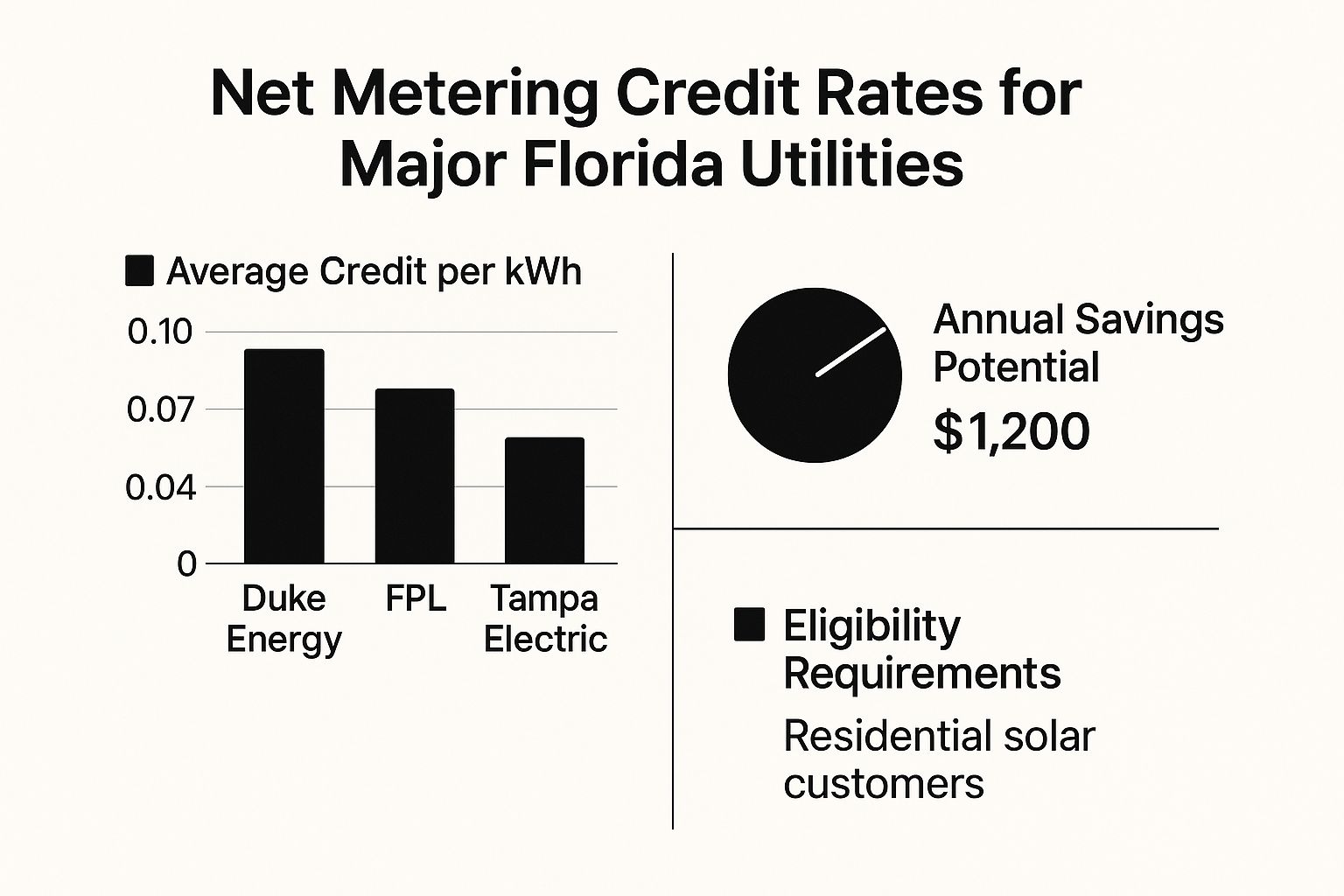
Florida's net metering statute (§ 366.91) requires investor-owned utilities to offer full retail-rate net metering to customer-owned renewable systems up to 2 MW. In practice: every kWh your array exports spins the ledger backward at the same cents-per-kWh you pay for imports. Excess credits roll month to month, and once a year (typically on your anniversary or January cycle) the utility pays out any remaining surplus at the much lower avoided-cost rate — so the game is sizing the system to offset consumption, not to overbuild. Our system sizing calculator is built for exactly that.
The major Florida utilities, side by side:
| Utility | Credit rate | System cap | Notes from the field |
|---|---|---|---|
| Florida Power & Light (FPL) | Full retail, 1:1 kWh | 2 MW (tiered review over 10 kW) | Biggest IOU; smooth online interconnection portal; annual surplus paid at avoided cost |
| Duke Energy Florida | Full retail, 1:1 kWh | 2 MW | Tier 2/3 systems need insurance riders and sometimes a disconnect witness |
| TECO (Tampa Electric) | Full retail, 1:1 kWh | 2 MW | Fast PTO turnaround by IOU standards in our experience |
| OUC / municipal & co-op utilities | Varies by ordinance | Varies | Munis and co-ops aren't bound by § 366.91 — verify before you design |
The 2022 scare is worth remembering. HB 741 would have gutted retail-rate net metering, the legislature passed it, and Governor DeSantis vetoed it — one of the few times a rooftop-solar bill died by veto in a Republican statehouse. The lesson for anyone modeling a 25-year investment: Florida's NEM is statutory and popular, but it has been attacked once and will be again. Systems grandfathered under existing rules have historically kept them, and the veto signaled where the state's politics actually sit. We size Florida systems for self-consumption resilience anyway — a modest battery keeps the economics intact even if export rates eventually degrade. The battery buyer's guide and sizing calculator will get you to a defensible kWh figure.
Utility and Local Programs Worth Checking
Florida's patchwork beyond the IOUs changes constantly, but the recurring items:
- FPL SolarTogether: the country's largest community solar program — an option for roofs that can't host panels, though it doesn't build home equity the way rooftop does.
- Duke and FPL battery pilots: periodic demand-response and virtual power plant pilots that pay bill credits for utility access to your battery. Worth enrolling if your hardware qualifies; we've seen credits of $10–25/month.
- Municipal programs: Jacksonville (JEA), Orlando (OUC), Gainesville, and the Keys each run their own interconnection and occasional rebate programs — muni customers should read their utility's tariff, not the IOU rules.
- PACE financing: available in many Florida counties for solar and hurricane hardening. It attaches to the property tax bill, which helps some buyers and complicates home sales — read the assessment terms twice.
- City of Dunedin, St. Petersburg and others: permitting fee waivers or expedited review for solar pop up regularly. Ask your installer; they know which AHJs are fast right now.
The Florida Market Landscape for Installers and EPCs
From the supply side, Florida is a volume market with three defining quirks. First, the roof problem: insurance carriers are forcing re-roofs across the state, and every re-roof is a solar opportunity or a solar removal-and-reinstall. Contractors who partner with roofers eat well here. Second, wind: the High-Velocity Hurricane Zone (Miami-Dade and Broward) requires NOA-approved racking and attachments, and even outside the HVHZ, design pressures of 140+ mph mean more attachments per panel and stiffer rail schedules than a Midwest job. Cheap racking is a false economy in Florida — the engineering letter drives the BOM. Third, resilience sells: post-hurricane weeks are when battery attach rates spike, and hybrid systems sized for whole-home backup dominate the premium end. We stock deep on hybrid inverters and batteries for exactly this demand pattern, and the EG4 vs. Powerwall comparison is our most-read Florida page some months.
Worked Example: A Tampa Home in 2026
Real arithmetic on a typical TECO customer — 10 kW system, cash purchase, 2026 rules:
| Line | Value | Notes |
|---|---|---|
| System size | 10 kW DC | 23 × 435W TOPCon modules |
| Gross installed price @ $2.90/W | $29,000 | Mid-range Florida pricing |
| Sales tax | $0 | Exempt — saves $1,740 vs. taxable goods |
| Federal credit | $0 | 25D expired |
| Net cost | $29,000 | — |
| Year-1 production | 15,000 kWh | 1,500 kWh/kW-yr, Tampa irradiance |
| Year-1 bill offset @ $0.16/kWh | $2,400 | Full retail NEM |
| Property tax increase | $0 | Exempt — saves ~$320/yr vs. taxable |
| Simple payback | 12.1 years | $29,000 ÷ $2,400 |
| Payback w/ 3.5% rate escalation | ~10.2 years | Florida IOU rates have run hotter than 3.5% recently |
| 25-year net gain (escalated) | ~$48,000 | ~$77,000 savings − $29,000 cost |
Slower than the 2021 version of this table — the expired credit stretches payback about four years. But note what Florida-specific policy still contributes: nearly $2,000 of sales tax avoided on day one and $300+ per year of property tax avoided forever. And the escalation line is doing heavy lifting: Florida IOU rates climbed steeply through the storm-hardening and fuel-cost pass-throughs of recent years, and every increase lands straight in the solar column. Model your own address with the ROI calculator — irradiance alone swings this table by 15% between Miami and Pensacola.
How to Claim Each Piece (In Order)
- Sales tax: nothing to do — verify your invoice shows no Florida sales tax line. Challenge it if it does.
- Net metering: your installer files the interconnection application with your utility; you sign the net metering agreement; the utility swaps or reprograms your meter and issues Permission to Operate. Don't energize before PTO.
- Property tax exemption: file with your county property appraiser after installation, then verify on the next TRIM notice.
- Federal (commercial/lease only): the system owner claims 48E on their return. Homeowner cash/loan buyers have no federal filing to make in 2026.
- Permitting: your contractor pulls the AHJ permit; Florida HB 683-era law requires most jurisdictions to turn residential solar permits around quickly — the permitting guide has the details.
Watch-Outs Specific to Florida
- HOAs can't block you. Florida Statute § 163.04 bars HOAs from prohibiting solar, though they can regulate placement within performance limits. A rear-facing requirement that costs you significant production is challengeable.
- Insurance first. Some Florida carriers are hostile to rooftop systems; confirm your premium won't jump before you sign, and get the system added to the policy at install.
- Hurricane-rated everything. Modules, racking, and attachments must meet your wind zone's design pressures. A quote without a wind-load engineering letter in Florida is incomplete.
- Roof age. With insurers forcing re-roofs at 12–15 years on shingle, sequence the projects: roof first, solar immediately after, one mobilization.
- Size to consumption. Annual surplus pays out at avoided cost — pennies. Overbuilding to "sell back to the grid" is a losing trade under Florida NEM.
Equipment-side, we're happy to be the supply partner on Florida jobs of any size — panels, inverters, racking, and storage, with the wind-load BOMs Florida engineering requires. Browse current Tier 1 inventory from Qcells, Trina, REC, and JA Solar, or run the comparison on our panel comparison page.
Battery Economics Under Florida Net Metering
Under full-retail NEM, a battery doesn't improve bill math — the grid already acts as a free, infinite battery crediting you retail for exports. So why are Florida attach rates climbing? Three reasons we see in actual orders. Resilience is the obvious one: after any major landfall, our battery inquiries triple within a fortnight, and a 13.5 kWh unit carrying a critical-loads panel through a multi-day outage is worth more than any spreadsheet shows. Second, rate-structure insurance: NEM has been attacked once, and if exports ever drop to avoided cost, a battery pre-positions the home for self-consumption. Third, time shifting for the munis and co-ops whose tariffs aren't retail 1:1 — under those, storage pays immediately.
Size honestly. A critical-loads backup (fridge, lights, fans, internet, a mini-split) needs 10–14 kWh and a 5–8 kW inverter; whole-home with central air conditioning needs 20+ kWh and serious surge capacity. The backup runtime calculator will tell you what a given kWh actually buys in hours, and the energy storage collection shows current Florida-shippable inventory.
A Short History of Florida Solar Policy (Why 2026 Looks Like This)

Florida's framework is the product of three collisions. The 2016 Amendment 4 ballot measure created the property tax exemption for commercial renewables, and the legislature extended the concept residential — which is why today's exemption reads the way it does. The net metering statute dates to 2008, when rooftop solar was a rounding error and utilities didn't care; by the time FPL's territory alone passed a hundred thousand net-metered customers, the fight of 2022 was inevitable, and the veto set the current détente. Then the federal OBBBA reset of 2025 removed the residential credit and pushed the market toward leases and third-party ownership. The through-line for buyers: Florida policy has been durable the tax exemptions and NEM structure have proven durable, but federal support is the volatile layer — and it's the layer that just disappeared. Any payback model older than January 2026 is archaeology, not analysis.
For EPCs and Installers: Procurement Under the New Trade Stack
The commercial side of Florida solar — schools, municipal buildings, ag operations, warehouses — is where the surviving 48E credit concentrates the action, and where procurement got harder. A credit-claiming project in late 2026 needs FEOC-compliant equipment, documented domestic content if chasing the +10-point bonus, and pricing that acknowledges the $0.38/W module floor. We've rebuilt our commercial quoting around exactly this: US-made and FEOC-clean BOMs from Mission Solar and domestic lines, stacked against compliant imports where the budget demands it. On the distribution side, pre-August 6 fixed contracts still deliver at old-stack pricing while inventory lasts — if you have a Q4 project with signed paperwork, lock equipment now, because every requote we've run this fall has moved up, not down.
Insurance, Roofs, and the Sequence That Saves Thousands
Florida's insurance crisis intersects with solar in a way outsiders miss. Carriers non-renew shingle roofs past 12–15 years routinely now, and a roof replacement is the single best moment to go solar: the penetrations get flashed into brand-new shingles, the roofer and the solar crew coordinate standoff locations, and some roofers will even warranty around the attachments when they've worked with the installer before. Do it backward — solar on an aged roof — and you're paying $3,000–6,000 for removal and reinstallation when the carrier forces the re-roof, plus two rounds of permitting in most counties. We tell every Florida customer the same thing: if the roof has under twelve years left, bundle the projects. If the carrier is already circling, bundle them fast.
On the policy side, get the system endorsed onto the homeowner policy at install and confirm the carrier covers the array at replacement cost, not depreciated value. Premium impact runs $0–150/year with most Florida carriers when the system is permitted and inspected — the horror stories almost always involve unpermitted installs or ground-mounts nobody told the insurer about.
Community Solar vs. Rooftop: Know What You're Buying
FPL SolarTogether and similar programs sell subscriptions to shared solar farms, crediting your bill monthly. For renters, shaded lots, and condo owners, it's the only solar available, and the programs do pencil out over their 20-year terms. But understand the trade: a subscription builds no equity, adds no property value, qualifies for no exemption, and ends when you cancel. Rooftop ownership — even at 2026's slower payback — builds an asset that transfers with the home and, per the property tax exemption, does so tax-free. If your roof works, own. If it doesn't, community solar beats nothing. One practical tell: if a salesperson leads with a community solar pitch but your roof is unshaded and south-facing, ask why — sometimes the honest answer is that their company sells subscriptions, not systems.
Leasing vs. Owning in Post-Credit Florida
With 25D gone, the lease/PPA comparison deserves fresh eyes. A typical 2026 Florida lease offers a rate around $0.11–0.13/kWh against a $0.16 retail rate, with a 1.9–2.9% annual escalator, $0 down, and the leasing company handling maintenance and claiming 48E. Ownership at $2.90/W beats that on lifetime value by a wide margin — our Tampa table above shows a ~$48,000 25-year net — but it requires $29,000 of cash or a loan with dealer fees, and it carries the equipment risk. The honest decision rule: if you have the cash or can borrow cheaply, own; the federal credit's absence narrows the gap but doesn't close it. If cash is tight or you'll sell within ten years, a no-escalator or low-escalator PPA at a rate 20%+ below retail is a legitimate deal again — for the first time in years, the leasing company's federal credit is subsidizing your rate instead of just their margin. Get the escalator in writing, get the buyout schedule in writing, and confirm how the contract transfers at sale. Florida's homestead-friendly market moves houses; your solar contract will eventually move with one.
Second Homes, Snowbirds, and Rental Properties
A question we get weekly: do the exemptions apply to non-homestead property? Sales tax — yes, it follows the equipment, not the owner's residency. Property tax exemption — yes, it attaches to the property regardless of homestead status. Net metering — yes, any customer class the utility's tariff covers. What changes is usage pattern: a winter-only occupancy home exports heavily in the mild months and imports in summer, which under full-retail NEM is fine (the annual true-up handles the imbalance), but it argues for sizing to annual kWh, not monthly bills. For short-term rentals, size to the peak season load and let the off-season build credits. And if the property is held in an LLC — as many Florida rentals are — the commercial 48E door may be open with proper tax advice, which makes rental solar one of the few remaining ways to access federal credit value in 2026.
What We'd Tell a Florida Homeowner Over the Counter
Strip away the acronyms and the 2026 Florida decision looks like this. The federal government is no longer helping you buy, so the gross price is the price — negotiate it like it. The state still covers you twice, at the register and on the tax roll, and those two exemptions are worth roughly $4,500–8,000 over the system's life on a typical job. The utilities still owe you retail for every exported kilowatt-hour, and that statute has survived its strongest challenge. And the sun still does what it has always done here: 1,400–1,550 kWh per installed kW per year, better than almost anywhere east of the Rockies. Solar in Florida pencils slower than it did in 2024 and better than the doom-posts claim. Buy good equipment, file the property tax form, keep the array on the sunny planes, and let the escalation math compound quietly in your favor for the next quarter century.
Frequently Asked Questions About Florida Solar Incentives
Does Florida have a state solar tax credit?
No — Florida has no state income tax, so there's nothing for a credit to offset. Florida's state-level support comes through the permanent 6% sales tax exemption on solar equipment and the 100% property tax exemption on the value a system adds, plus statutory full-retail net metering with the investor-owned utilities.
Is the federal solar tax credit available in Florida in 2026?
Not for homeowners. Section 25D expired December 31, 2025. Businesses can still claim Section 48E under tighter construction-window and FEOC rules, and third-party-owned lease/PPA structures pass that commercial credit value through to residential customers — which is why leases have become competitive again in Florida this year.
Is net metering still 1:1 in Florida?
Yes, for customers of FPL, Duke Energy Florida, TECO, and other IOUs covered by § 366.91: exports are credited at the full retail rate, rolled monthly, with any annual surplus paid at avoided cost. Municipal and co-op utilities set their own terms, so muni customers should verify their tariff. The 2022 attempt to cut retail NEM (HB 741) was vetoed, and grandfathered systems have historically kept their terms.
How much does the Florida sales tax exemption save?
Six percent of the equipment and system price — about $1,440 on a $24,000 system and $2,490 on a $41,500 solar-plus-battery job. It applies at the point of sale, including DIY equipment purchases, so there should never be a Florida sales tax line on a solar invoice.
Do solar panels raise my property taxes in Florida?
No. Florida exempts 100% of the value a renewable energy system adds from property tax assessment, through 2037. File the exemption with your county property appraiser after installation and confirm it on your next TRIM notice — it isn't always applied automatically.
What is a realistic payback period for solar in Florida in 2026?
On current rules, a cash-purchased 10 kW system at $2.90/W offsetting power at $0.16/kWh pays back in about 12 years simple and roughly 10 years with utility rate escalation. High-usage homes with larger systems do better; financed systems depend on dealer fees and rates. The 25-year net gain on that typical system still approaches $48,000.