Choosing the best generator is not a brand decision — it is a sizing decision, a fuel decision, and an installation decision, in that order. We quote generators every week at Portlandia Electric Supply, from 2kW inverter portables for tailgates to 175kW diesel units for cold-storage warehouses, and the failure mode is always the same: somebody buys the wrong class of machine for the job and then shops for a second generator inside a year. This guide is the exact workflow our counter staff runs, with the worksheets, the math, and the code references, so you can buy once and be done.

Step one: pick the class before the brand
Four generator classes cover 95% of what anyone actually needs. Everything else is a specialty machine.
| Class | Typical output | Fuel | Right job | Wrong job |
|---|---|---|---|---|
| Recreational inverter (portable) | 1,000–2,500W | Gasoline | Camping, tailgates, sensitive electronics, one fridge in an outage | Whole-house backup, job-site compressors |
| Open-frame portable | 3,500–12,000W | Gasoline / dual-fuel | Job sites, essential-circuit home backup via interlock or transfer switch | Continuous duty, noise-sensitive neighborhoods |
| Home standby (air-cooled) | 10–26kW | Natural gas / propane | Automatic whole-house or managed-circuit backup, outages counted in hours to days | Off-grid prime power (they are not rated for it) |
| Commercial / industrial (liquid-cooled) | 25kW–2MW | Diesel / NG | Businesses, farms, critical loads, prime power with the right rating | Occasional residential use (overkill capital and maintenance) |
The class decision hinges on three questions. How many hours per year will it run? Under a hundred, portable or standby. Over five hundred, you are shopping liquid-cooled commercial. Does anyone need the power to come on when nobody is home? That answer alone forces standby plus an automatic transfer switch. And what fuel is already on the property? A natural-gas meter on the wall makes the standby decision nearly free; an all-electric rural property pushes you toward propane or diesel storage.
Step two: size it with a load worksheet, not a guess
Every generator in our catalog is sold against two numbers: running watts and starting (surge) watts. Motors — well pumps, AC compressors, refrigerators, air compressors — pull two to five times their running current for a fraction of a second at startup, and the generator must absorb that surge without its voltage collapsing. Here is the worksheet we hand customers, filled in for a realistic 2,000 sq ft house on essential circuits:
| Load | Running watts | Starting watts | Notes |
|---|---|---|---|
| Refrigerator (modern, 21 cu ft) | 200 | 1,200 | Compressor inrush ~6× running |
| Freezer (garage) | 150 | 1,000 | Stagger starts with the fridge if possible |
| 1/2 HP well pump (240V) | 1,000 | 3,000 | Check the pump label — LRA is the truth |
| Gas furnace blower (1/3 HP) | 700 | 1,800 | ECM blowers surge less than PSC |
| 3-ton central AC | 3,500 | 9,000+ | Soft-start kit cuts surge roughly in half |
| Lighting + outlets (10 circuits) | 800 | 800 | LED everywhere by now |
| Sump pump | 800 | 2,400 | Non-negotiable in flood country |
| Microwave | 1,200 | 1,200 | Resistive-class load, no surge |
| Total, no AC | 4,850 | worst-case start stack ≈ 8,500 | Fits a 10–12kW standby |
| Total, with 3-ton AC | 8,350 | surge ≈ 14,000–17,000 | Needs 20–24kW class or load management |
The math rule: generator running watts ≥ your biggest simultaneous running load, and generator surge watts ≥ running total plus the single largest motor's starting watts. Then add 20% headroom, because generators run longest and cleanest at 60–80% of rating, and altitude plus heat derate every engine — figure roughly 3% power loss per 1,000 ft above sea level and 1% per 10 °F above 77 °F on air-cooled machines. A 22kW standby in Denver at 5,280 ft is really a ~19kW machine before the summer sun takes its cut.
Field note: I've sized hundreds of these, and the most expensive sentence in generator sales is "the AC is only a 3-ton." That compressor's locked-rotor amps will stall a generator that looked fine on running watts alone. Either put a soft starter on the condenser, buy load management into the transfer switch, or step up a generator size. Pick one before the install, not after the first failed start.
Step three: the fuel decision is a runtime decision
| Fuel | Energy reality | Storage | Best for |
|---|---|---|---|
| Natural gas | ~1,000 BTU/cu ft; generator output often derated vs LP | Unlimited (utility dependent) | Suburban standby; runs for weeks |
| Propane (LP) | ~91,500 BTU/gal; a 22kW unit at full load burns ≈ 3.5–4 gal/hr | 250–500 gal tanks typical; weeks of autonomy | Rural standby, dual-fuel portables |
| Gasoline | ~114,000 BTU/gal; a 7.5kW portable burns ≈ 0.75–1 gal/hr at half load | Degrades in months; stabilize and rotate | Portables only — never store 50 gal of gasoline for a standby |
| Diesel | ~138,000 BTU/gal; best fuel economy per kWh | Stable a year+ treated; polish for critical sites | Commercial, prime power, farms with diesel on site |
Worked fuel example — a 22kW air-cooled standby on propane feeding that essential-loads house at roughly half load: expect on the order of 2–2.5 gal/hr, so a dedicated 250-gallon propane tank (filled to 80%, ~200 usable gallons) carries you through roughly three to four days of continuous running. Double the tank or shed the AC and you double the autonomy. Natural gas removes the tank question entirely but ties your outage plan to the gas utility's pressure — which, to be fair, has held up far better than the electric grid in most US weather disasters.
Standby generators: what the install actually involves
A standby install is a small construction project, and the quote should reflect all of it: the generator, the automatic transfer switch, the concrete pad or composite pad, the gas line upsizing (most 22kW units want a larger gas service than the house already has), the electrical permit, and the startup. Budget roughly $3,000–$6,000 for installation on top of equipment in most markets, more if the gas meter needs a utility upgrade.
Code anchors your inspector will cite, and you should know first: NEC Article 702 governs optional standby systems, NEC 445 covers generator installation, NEC 250 the grounding electrode question (whether the generator is a separately derived system depends on the transfer switch), and NFPA 37 sets clearances — typically 5 ft from openings in walls and combustible surfaces unless the manufacturer's listing says otherwise. CO kills people every outage season: never run any engine-driven generator in a garage, even with the door open, and keep portables 20 ft from the house with the exhaust pointed away.
The transfer switch is not optional
Backfeeding a house through a dryer outlet is illegal, lethal to line workers, and it voids your insurance. Every permanent generator connects through a transfer device:
| Device | Rating classes | Behavior | Fit |
|---|---|---|---|
| Manual transfer switch | 30–100A, 6–10 circuits | You flip it when the power fails | Portables feeding essential circuits |
| Interlock kit | Panel-specific | Mechanical lockout between main and generator breaker | Budget code-compliant portable hookup |
| Automatic transfer switch (ATS) | 100A, 200A, 400A service-rated | Senses outage, starts generator, transfers in ~10–30 seconds | Every standby install |
Match the ATS to the service: a 200A house service pairs with a 200A service-rated ATS, and on larger homes we routinely split the load between a 22kW on essentials and load-shed modules for the big appliances. Browse our automatic transfer switches, 200A class transfer switches, and generator transfer switch kits — and size the generator conductors per NEC 445.13 and the ampacity tables in our NEC wire sizing guide.
What we actually recommend by use case
Essential circuits, suburban house, NG at the meter
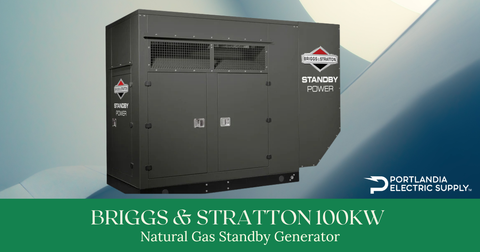
Air-cooled standby in the 10–14kW class — see our 10–14kW standby generators. Brands to compare: Generac, Briggs & Stratton, Kohler, and Cummins. At this size, dealer network and parts availability matter more than spec-sheet differences.
Whole house including central AC
20–26kW air-cooled — 20–28kW standby generators — with load management, or step into liquid-cooled commercial if the house is genuinely large. Pair with a 200A ATS and a soft starter on the condenser.
Job site / farm / portable power
Open-frame portables in the 6–10kW or 10–12kW classes — DuroMax, Champion, Westinghouse, and Honda all earn their keep; Honda's EU inverter series remains the noise-and-clean-power benchmark for sensitive electronics.
Business continuity
Liquid-cooled commercial standby, diesel or NG, with a service contract — our commercial standby generators and commercial generator catalog cover the range, and our commercial generator buyer's guide goes deep on that class.
Maintenance: the part everyone skips and then regrets
A generator is a small engine that must start perfectly after months of neglect. The schedule that actually works:
- Weekly: let the standby's exercise cycle run (they self-test); verify the status light is green.
- Every 6 months or 50 hours: oil and filter on portables; annually on standby air-cooled units per the manual.
- Annually: spark plugs, air filter, battery test (the number-one no-start cause on standby units is a $100 battery), valve lash on engines that specify it, firmware on the controller.
- Fuel discipline: gasoline rotated or stabilized; propane tanks leak-tested; diesel polished and treated on critical sites.
- Monthly load test on commercial units: engines that never see 30%+ load wet-stack and carbon up — run them under real load or a load bank.
Stock the consumables before storm season from our maintenance kit catalog and cold-weather kits — a battery warmer and oil warmer pay for themselves the first January night the temperature drops below zero.
Bottom line
Buy the class for the duty cycle, size it from a load worksheet with surge watts and altitude derate, pick the fuel your property already has, and put a real transfer switch between the generator and the panel. Do those four things and any major brand will serve you well for 15–20 years. Skip any of them and the brand on the label will not save you. When you are ready for numbers, our standby generator catalog and portable generator catalog are live-priced, and a Pro Account gets contractors wholesale terms on the whole BOM — generator, ATS, pad, wire, and gas fittings in one drop.
Inverter vs conventional open-frame: the THD question
Conventional open-frame generators produce power with total harmonic distortion that can exceed 20% as loads change — fine for saws and compressors, hard on anything with a circuit board. Inverter generators rectify and re-synthesize the output, holding THD under about 3% and locking frequency regardless of engine RPM. That is why the inverter class commands its premium: televisions, laptops, modern furnace control boards, and variable-speed appliances all behave better on clean power, and some modern equipment refuses to run on dirty power at all. The second dividend is fuel — an inverter generator throttles down at light load instead of holding 3,600 RPM all day, which is why a 2,200W inverter unit can sip under a gallon over an 8-hour night while a conventional unit drinks twice that making the same 200W.
Noise: the number your neighbors care about
| Source | Typical sound level | Comparable sound |
|---|---|---|
| 2,200W inverter portable at 25% load | ≈ 48–57 dBA @ 23 ft | Quiet conversation |
| 4,500W inverter at half load | ≈ 58–64 dBA | Normal conversation |
| 7,500W open-frame at half load | ≈ 68–74 dBA | Vacuum cleaner |
| 22kW air-cooled standby, exercising | ≈ 63–67 dBA @ 23 ft | Central AC condenser |
| 25kW+ liquid-cooled commercial, quiet enclosure | ≈ 65–72 dBA @ 23 ft | Busy street |
Check local ordinances before siting — plenty of municipalities enforce 65–70 dBA at the property line, which dictates both machine class and placement. A standby unit on the far side of the garage with the exhaust pointed away from the neighbor's bedroom window is the layout that passes inspection and keeps the peace.
Carbon monoxide: the rule with no exceptions
CO from portable generators kills roughly 70–100 Americans every year, and every one of those deaths followed the same pattern: the machine ran too close to the building. The discipline is absolute. Twenty feet minimum from the house, exhaust pointed away, never in a garage or shed even with doors open, never under a deck, and battery CO detectors on every floor with bedrooms. Newer portables with CO-shutdown sensors add a layer of protection, but placement is the real safety device. Standby units belong on their pad with NFPA 37 clearances — 5 ft from openings unless the listing allows closer — and no exceptions for "just this once."
Warranty and service network: the tiebreaker
| Brand | Standby warranty (typical) | Service network | Note |
|---|---|---|---|
| Generac | 5 years | Largest residential network in North America | Parts availability is the benchmark |
| Briggs & Stratton PowerProtect | Up to 7 years on bundles | Broad and growing | Longest common air-cooled coverage |
| Kohler | 5 years | Strong in metro and coastal markets | Premium commercial lineage |
| Cummins | 5 years | Strong commercial dealer base | Quiet Connect residential line is genuinely quiet |
| Champion | Up to 10 years (limited) on some home standby | Regional; direct support model | Aggressive warranty on aggressive pricing |
The machine is a 15-year relationship with whoever services it. Before you fall in love with a spec sheet, find the nearest authorized servicer and ask their parts lead time. A slightly inferior generator with a technician twenty minutes away beats the perfect generator with a three-week parts wait during ice season.
Total cost of ownership by class

| Class | Equipment | Install | 10-year fuel + maintenance (typical use) | 10-year TCO |
|---|---|---|---|---|
| 2,200W inverter portable | $500–$1,200 | $0 | $400–$800 | $900–$2,000 |
| 7,500W open-frame + interlock | $900–$1,600 | $400–$900 | $1,500–$3,000 | $2,800–$5,500 |
| 14kW standby + 100A ATS | $4,000–$5,500 | $3,000–$5,000 | $2,000–$3,500 | $9,000–$14,000 |
| 22–24kW standby + 200A ATS | $5,500–$7,500 | $4,000–$7,000 | $2,500–$4,500 | $12,000–$19,000 |
| 36–48kW liquid-cooled | $13,000–$20,000 | $8,000–$15,000 | $5,000–$9,000 | $26,000–$44,000 |
Maintenance dominates more than buyers expect. An air-cooled standby wants annual service at $250–$450 a visit, plus a starting battery every 2–3 years; portables want oil, plugs, and fuel discipline. The machine that never gets serviced is the machine that fails during the derecho — we have answered that call enough times to say it plainly.
Standby install timeline, start to finish
Plan six to ten weeks in normal times, longer after a major storm when every electrician in the county is booked. Week one: site assessment and load calc. Weeks two to four: permits, utility meter-capacity request, equipment lead time. Week five: pad pour and gas rough-in. Week six: set the unit, wire the ATS, startup and inspection. The bottleneck is almost never the generator — it is the gas utility and the permit office, in that order. Order equipment the day the load calc is done and file the utility paperwork the same week.
Solar-plus-generator hybrid backup
A growing share of our generator customers already own batteries. The modern pattern pairs a battery-backed hybrid inverter for the first hours of an outage — silent, instant, no fuel — with a generator as the deep-reserve layer that runs when the bank sags. Done right, the generator runs an hour or two a day at a healthy load charging batteries through a charger like the EG4 Chargeverter, and the house rides battery power the rest of the time. Fuel consumption drops by 70–80% versus running the generator around the clock, noise disappears overnight, and the engine accumulates a fraction of the hours. If you already have a 48V battery bank, this architecture beats a bigger generator almost every time; our runtime calculator helps size the battery side of the pairing.
Parallel kits and stacking portables
Two 2,200–4,500W inverter generators with a parallel kit deliver 4,000–8,000W combined — a legitimate alternative to one big open-frame, with redundancy, easier lifting, and the option to run one unit alone for light loads. The tradeoffs: two engines to maintain, two fuel systems to feed, and a parallel kit that must be the manufacturer's matched kit, not a jumper cable fantasy. For RVers who sometimes need AC and sometimes need quiet, the stacked-inverter approach is genuinely excellent. For job sites and whole-house duty, one properly sized unit is simpler and usually cheaper per watt.
Electric-start and remote features worth paying for
On portables, electric start is the single best dollar in the catalog — a pull cord in the rain at 11 PM during an outage changes minds quickly. On standby units, remote monitoring via Wi-Fi or cellular turns the weekly check into a phone notification and catches failed exercise cycles before they matter. Load-management modules for the ATS let a smaller generator carry a bigger house by sequencing the water heater and range; on the 10–14kW class they are nearly mandatory. Skip the gimmicks (Bluetooth speakers exist on generators now; we decline to comment) and spend on starting reliability, monitoring, and load management.
Common buying mistakes we see every season
- Sizing off the neighbor's unit. His house, his loads, his gas meter — none of it is yours. Run your own worksheet.
- Buying surge watts as running watts. The big number on the box is usually starting watts. Compare running watts only.
- Forgetting the gas meter. A 22kW standby needs utility confirmation of capacity; file it early.
- No transfer equipment in the budget. The generator is half the system; the ATS or interlock is the other half.
- Skipping the first oil change. Break-in oil comes out early — typically after the first 5–30 hours per the manual. Engines that keep break-in oil wear faster forever.
- Storing gasoline in the generator. Stabilize or drain. Every season. No exceptions.
A word on used generators
Used standby units tempt at half price, and sometimes they pencil: low documented hours, maintenance records, and a load-bank test before money moves can land a bargain. More often we see 1,200-hour air-cooled units with no records priced like machines with a decade of life left — they do not have it. On portables, walk away from anything that will not start cold in front of you, and assume every used carburetor needs cleaning. The discount must cover the risk; a used generator at 70% of new price is no discount at all.
The questions to ask before the quote
Whether you buy from us or anyone else, walk into the conversation with these answers ready and you will get a better generator and a better price. What is your address's outage history — hours per year, longest single event? What fuel is on the property, and what is the gas meter's rated capacity if natural gas? What are the five loads you cannot live without, and what are their nameplate amps? What is your panel's service size and brand (transfer equipment is panel-specific)? And who services generators within thirty miles of you? A supplier who asks you these questions back is a supplier who will still be answering the phone in year eight.
Reading a spec sheet like a contractor
Four lines tell you almost everything. Running watts on each fuel — not the surge number in the headline. Alternator type — brushless units regulate better and last longer. Engine displacement and brand — bigger displacement loafing at partial load outlives small displacement screaming at the same watts. Warranty term and the exclusions page — the exclusions are where the truth lives. Everything else on the sheet is detail work. If a spec sheet hides any of these four behind marketing language, that is your answer about the machine.
Outage behavior: what actually happens in the first minute
On a standby system the sequence is worth understanding so you do not mistake normal for broken. Utility fails; the ATS waits a few seconds to confirm it is not a blink; the controller starts the engine; the engine warms and stabilizes for roughly ten seconds; the ATS transfers the house to generator power; total elapsed, typically 15–30 seconds. Lights blink, clocks reset, the internet router reboots — all normal. On restoration, the house transfers back to utility and the generator runs a cool-down before shutdown. If transfer takes minutes instead of seconds, or the unit starts and immediately dies, that is a service call — and another reason the quarterly deliberate test matters: you want to learn about problems on a calm Tuesday, not during the ice storm.
Generators and home batteries: not either/or
The last five years made this a pairing question instead of a rivalry. Batteries own the first hours — silent, instant, zero fuel. Generators own the deep reserve — multi-day autonomy regardless of weather. A house with both rides a four-day outage with maybe four hours of total generator runtime, at a combined system cost below a liquid-cooled unit alone. Our battery buyer's guide covers the storage half of that architecture; this guide covers the generator half. The customers who install both stop calling us during storms entirely, which is the highest compliment the trade offers.
The sixty-second summary for the counter
If you read nothing else: match the class to the duty cycle, size from a load worksheet with surge watts and altitude derate, pick the fuel already on the property, install a listed transfer device, and service the machine on schedule. Those five decisions, made correctly, make the brand choice a rounding error. Made carelessly, no brand can rescue them. That is the whole trade.
Glossary for first-time buyers
Running watts — continuous output the generator sustains; the only watts that matter for sizing. Starting watts — brief surge capacity for motor starts. ATS — automatic transfer switch, the device that moves the house between utility and generator. Interlock — a mechanical panel lockout for portable hookup. Load management — modules that shed big appliances when the generator nears its ceiling. THD — total harmonic distortion; under 5% is electronics-safe. Derate — power lost to altitude and heat; roughly 3% per 1,000 ft and 1% per 10 °F above 77 °F. Wet stacking — carbon fouling from chronic light-load diesel running. Learn these eight terms and every generator conversation in the industry becomes legible.
A last word from the supply counter: the best generator is the one that starts on the worst night of the year. Everything in this guide — the worksheets, the fuel tables, the transfer equipment, the maintenance calendar — exists to make that sentence boring. Buy to the worksheet, install to the code, service to the calendar, and your outage stories will be the dullest ones at every neighborhood gathering. That is the goal.
Frequently asked questions
What size generator do I need to run a whole house?
Most 2,000–3,000 sq ft homes land in the 20–24kW class with central AC, or 10–14kW for essential circuits without AC. The only honest answer comes from a load worksheet: sum running watts, add the largest motor's starting surge, add 20% headroom, and derate for altitude and heat.
Is a portable generator enough for a house?
For essential circuits — fridge, furnace blower, some lights, well pump — a 7,500W-class portable through an interlock or manual transfer switch covers most outages. It will not start central AC reliably, it runs on gasoline you must store and rotate, and somebody has to wheel it out and flip switches in the storm.
Natural gas or propane for a standby generator?
Natural gas if the meter exists — unlimited runtime, no tank, slightly reduced output on some models. Propane everywhere else, with tank size setting your autonomy: a 250-gallon tank runs a 22kW unit at half load for roughly three to four days.
How much does it cost to install a standby generator?
Plan on $3,000–$6,000 for a typical residential install beyond the equipment — pad, gas plumbing, electrical, 200A ATS, permits, and startup. Gas service upgrades and long wire or gas runs push it higher. Get the site assessed before you buy the machine.
Can I install a standby generator myself?
The pad and landscaping, sure. The gas line and the transfer switch are licensed trade work in virtually every jurisdiction, inspected under NEC 702 and NFPA 37, and DIY gas work can void homeowner insurance. Budget for the electrician and the plumber or gas fitter.
How long will a standby generator last?
Air-cooled residential units typically deliver 1,500–3,000 run-hours — with normal outage duty plus weekly exercise, that is a 15–20 year machine if the oil changes and annual service actually happen. The units that die young die of skipped maintenance and dead starting batteries, not worn engines.