Designing a battery energy storage system is where good solar contractors become energy contractors — and where sloppy assumptions turn into six-figure change orders. We've supported BESS projects from a 10 kWh residential backup wall to multi-megawatt-hour commercial installations, and the design failures cluster in the same places every time: a load analysis that was actually a guess, a chemistry chosen by brand loyalty instead of duty cycle, and a code review that started after the equipment arrived. This guide walks the five-step design process we run on every project, with the sizing math shown in full so you can audit your own numbers.

Step 1: Defining BESS Project Goals & Technical Specifications
Starting with a Detailed Load Analysis
Every credible BESS design starts with interval data — not a square-footage rule of thumb, not "the panel is 400A." Pull 12 months of 15-minute or hourly interval data from the utility for commercial sites; for residential, pull hourly usage from the smart meter or the existing solar monitoring. What you're extracting is three numbers: the peak demand (kW) and when it occurs, the daily energy profile (kWh) by hour, and the critical load subset that must survive an outage. I cannot count the projects where the "500 kW facility" turned out to peak at 380 kW twice a year for twenty minutes — a completely different battery than the one the owner assumed he needed.
Translating Objectives into Design Specifications
The application determines which of the two sizing dimensions dominates. Power (kW) is how fast the battery can deliver; capacity (kWh) is how long. Get the application wrong and you buy the wrong ratio:
| Application | Primary Sizing Driver | Typical kW Requirement | Typical kWh Requirement | Example Use Case |
|---|---|---|---|---|
| Peak Shaving | Highest instantaneous load to offset | High (e.g., 500 kW) | Low (1–2 hours duration) | Commercial facility avoiding demand charges |
| Energy Arbitrage | Daily energy consumption and market price volatility | Moderate | High (4–6 hours duration) | Charging on low-cost off-peak power, discharging at peaks |
| Critical Backup | Total load of essential circuits | Sized to critical load | Sized to required outage duration | Data center needing 8 hours of uninterrupted power |
| Solar Self-Consumption | Evening/overnight energy needs | Low to Moderate | High (8–12 hours duration) | Storing daytime solar for use after sunset |
Step 2: Sizing BESS Power (kW) and Capacity (kWh) Correctly
Real-World Sizing Example: Slashing Demand Charges
Here's the full worked math for a commercial peak-shaving design, because this is where designs live or die:
| Design Step | Value | Calculation |
|---|---|---|
| Facility peak demand (from interval data) | 620 kW | Max 15-min interval, 12-month history |
| Target peak after shaving | 470 kW | Owner's economic target |
| Required BESS power | 150 kW | 620 − 470 |
| Peak event duration (from data) | 2.5 hours | Longest sustained excursion above 470 kW |
| Required usable energy | 375 kWh | 150 kW × 2.5 h |
| Nameplate capacity at 90% DoD (LFP) | 417 kWh | 375 ÷ 0.90 |
| Round-trip efficiency allowance (92%) | ≈ 453 kWh installed | 417 ÷ 0.92 — charge energy exceeds discharge |
| Demand charge savings | $2,700/month | 150 kW × $18/kW tariff |
| Annual savings | $32,400/yr | $2,700 × 12 |
Note the two derates stacked in the middle rows: depth of discharge and round-trip efficiency. A design that forgets them under-delivers by 15–20% on day one, and the owner concludes batteries don't work. The owner is wrong; the designer was lazy. Also note what the math says about duration: this application needs only 2.5 hours of storage. Buying a 4-hour system here doubles the battery cost for capacity the tariff never rewards.
C-Rate: The Spec Sheet Number That Limits Everything
C-rate expresses charge/discharge speed relative to capacity: a 100 kWh battery discharging at 100 kW runs at 1C; at 50 kW, 0.5C. Most LFP storage products rate continuous discharge at 0.5C–1C. Check it against your power requirement: our example above needs 150 kW from ~450 kWh installed — 0.33C, comfortable for nearly any LFP system. Flip the ratio — 150 kW from a 150 kWh battery — and you're demanding 1C continuous, which rules out a chunk of the residential-grade catalog and should push you toward power-rated commercial cabinets.
Residential Sizing: The Other End of the Same Math
The same power-versus-capacity logic scales down to the garage wall. A worked residential example for backup-plus-self-consumption duty:
| Design Step | Value | Calculation |
|---|---|---|
| Home daily consumption | 30 kWh/day | 12 months of utility data |
| Evening + overnight usage (4pm–8am) | ≈ 14 kWh | Hourly profile analysis |
| Critical backup loads (fridge, furnace blower, lights, network, outlets) | ≈ 850 W continuous | Load-by-load measurement or nameplate sum with diversity |
| Required battery power (with surge margin) | 5 kW continuous / 7+ kW peak | Covers well-pump or microwave surge |
| Required usable capacity (evening + 1 night's critical loads) | ≈ 20 kWh | 14 kWh evening + 6.8 kWh overnight critical (850W × 8h) |
| Installed nameplate at 90% DoD | ≈ 22–24 kWh | 20 ÷ 0.90, rounded to available modules |
That's a two-Powerwall-class or three 8–10 kWh modular-pack installation — a $20,000–$30,000 residential storage project in most markets, before incentives. Notice the power requirement nearly always forces the configuration before capacity does in homes with pumps or big motor loads. An 850-watt critical load sounds trivial until the well pump's 3× starting surge locks the rotor against an undersized inverter. We size residential batteries on surge first and energy second, and we've never regretted it.
How Different Applications Dictate Sizing
The pattern across both examples: peak shaving and backup are power-dominated at short durations; self-consumption and arbitrage are capacity-dominated at long durations. Hybrid duty — the most common real-world case — sizes to whichever dimension is larger, then verifies the other. Never average the two requirements and never size to the utility bill's total kWh. The interval shape of the load is the design input; everything else is arithmetic.
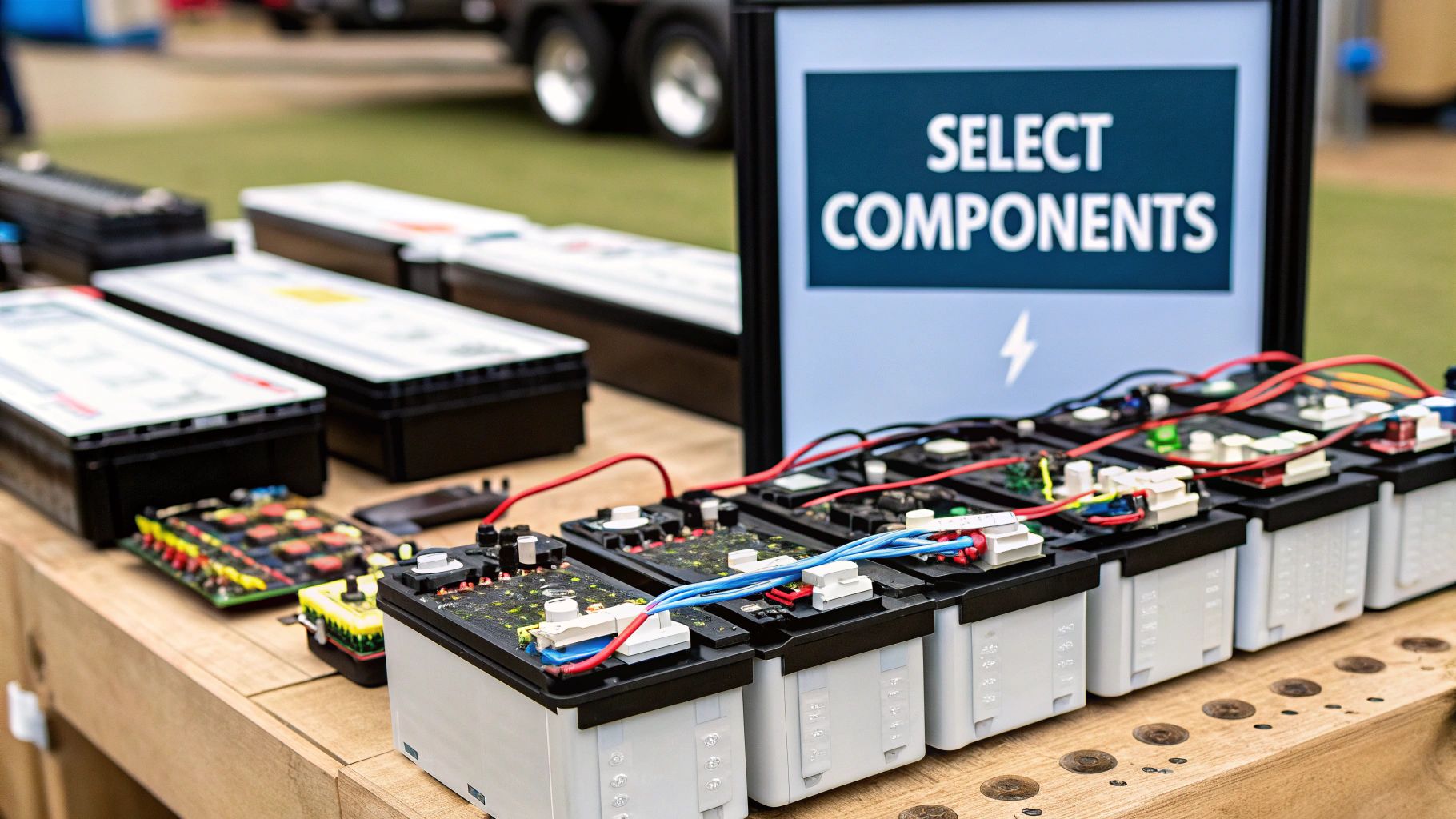
Step 3: Selecting Core BESS Components
The Battery Chemistry Decision: LFP vs. NMC
| Attribute | LFP (Lithium Iron Phosphate) | NMC (Nickel Manganese Cobalt) |
|---|---|---|
| Energy density | Lower (~120–160 Wh/kg cell class) | Higher (~180–250 Wh/kg cell class) |
| Cycle life | 4,000–6,000+ cycles to 80% SOH | 1,500–3,000 cycles to 80% SOH |
| Thermal runaway risk | Low; higher onset temperature | Higher; more energetic failure mode |
| Typical DoD window | 90–100% usable | 80–90% usable |
| Best fit | Daily-cycling stationary storage | Space/weight-constrained installs |
| 2026 market position | Dominant in stationary storage | Legacy fleets, niche density plays |
For stationary storage in 2026, LFP is the default answer and NMC is the exception you justify. The cycle-life difference is not marginal — it's roughly 2× — and daily-cycling applications (peak shaving, arbitrage, self-consumption) will cycle the battery 300+ times a year, every year, for the life of the project. Some jurisdictions effectively force the decision: NYC's fire code environment strongly favors LFP chemistry in practice, and AHJs everywhere have gotten more chemistry-curious since the early NMC-era fires made headlines.
One chemistry note for the forward-looking: sodium-ion is shipping in stationary products now and wins on cold-temperature charge acceptance and materials cost, at lower energy density and a short field track record. We aren't speccing it for primary-duty commercial projects yet — bankability and warranty depth matter more than a cheaper cell — but for cold-climate residential and DIY-scale systems it's worth watching over the next two product cycles. Ask us again in 2027; the answer may have changed.
Choosing the Right Inverter Architecture
Three architectures cover the market. AC-coupled (battery has its own inverter, bolts onto an existing solar system) is the retrofit king — no rewiring the PV, no touching the existing interconnection beyond the load side. DC-coupled (battery shares a hybrid inverter with the PV) is the new-construction efficiency play — one conversion step less, a few points better round-trip efficiency. Central vs. string PCS is the commercial-scale decision: string inverters give you modularity and graceful degradation, central gives you cost per kW at megawatt scale. Match to the project, not the rep's quota. Our inverter catalog spans all three; the Sol-Ark 8K and EG4 FlexBOSS21 cover the hybrid residential/light-commercial band, and MidNite's E-Station-class gear serves the off-grid and DIY-commercial space.
The Unsung Hero: The Battery Management System
The BMS decides what the battery actually is in operation: usable capacity, charge limits at temperature, cell balancing behavior, and — critically — what happens at the edges. A conservative BMS that locks out charging below 32°F protects the cells and frustrates the owner in January; a permissive one quietly plates lithium and shortens pack life. When comparing systems, ask for the BMS behavior spec, not just the capacity: low-temperature charge limits, cell-level monitoring granularity, and whether the BMS or the inverter owns the charge algorithm. Systems where the BMS and inverter are from different vendors with a handshake protocol between them fail in ways that take weeks to diagnose. Single-vendor integration is worth real money.
A second BMS question most spec sheets dodge: what data leaves the box? Cell-level voltages and temperatures, per-string current, and alarm history should be retrievable locally — not locked behind a cloud subscription that goes dark if the manufacturer's servers or your site's internet hiccup. On commercial jobs, we now write local-data-access and Modbus/Sunspec point lists into the procurement spec. The owners who skipped that clause are the ones calling us when a pack faults and the only diagnostic path is a support ticket queue.
Degradation and Warranty: Designing for Year 10, Not Day 1
Battery warranties in this industry are energy-throughput warranties wearing a costume. A typical residential/commercial LFP pack warranty reads: 10 years, 70% retained capacity, subject to a cumulative throughput limit and cycle count. Read all three limits, because the binding one depends on the duty:
| Warranty Limit Type | Typical LFP Terms | Which Applications Hit It First |
|---|---|---|
| Time | 10 years | Backup-only systems (few cycles per year) |
| Cycle count | 4,000–6,000 cycles to 70–80% SOH | Daily self-consumption cycling |
| Energy throughput | Often 2–3 MWh per kWh of capacity over warranty life | High-utilization arbitrage and peak shaving |
| Retained capacity floor | 70% of nameplate at end of term | All — the number the other limits protect |
Design implication: a daily-cycled 10 kWh pack at 90% DoD moves roughly 3.3 MWh per year (10 × 0.9 × 365). Over 10 years that's ~33 MWh against a throughput cap that may sit near 25–30 MWh. The pack doesn't die at the cap — the warranty's capacity guarantee does. For revenue-critical commercial projects, model the throughput cap in the pro forma; a battery that exits warranty support in year 7 of a 10-year payback changes the deal. This is also where LFP's 4,000–6,000 cycle life earns its premium over cheaper chemistries: at one cycle per day, 4,000 cycles is nearly 11 years of structural margin.
Step 4: Navigating Safety and Code Compliance
Key U.S. Standards You Must Master
| Standard / Code | Scope | Design Impact |
|---|---|---|
| UL 9540 | System-level listing for energy storage | Non-negotiable — unlisted systems don't get permitted; AHJ won't engage |
| UL 9540A | Thermal runaway fire propagation test method | Data package that determines allowable installation density and spacing |
| NFPA 855 | Installation standard for stationary ESS | Setbacks, fire-rated separations, max unit sizes, suppression requirements |
| NEC Article 706 | Energy storage systems in the National Electrical Code | Disconnects, working clearances, signage, circuit sizing |
| NEC 705 / interconnection | Interconnected power sources | Export limits, PCS (power control system) settings, utility approval |
| IFC Chapter 12 | Fire code ESS provisions | Fire department access, emergency response plans for larger systems |
Fire and Electrical Safety: Field Application
The code table translates to site rules. NFPA 855 drives physical spacing — residential units typically need 3-foot separations between units and clearances from doors, windows, and property lines unless large-scale fire test data says otherwise. Garages need vehicle-impact protection if the pack sits in a bollard's world. Outdoor commercial installations need the 9540A report in the permit package, and the fire marshal will read it. Our surge protection guide and disconnect/OCPD guide cover the electrical-protection side; the DU221RB-class safety disconnects handle the visible-blade requirements that 706 and 690 both lean on.
One field note from the service side: every thermal event we've been adjacent to — thankfully none ours — traced back to installation workmanship or damage, not spontaneous chemistry. Torque the busbar connections to spec with a calibrated wrench, witness-mark them, and photograph them. Loose high-current connections heat; heat at a battery terminal is the failure mode that actually happens.
Step 5: Creating the Final Design and Installation Plan
Nailing the Single-Line Diagram
The SLD is the document the AHJ, the utility, and the installer all read, and it's where design integrity is proven or exposed. Show the PCS with ratings, every disconnect with location and type, conductor sizes and insulation ratings, grounding electrode configuration, the point of interconnection with available fault current, and the PCS export-limit settings if the interconnection agreement caps export. A one-page SLD that a plan reviewer can trace in two minutes gets stamped in one pass. A schematic collage of manufacturer cut sheets gets correction cycles.
Don't Forget Balance of System
BOS is where BESS budgets blow up: the step-up transformer nobody quoted, the switchgear section the battery ties into, the concrete pad and bollards, the network drops for monitoring, the fire-rated wall section, the crane. On commercial projects we routinely see BOS plus soft costs land at 40–60% of total project cost against a battery price the owner had anchored on as "the cost." A realistic commercial breakdown, as a percentage of total installed cost:
| Cost Category | Typical Share of Total Project | Commonly Missed Items |
|---|---|---|
| Battery cabinets / packs + PCS | 40–55% | Spare-parts kit, extended commissioning support |
| Electrical BOS (switchgear, transformers, wire, disconnects) | 15–25% | Fault-current upgrades to existing gear |
| Civil/structural (pad, bollards, trenching, fencing) | 5–10% | Soil work, drainage, crane day |
| Engineering, permitting, interconnection | 5–10% | Utility studies, fire-review fees, stamped calcs |
| Labor + commissioning | 10–15% | Load-bank rental, third-party commissioning agent |
| Fire protection / suppression | 2–8% | Detection systems, AHJ-required monitoring tie-ins |
Price the whole system or don't price it at all.
Building a Bulletproof Commissioning Plan
Commissioning is a written sequence, executed and recorded: insulation resistance and continuity before energization; BMS firmware versions logged; charge/discharge test at rated power with thermal watch; protection-settings verification against the stamped settings, not the factory defaults; transfer/backup test with actual load drop; monitoring points verified end-to-end; and an owner handover that includes the O&M schedule and the warranty-registration confirmations. We've been called to troubleshoot "broken" systems that were never commissioned — they were energized and abandoned. The commissioning day is the cheapest insurance in the entire project, and the signed commissioning report is the document that settles every warranty argument you'll ever have. Keep it with the permit file and give the owner a copy they'll actually find in year six.
Interconnection and Export Control: The Utility's Seat at the Table
A BESS that can export is a generation source as far as the utility is concerned, and the interconnection agreement will treat it that way. Three export configurations cover most projects: full export (participating in grid programs — full interconnection study), limited export via a certified power control system (PCS) with setpoints the utility can witness, and zero-export (non-export relay or PCS, fastest approval path). The PCS route is where designs get clever and where they get rejected: the control system must be listed for the function, the setpoints must be fail-safe (loss of comms = clamp to zero or trip, never drift), and the utility's witness test will actually test it. We've seen a project lose six weeks because the PCS clamped correctly on comms loss but re-enabled export on reboot before re-establishing the limit handshake — a firmware detail nobody read until the witness test failed. Ask the manufacturer the uncomfortable question early: "what does the system do in the first thirty seconds after a power-cycle?"
For residential retrofit storage, the path of least resistance is usually non-export backup mode with self-consumption: most utilities treat it as a load-side modification with a simplified application. The moment the battery participates in a virtual power plant or exports for compensation, expect the full interconnection file — application fee, engineering review, and a commissioning witness. Price that timeline into the customer promise; "six to ten weeks for utility approval" is honest, and installers who promise two weeks create their own one-star reviews.
Common BESS Design Questions Answered
What Are the Most Common BESS Design Mistakes?
In order of financial damage: sizing from assumptions instead of interval data; forgetting DoD and round-trip efficiency in the capacity math; ignoring C-rate limits against the power requirement; starting code review after procurement; and under-budgeting BOS and soft costs. All five are preventable in the design week with a load study and this checklist.
How Does Battery Chemistry Choice Affect the Design?
LFP gives you roughly 2× the cycle life, a wider usable DoD window, and a friendlier thermal profile — at lower energy density. NMC gives you density for space-constrained installs at higher thermal-management burden and shorter cycle life. For stationary daily-cycling storage, LFP is the default; NMC needs a specific justification.
Why Is a UL 9540 Listed System So Important?
Because the AHJ will not permit an unlisted stationary ESS, full stop — and because the 9540 listing plus the 9540A test data determine your allowable installation density, setbacks, and suppression requirements under NFPA 855. The listing is not a marketing badge; it is the permit path.
How do I size a battery for peak shaving?
Pull 12 months of interval data, identify the peak demand and the duration of excursions above your target level. Required power = measured peak minus target peak; required usable energy = that power multiplied by the longest excursion duration. Then divide by DoD and round-trip efficiency to get installed nameplate. Worked example in the sizing table above.
Can a BESS replace a backup generator?
For short-duration outage profiles — two to eight hours, moderate loads — yes, and increasingly it should: no fuel, no air permit, no exercise cycles. For multi-day autonomy or heavy motor loads, a generator or a generator-plus-battery hybrid still wins. The runtime calculator will test your load profile in minutes.
What's the difference between AC-coupled and DC-coupled storage?
AC-coupled batteries carry their own inverter and connect on the building side — ideal for retrofitting storage to existing solar without touching the PV system. DC-coupled batteries share a hybrid inverter with the array — one fewer conversion step, a few points better round-trip efficiency, and cleaner new-construction economics.
Related Resources
Continue with the battery bank sizing guide for residential-scale math, the off-grid storage sizing walkthrough, and our battery maintenance best practices. Shop batteries and energy storage, complete ESS packages, and hybrid inverters — or send us the interval data and we'll return a sized, code-checked design with real pricing.