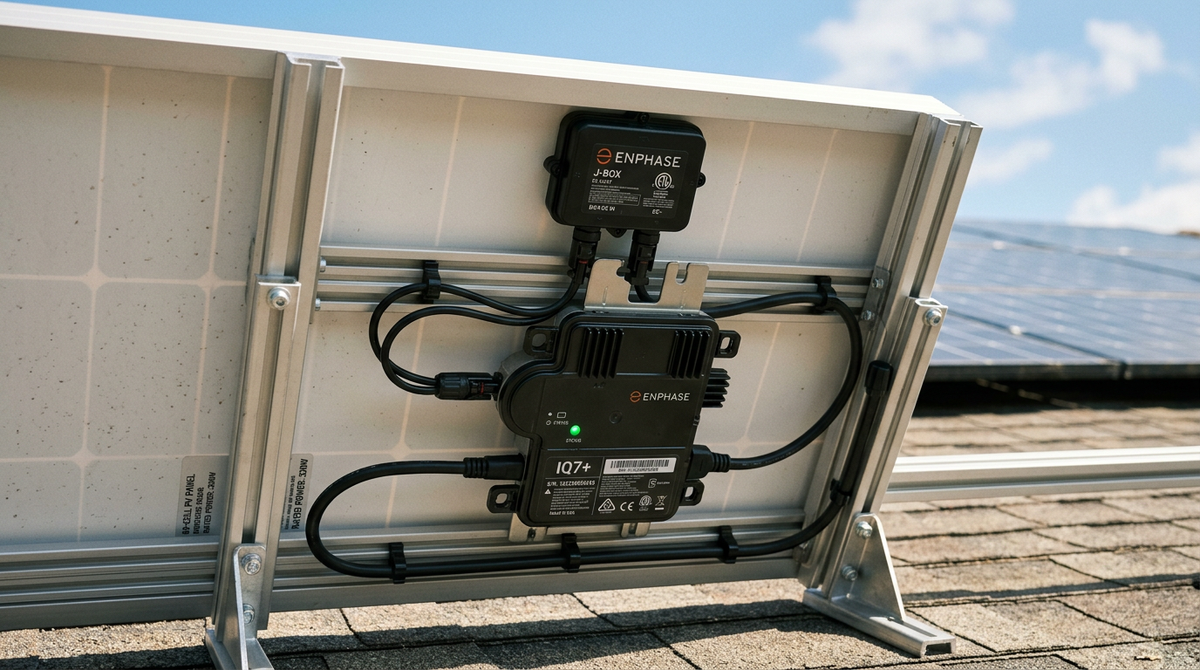
The Yotta SolarLeaf SL-1000 sits in a category most people still don't have a name for: a microinverter with battery storage built into the same panel-level enclosure. Instead of converting DC to AC at the module and sending power to a separate battery cabinet in the garage, the SolarLeaf architecture stores energy right at the panel and dispatches it when the array stops producing. I've specified panel-level storage on shade-challenged and outage-prone sites where a conventional string-plus-battery design would have cost more and done less, and this class of hardware keeps proving itself. This guide covers what the SL-1000 is, how the panel-level storage concept works electrically, where it shines, and how to size a system around it.

What is the Yotta SolarLeaf SL-1000 Microinverter?
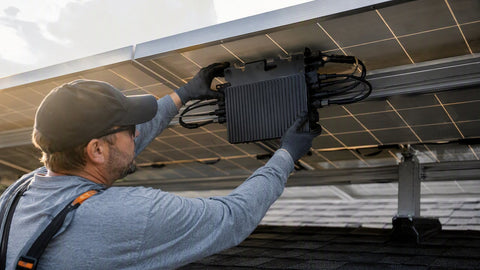
The SolarLeaf SL-1000 is Yotta Energy's panel-integrated power electronics unit: a microinverter combined with lithium battery storage in a sealed enclosure that mounts under the solar module on the racking, the same way a conventional microinverter does. Each unit handles its own module (or module pair, depending on configuration), stores surplus production during peak sun, and discharges through the same inverter stage when the building needs power after sunset or during a grid outage. The result is a fully distributed energy system — no central battery, no single point of failure, no high-voltage DC runs across the roof.
Yotta Energy built its reputation on exactly this distributed architecture, and you can browse current Yotta Energy equipment in our catalog alongside the broader microinverter lineup for comparison. For buyers evaluating panel-level electronics generally, our guide to microinverters versus string inverters sets the baseline this article builds on.
Key Features and Benefits of the Yotta SolarLeaf SL-1000
1. Panel-Level Energy Conversion
Like any microinverter, the SL-1000 converts DC to AC at the module. That eliminates string sizing math at the array level, kills the single-point-of-failure risk of a central inverter, and delivers module-level maximum power point tracking. On roofs with mixed orientations, dormers, or partial shade — the roofs that actually exist in the real world — per-module MPPT routinely recovers 5–15% of annual energy that a string architecture would lose to mismatch.
2. Modular and Scalable Design
Because every panel-storage unit is independent, system capacity scales linearly. A homeowner can commission a 10-panel system this year and add six more panels with their own SL-1000 units next year without touching the existing installation. I've watched customers start with a partial array sized to their budget and grow it as finances allowed — something a central-battery design makes painful, because storage cabinets come in fixed capacity steps.
3. Superior Efficiency Through Distributed Storage
Central storage systems convert energy multiple times: DC from the array, through the inverter to AC, back to DC for the battery, and back to AC for the home — with losses at every stage. Panel-level storage shortens that path dramatically. Every avoided conversion is 2–4% of energy kept instead of lost, and across a 25-year system life those points compound into thousands of kilowatt-hours.
4. Integrated Storage Solution
The defining feature: the battery is in the unit. This changes installation economics more than most buyers expect. There's no separate battery wall to mount, no dedicated battery circuit to run, no garage space surrendered, and no oversized conduit between a central battery and the main panel. For retrofit solar-plus-storage on finished homes, that simplification routinely removes a full day of labor from the job.
5. Smart Monitoring and Remote Management
Panel-level systems generate panel-level data. Every SL-1000 reports its module's production, storage state of charge, and unit health to a cloud dashboard. For owners, that means seeing exactly which panel underperforms after a dust storm. For installers like us, it means diagnosing issues from the office instead of rolling a truck — a real operating cost difference over a 25-year service relationship.
6. Durable and Weather-Resistant
Panel-mounted electronics live in the harshest environment on the house: full sun, thermal cycling, and roof temperatures that can exceed 70°C in summer. Units in this class are sealed to outdoor enclosure standards and engineered for rooftop service life. The distributed architecture also means thermal stress is spread across many small units rather than concentrated in one hot central cabinet. There's a resilience dividend hiding in that distribution: when a hailstorm or a fallen branch kills one panel position, the other nineteen keep producing and storing — a degraded system, not a dead one. Anyone who has watched a single central inverter failure zero out a whole array for six weeks waiting on parts understands what that's worth.
The Electrical Case for Panel-Level Storage
Storage at the panel changes the voltage and current math of the whole system. Here's how the comparison looks on a representative 20-panel residential array:
| Design Factor | String Inverter + Central Battery | Panel-Level Micro + Storage (SL-1000 class) |
|---|---|---|
| DC voltage on the roof | 300–600V string DC | Module-level DC only (~40–60V per unit) |
| Single point of failure | Inverter or battery cabinet | None — each unit independent |
| Round-trip path | DC→AC→DC→AC (up to 4 conversions) | Shortened path at panel level |
| Expansion | Fixed battery capacity steps | Add panels + units linearly |
| Shade/mismatch losses | String-level MPPT, worst panel drags string | Per-module MPPT |
| Rapid shutdown | Module-level devices required by NEC 690.12 | Inherent — each module converts independently |
Sizing a System Around Panel-Level Storage
Sizing a SolarLeaf-style system starts with the same load analysis as any solar-plus-storage design, then divides across the array. Work through it in four steps:
- Daily energy target. Pull 12 months of utility bills, average daily kWh, and decide what fraction you want solar to cover.
- Array size. Daily kWh ÷ (peak sun hours × 0.82 system factor). A 30 kWh/day home in a 4.5-sun-hour region needs 30 ÷ (4.5 × 0.82) = 8.13 kW of array — about 20 panels at 405W.
- Storage capacity per panel. Total desired backup storage ÷ panel count. Wanting 20 kWh of storage across 20 panels means roughly 1 kWh of usable storage per panel position — right in the panel-level unit class.
- Backup load review. Panel-level storage discharges through the microinverter's AC output, so per-panel discharge power is bounded by the inverter rating. Size critical loads against aggregate discharge power, not just stored energy.
| Home Profile | Daily Use | Peak Sun Hours | Array Needed | Panels @ 405W | Storage @ 1 kWh/panel |
|---|---|---|---|---|---|
| Efficient small home | 20 kWh/day | 5.0 | 4.88 kW | 13 | ~13 kWh |
| Average home | 30 kWh/day | 4.5 | 8.13 kW | 21 | ~21 kWh |
| Large home / EV | 45 kWh/day | 4.5 | 12.2 kW | 31 | ~31 kWh |
| Off-grid cabin | 12 kWh/day | 4.0 | 3.66 kW | 10 | ~10 kWh |
The panel count formula is array watts ÷ module watts: 8,130W ÷ 405W = 20.07, round up to 21 panels. Every one of those panels gets its own conversion and storage, so the 21st panel isn't an awkward string remainder — it's just one more independent unit. Use our solar system calculator and battery sizing calculator to run your own numbers.
Applications for the Yotta SolarLeaf SL-1000 Microinverter
Residential Use
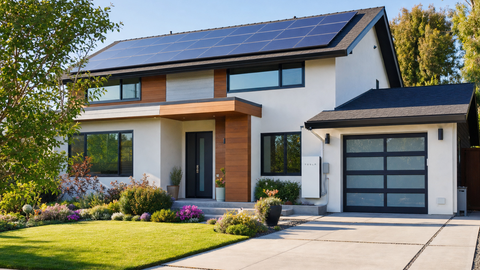
Residential is the sweet spot. Complex roofs, shading from trees and chimneys, HOA restrictions on visible equipment, and homeowners who want backup without a battery wall in the garage all argue for panel-level storage. NEC 690.12 rapid shutdown compliance is also cleaner with per-module conversion — a real inspection-day advantage. Pair the array with modules from our 400–459W residential class for a matched modern build.
Commercial Use
On commercial flat roofs, distributed storage simplifies demand-charge management: stored energy dispatches at the panel during peak windows without a central storage interconnection study. Scalability matters here too — commercial tenants can phase buildouts as leases and budgets allow. For larger projects, our commercial installation cost guide frames the full budget picture.
Off-Grid Installations
For cabins and remote structures, panel-level storage removes the separate battery shed, charge controller, and inverter stack. Each panel is a self-contained power plant. I still counsel off-grid customers to think carefully about winter autonomy — storage sized at ~1 kWh per panel gives you evening coverage, not three cloudy days — so honest load analysis matters more off-grid than anywhere. Our off-grid cabin kits and off-grid battery sizing guide cover that math in detail.
SolarLeaf vs. Conventional Microinverter + Separate Battery

| Factor | Conventional Microinverters + Separate Battery | SolarLeaf SL-1000 (Integrated) |
|---|---|---|
| Equipment footprint | Micros on roof + battery cabinet indoors | Roof only |
| Install labor | Two trades, two mounting jobs, battery circuit run | Single mounting workflow |
| Indoor space required | Garage/wall space for battery | None |
| Monitoring granularity | Panel-level production; battery-level storage | Panel-level production and storage unified |
| Failure impact | Battery fault takes whole storage offline | One unit affects one panel position |
If you're comparing microinverter ecosystems more broadly — Enphase, APsystems, Hoymiles, and others — our APsystems vs. Enphase comparison and microinverter vs. string inverter guide are worth reading alongside this one. For whole-home backup strategy at the system level, the EG4 vs. Tesla Powerwall comparison shows the central-storage approach this architecture replaces. The honest summary of that comparison page ecosystem: no platform wins every roof, which is why we stock several and spec per project rather than per habit.
Installation Considerations for Panel-Level Storage
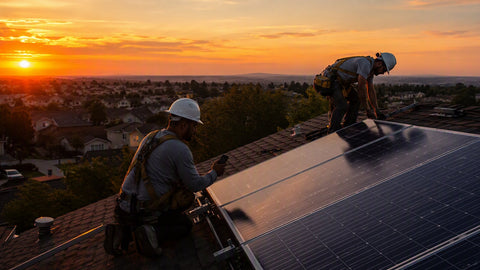
Installing an SL-1000-class system looks like a conventional microinverter job with a few extra disciplines. The units mount to the racking under each module, trunk cable connects them into branch circuits, and those branch circuits land in a combiner or dedicated breaker space in the main panel. Three planning details matter more than they do on a standard micro job:
- Racking load and layout. Each unit adds weight under the module. Confirm the racking manufacturer's allowable point loads and keep unit placement consistent with the racking engineering letter your AHJ will want to see.
- Branch circuit sizing. Microinverter branch circuits follow NEC 690.8 like any inverter output circuit. Twenty units at 1.0A continuous output each is 20A; apply the 125% continuous multiplier and you're at 25A of required ampacity — 10 AWG copper (35A at 75°C per NEC 310.16) on a 30A breaker from the NEC 240.6 ladder, or split into two 20A branch circuits of ten units each. Two smaller branch circuits is usually the cleaner design.
- Commissioning and labeling. Every unit needs its serial mapped to its array position during commissioning. Do the mapping while the crew is on the roof with the layout drawing, not from a spreadsheet later — mislabeled panels turn monitoring data into noise.
Branch Circuit Planning Table
| Units per Branch | Continuous Output @ 1.0A/unit | × 1.25 (NEC 690.8) | Wire (75°C Cu, NEC 310.16) | Breaker (NEC 240.6) |
|---|---|---|---|---|
| 8 | 8.0A | 10.0A | 14 AWG (20A) | 15A |
| 12 | 12.0A | 15.0A | 12 AWG (25A) | 20A |
| 16 | 16.0A | 20.0A | 10 AWG (35A) | 25A |
| 20 | 20.0A | 25.0A | 10 AWG (35A) | 30A |
Conductor and breaker selections above assume the microinverter's maximum continuous output current of 1.0A per unit — substitute the actual datasheet value for the units you install and keep breaker size at or below conductor ampacity after the 125% factor.
Monitoring, Maintenance, and Service Life
Day-to-day ownership of a panel-level storage system is deliberately boring, which is the point. The monitoring platform watches per-panel production and storage behavior; the owner's job is to keep the modules reasonably clean and glance at the dashboard monthly. Where maintenance gets real is in the outliers:
- Underperforming panels show up as unit-level production deltas. A panel producing 15% below its neighbors after cleaning usually means a warranty conversation — and per-module data makes that claim airtight.
- Storage state-of-charge patterns reveal load problems. If units consistently hit 100% by noon, the array outproduces the storage and you're exporting value; if they never reach full charge in winter, loads or shading need attention.
- Thermal flags matter in hot climates. Sealed rooftop electronics derate in extreme heat; the dashboard shows it before it becomes a failure.
On service life: panel-level storage units carry product warranties in the 10–25 year range depending on program, and the storage cells inside are engineered for daily cycling. Plan for the same 25-year roof life as the modules, and keep a spare unit or two on the shelf — replacing one unit is a one-person, one-hour job when you have the part. One more habit worth adopting at commissioning: export the as-built unit map and keep it with the homeowner's paperwork. Every service call I've ever run went faster when the map was accurate, and slower when it wasn't.
Real-World Energy Math: One Day in the Life of a 20-Panel System
Abstract specs don't pay bills, so here's what a representative day looks like for the 21-panel, 8.5 kW array from the sizing table above in a 4.5-sun-hour region:
| Period | Array Behavior | Storage Behavior | Grid Interaction |
|---|---|---|---|
| 7–10 AM | Ramping production, home loads served first | Charging from surplus | Minimal export |
| 10 AM–3 PM | Peak production ~30 kWh cumulative | Reaches full charge mid-afternoon | Surplus exports after storage full |
| 3–7 PM | Declining production | Begins dispatch as array fades | Near-zero import during peak-rate window |
| 7 PM–midnight | No production | Discharges through evening loads | Import only if storage depletes |
| Overnight | No production | Reserve held or depleted by design | Off-peak import for base loads |
The pattern that matters: storage charges from energy that would have exported at low midday value and discharges against peak-rate evening imports. That arbitrage — plus outage resilience — is where panel-level storage earns its keep. I've pulled utility interval data for customers before and after storage installs, and the evening import window is where the bill shrinks.
Who Should (and Shouldn't) Choose Panel-Level Storage
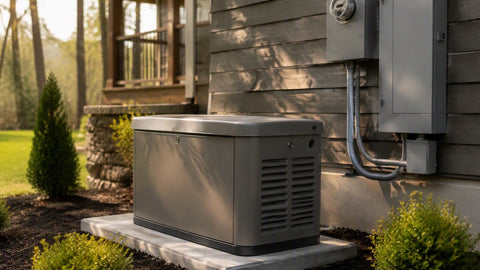
Honest equipment guidance means naming the losers as well as the winners. Panel-level integrated storage is the right answer when the roof is complex or shaded, when indoor battery space doesn't exist, when the build will happen in phases, or when the owner's priority is resilience distributed across every panel rather than concentrated in one cabinet. It's the wrong answer for a large, unshaded commercial array feeding a hungry overnight load profile — there, a centralized storage block with a bigger inverter usually wins on both cost and discharge power. It's also a poor fit where extreme sustained cold dominates and units would spend winters at temperature extremes without the shelter a conditioned battery room provides.
The decision framework I use with customers is simple: draw the load curve, look at the roof, and price both architectures. When the roof is ugly or the garage is full, panel-level wins. When the roof is a clean rectangle and the loads are big and nocturnal, central storage wins. The SL-1000 class exists to own the first category, and it does.
The Bigger Picture: Why Panel-Level Storage Keeps Gaining Share
Zoom out from any single product and the trend is structural. Residential solar buyers increasingly expect storage from day one, installers want fewer boxes to mount and wire, and inspectors want simple, code-clean arrays. Integrated panel-level storage answers all three pressures at once. It also future-proofs the array against rate-plan changes: as utilities shift value away from midday exports toward evening consumption, storage that charges from your own panels and dispatches on your schedule captures value that a storage-free array simply gives away. The SolarLeaf SL-1000 isn't a niche experiment — it's an early, well-executed member of a category that will be standard practice within this decade.
Why Choose the Yotta SolarLeaf SL-1000 Microinverter?
Choose it when the project profile matches its strengths: a shaded or complex roof that demands per-module MPPT, a homeowner who wants storage without surrendering indoor space, a phased buildout that grows over time, or an outage-prone site where distributed resilience beats centralized capacity. I've recommended central batteries where they fit — big uniform arrays with hungry overnight loads — but the panel-level pattern keeps winning the jobs where the roof is ugly and the garage is full. There's also a quieter benefit that shows up a year in: because every panel reports individually, owners actually engage with their systems. Engaged owners catch problems early, keep panels clean, and call us with data instead of guesses — which makes the whole service relationship cheaper and better for everyone involved.
Procurement-wise, panel-level storage consolidates the bill of materials: modules, racking, and the SL-1000 units are most of the system. You can source Yotta hardware through our Yotta Energy collection, pair with panels from the solar panel catalog, and round out the design with guidance from the inverter buyer's guide. When you're ready to talk through a specific roof, contact us at Portlandia Electric Supply — this is exactly the kind of design conversation we have every day.
Frequently Asked Questions
What makes the SolarLeaf SL-1000 different from a regular microinverter?
A regular microinverter only converts DC to AC at the panel. The SL-1000 adds battery storage in the same panel-mounted enclosure, so each panel stores its own surplus energy and dispatches it later — no separate battery cabinet required.
How much storage does a panel-level system provide?
Storage scales with panel count. At roughly 1 kWh of usable storage per panel position, a 20-panel array carries about 20 kWh of distributed storage — enough for evening loads and overnight essentials for most efficient homes.
Can I expand a SolarLeaf system later?
Yes — that's one of its core strengths. Each new panel gets its own integrated unit, so expansion is linear: add panels and units, commission them, done. No battery cabinet resizing, no inverter replacement.
Does panel-level storage work during a grid outage?
Panel-level storage systems are designed to form a local microgrid and power critical loads during outages. Work with your installer to define the backup load panel and confirm aggregate discharge capacity covers those loads.
How many panels do I need for a typical home?
For a 30 kWh/day home in a 4.5 peak-sun-hour region: 30 ÷ (4.5 × 0.82) = 8.13 kW of array, or 21 panels at 405W each. Storage then scales to roughly 21 kWh distributed across the array.
Is panel-level storage more expensive than a central battery?
Equipment cost per kWh is comparable, but installed cost often favors panel-level on retrofit jobs because it eliminates the battery cabinet, its dedicated circuit, and the indoor mounting labor. On new construction with a dedicated utility space, central storage can still pencil out — run both quotes.