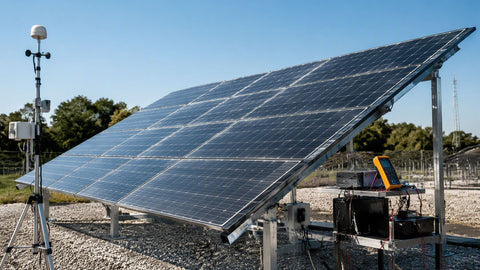
The first solar inverter I ever replaced failed on the hottest afternoon of the year, right at peak production — which is exactly when inverters die, because that's when they work hardest. Panels get the glamour in every solar brochure, but the inverter is the component that decides whether your array delivers its rated power, survives a grid fault, and reports its own health. This guide covers what solar inverters actually do, how the three architectures differ in the field, how to size one against your array, and the NEC requirements that govern every installation I sign off.

What a Solar Inverter Actually Does
A solar module produces DC power whose voltage and current slide constantly with irradiance and temperature. The grid — and everything in your house — runs on fixed 60 Hz, 120/240V AC. The inverter is the translator between those two worlds, but modern units carry four jobs, not one:
- DC-to-AC conversion at 95–98.5% efficiency, synchronized precisely to grid frequency and phase.
- Maximum power point tracking (MPPT). Every module has an operating point where voltage × current peaks, and that point moves all day. The inverter's MPPT algorithm hunts it continuously, per input. More independent MPPT inputs means more tolerance of shade and mixed orientations.
- Grid safety functions. Anti-islanding (UL 1741 / IEEE 1547 in North America) forces the inverter to shut down within milliseconds of a grid outage so it can't energize lines that crews are repairing. Modern "grid support" functions — voltage ride-through, frequency-watt response, volt-var — are now required by the same standards.
- Monitoring and communications. The inverter is the system's black-box recorder: production logging, fault codes, and the data that warranty claims run on.
The Three Architectures, Compared Honestly
| Factor | String Inverter | Microinverters | String + DC Optimizers |
|---|---|---|---|
| Architecture | One central unit; panels wired in series strings | One small inverter per module, on the roof | Per-module electronics condition DC; central inverter converts |
| Typical efficiency (CEC weighted) | 96–98% | 96–97% | 97–98% (inverter) minus optimizer losses |
| Shade tolerance | Weakest — one shaded module drags its string | Strongest — each module independent | Strong — module-level MPPT |
| Module-level monitoring | No (string level) | Yes | Yes |
| Rapid shutdown compliance (NEC 690.12) | Needs added module-level devices on roofs | Inherent | Inherent |
| Single point of failure | Yes — one failure takes the whole array down | No — one failure costs one module | Partial — inverter still central |
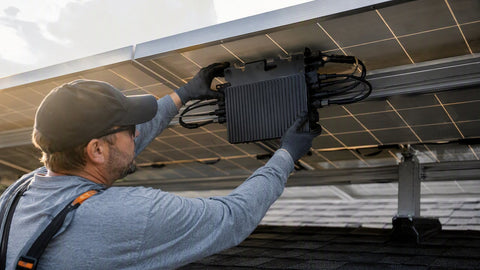
| Roof-mounted electronics | None | All of it — heat and access are real concerns | Optimizers only |
| Typical warranty | 10–12 years (extendable) | 20–25 years | 25 years (optimizer) / 10–12 (inverter) |
| Cost per watt | Lowest | Highest | Middle |
| Best fit | Unshaded, single-plane roofs; budget commercial | Complex, shaded, multi-plane roofs; monitoring-focused owners | Shaded roofs where one failure point is unacceptable |
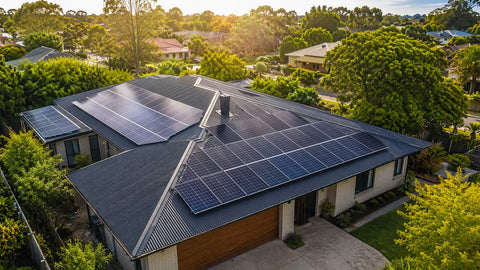
My field bias, for what it's worth: on a clean south-facing rectangle with no shade, a quality string inverter is the best value in solar — period. The moment a roof has three orientations, a chimney, or a tree the customer won't trim, microinverters or optimizers pay for themselves in harvested energy. I stopped arguing about it years ago and just model both.
Hybrid Inverters: Where the Market Went
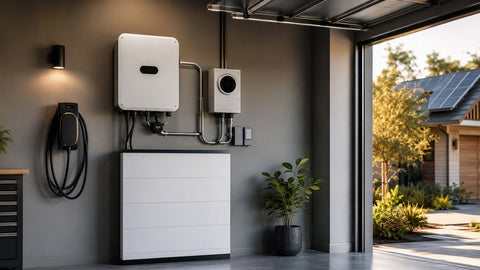
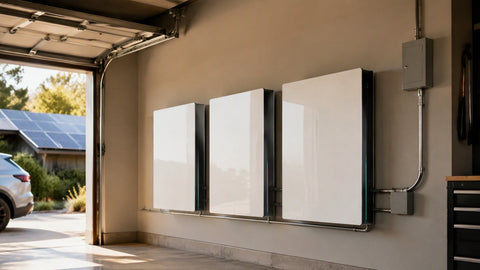
The fastest-growing category is the hybrid (battery-ready) inverter — a string inverter with a built-in battery interface, charge control, and an automatic transfer function. One box replaces what used to require an inverter, a separate battery inverter/charger, and an external transfer switch. For anyone planning storage now or later, hybrid is the architecture to buy; retrofitting batteries onto a legacy string inverter usually means AC-coupling a second inverter, which works but adds cost and conversion losses. Our hybrid solar inverter guide goes deep on topologies, and current stock lives in the 10–12 kW hybrid inverter collection.
Sizing: DC/AC Ratio, Voltage Windows, and the 125% Rules
Inverter sizing is a set of constraints, not a single number. All of these must hold simultaneously:
| Constraint | Rule | Worked Example (8 kW Inverter) |
|---|---|---|
| DC/AC ratio | Array STC watts ÷ inverter AC watts; typical sweet spot 1.1–1.35 | 10 kW array ÷ 8 kW inverter = 1.25 — healthy |
| Max DC input voltage | Cold-corrected string Voc (NEC 690.7) must stay under the input max | 10 modules × 57.2 V (cold-corrected) = 572 V < 600 V limit ✓ |
| MPPT operating window | String Vmp (hot) must stay above the MPPT minimum | 10 × ~34 V hot ≈ 340 V, inside a 200–500 V window ✓ |
| Max input current per MPPT | String Isc × 1.25 (NEC 690.8) under the input rating | 11.55 A × 1.25 = 14.4 A < typical 15–20 A input ✓ |
| AC output breaker | Continuous output × 1.25, next standard NEC 240.6(A) size up | 8,000 W ÷ 240 V = 33.3 A × 1.25 = 41.7 A → 45 A or 50 A breaker |
The DC/AC ratio row deserves emphasis because it's the most misunderstood. Oversizing the array relative to the inverter ("clipping") sounds like waste but is standard engineering: modules rarely make nameplate power, mornings and evenings harvest more with a bigger array, and the small amount of midday energy clipped on perfect cool days costs less than the inverter capacity you'd buy to catch it. Ratios up to 1.3–1.35 typically clip under 2% of annual energy. Above 1.5, returns fall off a cliff.
The NEC 690.7 cold correction that drives the voltage row: crystalline modules gain voltage as temperature drops, so a string sized to "599 volts, just under the limit" at STC becomes a 695 V string at −20°C and a very expensive smoke signal on the first cold snap. Correction factors run from 1.02 (mild climates) to 1.25 (−40°C); our NEC ampacity guide and NEC 690 disconnect and OCPD guide walk the full calculation chain.
Efficiency: What the Numbers on the Datasheet Mean
| Metric | Definition | Good Number (Current Equipment) | Why It Matters |
|---|---|---|---|
| Peak efficiency | Best-case conversion at optimal input | 97.5–98.5% | Marketing number; achieved at one operating point |
| CEC / Euro weighted efficiency | Weighted average across realistic power levels | 96–98% | The honest comparison metric — use this one |
| MPPT tracking efficiency | How close the tracker holds the true peak | >99% | Poor tracking loses energy every minute of every day |
| Standby/night consumption | Power drawn with no sun | <1–5 W | Trivial per night, real over 25 years |
Two percentage points of weighted efficiency on a 10 kW array producing 14,000 kWh/year is about 280 kWh annually — roughly $48/year at $0.17/kWh, or $1,200 over 25 years before rate escalation. Worth paying a modest premium for; not worth paying a fortune for.
Failure Modes and Lifespan: The Truth About the Weak Link
Inverters are the shortest-lived major component in a PV system — panels carry 25-year warranties while string inverters typically carry 10–12. The failure curve has a physics reason: electrolytic capacitors age with heat and ripple current, and cooling fans wear. The failures I see most, in order:
- Fan failure → thermal derating or shutdown. The inverter reports a temperature fault and throttles. Fan replacement is a standard service item on most string units.
- Capacitor aging → DC bus faults. Years 8–12 is the typical window. Some designs allow capacitor board replacement; many mean a unit swap.
- Surge damage. Lightning-induced transients come in on both the DC and AC sides. A proper SPD on both sides is cheap insurance — see our solar surge protection guide.
- Firmware/communications faults. The inverter works but stops reporting. Annoying, not fatal — but it blinds your monitoring, and undetected production loss is how systems silently underperform for years.
Two habits extend inverter life materially: mount it out of direct sun (south-wall mounting in full afternoon sun bakes capacitors — I move installs to north walls or shaded garages whenever the wire run allows), and keep clearances clean for airflow. Budget one inverter replacement over a 25-year panel life in your financial model and the numbers will match reality.
Monitoring: The Feature That Pays for Itself
An unmonitored solar system is an unverified promise. Module-level monitoring (microinverters or optimizers) catches a dead module in days; string-level monitoring catches it in a billing cycle; no monitoring catches it when the owner finally looks at the app they never installed. I've diagnosed systems that ran at 60% production for over a year before anyone noticed. Minimum viable practice: production alerts enabled, a monthly glance at kWh vs. expectation, and an annual comparison against the installer's model. Size expectations with our system size calculator.
Choosing: The Checklist I Run Through

- Architecture first — shade and roof complexity pick string vs. micro vs. optimizer before brand enters the conversation.
- Battery future — if storage is even a maybe within five years, buy hybrid now. Retrofitting costs more than the price difference. Pair it with the battery sizing guide when you're ready.
- MPPT count — one per distinct roof orientation, minimum.
- Certifications — UL 1741 with the current IEEE 1547 supplements; your utility's interconnection list will enforce this anyway.
- Warranty and service network — a 10-year warranty from a company with US-based support beats 12 years from a brand with none. Current inventory by size: 10 kW inverters, 12 kW inverters, and the broader top picks roundup.
- Grounding and code details — the grounding and bonding guide covers what your inspector will check.
Grid-Tied, Off-Grid, and Hybrid: Pick the System Before the Box
The inverter question is really a system question. Three system types dominate, and they demand different hardware:
| System Type | Grid Relationship | Inverter Requirements | Typical Buyer |
|---|---|---|---|
| Grid-tied | Exports surplus; dies with the grid | UL 1741 grid-interactive inverter; no transfer hardware | Lowest-cost bill reduction |
| Off-grid | No utility connection at all | Off-grid inverter/charger forming its own grid; generator input almost mandatory | Remote property; grid connection cost exceeds system cost |
| Hybrid (grid-interactive with backup) | Uses grid normally; islands itself during outages | Hybrid inverter with battery port and automatic transfer; critical-loads subpanel | Outage-prone areas; anyone who wants resilience plus bill savings |
Two expensive misunderstandings drive most mis-buys in this category. First, a grid-tied inverter without batteries provides zero blackout power — anti-islanding shuts it off even though the sun is shining. Second, an off-grid inverter is not a better grid-tied inverter — off-grid units form their own 60 Hz reference and many can't export; buying one for a grid-connected house wastes its capabilities and complicates permitting. Match the box to the system architecture. If outages are why you're here, start with the hybrid inverter overview and the battery runtime calculator, and consider whether a standby generator covers your outage profile more cheaply.
A Complete Residential Sizing Example
Putting every constraint together on a realistic job: a customer wants a 24-module array of 440W-class panels (10.56 kW STC) on a two-plane roof, storage planned for next year, in a climate with a −10°C design temperature. Module nameplate: Voc 49.3 V, Isc 11.55 A, Vmp 41.0 V.
- Architecture: Two roof planes → at least two MPPT inputs → hybrid string inverter with 3 MPPTs (growth headroom) in the 10–12 kW class.
- String voltage, cold (NEC 690.7): −10°C correction factor 1.14. Corrected Voc = 49.3 × 1.14 = 56.2 V. A 12-module string = 674 V — over a 600 V residential limit. Two strings of 12 on 1,000 V commercial equipment would pass, but residential gear caps at 600 V, so the design becomes three strings of 8: 8 × 56.2 = 449.6 V ✓.
- Hot MPPT floor: 8 × ~34 V hot Vmp ≈ 272 V — above the inverter's ~200 V MPPT minimum ✓.
- Current per input (NEC 690.8): 11.55 × 1.25 = 14.4 A per string; three separate MPPT inputs, no paralleling, each under a 15–20 A input rating ✓.
- DC/AC ratio: 10.56 kW on a 10 kW hybrid = 1.06 — conservative; on an 8 kW = 1.32, still healthy. With storage coming, the 10 kW unit preserves charging headroom.
- AC side: 10,000 W ÷ 240 V = 41.7 A continuous × 1.25 = 52.1 A → 60 A breaker (NEC 240.6(A) standard size), 6 AWG copper conductors (65 A at 75°C per NEC 310.16) ✓.
Every box ticked, every number traceable to a code section or a datasheet line. That's what a permit package looks like when it sails through plan review in one pass.
Installation Details That Determine Reliability
The same inverter model lasts fifteen years on one wall and six on another. The difference is installation discipline:
- Sun exposure. Direct afternoon sun on the enclosure raises internal temperature 15–25°C. Capacitor life roughly halves for every 10°C. North walls, shade, or garage interiors — pick one.
- Clearances. Manufacturers spec clearances (commonly 8–12 inches above and to the sides) because convection is the cooling system. An inverter boxed in by stored lumber derates or dies.
- Conduit entries from below. Bottom entries shed condensation and keep drip loops honest. Top entries invite water into the electronics compartment — I've opened more than one inverter with a rust ring under a top knockout.
- Torque the DC terminals. Loose MC4s and loose inverter lugs are the leading cause of DC arcs and burnt terminals. Torque to the labeled spec with a calibrated driver, then mark the terminal with a paint pen so the next tech can see it's been done.
- Label everything. NEC 690 requires specific labels; future-you requires more. String maps on the inverter door turn a fault diagnosis from a roof day into a ten-minute fix.
Where Inverter Technology Is Heading
Three trends are reshaping the category and worth timing a purchase around. First, higher-voltage residential platforms — 600 V equipment giving way to designs that tolerate longer strings — simplify design in cold climates. Second, grid-interactive functionality keeps deepening: utilities increasingly require IEEE 1547-2018 smart-inverter functions (volt-var, frequency-watt), and buying a unit certified to the current standard avoids a forced replacement when your utility updates its interconnection agreement. Third, whole-home backup integration — hybrids now ship with 200 A-rated automatic transfer options that back up the entire panel instead of a critical-loads subpanel, collapsing what used to be three boxes and a day of wiring into one. If your install is more than a year out, these shifts matter; if it's this quarter, buy proven current-generation hardware and don't wait for vaporware.
Rapid Shutdown, NEC 690.12, and Why It Shapes Your Choice
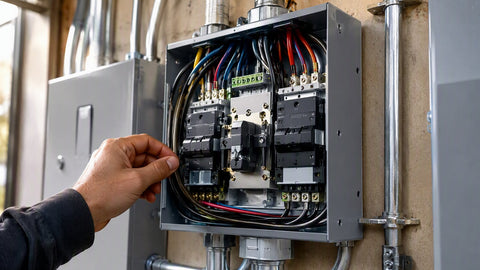
NEC 690.12 requires module-level rapid shutdown on roof-mounted systems: inside the array boundary, conductors must drop to 30 V within 30 seconds of initiation; outside it, the same for anything more than a foot from the array. This single code section quietly decides architecture on residential roofs. Microinverters and optimizers comply inherently — kill AC and each module goes quiet. A plain string inverter needs an added module-level shutdown device on every panel, which narrows the cost gap that made string architecture attractive. When I quote string-plus-RSD versus optimizers on a shaded roof, the optimizer quote usually wins on hardware count alone. Factor that before falling in love with a low string-inverter number, and confirm your AHJ is enforcing the module-level version of 690.12 — nearly all of them now are.
A Word on Used and Gray-Market Inverters
I've been offered pallets of "surplus" inverters more times than I can count, and my answer is always the same. An inverter is a warranted, certified, firmware-living device: UL 1741 certification ties to specific firmware, warranty service ties to serials and purchase channels, and a unit with unknown thermal history is a capacitor-aging lottery ticket. The $400 saved on a gray-market string inverter evaporates the first time you need a warranty RMA and discover the serial was never sold into your region. Buy through authorized channels — the current top picks are all stocked through legitimate distribution — and keep the receipt with your permit package. I've watched exactly one customer win a warranty claim on a gray-market unit, and it took him eleven months and one very patient distributor rep. The lesson stuck with me: provenance is a feature, and it costs less than the discount that removes it.
Frequently Asked Questions
What size inverter do I need for a 10 kW solar array? A 7.6–8 kW inverter handles a 10 kW array well (DC/AC ratio of 1.25–1.32). Oversizing the array relative to the inverter is standard practice and typically costs under 2% of annual production to clipping while improving morning and evening harvest.
How long does a solar inverter last? String inverters typically carry 10–12 year warranties and often run 12–15 years; microinverters are warrantied 20–25 years. Budget for one string-inverter replacement over the 25-year life of the panels.
What's the difference between a string inverter and a microinverter? A string inverter converts DC from series-wired panel groups at one central unit; microinverters convert at each panel. Microinverters win on shade tolerance and module-level monitoring; string inverters win on cost per watt and serviceability.
Can a solar inverter work during a blackout? Standard grid-tied inverters shut down during outages (anti-islanding, required by UL 1741/IEEE 1547). Hybrid inverters with battery backup or specific secure-power features can power loads during an outage — this capability has to be designed in, not assumed.
Where should a solar inverter be mounted? Out of direct sun, with the manufacturer's clearances for airflow, within the wire-run economics of your array, and accessible for service. A shaded north wall or garage interior beats a sun-baked south wall every time for component life.
Do solar inverters need maintenance? Minimal but not zero: keep vents and fans clear of dust and debris, verify production monthly, and check for fault codes. Fan replacement around years 5–8 is the most common service item on fan-cooled string units.
The Component That Earns Its Keep
Panels harvest sunlight, but the inverter decides how much of that harvest your meter ever sees. Match the architecture to your roof's reality, size the DC/AC ratio deliberately, respect the NEC 690 voltage and current math, and buy from a brand whose warranty you can actually exercise. Do those four things and the inverter — the supposed weak link — will quietly out-earn every dollar you spent on it. If you're still weighing brands and capacities, our team specs systems daily and can pressure-test your short list against your actual roof and load profile — reach out with your address and rough goals, and we'll tell you what we'd put on our own house.