⚡ Solar Panel Calculator
Explore the Solar Hub → panel sizing guides, brand comparisons, and in-stock kits in one place.
Fifteen hundred kWh a month is a serious house. The average U.S. home burns 900–1,200 kWh, so if your bills land at 1,500 you likely have electric water heating, a pool pump, an EV in the garage — or just a big family in a big footprint. Either way the question is the same: how many solar panels does it take to cover 1,500 kWh every month? We size systems like this every week at PES Supply, and the honest answer is a range — roughly 24 to 40+ panels — set by three numbers you can pin down in ten minutes: your peak sun hours, your panel wattage, and your loss factor.
This guide runs the full calculation the way our engineering team does it on real quotes: usage first, then peak sun hours, panel wattage, and system losses, then the companion gear — inverters, battery storage, and racking — and finally the incentives that decide the check you actually write. Every table uses real catalog equipment and shows the arithmetic out loud, so you can check our work before you spend a dollar.
Key Takeaways
- Panel count: Expect 24–36 panels depending on wattage (300W–430W) and your location's sunlight hours
- Core formula: 1,500 kWh ÷ Monthly Output per Panel = Base Panel Count (+ 15% loss buffer)
- Location matters: Phoenix homeowners may need just 21 panels, while Portland or Seattle may require 36+
- Higher wattage = fewer panels: Upgrading from 300W to 430W cuts your panel count from ~34 to ~24
- Complete system: Panels, inverters, battery storage, and racking all work together — Portlandia supplies everything under one roof
In This Guide:
- Step 1: Understand Your Monthly Energy Needs
- Step 2: Determine Your Daily Sunlight Hours
- Step 3: Choose Your Panel Wattage
- Step 4: Calculate the Number of Panels
- Quick Reference Sizing Tables (Region & Wattage)
- Step 5: Account for System Losses
- How Location & Climate Affect Your System Size
- Key Factors That Affect Solar Panel Efficiency
- Building a Complete Solar System
- Financial Incentives & ROI
- Why Choose PES Supply?
- Frequently Asked Questions
Step 1: Understand Your Monthly Energy Needs


Start with twelve months of utility bills, not one. A 1,500 kWh monthly target works out to roughly 50 kWh per day (1,500 ÷ 30), and that daily figure anchors every calculation below. Summer cooling and winter heating swing residential usage by 30% or more, so an annual average sizes the system correctly for net-annual production. If the goal is a zeroed bill in every single month, size to your peak month instead and accept the extra panel or two.
💡 Pro Tip: Let Us Analyze Your Bill
Not sure about your exact usage? PES Supply offers a free Submit My Bill tool where our in-house engineering team analyzes your consumption and recommends the right system size — complete with an itemized equipment quote delivered within 24 hours.
Panels only make power while the sun is on them, so geography sets the ceiling on what each module can produce. The metric that matters is peak sun hours — the daily equivalent of full-strength noon sun hitting the array. Phoenix gets roughly double what Seattle gets, which is why the identical 1,500 kWh target is a 10 kW system in Arizona and a 17 kW system in the Pacific Northwest. PES Supply serves customers in all 50 states and maintains location-specific solar kit pages for hundreds of cities — from Birmingham, AL to Portland, OR.
| Location | Avg. Peak Sun Hours/Day | Solar Potential |
|---|---|---|
| Phoenix, AZ | 6–7 hours | ☀️ Excellent |
| Los Angeles, CA | 5–6 hours | ☀️ Very Good |
| Louisville, KY | 4–5 hours | ⛅ Good |
| New York City, NY | 3.5–5 hours | ⛅ Good |
| Portland, OR | 3–4.5 hours | 🌥️ Moderate |
| Seattle, WA | 2.5–4 hours | 🌥️ Moderate |
Panel wattage decides how many modules go on the roof — not how big the system is. A 10 kW array is 25 × 400W panels or 19 × 550W panels either way. Higher-wattage modules mean fewer attachments, less racking, and less labor per kilowatt, which is why installers bid them aggressively. PES Supply carries a wide range of Tier 1 panels to fit every project size and budget.
Popular Panels in Our Catalog
Mission Solar Mono PERC 430W (MSE430SX9Z)
A high-output 72-cell black-on-black panel ideal for residential rooftops where aesthetics matter. One of our best sellers for homeowners who want maximum output with a sleek appearance.
Hyundai 410W Bifacial (HiS-S410YH)
A 132 half-cell bifacial commercial panel that captures light from both sides, boosting total energy yield by 5–15%. Available by the truckload (768 panels per container) for large-scale projects.
JinkoSolar & Canadian Solar Modules
Industry-leading monocrystalline panels with multi-busbar (MBB) and PERC technology for superior low-light and shaded-condition performance. (Note: as of 2026, N-type TOPCon is the volume standard and HJT/back-contact the premium tiers; PERC/P-type is end-of-life, liquidation-only.) Available in 400W–440W configurations.
300W–350W Standard Modules
Budget-friendly options from brands like SEG Solar and Solaria for cost-conscious residential installations where roof space isn't a limiting factor.
The formula is three lines of arithmetic: multiply panel wattage by your daily peak sun hours, multiply by 30 days, and divide by 1,000 — that's the monthly kWh each panel produces. Then divide your 1,500 kWh target by that number.
📐 The Sizing Formula
Step A: Panel Wattage × Sun Hours × 30 days ÷ 1,000 = Monthly kWh per Panel
Step B: 1,500 kWh ÷ Monthly kWh per Panel = Base Panel Count
Step C: Base Panel Count × 1.15 = Final Panel Count (with 15% loss buffer)
Here's how the math works with real products from the PES Supply catalog, assuming 5 peak sun hours per day:
| Panel | Sun Hours | Monthly Output/Panel | Panels for 1,500 kWh | With 15% Buffer |
|---|---|---|---|---|
| Mission Solar 430W | 5 hrs | 64.5 kWh | ~24 | ~28 |
| Hyundai 410W Bifacial | 5 hrs | 61.5 kWh | ~25 | ~29 |
| JinkoSolar 440–520W | 5 hrs | 60 kWh | ~25 | ~29 |
| Standard 350W | 5 hrs | 52.5 kWh | ~29 | ~34 |
| Standard 300W | 5 hrs | 45 kWh | ~34 | ~40 |
Field note from the quoting desk: We've sized hundreds of systems off submitted utility bills, and the most common mistake is sizing to the average month, then calling in August to ask why the bill isn't zero. If you want a $0 bill year-round, size to the peak month or accept a small summer shortfall. Closing that gap is usually one or two extra panels — cheaper than most people fear.
The math behind every 1,500 kWh per month solar system is the same three steps: 1,500 kWh ÷ 30 days = 50 kWh per day, then 50 kWh ÷ your peak sun hours = array size in kW, then add roughly 20% for real-world losses (inverter, wiring, heat, soiling). The tables below do that arithmetic for you — find your region, then read across to the panel wattage you're considering from our solar panel catalog.
System Size Needed by Region (after 20% losses)
| Region | Avg Peak Sun Hours | System Size Needed | 400W Panels |
|---|---|---|---|
| Southwest (AZ, NM, NV) | 6.25 | 10.0 kW | 25 panels |
| California | 5.75 | 10.9 kW | 28 panels |
| Mountain West (CO, UT) | 5.25 | 11.9 kW | 30 panels |
| Texas & the South | 5.25 | 11.9 kW | 30 panels |
| Florida & Gulf Coast | 5.15 | 12.1 kW | 31 panels |
| Midwest (OH, IN, IL) | 4.25 | 14.7 kW | 37 panels |
| Northeast (NY, PA, New England) | 4.05 | 15.4 kW | 39 panels |
| Pacific Northwest (WA, OR) | 3.65 | 17.1 kW | 43 panels |
The takeaway most shoppers miss: the same 1,500 kWh target takes a 10 kW array in Phoenix but a 17 kW array in Seattle — a 70% difference driven entirely by sun hours. For the majority of U.S. homeowners in the 4.5–5.5 sun-hour band, the right system lands between 10 and 12 kW, which is why 10 kW kits are the sweet spot of the residential market.

Panel Count by Wattage: 400W vs 450W vs 550W
| Peak Sun Hours | 400W Panels | 450W Panels | 550W Panels |
|---|---|---|---|
| 4.0 hrs | 40 | 35 | 29 |
| 4.5 hrs | 35 | 31 | 26 |
| 5.0 hrs | 32 | 28 | 23 |
| 5.5 hrs | 29 | 26 | 21 |
| 6.0 hrs | 27 | 24 | 19 |
Higher-wattage panels shrink the panel count, not the system size — a 10 kW array is 25 × 400W or 19 × 550W either way. Where wattage matters is roof space: a standard 440–520W residential panel covers about 21 sq ft, so a 25–30 panel array needs 525–630 sq ft of unshaded roof. Stepping up to 550W large-format modules cuts that footprint by roughly 25%, which can be the difference between fitting on one roof face and splitting across two. If space is tight, browse the high-wattage options in our solar panels collection; if you'd rather get everything engineered as one package, our solar panel power system kits bundle panels, inverter, and racking at the right size for your kWh target.
⚡ Rule of Thumb for 1,500 kWh Homes
In most of the country, a 1,500 kWh/month home needs a 10–12 kW system — about 25 to 30 standard 440–520W panels on 550–650 sq ft of roof. Sun-belt states land at the low end (25 panels, ~10 kW); the Midwest and Northeast land high (35–40 panels, 14–16 kW). Get your utility's 12-month kWh history before you buy: if your real usage drifts above 1,500 in summer, size to the peak month, not the average.
No array delivers its nameplate rating. Wiring resistance, inverter conversion, soiling, and heat shave 10–20% off the paper number every single day. To compensate, multiply your calculated panel count by a loss factor of 1.15 to 1.20. If the base math said 25 panels, plan for 29–30 panels — and hold your installer (or yourself) to that buffer.
⚠️ System Losses Are Unavoidable — Plan for Them
Every professional system design includes a 15% loss buffer at minimum. Skipping this step means your system will fall short of your 1,500 kWh target from day one. Wiring resistance, inverter conversion, panel soiling, and temperature effects are real — the buffer ensures you hit your energy goal even in less-than-ideal conditions.
This is where choosing premium equipment makes a real difference. High-efficiency inverters from Fronius, SolarEdge, SMA Solar, and Sol-Ark — all available in our catalog — minimize conversion losses. Likewise, advanced panel technologies like PERC and bifacial cells from JinkoSolar and Hyundai capture more energy from the same amount of sunlight, effectively reducing the number of panels you need. (Note: as of 2026, N-type TOPCon is the volume standard and HJT/back-contact the premium tiers; PERC/P-type is end-of-life, liquidation-only.)
Geography is the single biggest variable in the whole sizing exercise. A homeowner in Phoenix with 6+ peak sun hours needs roughly 21 panels (at 400W) for 1,500 kWh a month; a homeowner in Seattle with 3.5 needs 36 or more for the identical bill. Same target, 70% more hardware — that gap is why we ask for your zip code before we quote anything. PES Supply ships nationwide with shipping options on qualifying orders and maintains location-specific solar kit pages for hundreds of cities across all 50 states.
| Location | Peak Sun Hours | Est. Panels (400W)* |
|---|---|---|
| Phoenix, AZ / Tucson, AZ | 6 hours | ~21 panels |
| Los Angeles, CA / San Diego, CA | 5.5 hours | ~23 panels |
| Louisville, KY / Atlanta, GA | 4.5 hours | ~28 panels |
| New York, NY / Boston, MA | 4 hours | ~32 panels |
| Portland, OR / Seattle, WA | 3.5 hours | ~36 panels |
*Estimates include a 15% system loss factor. Actual results vary based on roof orientation, tilt, and shading conditions.
Panel Type & Technology
Monocrystalline panels — like those from JinkoSolar and Canadian Solar in our catalog — offer the highest efficiency ratings, typically 20–22%. Bifacial panels such as the Hyundai HiS-S410YH capture reflected light from the ground surface, adding 5–15% extra energy production without additional roof space. Thin-film panels are a flexible alternative for unconventional mounting surfaces but generally produce less power per square foot.
Roof Orientation & Tilt
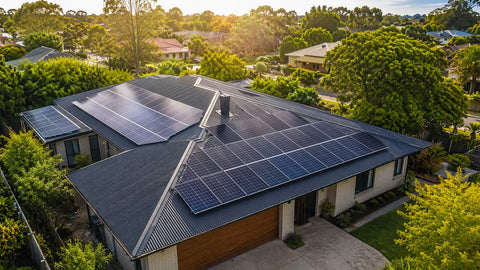
South-facing roofs in the Northern Hemisphere receive the most direct sunlight throughout the year. The optimal tilt angle roughly equals your latitude. East- or west-facing arrays typically produce 10–20% less energy, while north-facing installations can lose 30–40%. PES Supply carries racking and mounting solutions from Unirac, SnapNrack, SunModo, and EZ Solar that allow precise angle adjustment for both roof-mount and ground-mount installations.
💡 Pro Tip: Ground Mounts Solve Bad Roof Angles
If your roof faces east/west or has significant shading, a ground-mounted system using EG4 BrightMount racking lets you orient your array due south at the optimal tilt — regardless of what your roof looks like. This can mean the difference between 28 and 36 panels for the same 1,500 kWh target.
Shading & Obstructions
Even partial shading from a single tree branch can significantly reduce a panel's output — and in a traditional string inverter setup, one shaded panel can drag down an entire string. Module-level power electronics (MLPEs) like SolarEdge optimizers and Tigo Energy products — both available from Portlandia — mitigate shading losses by allowing each panel to operate independently.
Temperature
Solar panels actually perform best in cooler temperatures. Extreme heat can reduce output by 0.3–0.5% per degree Celsius above 25°C (77°F). This is another reason high-efficiency Tier 1 panels with superior temperature coefficients — like those we carry — are worth the investment. In hot climates like Phoenix and Tucson, the temperature penalty is already factored into our regional estimates above.
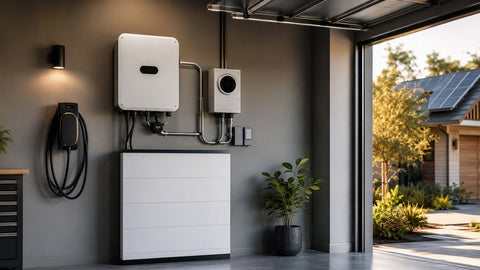
Solar panels are just one piece of the puzzle. A properly designed system requires several integrated components, all of which are available in our catalog with free nationwide shipping on qualifying orders.
Inverters
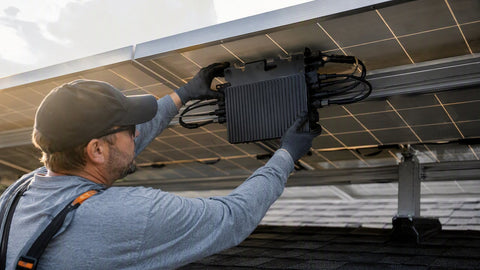
Inverters convert DC power from your panels into AC electricity your home can use. We carry string inverters, microinverters, and hybrid models from Fronius, SMA Solar, Sol-Ark, Solectria, Solis, and EG4 Electronics. Hybrid inverters from Sol-Ark are particularly popular for homeowners who want seamless battery integration and the ability to operate independently during grid outages.
Battery Storage / ESS
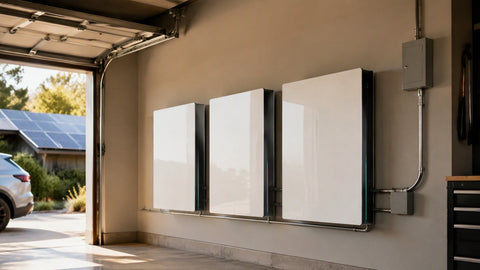
Energy storage lets you use solar power after dark, during outages, or to avoid peak utility rates. Our battery collection includes over 1,200 SKUs, with scalable systems like the EG4 14.3–28.6 kWh stackable bundles, BYD Battery-Box modules, SimpliPhi turnkey ESS, and LiFePO₄ batteries from Pylontech, Battle Born, and Victron Energy. Systems start from $2,899.
Sizing the Battery Bank for a 1,500 kWh Home
At 50 kWh of usage per day, storage sizing comes down to one question: how much of that day do you want to survive without the grid? Size batteries by usable capacity (after depth-of-discharge limits), not nameplate.
| Backup goal | Usable capacity needed | Example configuration |
|---|---|---|
| Essential loads overnight (fridge, furnace blower, lights, Wi-Fi) | 8–12 kWh | One 14.3 kWh stack |
| Whole-home overnight at normal evening usage | 18–25 kWh | Two 14.3 kWh stacks (28.6 kWh) |
| Peak-shaving the 4–9 PM time-of-use window | 10–15 kWh | One to two stacks |
| Full 24-hour autonomy at your average usage | ~50 kWh | Four 14.3 kWh stacks (57.2 kWh) |
Field note from storm season: Customers routinely expect days of whole-home backup from a single battery. One 14.3 kWh stack runs the essentials beautifully overnight — but a whole house with air conditioning drains it before breakfast. Set expectations at the kitchen table, not during the outage, and pair bigger banks with a hybrid inverter that can actually feed the surge loads.
Racking & Mounting
We offer roof-mount and ground-mount racking from Unirac, SnapNrack, SunModo, and EG4 BrightMount. Proper racking ensures your panels are securely mounted at the optimal angle for maximum energy capture, engineered for your regional wind and snow load requirements.
Field note from the roof: We've laid out arrays on everything from dead-south standing seam to split east/west comp shingles. A west-facing array gives up 10–15% of annual production but makes its power late in the day — exactly when time-of-use rates peak. Don't let anyone talk you out of a workable roof plane over a few percent; run the rate math first.
EV Charging
Pairing solar with an EV charger from Wallbox or other brands in our EV Charging collection lets you fuel your vehicle with clean, self-generated electricity — further reducing your dependence on the grid and maximizing your solar investment.
Generators
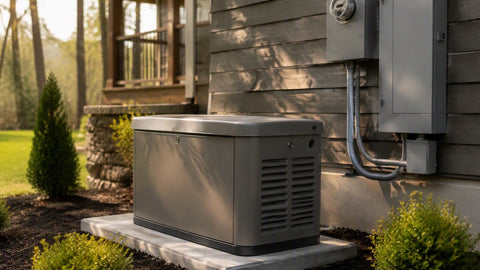
For ultimate resilience, backup generators complement solar-plus-storage systems by providing power during extended outages or periods of low sunlight. Pairing solar, battery storage, and a Generac standby generator gives you uninterrupted power regardless of weather or grid conditions.
Going solar is more affordable than ever thanks to federal and state incentives. The Federal Investment Tax Credit (ITC) currently allows you to deduct up to 30% of your total solar installation cost from your federal taxes — including panels, inverters, batteries, racking, and labor. Many states offer additional rebates, grants, and programs. Power purchase agreements (PPAs) and solar loans are additional financing options that can eliminate or significantly reduce upfront costs.
💡 Pro Tip: Stack Your Incentives
The federal ITC (30%) can be combined with state-level rebates, utility incentives, and net metering credits. Some states like California offer additional rebates through programs like SGIP for systems integrated with energy storage. Check the DSIRE database for incentives available in your zip code, or ask our team — we'll help you identify every dollar available for your project.
| Feature | Details |
|---|---|
| 50,000+ SKUs from 169 authorized brands | One-stop shop for panels, inverters, batteries, racking, EV chargers, generators, transformers, and accessories |
| Tier 1 Certified Products | Only bankable, top-quality equipment from JinkoSolar, Canadian Solar, Hyundai, Mission Solar, SMA, Fronius, Sol-Ark, and dozens more |
| Shipping Options Nationwide | On qualifying orders, with direct manufacturer shipments when minimums are met for the best pricing |
| Technical Engineering Support | in-house team assists with system design, permitting documentation, and compliance — we've supported projects exceeding 15 MW |
| PowerLink Installer Portal | Network of authorized service providers with lead generation, featured listings, and exclusive benefits |
| Quote My System Tool | Get a customized, project-specific quote in minutes — submit your electric bill and let our team do the sizing |
| EOL Upgrades Available | End-of-life inverter and component upgrade paths so your system stays current and performing at its best |
Related Products


CW Energy 410W Solar Panel 108 Cells Bifacial CWT410-108PMB10 Assembled in the USA Wholesale 35 panels per pallet
ViewReady to Size Your 1,500 kWh System?
Whether you're a homeowner planning a DIY install, a contractor quoting a residential project, or a developer designing a commercial array — we have the products, expertise, and support to bring your solar vision to life. Submit your electric bill and get a complete equipment quote within 24 hours.
Quote My System Shop Solar PanelsShop this guide
Frequently Asked Questions
How many solar panels do I need for 1,500 kWh per month?
With 5 peak sun hours per day and high-wattage panels (400–430W) like Mission Solar or JinkoSolar modules from PES Supply, you'll need approximately 24–30 panels after accounting for a 15% system loss buffer. In lower-sun areas or with smaller 300W panels, plan for 34–40+. Our Quote My System tool provides a personalized estimate based on your exact location and electric bill.
Can higher-wattage panels reduce the total number I need?
Absolutely. Upgrading from 300W to 430W panels can reduce your panel count from approximately 40 to 28 — saving valuable roof space and lowering installation labor costs. Our Hyundai 410W bifacial panels and Mission Solar 430W modules are among the most efficient options we carry, and bifacial technology adds another 5–15% of production from reflected light.
Do I need battery storage with my solar system?
Battery storage is optional but highly recommended for backup power, time-of-use rate optimization, and energy independence. Without storage, excess daytime production is exported to the grid (often at low credit rates) and you draw from the grid at night. PES Supply carries over 1,200 battery SKUs including the EG4 stackable systems starting at $2,899, BYD modules, and SimpliPhi turnkey solutions.
Does PES Supply offer installation services?
We are a wholesale supplier and equipment provider, not a direct installer. However, our PowerLink Portal connects you with authorized, vetted installers in your area who are experienced with the equipment we carry. We also provide full technical engineering support for system design, permitting documentation, and compliance — we've supported projects exceeding 15 MW.
What tax credits are available for solar in 2026?
The Federal Investment Tax Credit (ITC) currently offers up to 30% off your total solar installation costs — covering panels, inverters, batteries, racking, and labor. Many states provide additional rebates and incentive programs on top of the federal credit. Contact our team or visit our Resource Center for the latest information on incentives in your area.
How much roof space do I need for 1,500 kWh per month?
Each standard solar panel requires approximately 20 square feet of roof space including mounting clearances. For a 1,500 kWh/month system at 5 sun hours, you'll need roughly 28 panels (at 430W) which translates to about 560 square feet of unobstructed area. In lower-sun regions requiring 36+ panels, plan for approximately 720 square feet. If roof space is limited, ground-mounted systems are an excellent alternative.
What is the difference between string inverters and microinverters?
String inverters connect multiple panels in series and convert their combined DC output to AC in a single unit — they're cost-effective for unshaded, uniformly oriented arrays. Microinverters are installed behind each individual panel and allow each module to operate independently, making them ideal for roofs with shading, multiple orientations, or complex layouts. PES Supply carries both types from leading manufacturers including Fronius, SMA Solar, Sol-Ark, and SolarEdge.
Can I start with a smaller system and expand later?
Yes — phased installation is a smart strategy if budget is a concern. Start with a partial system (for example, 15 panels covering half your usage) and expand as needed. The key is to choose an inverter with enough capacity to support your future panel count from the beginning. Hybrid inverters from Sol-Ark and EG4 are designed for exactly this kind of scalable deployment, and modular battery systems like EG4's stackable bundles let you add storage capacity over time as well.
What size solar system do I need for 1,500 kWh per month?
Most U.S. homes need a 10–12 kW system for 1,500 kWh per month. The exact size is 50 kWh/day ÷ your peak sun hours, plus 20% for system losses — so 10 kW in the Southwest (6+ sun hours), 11–12 kW in Texas and Florida, and 14–17 kW in the Midwest, Northeast, and Pacific Northwest.
Is a 10kW solar system enough for 1,500 kWh a month?
In high-irradiance states like Arizona, California, and New Mexico — yes, a 10 kW system produces roughly 1,400–1,600 kWh per month. In states with fewer than 5 peak sun hours (Midwest, Northeast, Pacific Northwest), a 10 kW system will fall short and you should size up to 12–16 kW.
How many 400-watt panels does a 1,500 kWh system take?
Between 25 and 43 depending on location: about 25 panels in Arizona, 27 in California, 30 in Texas, and 38–44 in northern states with 4 or fewer peak sun hours. Each 400W panel produces roughly 1.6–2.6 kWh per day after losses, depending on sun hours.
How many peak sun hours does my state get?
Annual averages range from about 3.3–4.0 hours in the Pacific Northwest and upper Northeast to 6.0–6.5 in the desert Southwest. Most of the Sun Belt, including Texas and Florida, averages 5.0–5.5. Use your annual average for grid-tie sizing and your winter-month low if you're designing an off-grid system.
How much does a 1,500 kWh per month solar system cost in 2026?
A 10–12 kW system typically runs $20,000–$30,000 before incentives at current residential pricing of $2.00–$2.50 per watt, or $14,000–$21,000 after the 30% federal tax credit. Equipment-only purchases — panels, inverter, and racking from a supplier like PES Supply — cut that substantially for DIY and contractor installs.
Can I run my whole house on 1,500 kWh of solar per month?
For most households, yes — 1,500 kWh per month covers the average U.S. home (which uses about 900–1,200 kWh) with room for an EV or electric water heater. Homes with electric heat, pools, or multiple EVs may exceed it, so compare against your actual utility bills before sizing.
About PES Supply
PES Supply is a nationwide electrical supply distributor offering premium Tier 1 solar panels, standby generators, inverters, battery storage systems, EV chargers, and related electrical equipment. With a catalog of 50,000+ SKUs across 169 authorized brands and nationwide LTL freight delivery from our Louisville, Kentucky supply house, we deliver turnkey power solutions with live support and fast nationwide delivery.
📍 Location: 1507 Portland Ave, Louisville, KY, United States 📞 Phone: +1 888-876-0007 🌐 Website: www.portlandiaelectric.supply
Article: How Many Solar Panels Do I Need for 1,500 kWh Per Month? — Your Complete 2026 Sizing Guide
Category: Solar Energy / System Sizing Guides
Last Updated: August 2026
Related Articles: Solar System Size Calculator | Home Battery Bank Sizing Guide | String Inverter Sizing Guide
Related Resources:
- Best Solar Panels 2026 — Buyer's Guide
- EG4 vs Tesla Powerwall
- Qcells vs Trina vs JA
- Solar Inverter Buyer's Guide
- Solar Battery Buyer's Guide
- 5kW Solar Kit
- 10kW Solar + Battery Kit
- Off-Grid Cabin Kit
- EG4 Batteries
- Qcells Solar Panels
- Trina Solar
- JA Solar
- REC Solar
- Mission Solar
- Sol-Ark Inverters
- SolarEdge Inverters
- Generac PWRcell
Calculate how much storage you need with our battery sizing calculator.
Check solar incentives available in your state.
Use our free solar system calculator to size your array.
Check out our Solar Panel Comparison Tool. Check out our Inverter Sizing Calculator.
Calculate your solar payback and 25-year savings with our Solar ROI Calculator. Follow our complete DIY solar installation guide for step-by-step instructions. Keep your system running at peak performance with our Solar Maintenance Guide.
- NEC Article 690 — Solar Photovoltaic (PV) Systems (nfpa.org)
- NEC Article 705 — Interconnected Electric Power Production Sources (nfpa.org)
- PVEL Module Reliability Scorecard 2025 (pvel.com)
- BloombergNEF Tier 1 module manufacturer list (bankability note — cited by name)
- California Energy Commission (CEC) PV module performance listing (cited by name)
- SEIA / Wood Mackenzie U.S. Solar Market Insight (market data — cited by name)
Related Resources
- Quote My System — free project pricing from PES
- Solar System Calculator
- Battery Sizing Calculator
- Solar Panel Comparison Tool
- Inverter Sizing Calculator
- Solar ROI Calculator
- Solar Installation Guide
- Solar Maintenance Guide
- Solar Permitting Guide
- Battery Installation Guide
- NEC Code Compliance Guide
- Solar Panel Mounting Guide
- Grounding & Bonding Guide
- Solar Incentives by State
- Solar Hub — All Solar Guides
- Generator Hub — All Generator Guides
What size wire do I need?
Wire sizing follows NEC Table 310.16 based on ampacity. A 20A circuit needs 12 AWG copper, a 30A circuit needs 10 AWG, and a 50A circuit needs 6 AWG.
Do I need a permit for electrical work?
Most electrical work requires a permit. Check with your local AHJ (Authority Having Jurisdiction). PES Supply provides spec sheets for permit submittals.
What is the NEC 125% rule?
NEC 210.19(A)(1) requires continuous loads (3+ hours) to be sized at 125% of the rated load. A 16A continuous load needs a 20A breaker (16 x 1.25 = 20A).
PES Supply carries a catalog of 50,000+ SKUs from 169 authorized brands. One PO, one invoice, every trade covered.
Need help sizing? Our team can calculate loads, select equipment, and source everything from one PO.
Call (502) 790-0600
Shop the products mentioned in this guide and get everything you need for your project.


ZNShine 540W Clear On White 144 Half-cell Mono Solar Panel - ZXM7-SHLDD144-540/M
ZNShine
$349.30
View Product
SolarEdge Energy Hub HD-Wave 3.8kW 1-Ph Inverter - SE3800H-USMNBBX14
SolarEdge
$1,979.00
View Product
Trina Solar - Tallmax Plus - 380W Clear On Black 72 Cell Mono Solar Panel - TSM-380-DE14A(II)
Trina Solar
$288.42
View Product
Silfab Elite 440W N-Type TOPCon Residential Solar Panel
by Silfab Solar
$159.30
View Product DetailsExplore our full selection: Silfab Elite 440W N-Type TOPCon Resident · Qcells Q.PEAK DUO 590W Solar Panel - XL- · ZNShine 540W Clear On White 144 Half-cel · SolarEdge Energy Hub HD-Wave 3.8kW 1-Ph · Trina Solar - Tallmax Plus - 380W Clear
🔧 Need Help Choosing?
Our team can help you find the right product for your project. Get a free quote today!
Get a QuoteRelated Products:
Silfab Elite 440W N-Type TOPCon Residential S... Qcells Q.PEAK DUO 590W Solar Panel - XL-G11S ZNShine 540W Clear On White 144 Half-cell Mon... SolarEdge Energy Hub HD-Wave 3.8kW 1-Ph Inver...