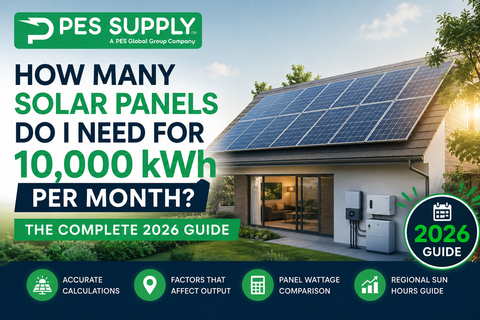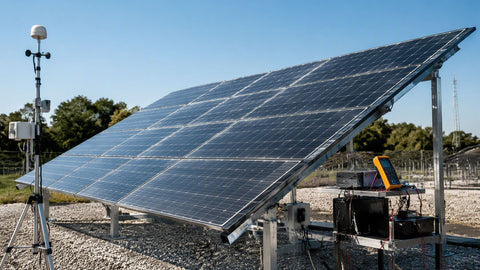
Most American homes need between 6 kW and 10 kW of solar to cover their electric bill — about 15 to 24 modern panels. The exact answer comes from one division problem: your annual kWh usage divided by how much energy each installed kW produces on your roof. This guide gives you the formula, the worked tables for every usage level and climate, and the code-compliance details (NEC 690.7 voltage and 690.8 current sizing) that turn a back-of-envelope estimate into a buildable system.
I size systems for a living, and the process below is the same one I run on every quote — pull the real usage, apply the real sun-hours, derate honestly, and check the result against the roof and the electrical panel. It takes fifteen minutes and it has never steered a customer wrong.
The Formula
Solar system size (kW) = Annual electricity use (kWh) ÷ (Peak sun hours × 365 × system efficiency)
Where:
- Annual use comes from 12 months of utility bills. The US average is ~10,500 kWh; your number is the only one that matters.
- Peak sun hours (PSH) is your location's daily equivalent of full-strength sun: 3.5–4.0 in the Pacific Northwest and Northeast, 4.5–5.0 across the midsection, 5.5–6.5 in the desert Southwest.
- System efficiency (the derate factor) accounts for inverter losses, wiring, temperature, soiling, and shading: use 0.75–0.80 for an honest estimate, 0.85 only for a cool, shade-free, well-ventilated roof.
Worked example for the average home in average sun: 10,500 ÷ (4.5 × 365 × 0.78) = 10,500 ÷ 1,281 = 8.2 kW, or 18 panels at 450W.
System Size by Annual Usage (National-Average Sun, 4.5 PSH)
| Annual Usage (kWh) | Typical Home Profile | System Size @ 0.78 Eff. | Panels @ 400W | Panels @ 450W | Panels @ 550W |
|---|---|---|---|---|---|
| 5,000 | Efficient apartment/small home, gas heat | 3.9 kW | 10 | 9 | 7 |
| 7,500 | Modest home, mild climate | 5.9 kW | 15 | 13 | 11 |
| 10,500 | US national average | 8.2 kW | 21 | 18 | 15 |
| 13,000 | Southern home with heavy AC | 10.2 kW | 26 | 23 | 19 |
| 16,000 | Large or all-electric home | 12.5 kW | 31 | 28 | 23 |
| 20,000 | All-electric + EV + pool | 15.6 kW | 39 | 35 | 28 |
| 25,000 | Large estate / dual EVs | 19.5 kW | 49 | 43 | 35 |
Check a row yourself: 13,000 ÷ (4.5 × 365 × 0.78) = 13,000 ÷ 1,281 = 10.15 kW. Panel counts round up to whole modules — you cannot install 22.6 panels, and rounding up is usually right anyway since usage tends to grow.
How Your State Changes the Answer
The same 10,500 kWh home needs very different arrays in Seattle and Phoenix:
| Location | Avg Peak Sun Hours | System Size for 10,500 kWh/yr | Panels @ 450W | vs. National Average |
|---|---|---|---|---|
| Phoenix, AZ | 6.5 | 5.7 kW | 13 | 31% smaller |
| Denver, CO | 5.5 | 6.7 kW | 15 | 18% smaller |
| Dallas, TX | 5.2 | 7.1 kW | 16 | 13% smaller |
| Atlanta, GA | 4.8 | 7.7 kW | 17 | 6% smaller |
| Chicago, IL | 4.2 | 8.8 kW | 20 | 7% larger |
| Portland, OR | 3.9 | 9.5 kW | 21 | 16% larger |
| Seattle, WA | 3.6 | 10.2 kW | 23 | 25% larger |
That is a 45% spread from Phoenix to Seattle for identical usage — which is why any quote that does not state its PSH assumption deserves a follow-up question. The solar system calculator applies location-specific sun data automatically, and the system size calculator guide explains the model behind it.
The Five Factors That Move the Number
| Factor | Effect on Required Size | Typical Swing |
|---|---|---|
| Roof orientation | South is 100%; east/west lose 10–20%; north loses 30%+ | +0–3 kW on the system |
| Shading (trees, chimneys, dormers) | Each shaded hour on a string costs real production | +10–30% size, or microinverters/optimizers to recover it |
| Tilt | Flat roofs and steep pitches deviate from optimal tilt | ±5–15% |
| Panel wattage & efficiency | Higher-wattage panels fit more kW per roof square | Same kW, fewer panels |
| Future loads (EV, heat pump, hot tub) | An EV adds ~2,500–4,000 kWh/yr; a heat pump water heater adds ~1,000 | +2–4 kW if known today |
The future-loads row is the one I argue for most often. An EV is not a hypothetical — it is a plan most households already have — and adding 2 kW of panels now costs a fraction of adding them in a second project later. Browse what is available in the residential panel collection or the higher-output 460–549W class when roof space is tight.
Inverter Sizing: The Other Half of "How Many kW"
The array kW and the inverter kW are deliberately different numbers. Designers typically size the inverter at 80–100% of array DC capacity (a DC:AC ratio of 1.0–1.25), because panels rarely produce nameplate and a slightly undersized inverter clips a few peak-hours per year while running more efficiently the other 99% of the time:
| Array Size (DC) | Typical Inverter (AC) | DC:AC Ratio | Notes |
|---|---|---|---|
| 6 kW | 5.0–6.0 kW | 1.0–1.2 | String or microinverters both common |
| 8 kW | 6.5–7.6 kW | 1.05–1.23 | The residential sweet spot; see 7.6kW inverters |
| 10 kW | 8–10 kW | 1.0–1.25 | Split-phase hybrids live here: 10–12kW hybrids |
| 13 kW | 10–11.4 kW | 1.14–1.3 | Clipping losses stay under ~2% annually |
| 16 kW | 12.5–15 kW | 1.07–1.28 | Often two inverters or a 15K hybrid |
Microinverter systems sidestep the ratio question — each panel gets its own inverter — at the cost of more rooftop electronics. String and hybrid options are in the inverter catalog; the inverter sizing calculator and inverter buyer's guide cover the tradeoffs.
The Code Reality Check (NEC 690.7 / 690.8 / 705.12)
Three code checks decide whether your calculated system is actually buildable:
- NEC 690.7 — voltage. String voltage is calculated at record-low temperature using the module's temperature coefficient. A string of twelve 50Voc panels is 600V at STC but can exceed 660V at −10°F — over a 600V inverter input limit. This is why northern designs run shorter strings.
- NEC 690.8 — current. Circuit conductors and overcurrent devices size at 156% of short-circuit current (1.25 × 1.25). A string with 14A Isc needs wire and fusing for ~21.8A → 12 AWG copper and a 25A fuse per NEC 240.6 standard sizes. The NEC wire sizing guide and the NEC 690 disconnect guide have the full tables.
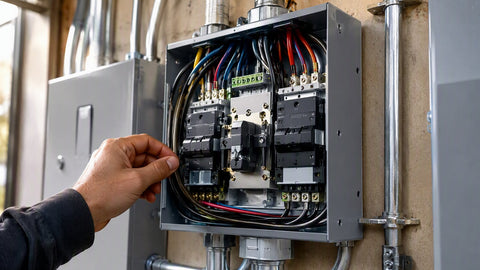
- NEC 705.12 — the panel busbar. The 120% rule limits backfed solar on a residential panel: a 200A panel with a 200A main allows 40A of solar breaker (9.6 kW AC at 240V). Bigger systems need a line-side tap, a derated main, or a panel upgrade — a real constraint I hit on roughly a third of large residential designs.
Worked Examples, Start to Finish
Efficient ranch, Columbus, OH. 7,800 kWh/yr, 4.2 PSH, clear south roof. 7,800 ÷ (4.2 × 365 × 0.80) = 6.4 kW → 15 × 430W panels (6.45 kW), 5 kW string inverter, 30A backfeed breaker on a 200A panel. Covers ~100% on paper, ~95% after shading reality.
All-electric two-story, Houston, TX. 16,500 kWh/yr, 5.0 PSH, east/west roof (–12%), EV arriving next year (+3,000 kWh). Design load 19,500 kWh ÷ (5.0 × 365 × 0.80 × 0.88 orientation) = 15.1 kW → 34 × 450W panels, two 7.6 kW inverters or a 15K hybrid with battery-ready bus. The east/west split actually flatters summer afternoon production, which is exactly when Houston's AC runs hardest.
Field Notes
Three things I have learned sizing these systems. First, nobody has ever complained about too much solar — the regrets all run the other direction, usually arriving with the first EV. Second, the derate factor is where dishonest quotes hide: I have reviewed competitor proposals using 0.90+ efficiency on a shaded east roof, inflating projected production 15% over what the roof will ever deliver. Third, the roof decides as often as the bill does — a 2,000-square-foot house with a chopped-up hip roof sometimes fits 5 kW where the usage wants 9, and that is when ground mounts, carports, or high-wattage panels stop being luxuries and start being the answer.
Roof Space: The Constraint Nobody Checks First
Usage math says how many kW you need; geometry says whether it fits. Modern residential panels run 17–22 sq ft each, so a kW of solar (2.2 panels at 450W) occupies roughly 40–45 sq ft of usable roof. The catch is "usable": setbacks from ridges and eaves (typically 18–36 inches for fire code pathways), obstructions like vents and skylights, and orientation rules all carve away at the gross roof:
| Roof Scenario | Usable Area (typical) | Max Array That Fits | Annual Production (4.5 PSH) |
|---|---|---|---|
| Simple south-facing gable, 800 sq ft face | ~500–600 sq ft | 11–13 kW | 14,000–17,000 kWh |
| South face with dormers/vent clutter | ~300–400 sq ft | 7–9 kW | 9,000–11,500 kWh |
| Hip roof, four equal faces | ~200–350 sq ft on best face | 4.5–8 kW | 5,800–10,000 kWh |
| East/west pair of faces | ~600–800 sq ft combined | 9–12 kW (at −10–20% production) | 9,500–13,500 kWh |
| Flat roof, tilted racking | ~60% of gross (row spacing) | Varies widely | Tilt + spacing trade against each other |
When the roof comes up short, the options in order of popularity: high-wattage panels (a 470W panel in the same footprint as a 400W adds 17% capacity), the second-best roof face with microinverters, a garage or barn roof, a patio-cover or carport structure, and finally a ground mount. I have never had a project where usage could not eventually be covered — but I have had plenty where the answer was not the roof anyone expected.
Grid-Tie vs. Hybrid vs. Off-Grid: Three Different Size Answers
The same house needs three different solar sizes depending on the architecture:
| Architecture | Sizing Basis | System for 10,500 kWh/yr Home | Storage |
|---|---|---|---|
| Grid-tied (net metering) | Annual kWh offset | ~8.2 kW | None — grid banks the surplus |
| Hybrid (battery + grid) | Annual offset + critical-load autonomy | 8–10 kW + 10–20 kWh battery | Sized to overnight critical loads, not whole-home |
| Off-grid | Worst-month production + autonomy days | 12–16 kW + 30–60 kWh battery | Sized to December and 2–3 dark days |
The off-grid row shocks people, and it should: going off-grid roughly doubles the array and adds a battery bank, because December delivers 40% of July's energy and the load does not care. This is why I tell off-grid dreamers to brutalize their load list first — every kWh eliminated from the daily budget removes roughly a panel and a half plus a slice of battery. The battery bank sizing guide handles the storage math, and the hybrid inverter collection is where the middle architecture lives.
The Five Sizing Mistakes I Correct Most Often
- Sizing to the monthly average instead of the annual total. A system that matches your average month under-produces in your peak month. Annual kWh is the only correct denominator for net-metered systems.
- Using nameplate inverter AC as system size. An "8 kW system" with 10 kW of panels and an 8 kW inverter is a 10 kW system that clips a little at noon. Quotes should state both DC array size and AC inverter size.
- Ignoring the roof's orientation penalty. An east/west design needs 10–20% more panels than the same kW rating facing south. The production estimate, not the nameplate, is what you are buying.
- Forgetting the future. EVs and heat pumps add 3,000–7,000 kWh/yr. Oversizing by 10–15% today costs hundreds; a second project in three years costs thousands.
- Trusting a single PSH number for a shaded lot. Sun-hours from a map assume an open sky. A proper shade analysis (even a free satellite tool) is the difference between a model and a guess on treed lots.
What an Honest Quote Contains
Whether you buy from us or anyone else, the quote should state: annual kWh production (not just system kW), the PSH and derate assumptions behind it, panel model and wattage, inverter model with the DC:AC ratio, the warranty floors for both panels and inverter, and the interconnection path (backfeed breaker size or line-side tap). A quote missing any of those is a price, not a design. The inverter buyer's guide and battery buyer's guide give you the vocabulary to read one critically, and the complete solar kits show what fully-specified systems look like when the BOM is published up front.
Seasonal Production: What Your Sized System Delivers Month by Month
An 8.2 kW system sized to cover 10,500 kWh a year does not deliver 875 kWh every month — it delivers a summer-weighted curve, and knowing the curve prevents two common panic calls. In a mid-sun region (4.5 PSH annual average), expect roughly: January ~600 kWh, April ~880, July ~1,150, October ~770, December ~540. The system "fails" to cover December by design and banks the difference in June. Under annual net metering this is invisible; under monthly billing with no rollover, it argues for sizing to 110–120% of annual usage or shifting flexible loads (water heating, EV charging) toward midday solar hours. The families happiest with their systems are the ones who understood the curve before the first winter bill arrived.
The Bottom Line on Sizing
Everything in this guide compresses into a five-step ritual: pull twelve months of kWh, divide by (PSH × 365 × 0.78), round the panel count up, verify the roof fits and the panel busbar accepts the backfeed, then add 10–15% if an EV or heat pump is anywhere in your three-year plans. Do those five things and your system size will be right — not approximately right, not marketing right, but right in the way that still looks correct on the utility bill in year ten.
Does Adding a Battery Change How Many kW You Need?
Slightly, and in both directions. A battery adds round-trip losses — 5–10% of every kWh that passes through storage — so a hybrid system sized to self-consume heavily wants an extra 0.3–0.8 kW of array to cover conversion losses. Running the other direction, a battery lets a smaller array serve bigger loads by time-shifting: an 8 kW array with 20 kWh of storage can carry overnight loads that a bare 8 kW array cannot touch, and in export-limited jurisdictions a battery unlocks self-consumption value that effectively raises each panel's worth. My sizing rule for hybrids: size the array to annual kWh as normal, add 5% for storage losses, then size the battery to the overnight critical load (usually 8–20 kWh for a home), not to the array. Array answers "how much energy per year"; battery answers "when can I use it." Confusing the two jobs is how people end up with $15,000 of storage and an undersized roof.
A Word on Panels per kW and Roof Geometry
Since this question arrives constantly: a kW is 1,000 watts of nameplate, and panel wattage only changes how many rectangles achieve it — two 500W panels, three 335W panels, or four 250W legacy panels are all 1 kW and produce the same annual kWh on the same roof. Where count matters is layout: more, smaller panels tile awkward roof shapes better; fewer, larger panels install faster on open rectangles. When I design on a roof with a chimney and two plumbing vents, I reach for higher-wattage modules not for their watts but for their dimensions — one panel that lands cleanly between obstructions beats two that straddle a vent pipe and violate setback rules. Geometry first, wattage second, brand third.
Why this question is worth doing carefully. Solar is one of the few home purchases where the "size" directly prints money for thirty years, and the sizing error in either direction compounds: undersize by 20% and you buy that shortfall from the utility every month for decades; oversize wildly without net-metering support and you donate surplus to the grid at wholesale rates. An hour with your bills, your PSH, and the tables above lands within a panel or two of the engineering answer — close enough that the remaining precision belongs to the site survey, not the spreadsheet. Then put the array where the sun actually hits, buy panels whose year-25 warranty floor you have read, verify the derate assumption on every quote, and let the next thirty years of production be the quiet confirmation that the sizing hour was time well spent. The sun has never once missed an appointment; design to the data and your array will not either — not this year, and not in year twenty-five when the warranty paperwork finally expires and the panels still have not noticed the milestone at all.
Frequently Asked Questions
How many kW of solar does the average US home need?
About 7–9 kW to cover the national-average 10,500 kWh per year in average sun — roughly 16–20 panels at 450W. Sunbelt homes need less (5.5–7 kW); cloudy-region homes need more (9–11 kW) for the same usage.
Is a 10 kW solar system enough for a house?
For most homes, yes — a 10 kW system produces roughly 12,000–16,000 kWh per year depending on location, covering average usage with margin for an EV. Large all-electric homes using 16,000+ kWh per year may need 12–16 kW.
How do I calculate the kW of solar I need?
Divide your annual kWh usage by (peak sun hours × 365 × 0.78 system efficiency). Example: 12,000 kWh in 5 PSH sun needs 12,000 ÷ 1,424 ≈ 8.4 kW. Get PSH for your address from a solar calculator or NREL's PVWatts.
How many solar panels make 1 kW?
Two to three modern panels: 1,000W ÷ 450W ≈ 2.2 panels. A 10 kW system is therefore 22–25 panels at 400–450W, or about 18 panels at 550W. Panel wattage changes the count, not the production.
Can I install more solar than my house uses?
Usually yes, within limits. Many utilities cap systems at 100–120% of historical usage for net metering, and NEC 705.12's 120% rule caps backfeed on your panel busbar. Oversizing 10–15% for future EVs and heat pumps is standard practice and generally approvable.
Does roof direction change how many kW I need?
Yes. East or west roofs produce 10–20% less than south, so the same bill needs a 10–20% larger array. North-facing roofs lose 30%+ and usually are not worth mounting on. Microinverters or optimizers help on mixed-orientation roofs.
Related reading: Solar panel kits buyer's guide · Best solar panels 2026 · Complete solar kits · Solar ROI calculator