A heat pump water heater (HPWH) looks like a standard electric tank, but it heats water the way a refrigerator cools food — by moving heat instead of making it. That single difference cuts water-heating electricity use by 60 to 70 percent in most homes, which is why utilities, Energy Star, and the Department of Energy keep pushing them. I've pulled plenty of tired 4,500-watt resistance tanks out of garages and swapped in hybrids, and the utility-bill drop is real. But these units are not a universal win: they need the right room, the right circuit, and the right expectations. This guide walks through how they work, what Energy Star certification actually guarantees, the honest pros and cons, the electrical and code requirements, sizing, and what installed cost and payback look like in 2026 dollars.

How a Heat Pump Water Heater Actually Works
A standard electric water heater converts electricity directly into heat through resistance elements — typically two 4,500-watt elements in a 50-gallon tank. Every kilowatt-hour you buy becomes roughly one kilowatt-hour of heat in the water. A heat pump water heater bolts a small refrigeration loop on top of the tank: an evaporator coil, a fan, a compressor, and a condenser wrapped around or under the tank. The fan pulls room air across the evaporator, the refrigerant absorbs heat from that air, the compressor concentrates it, and the condenser dumps it into the water.
Because the unit moves heat rather than generating it, it delivers two to four units of heat for every unit of electricity consumed. That ratio is what drives the efficiency numbers in the next section. The tank still carries resistance elements as backup — that's why these units are sold as "hybrids." In heat-pump-only mode the compressor does all the work and recovery is slow; in hybrid mode the control board blends compressor and element run time; in high-demand or "electric" mode it behaves like a conventional resistance tank.
Two side effects fall out of the physics, and both matter for placement. First, the unit exhausts cold, dehumidified air — roughly 4,000 to 7,000 BTU per hour of cooling while the compressor runs. In a hot, humid garage in Texas or Florida, that's free air conditioning and dehumidification. In a conditioned basement in Minnesota in January, that cooling load lands on your furnace. Second, the fan and compressor make noise — typically 45 to 60 decibels, about the level of a modern dishwasher. I've had exactly one customer in fifteen years complain about the hum, and that unit was sharing a wall with a nursery; placement solved it.
Recovery Rate: the Spec Nobody Reads
First-hour rating (FHR) tells you how many gallons of hot water the unit can deliver in an hour starting with a full tank. In hybrid mode, most 50-gallon HPWHs post an FHR between 60 and 75 gallons — comparable to or better than a standard 50-gallon electric tank (usually 55 to 65 gallons). In heat-pump-only mode, recovery drops to roughly 15 to 25 gallons per hour. If your household routinely draws the tank flat — back-to-back showers plus a running dishwasher — you'll either run hybrid mode or upsize the tank.
The Efficiency Numbers: UEF, Real kWh, Real Dollars
Since 2015, residential water heaters have been rated by Uniform Energy Factor (UEF), which measures delivered hot-water energy against total electrical or fuel input across a standardized 24-hour draw pattern. Higher is better, and the spread between technologies is enormous:
| Water heater type | Typical UEF range | Typical annual energy use (50-gal class) | Annual cost @ $0.16/kWh or $1.30/therm |
|---|---|---|---|
| Standard electric resistance (50 gal) | 0.90–0.95 | ~4,600 kWh | ~$736 |
| Heat pump water heater, hybrid (50 gal) | 3.30–4.10 | ~1,250–1,400 kWh | ~$200–$224 |
| Atmospheric gas storage (40–50 gal) | 0.58–0.65 | ~200–225 therms | ~$260–$292 |
| Condensing gas tankless | 0.80–0.87 | ~140–160 therms | ~$182–$208 |
| Electric tankless (whole-home) | 0.96–0.99 | ~4,400–4,600 kWh | ~$704–$736 |
The math behind the HPWH row is simple: take the DOE reference annual consumption for a standard electric tank (about 4,600 kWh at UEF 0.93) and divide by the efficiency ratio. A hybrid running at UEF 3.5 for the year uses roughly 4,600 × (0.93 ÷ 3.5) ≈ 1,222 kWh. At the current national average residential rate of about 16 cents per kWh, that's a $530-a-year difference. Scale it to your own rate:
| Electricity rate | Standard electric (4,600 kWh) | HPWH hybrid (~1,230 kWh) | Annual savings |
|---|---|---|---|
| $0.12/kWh (parts of the Midwest, Southeast) | $552 | $148 | $404 |
| $0.16/kWh (national average) | $736 | $197 | $539 |
| $0.20/kWh (Northeast, California tiers) | $920 | $246 | $674 |
| $0.24/kWh (California top tiers, Hawaii light usage) | $1,104 | $295 | $809 |
One honest caveat I give every customer: those savings assume the compressor does the bulk of the work. If the unit spends its life in electric-resistance mode because the room is too cold or the draw pattern is too aggressive, you've bought a very expensive standard tank. Mode selection and placement are everything.
Energy Star Certification: What It Actually Guarantees
Energy Star isn't a marketing sticker — for heat pump water heaters it maps to specific, testable thresholds. To carry the label, a unit must meet minimum UEF requirements (currently a UEF of 3.30 or higher for the most common draw patterns), a minimum first-hour rating so efficiency doesn't come at the cost of usability, and a warranty of at least six years on the sealed refrigeration system. Products are certified through third-party labs under the DOE test procedure, and the EPA can pull the label from units that fail verification testing off the shelf.
Practically, Energy Star certification matters for three reasons:
- Rebates key off it. Most utility rebates — commonly $300 to $750, with some service territories exceeding $1,000 — require an Energy Star-certified unit. The same goes for many state programs.
- It's a performance floor. A certified 50-gallon hybrid will post a UEF of at least 3.3, meaning real-world consumption in the 1,200 to 1,400 kWh range for an average household. Non-certified units have no such floor.
- It screens the warranty. The six-year sealed-system minimum eliminates the bottom of the market where compressor failures turn a money-saver into a money pit.
Well-known certified families include the Rheem ProTerra line (50 to 80 gallons, UEFs up to about 4.0), A. O. Smith's Voltex hybrids, Bradford White's AeroTherm series, and Stiebel Eltron's Accelera. Verify any specific model against the Energy Star product finder before you buy — certifications change as lines are updated.
The Pros, in Detail
Operating cost. As the tables above show, $400 to $800 per year in savings versus resistance electric is normal. Over a 13-year expected service life, that's $5,000 to $10,000 — several times the purchase price.
Cooling and dehumidification as a byproduct. In garages and basements across the Sun Belt, the exhaust air is a feature. I've measured a 6 to 8 degree temperature drop in a closed single-car garage after a week of runtime, and the humidity reduction is obvious — fewer rusty tools, less mildew smell.
Demand flexibility. Most current hybrids ship with Wi-Fi and a scheduling app. Several utilities run demand-response programs that pay you an annual credit for letting them shift your water heating out of peak windows. A tank full of 120-degree water is a thermal battery; the grid can use it.
Lower panel load than resistance electric. In heat-pump mode the compressor draws roughly 400 to 700 watts — trivial next to a 4,500-watt element. That matters in homes with a full 100-amp or 125-amp panel where every spare amp is spoken for by an EV charger or a range. If you're planning broader electrification, run your loads through a system sizing calculator and our NEC code compliance guide before assuming you need a panel upgrade.
Longevity of the tank itself. Because the compressor heats gently and the elements run rarely, element burnout and severe sediment bake-on are less common than in pure resistance tanks.
The Cons, With No Sugarcoating
Upfront cost. A 50-gallon hybrid runs $1,400 to $2,200 for the unit alone, versus $450 to $700 for a standard electric tank. Installed, expect $2,200 to $4,000 depending on whether you need a new circuit, a condensate drain, or a drain pan with a piped discharge.
Space and air volume requirements. Manufacturers typically specify 700 to 1,000 cubic feet of surrounding air volume (a 10×10 room with an 8-foot ceiling is 800 cubic feet) or louvered doors/ducting to an adjacent space. Stuff one in a 3×3 closet and it will choke, freeze its coil, and fall back to resistance mode.
Cold-room performance. Most units cut the compressor out between 37 and 45 degrees ambient. An unconditioned garage in a northern climate can spend December through February below that threshold, forcing resistance operation exactly when hot-water demand peaks. Some cold-climate models extend compressor operation lower, but verify the spec.
Noise. 45 to 60 dB is dishwasher-level — fine in a garage, annoying in a hallway closet next to a bedroom.
Condensate management. The evaporator coil condenses moisture out of the air, producing up to a few gallons of water a day in humid weather. You need a floor drain, a condensate pump, or a drain line. I have opened exactly one closet install with no condensate plan; the swollen baseboards told the story.
Slower recovery in efficiency mode. Heat-pump-only recovery of 15 to 25 gallons per hour means a depleted tank takes two hours or more to come back. Large households should size up or accept hybrid-mode runtime.
Electrical Requirements and Code Notes

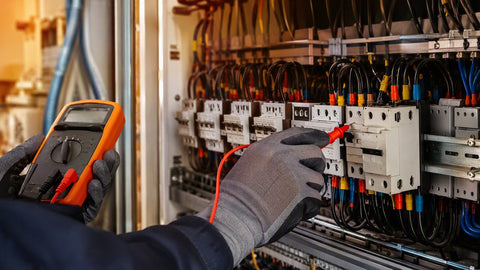
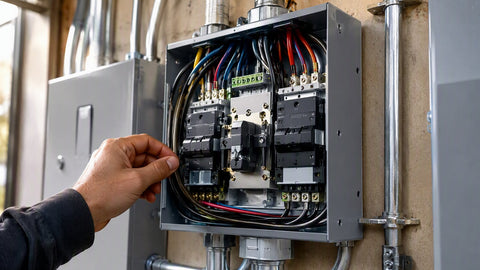
Almost every 240-volt hybrid uses the existing electric water heater circuit — that's one of the format's best tricks. The nameplate typically calls for a 30-amp, 240-volt dedicated circuit, and the actual continuous draw never exceeds the 4,500-watt element's 18.75 amps. Under NEC 422.13, a storage water heater is a continuous load, so branch-circuit sizing is 125 percent of nameplate: 18.75 × 1.25 = 23.4 amps, which lands on a 25- or 30-amp breaker with 10 AWG copper conductors (35 amps at 75°C per NEC 310.16 — comfortable margin).
| Unit class | Nameplate max draw | Continuous-load sizing (×1.25) | Breaker (NEC 240.6) | Copper conductor (NEC 310.16, 75°C) |
|---|---|---|---|---|
| 240V hybrid, 4,500W element | 18.75 A | 23.4 A | 25 A or 30 A | 10 AWG (35 A) |
| 240V hybrid, 5,500W element | 22.9 A | 28.6 A | 30 A | 10 AWG (35 A) |
| 120V plug-in hybrid (~1,400W max) | 11.7 A | 14.6 A | 15 A dedicated or shared per listing | 14 AWG (20 A) |
| Standard 240V resistance tank, 4,500W | 18.75 A | 23.4 A | 25 A or 30 A | 10 AWG (35 A) |
The 120-volt plug-in hybrids that arrived a few years ago deserve attention: they draw under 1,500 watts and are designed for gas-to-electric conversions where no 240V circuit exists. Recovery is slow, but for a two-person household they're a legitimate option. Whatever you install, the disconnect, grounding, and bonding rules in NEC 422 and Article 250 still apply — our grounding and bonding guide covers the electrode and bonding-jumper details inspectors actually check.
Sizing the Tank
Size on first-hour rating, not just gallons. A 50-gallon hybrid with a 70-gallon FHR outperforms a 65-gallon resistance tank with a 62-gallon FHR in the morning rush. As a field rule:
| Household | Recommended tank | Target FHR | Notes |
|---|---|---|---|
| 1–2 people | 40–50 gal | ≥50 gal | Heat-pump-only mode is usually viable |
| 3–4 people | 50–65 gal | ≥65 gal | Hybrid mode covers morning peaks |
| 5+ people | 65–80 gal | ≥80 gal | Consider an 80-gal or a mixing valve at 140°F setpoint |
| Household with soaking tub or body-spray shower | 80 gal | ≥90 gal | Verify FHR against the tub's fill volume |
One trick worth knowing: raising the setpoint to 135–140°F and adding a thermostatic mixing valve at the outlet effectively stretches tank capacity 20 to 25 percent, because you blend more cold at the tap. The mixing valve is cheap insurance against scald risk, and most codes require it above 120°F delivery anyway.
Installed Cost, Incentives, and Payback in 2026
Budget honesty: the federal Section 25C energy-efficient home improvement credit — which covered 30 percent of HPWH cost up to $2,000 — expired for property placed in service after December 31, 2025. What remains in 2026 are utility rebates (commonly $300–$750, occasionally $1,000+ in aggressive electrification territories), state programs, and manufacturer promotions. Check the Energy Star rebate finder and your utility before purchase. Some state-level incentives are cataloged on our incentives-by-state page, which we keep updated as programs open and close.
| Line item | Low | High | Notes |
|---|---|---|---|
| 50-gal Energy Star hybrid unit | $1,400 | $2,200 | Big-box to supply-house pricing |
| Installation labor, like-for-like swap | $500 | $900 | Existing 240V circuit and drain nearby |
| New 240V/30A circuit, 30-ft run | $350 | $800 | Panel capacity permitting |
| Condensate pump + drain line | $120 | $300 | When no gravity drain exists |
| Drain pan, mixing valve, permits | $150 | $400 | Varies by jurisdiction |
| Total installed | $2,520 | $4,600 | Typical midpoint ~$3,400 |
| Typical utility rebate | −$300 | −$750 | Energy Star unit required |
Against a like-for-like resistance replacement (about $1,200 to $1,600 installed), the incremental cost lands around $1,300 to $2,200 after rebate. At $500-plus a year in savings, simple payback runs two and a half to four years — after which the unit pays you roughly $40 to $65 every month for the rest of its life. In high-rate territories the payback can be under two years. I still tell customers the same thing I did a decade ago: if you're replacing a dead electric tank anyway, choosing resistance over a hybrid in 2026 is choosing to donate money to your utility.
When a Heat Pump Water Heater Is the Wrong Call
Three scenarios where I steer people elsewhere. First, a conditioned utility room in a cold climate where the water heater shares air with living space — the cooling penalty eats the savings, and a condensing gas unit or a split-system HPWH with outdoor air makes more sense. Second, a household that routinely drains 80+ gallons in an hour; even hybrid mode can't keep pace, and a high-input gas unit or tankless will serve better. Third, any install where the only available location fails the air-volume, noise, or condensate requirements — fix the location problem or pick different equipment. Forcing a hybrid into a bad closet is how these units get their undeserved bad reputation.
Maintenance: What Keeps a Hybrid Alive
Heat pump water heaters ask for slightly more attention than a dumb resistance tank, but none of it is hard. The air filter on the evaporator intake — a foam or mesh screen — needs a rinse every three to six months in dusty garages; a clogged filter strangles airflow, drops efficiency, and can ice the coil. The condensate line deserves an annual look, especially if it drains through a pump: algae slime is the usual failure, and a cup of vinegar down the line once a year prevents it. The anode rod is the same story as any tank — inspect at year three, replace when it's eaten to the core wire, and you'll buy the tank a second decade. Flush a few gallons off the drain valve annually in hard-water areas to keep sediment from insulating the bottom of the tank. Finally, test the temperature-and-pressure relief valve once a year by lifting the lever and confirming a clean snap shut; it's a two-dollar part that prevents a catastrophic failure mode. We've seen hybrids in our own service territory hit fifteen years with nothing but filters, anodes, and common sense — the compressor hardware, when it isn't starved of air, is the most reliable part of the appliance.
Frequently Asked Questions
Do heat pump water heaters work in cold climates?
Yes, with placement discipline. Install in a basement or garage that stays above roughly 40°F, and the unit will run its compressor most of the year. In the coldest months it will lean on the resistance elements more, trimming annual savings from the 65–70 percent range down toward 50–55 percent — still a large win over resistance-only. Avoid conditioned-space installs in heating-dominated climates unless you duct the unit.
How long do heat pump water heaters last?
Plan on 13 to 15 years for the tank, comparable to a standard electric unit, with the sealed refrigeration system typically warrantied for six to ten years depending on brand. Anode-rod maintenance every three to five years is the single biggest lever on tank life — the same as any storage water heater.
Can I install a heat pump water heater myself?
The plumbing is a standard like-for-like swap if you're replacing an electric tank, but the electrical work (a 240V continuous-load circuit sized at 125 percent of nameplate per NEC 422.13), condensate handling, and permit requirements make this a gray-area DIY. Most jurisdictions require a permit for water heater replacement, and a failed inspection on a DIY electrical run costs more than the labor you saved.
Will a heat pump water heater work during a power outage?
Only with backup power, and only modestly. The compressor draws 400–700 watts, so a small inverter generator or home battery can run it in heat-pump mode — but if the elements kick in at 4,500 watts, most portable backup systems can't carry it. Pair it with a correctly sized standby generator or storage system and lock the unit into heat-pump-only mode during outages.
Are heat pump water heaters worth it without the federal tax credit?
In most cases, yes. The 25C credit expired at the end of 2025, but the math still works: $400 to $800 in annual savings against an incremental cost of roughly $1,300 to $2,200 after utility rebates pays back in two to four years. In $0.20-plus electricity markets it's one of the fastest-payback efficiency upgrades in a home.
The Bottom Line
A heat pump water heater is the highest-certainty efficiency upgrade in most all-electric homes: predictable savings, mature technology, a real certification framework, and a payback measured in seasons rather than decades. Respect the placement rules — air volume, temperature, noise, condensate — and size on first-hour rating rather than habit. If you're scoping a broader electrification or backup-power project at the same time, our installation guide, permitting guide, and inverter sizing calculator will help you plan the panel capacity, and you can always request a quote for the equipment side. For complementary reading, see the panel comparison, ROI calculator, battery sizing calculator, battery installation guide, maintenance guide, and mounting guide.