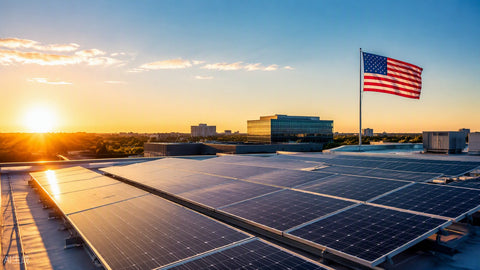
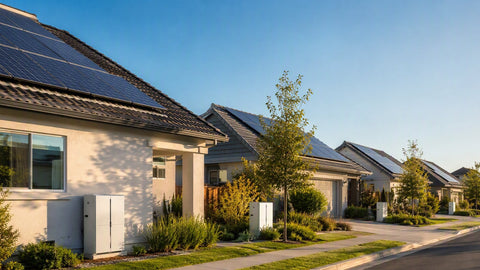
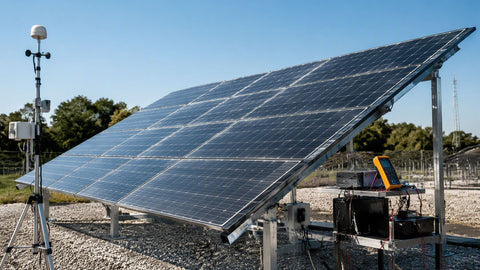
On May 9, 2018, the California Energy Commission voted unanimously to require solar photovoltaic systems on nearly every new home built in the state — the first mandate of its kind in the nation. The rule took effect January 1, 2020, as part of the 2019 update to Title 24, Part 6 of the California Building Energy Efficiency Standards, and it permanently changed how builders, electricians, and equipment suppliers think about residential construction in the country's largest housing market.

I remember the week that vote happened. My phone started ringing before the CEC press conference was even over — builders in Fresno and Riverside asking whether their Q3 starts were grandfathered, and one electrical contractor in Sacramento who wanted to know if he should hire two more journeymen on the spot. He should have. What follows is the full picture: what the mandate actually requires, what it costs, how the math works for homeowners, and where the rule stands today after half a decade of amendments.
What the CEC actually voted on
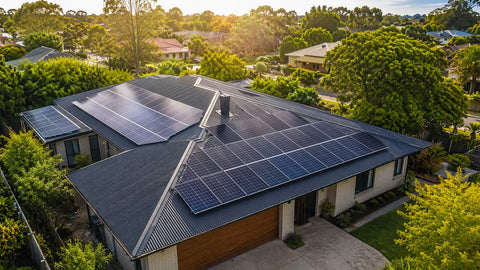
The 2018 vote adopted the 2019 Building Energy Efficiency Standards, which added Section 150.1(c)14 to Title 24, Part 6. The requirement: every newly constructed low-rise residential building — single-family homes and multifamily buildings up to three stories — must include a photovoltaic system sized to offset the building's expected annual electricity use, subject to a set of specific exceptions.
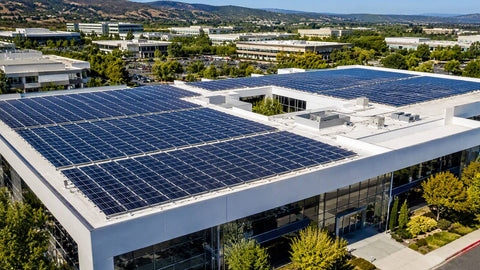
The standards are updated on a three-year cycle, and each cycle since has tightened or refined the rule. The 2022 standards (effective January 1, 2023) added battery-storage-ready requirements and expanded the mandate's reach to more building types, including many high-rise multifamily projects, hotels, offices, and retail spaces. The 2025 cycle continues the trajectory toward all-electric, solar-equipped new construction.
This was not a surprise vote. The CEC had telegraphed the direction since the 2013 standards cycle, which set a goal of zero net energy (ZNE) for all new residential construction by 2020. The solar mandate was simply the mechanism that made ZNE enforceable rather than aspirational.
How big a system the mandate requires
The CEC's sizing formula is based on the home's conditioned floor area and its California climate zone (there are 16, from foggy Arcata in Zone 1 to Palm Springs in Zone 15). The compliance software uses a prescribed kW-per-square-foot factor that assumes a mixed-fuel home; all-electric homes — which the 2022 and 2025 standards strongly push — size larger systems because the PV must cover heat-pump space heating, water heating, and induction cooking loads.
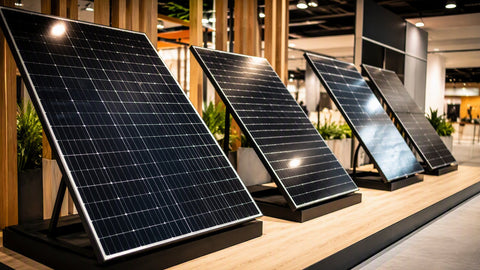
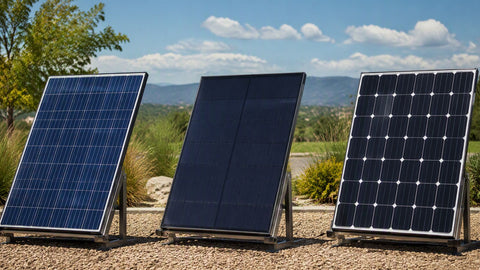
In practice, builders typically install between 2.7 kW and 5.5 kW on a code-minimum new home. Here is what that looks like across common scenarios, using modern 440 W modules:
| Home type | Conditioned area | Climate zone example | Typical code-minimum PV size | Modules (440 W) | Est. annual production |
|---|---|---|---|---|---|
| Small single-family | 1,400 sq ft | CZ 12 (Sacramento) | 2.6–3.1 kW | 6–7 | ~4,400 kWh |
| Average single-family | 2,100 sq ft | CZ 10 (Riverside) | 3.5–4.4 kW | 8–10 | ~6,600 kWh |
| Large single-family, all-electric | 3,000 sq ft | CZ 13 (Fresno) | 5.0–6.2 kW | 12–14 | ~9,300 kWh |
| 3-story multifamily unit (average) | 1,100 sq ft/unit | CZ 9 (Los Angeles basin) | 2.2–2.8 kW/unit | 5–6/unit | ~3,700 kWh/unit |
Production figures assume roughly 1,500 kWh per kW-year for inland California sites — a number I have verified against actual monitoring data from systems we have supplied over the years. Coastal zones run closer to 1,350–1,450 kWh/kW-year; the desert zones exceed 1,700.
The exceptions that let builders off the hook
The mandate is not absolute. The standards include compliance exceptions that matter on real job sites:
- Shading exception: If the available unshaded roof area is too small, the required system size is reduced to what fits in the solar access zone. A home with a large tree to the south may legally install a much smaller array.
- Community solar option: Builders can meet the requirement through an approved community-shared solar or battery system serving the development, rather than rooftop PV on each unit.
- Battery substitution: Under later standards cycles, adding qualifying battery storage allows a modest reduction in required PV capacity, because storage shifts solar generation into evening peak hours where it displaces more expensive and more carbon-intensive grid power.
- Alterations and repairs: The mandate applies to new construction, not remodels — though reroofing combined with other work can trigger related ready-requirements in some jurisdictions.
What it costs — and what it saves
The CEC's own economic analysis at adoption estimated the mandate would add roughly $9,500 to the cost of a new home (about $40 per month on a 30-year mortgage at the time) while saving approximately $80 per month on utility bills — a net positive cash flow from day one. Actual installed costs for production builders came in well below that estimate because of volume purchasing and the elimination of customer-acquisition and permitting friction that drives retail solar pricing.
Here is the math the way we run it for builder customers today, using 2026 wholesale equipment pricing:
| Cost component | Retail retrofit (per W) | New-construction volume install (per W) | 4 kW system total (new construction) |
|---|---|---|---|
| Modules (440 W class) | $0.45–$0.65 | $0.30–$0.42 | $1,400 |
| Inverter (string or micro) | $0.30–$0.55 | $0.22–$0.35 | $1,100 |
| Racking, wire, BOS | $0.35–$0.50 | $0.25–$0.35 | $1,200 |
| Labor and electrical | $0.60–$0.90 | $0.35–$0.55 | $1,800 |
| Permit, design, overhead | $0.40–$0.70 | $0.15–$0.25 | $800 |
| Total | $2.10–$3.30 | $1.27–$1.92 | ~$6,300 |
At California's average residential electricity rate — which crossed $0.30/kWh for the big three investor-owned utilities and keeps climbing — a 4 kW system producing 6,600 kWh per year offsets roughly $1,980 in annual purchases at retail rates. Even under NEM 3.0's reduced export compensation, a self-consumption-weighted value of $0.22/kWh yields about $1,450 per year. Simple payback on the incremental new-construction cost runs three to five years, and the system is financed at mortgage rates rather than solar-loan rates, which is the cheapest capital any homeowner will ever access for energy equipment.
The electrical code side installers cannot ignore
Every mandated system is still a PV system under Article 690 of the National Electrical Code, and California enforces the current adopted NEC cycle with state amendments. The calculations below are the ones I walk through with contractors constantly — get them wrong and the plan check comes back red-lined.
Voltage at coldest expected temperature (NEC 690.7): Module open-circuit voltage rises as temperature falls. For a string of ten 440 W modules with a Voc of 49.2 V and a temperature coefficient of −0.27%/°C, in a Northern California location with a −4°C design minimum, NEC Table 690.7(A) gives a correction factor of 1.10 for crystalline silicon:
| Parameter | Value | Calculation |
|---|---|---|
| Module Voc (STC) | 49.2 V | Datasheet |
| Modules in series | 10 | Design |
| String Voc (STC) | 492 V | 49.2 × 10 |
| Correction factor (−4°C) | 1.10 | NEC Table 690.7(A) |
| Maximum system voltage | 541 V | 492 × 1.10 |
That 541 V result must stay under the inverter's 600 V absolute maximum input rating — and under the 600 V limit for residential one- and two-family dwellings in NEC 690.7(C). It does, with about 10% margin. In a mountain climate zone with a −12°C design minimum the factor becomes 1.14, pushing the same string to 561 V. Comfortable, but you can see why eleven modules in series would fail plan check in cold zones: 492 × 1.1 × 11 = 595 V, leaving no margin at all.
Circuit sizing (NEC 690.8 and 240.4): PV source circuit current is multiplied by 1.25 for continuous operation and another 1.25 for irradiance enhancement — a combined 1.56 factor on Isc. For a string with 13.9 A Isc: 13.9 × 1.56 = 21.7 A, requiring 10 AWG copper (35 A at 75°C per NEC Table 310.16) protected by a 25 A breaker from the NEC 240.6(A) standard sizes. I have seen more failed inspections from conductors sized to the breaker instead of the 1.56× rule than from any other single error.
How the mandate interacts with net metering
The mandate arrived during NEM 2.0, when exported solar earned full retail credit and batteries were optional. Since April 2023, new systems fall under the Net Billing Tariff (NEM 3.0), which pays exports at avoided-cost rates that average roughly 75% below retail. That change did not weaken the mandate — it changed the design. New homes now pair PV with battery storage far more often, and the 2022 Title 24 cycle made homes battery-ready with dedicated breaker spaces and conduit even when no battery is installed on day one.
The combined effect: a mandated 4 kW system with a 10 kWh battery in a new California home now self-consumes 70–85% of its production, versus 30–40% for a bare solar-only system whose occupants are at work during peak sun. The storage addition raises the incremental cost by roughly $7,000–$9,000 at volume pricing but lifts the annual value of the same array by 40–60% under NEM 3.0 economics.
Where the rule stands today
Every standards cycle since 2018 has expanded rather than retreated. The 2022 standards extended PV requirements to high-rise multifamily, hotel/motel, office, medical office, retail, grocery, restaurant, school, and warehouse construction — with battery storage required on many of those commercial categories, not just encouraged. The 2025 standards, effective for permits pulled January 1, 2026 and later, continue pushing heat-pump-ready electric infrastructure and refined solar-access rules.
Other states have watched but not followed at the same scale. Several cities — including a handful in Colorado, Massachusetts, and Washington — have adopted local solar-ready or solar-required ordinances, but no other state has matched California's blanket statewide requirement. The reason is simple: California's Title 24 machinery gives the CEC a recurring, legally enforceable update vehicle that most states lack.
What this means for installers, builders, and buyers
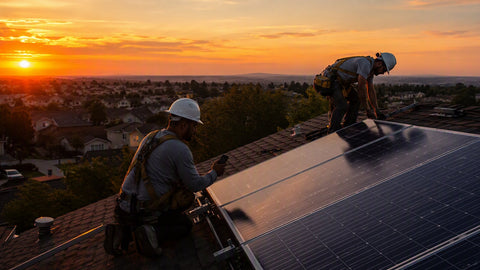
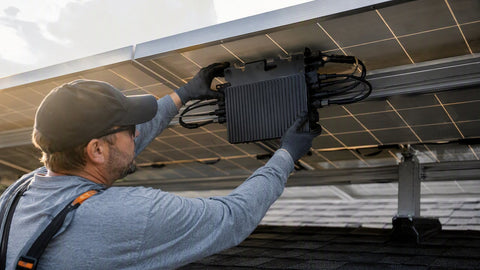
For installers, the mandate shifted the residential market from sales-driven retrofit work to specification-driven volume work. The margins are thinner per watt, the paperwork is cleaner, and the winners are the shops that can run 15 roofs a week with a repeatable bill of materials instead of three custom jobs. One GC I work with in the Inland Empire told me his solar rough-in is now as routine as the HVAC rough-in — same subs, same schedule slot, every house.
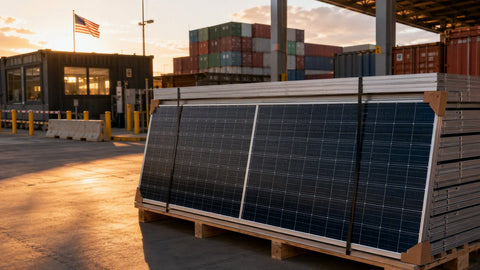
For equipment buyers, the lesson is standardization. Builders who lock a module class, an inverter family, and a racking system across an entire subdivision cut their per-watt cost by double digits and eliminate most plan-check surprises. We stock the 400–470 W residential module classes and the hybrid inverter lines these jobs run on, and we can kit an entire subdivision's bill of materials for delivery in phase with the framing schedule.
For homeowners, the honest summary is this: you will pay for solar on a new California home whether you want it or not, but you will pay less for it than any retrofit customer ever has, and under current rates it pays you back faster than almost any other appliance in the house.
Climate zones drive the sizing formula
The CEC's 16 climate zones are not administrative trivia — they directly set the prescribed PV capacity per square foot of conditioned space, because the formula balances expected cooling load against expected solar resource. A home in mild coastal Zone 3 needs fewer watts per square foot than the identical floor plan in desert Zone 15, even though the desert site produces more energy per installed watt. Builders running the same tract design across multiple counties have to rerun the compliance model for each zone; there is no single statewide number.
| Climate zone | Example city | Character | Relative PV sizing factor | Typical yield (kWh/kW-yr) |
|---|---|---|---|---|
| CZ 1–3 | Arcata, San Francisco, Oakland | Cool coastal, fog | Lower | 1,250–1,400 |
| CZ 8–10 | Los Angeles basin, Riverside | Warm inland valleys | Moderate | 1,450–1,600 |
| CZ 11–13 | Sacramento, Fresno, Bakersfield | Hot Central Valley | Higher | 1,500–1,650 |
| CZ 14–15 | Palm Springs, El Centro | Desert, extreme cooling load | Highest | 1,650–1,800 |
| CZ 16 | Blue Canyon, Truckee | Mountain snow | Moderate (snow losses) | 1,300–1,500 |
I have walked roofs in Zone 15 in August where the module backsides were reading 71°C on the IR gun — at that cell temperature a 440 W panel is really a 380 W panel, and the compliance model knows it. That is why the desert zones get the largest prescribed systems despite having the best sun in the state.
How enforcement actually works at permit and inspection
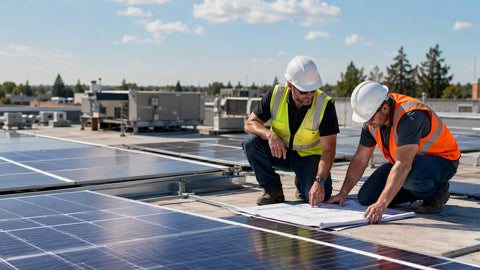
The mandate is enforced through the normal building-permit pipeline, not by a separate solar bureaucracy. The builder's energy consultant runs the CEC-approved compliance software (CBECC-Res or an approved alternative) to generate the CF1R certificate of compliance, which specifies the exact PV capacity in kW-DC that must appear on the plans. Plan checkers verify the array on the roof plan matches the CF1R number. At final inspection, the field inspector confirms the installed system matches the approved plans — module count, inverter rating, and orientation — before the certificate of occupancy issues.
The practical consequence: solar is locked in before the foundation is poured, not negotiated at the end. Builders who try to value-engineer the array down late in the process discover that the CF1R number follows the permit, and shrinking the system means resubmitting energy documentation. I have had exactly one customer attempt it. He reinstalled the full array three weeks later at his own expense after the city refused to final the house.
The battery-ready requirement most people missed
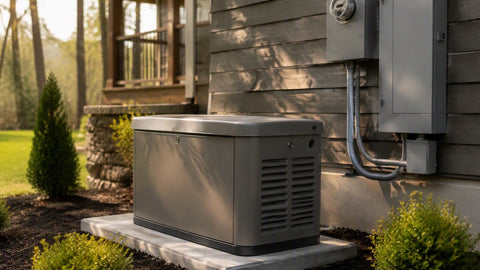
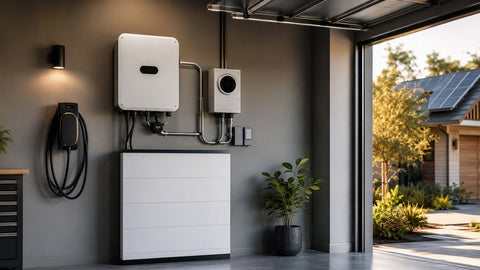
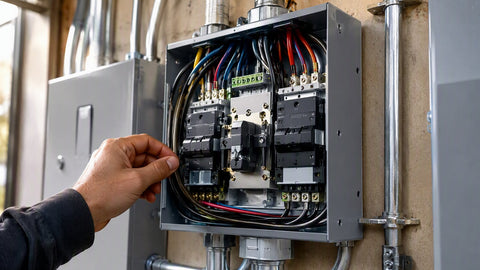
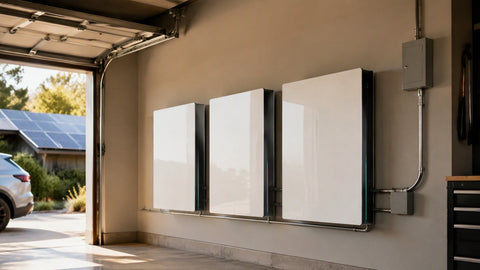
Buried in the 2022 standards cycle is a provision with long legs: new single-family homes must now be built energy-storage-ready, with a dedicated backed-up loads panel or panel space, conduit pathways, and busbar capacity for a future battery and its interconnection equipment. The cost at rough-in is a few hundred dollars. The cost of retrofitting the same provisions into a finished garage wall is ten times that. This single provision is why battery attachment rates on California new construction climbed so steeply after NEM 3.0 — the infrastructure was already in the walls, waiting.
Between the mandated PV, the battery-ready wiring, the heat-pump-ready electrical service, and EV-ready circuits under CALGreen, a 2026 California new home is effectively a distributed power plant that happens to have bedrooms. The electricians who understand that framing are the ones staying busy.
The affordability argument, eight years on
The strongest criticism of the mandate in 2018 was that adding any cost to new California housing — already the most expensive in the continental United States — was the wrong priority during an affordability crisis. The CEC's counterargument was cash-flow arithmetic: because the system is financed inside the mortgage at mortgage rates and immediately offsets utility bills at retail rates, the buyer's total monthly cost of ownership drops from the first payment. Eight years of operating data have largely settled the argument in the CEC's favor for owner-occupied buyers, with two honest caveats. First, the benefit flows to whoever holds the utility account, so renters in mandated multifamily buildings depend on how the owner structures billing. Second, the arithmetic assumes California retail rates, which are exceptional; the same mandate would not pencil as cleanly in a $0.12/kWh state.
There is also a grid-level dividend that rarely makes the press releases. Several hundred thousand mandated rooftops, increasingly paired with batteries, have become a meaningful distributed resource during evening ramps. When the ISO calls a Flex Alert now, the new-home stock responds differently than it did in 2018 — and that was precisely the long game the CEC was playing when it tied the PV mandate to storage-ready wiring.
Frequently asked questions
Does California really require solar panels on every new house? Yes — since January 1, 2020, the Title 24 energy standards require PV on new low-rise residential construction, sized to the home's expected annual electricity use, with exceptions for shaded sites and an option to use community solar instead.
How much does the mandate add to the price of a new home? At volume builder pricing, roughly $5,000–$8,000 for a code-minimum 3–4.5 kW system — less than the CEC's original $9,500 estimate — typically $25–$45 per month on a 30-year mortgage, against utility savings that exceed the payment.
Can a builder skip the panels if the roof is shaded? Partially. The required capacity is reduced to what fits the unshaded solar-access zone, and the community-solar compliance path can cover the remainder. Fully exempt homes are rare.
Does the mandate apply to remodels or additions? No — it applies to newly constructed buildings. Large additions can trigger other Title 24 measures, but existing homes are not retroactively covered.
What changed under NEM 3.0 for mandated systems? Export compensation fell about 75%, which pushed new-home designs toward battery storage and higher self-consumption rather than changing the requirement to install PV itself.
What builders learned the hard way
Three lessons came out of the first four years of mandated construction, and I have watched all three play out on real projects. First, roof design is now solar design: hips, valleys, and dormers that look handsome on an elevation can cost 30% of the usable array area, so the smartest production builders flattened and simplified south-facing planes starting with their 2021 model refreshes. Second, electrical service sizing had to anticipate the all-electric endgame — a 200 A panel that seemed generous in 2019 feels tight once you add a heat pump, an induction range, an EV circuit, and a battery, which is why we now see 225 A busbars specified on mid-size plans. Third, procurement timing matters: the builders who locked module supply a full phase ahead never missed a final inspection over a missing pallet, and the ones who bought spot market learned what a two-week framing delay costs in carrying charges.
The bottom line
California's first-in-nation solar mandate turned rooftop PV from a consumer choice into standard building infrastructure — like insulation or arc-fault breakers. Eight years after the vote, the rule is broader, the equipment is cheaper per watt, and the economics under NEM 3.0 favor solar-plus-storage designs that the 2018 authors could only hope for. If you are building, wiring, or supplying new California construction, solar is no longer a product category. It is a code section.
Portlandia Electric Supply stocks the modules, inverters, racking, and balance-of-system components that California new-construction solar runs on. Browse our solar panels, 400–459 W modules, hybrid inverters, microinverters, mounting systems, and 10 kWh battery options, or read our guides on NEC code compliance, solar installation, solar incentives by state, system sizing, and commercial solar installation costs.