Briggs & Stratton 80kW Standby Generator (Model 080082): Complete Guide to Industrial-Grade Backup Power
Full specifications, NEC electrical design, fuel planning for natural gas and propane, application coverage, and installed-cost reality for the 80kW class.

Eighty kilowatts is where backup power stops being a comfort purchase and becomes an operational requirement. The Briggs & Stratton 80kW standby generator (model 080082) sits at a genuinely useful intersection: large enough to carry a small commercial building, a working farm's critical loads, or a very large estate without compromise — and still single-phase 120/240V, which keeps it compatible with the electrical services found on most rural and light-commercial properties in North America.
We move a steady stream of units in this class, and the buyer profile is remarkably consistent: someone who ran the load math, watched a smaller unit fall short during a real outage, or got quoted a three-phase commercial rig for a property that doesn't have three-phase service. The 080082 answers all three situations. This guide covers the complete specification set, the National Electrical Code design math for feeders and transfer equipment, realistic fuel consumption planning on both natural gas and propane, the facilities an 80kW set genuinely covers, and what the project costs installed in 2026.
The headline features tell you who this unit is built for: an integrated 300-amp main breaker, a factory-installed block heater, an integrated battery charger, and fully automatic operation with ATS integration. This is not a residential unit scaled up — it's industrial-grade equipment configured for the single-phase world.
| Key Product Overview | |
|---|---|
| Model Number | 080082 |
| Rated Output | 80 kW |
| Voltage | 120/240V, Single-Phase |
| Main Breaker | Integrated 300-Amp Circuit Breaker |
| Cold-Weather Readiness | Factory-Installed Block Heater |
| Starting Reliability | Integrated Battery Charger |
| Operation | Fully Automatic with ATS Integration |
Integrated Block Heater for Cold Climate Performance
That factory block heater deserves emphasis because it's the feature northern buyers should care about most and the one competitors often charge extra for. Cold starts are where standby generators die young — oil at 0°F flows like honey, and every cold crank is a wear event the engine never fully gets back:
| Block Heater Benefit | Why It Matters |
|---|---|
| Maintains Optimal Oil Viscosity | Ensures proper lubrication during startup, reducing wear |
| Reduces Startup Wear | Warm engines experience less mechanical stress during cranking |
| Improves Ignition Reliability | Warmer combustion chamber promotes more reliable ignition |
| Extends Engine Lifespan | Reduced cold-start stress means longer service life |
I've taken calls from Minnesota and Montana customers whose unheated units failed to start during the exact polar-vortex events they were purchased for. A factory block heater, powered from the same circuit as the battery charger, eliminates that failure mode for the cost of a few watts of continuous heat. If you're north of the 40th parallel, treat it as mandatory equipment — and if you're comparing brands, note which ones include it standard versus as an add-on line item.
High-Capacity 120/240V Power Output
| Electrical Specifications | |
|---|---|
| Rated Output | 80 kW / 80 kVA |
| Voltage Configuration | 120/240V Single-Phase |
| Frequency | 60 Hz |
| Main Breaker | 300 Amp Integrated |
| Maximum Amperage | 333A @ 240V |
| Power Factor | 1.0 |
Read those numbers together and they tell a design story. The alternator can produce 333A at 240V — the full 80kW at unity power factor — but the integrated main breaker is 300A. In practice that means the continuous deliverable current through the factory breaker path is 300A (72kW), with alternator headroom above it. For virtually every real application that's a distinction without a difference, because a properly sized 80kW installation runs at 60–80% of rating anyway. But your electrician needs to know which number governs which decision: the alternator's 333A maximum sets the NEC 445.13 conductor sizing conversation, and the 300A breaker sets the overcurrent protection frame.
Here's the code-checked design path for a whole-facility 80kW single-phase installation. Full-load current: I = 80,000 ÷ 240 = 333.3 A. NEC 445.13 requires conductors rated at least 115% of nameplate current: 333.3 × 1.15 = 383.3 A. Applying NEC Table 310.16 (75°C copper) and Table 250.122 for the equipment grounding conductor:
| Design Element | Calculation / Code Reference | Result |
|---|---|---|
| Maximum output current | 80,000 W ÷ 240 V | 333.3 A |
| Min. conductor ampacity | 333.3 A × 115% (NEC 445.13) | 383.3 A |
| Copper feeder option A (75°C) | Table 310.16 — 600 kcmil CU = 420 A | 600 kcmil per leg |
| Copper feeder option B (75°C) | Table 310.16 — parallel 3/0 CU = 2 × 200 A | Parallel 3/0 per leg (400 A) |
| Overcurrent protection | Factory-integrated breaker | 300 A (as shipped) |
| Equipment grounding conductor | Table 250.122 (300 A OCPD) | 4 AWG copper |
| ATS pairing | Match service / load configuration | 400 A class typical |
Two practical notes from the field. First, parallel 3/0 runs are usually cheaper and far easier to pull than 600 kcmil — parallel conductors are legal at 1/0 and larger per NEC 310.10(G), and your electrician will thank you for not speccing a conductor that needs a hydraulic bender. Second, the ATS class: most 80kW single-phase installs pair with a 400A service-rated switch, because the buildings that need 80kW of backup typically have 400A services. Our 400A+ transfer switch inventory and broader automatic transfer switch lineup cover the standard pairings, and the NEC ampacity guide lets you verify every row of that table against the code text.
| Engine & Fuel System | |
|---|---|
| Engine Type | Industrial-Grade, Liquid-Cooled |
| Fuel Type | Natural Gas / Liquid Propane (LP) |
| Cooling System | Liquid-Cooled with Radiator |
| Block Heater | Factory-Installed (Standard) |
| Battery Charger | Integrated Automatic |
| Operational Features | |
|---|---|
| Starting System | Electric Start with Automatic Activation |
| Transfer Time | Seconds (with compatible ATS) |
| Operation Mode | Fully Automatic / Unattended |
| Runtime Capability | Extended (Continuous Duty Design) |
| ATS Compatibility | Designed for Automatic Transfer Switch Integration |
The phrase that matters most in those two tables is continuous duty design. An 80kW buyer isn't protecting against a two-hour brownout; they're protecting against the ice storm that takes down distribution lines for nine days. Liquid cooling with a proper radiator, an industrial engine block, and unattended automatic operation are what make week-plus runtimes a maintenance question rather than an equipment-survival question. During extended events, the discipline is simple: check oil daily, watch the coolant, and schedule service per the engine hour meter rather than the calendar.
Fuel planning splits into two very different conversations. On natural gas, the question is utility capacity: an 80kW engine at full load is a massive gas appliance, and most rural services need a meter or regulator upgrade to feed it alongside existing loads. On propane, the question is storage autonomy: how many days can the tank farm carry the property? Planning figures for this class — using the industry convention of roughly 10 ft³ of natural gas per kW-hour at full load (part-load efficiency degrades below half load) and typical LP consumption for an 80kW liquid-cooled engine:
| Load Point | Output | Natural Gas (est.) | Propane (est.) | 500-gal LP Tank Autonomy |
|---|---|---|---|---|
| 25% load | 20 kW | ≈240 ft³/hr | ≈2.6 gal/hr | ≈6.4 days continuous |
| 50% load | 40 kW | ≈440 ft³/hr | ≈4.8 gal/hr | ≈3.5 days continuous |
| 75% load | 60 kW | ≈640 ft³/hr | ≈7.0 gal/hr | ≈2.4 days continuous |
| 100% load | 80 kW | ≈850 ft³/hr | ≈9.3 gal/hr | ≈1.8 days continuous |
The autonomy column uses 400 usable gallons (propane tanks fill to 80% for thermal expansion) at continuous load — real outages cycle, so actual autonomy typically runs 30–50% longer than the continuous figure. Even so, the lesson stands: propane customers in this class should be thinking in terms of multiple 500-gallon tanks or a 1,000-gallon vessel, not a single residential tank. I've watched a farm customer burn through a 500-gallon tank in under four days during an ice event because his ventilation fans and well pumps never cycled off; he now owns two 1,000-gallon tanks and sleeps fine. On the natural gas side, get the full-load BTU requirement to your utility early — at roughly 850,000 BTU/hr, most standard residential meters and many light-commercial services can't deliver full-load volume without an upgrade, and that work order routinely takes longer than the generator delivery.
What an 80kW Set Actually Covers

| Application Sector | Critical Loads Protected | Key Benefit |
|---|---|---|
| Large Residential | HVAC, security, automation, well pumps | Whole-home coverage |
| Commercial/Retail | POS, refrigeration, lighting, HVAC | Business continuity |
| Healthcare | Medical equipment, climate, IT, safety | Patient safety compliance |
| Agricultural | Pumps, motors, controls, refrigeration | Livestock and crop protection |
| Light Industrial | Manufacturing, processing, IT | Production continuity |
A few grounding examples from each sector. Large residential: 80kW carries a 10,000+ square foot estate — multiple HVAC systems, pool equipment, guest house, workshop — with zero load management, which is exactly why estate buyers end up here. Commercial/retail: a 5,000–8,000 sq ft retail building with refrigeration and POS loads typically peaks at 35–60kW, so an 80kW set provides full coverage with genuine headroom. Agricultural: the loads are motors — well pumps, ventilation fans, feed systems, bulk tanks — and motor starting kVA is why farms buy one class larger than their running load suggests. If your operation runs 40kW of motors, the starting surge on the biggest pump is why you want the 80kW and not the 60kW.
Where 80kW is the wrong answer: true three-phase commercial facilities (you need a three-phase unit, full stop — see the 100kW three-phase class), and homes under about 5,000 square feet, where a 48kW unit delivers the same lifestyle coverage for substantially less equipment and fuel cost.
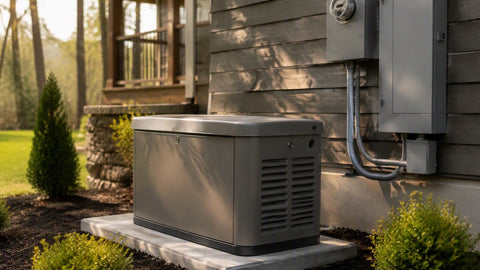
An 80kW liquid-cooled set is a permanent infrastructure project. The sequence that keeps these installs on schedule: site assessment and load confirmation first (get the gas utility work order opened this same week — it's the pacing item on nearly every job), permits second, pad and rough-in third, set-and-connect fourth, commissioning last. The pad is a real pad — reinforced concrete engineered for the unit's wet weight, anchors set to the factory drawing, not field-drilled. Placement needs the manufacturer's clearances on all sides, exhaust discharge aimed away from air intakes and occupied space, and year-round service access. Sound planning matters at this size: an 80kW engine under load is not a porch conversation, so property-line distance and any local noise ordinance belong in the placement decision. Typical timeline from order to commissioned: four to eight weeks, with the utility gas work and the electrical permit review consuming most of it.
Single-phase means single-phase
The 080082 is a 120/240V single-phase machine. If your facility has a three-phase service, this unit cannot back it up directly — you'd need phase conversion (expensive and lossy) or a three-phase generator. Confirm your service configuration with your electrician before falling in love with any specific model. This is the most expensive assumption error we see in this class.
| Cost Component | Typical Range (2026) | Notes |
|---|---|---|
| 80kW generator unit (080082) | $22,000 – $32,000 | Configuration and lead time dependent |
| 400A-class ATS | $3,000 – $6,500 | Service-rated, correct fault-current rating |
| Concrete pad & set | $2,500 – $6,000 | Site access drives the number |
| Electrical labor & feeders | $5,000 – $12,000 | Run length and parallel conductor choice |
| Gas service upgrade / LP tanks | $2,000 – $8,000 | Utility charges or tank purchase/install |
| Permits & commissioning | $1,500 – $4,000 | Includes startup and transfer testing |
| Project total | $36,000 – $68,500 | Turnkey range, straightforward sites |
Buyers inevitably ask whether the jump from a 48kW to an 80kW is "worth it." Reframe it: the equipment delta is roughly $8,000–$12,000, but the installed delta is smaller because pad, labor, and permits barely change. If your load calculation says 55kW peak, the 48kW isn't a money-saving choice — it's an undersized system waiting for its first failure under stress. Buy the size the math says, and buy it once.
- Weekly self-exercise with verification — the integrated battery charger and exercise clock do their jobs silently; confirm periodically that cycles are completing and add remote monitoring from the monitoring accessories category if the unit sits at an unattended property.
- Oil and filter service annually or per run-hours — during extended outage events, check oil daily and service per the engine hour meter, not the calendar.
- Coolant concentration tested every fall — the block heater keeps the engine warm, but only if the coolant isn't already slush.
- Battery replaced proactively at 3–4 years — still the number-one no-start cause at every size class we support.
- Annual professional PM with a loaded transfer test — a documented annual test under real load is what separates a maintained asset from a very expensive lawn ornament, and it keeps warranty coverage unambiguous. Supplemental cold-weather accessories beyond the factory block heater are worth discussing for sites that see extended sub-zero stretches.
Every nameplate kilowatt assumes standard conditions — 77°F at sea level — and real properties rarely cooperate. The industry conventions: naturally aspirated gaseous engines give up roughly 1% of output per 100 feet of elevation, while turbo-charged variants typically hold rating to somewhere between 1,500 and 3,000 feet; heat costs about 1% per 10°F above the rating temperature. A farm at 4,500 feet running loads on a 100°F August afternoon can lose a third of a naturally aspirated unit's effective capacity — an "80kW" system that behaves like a 55kW system at exactly the wrong moment. If your site is above 2,000 feet or sees genuine summer heat, pull the factory derate curve for the 080082 and overlay your conditions before committing. In my experience this step gets skipped on rural installs more than any other, because nobody at the kitchen table wants to hear that the generator costs the same but delivers less. Better to hear it at the kitchen table than during a wildfire-season outage.
Straight counter talk: the single-phase 80kW niche has few serious occupants, and the Briggs 080082 earned its place with the factory block heater, the integrated breaker and charger, and a dealer channel that actually services what it sells. Against the Generac industrial single-phase options in our Generac lineup, the honest differences are dealer coverage in your county and current lead time — both brands will carry the load. Where we steer buyers elsewhere without hesitation: three-phase facilities (wrong machine entirely), diesel-required applications under certain codes, and buyers whose load calc comes in under 45kW — for them the 80kW is money spent on capacity that runs at inefficient part load for its whole life, and a 48kW or 60kW unit serves them better. The best generator purchase is the one matched to measured demand, and we'd rather sell you the right size once than the wrong size twice.
One closing ownership note: document everything from day one — the commissioning report, the first transfer test, every annual PM. Resale value on a maintained 80kW unit with records is genuinely strong, because the secondary market for commercial standby equipment prices documentation almost as much as hours on the meter.
What can an 80kW generator actually power? A full 10,000+ sq ft estate with multiple HVAC systems, a 5,000–8,000 sq ft retail building including refrigeration, or a working farm's pumps, fans, and bulk tanks — simultaneously, without load management. The coverage table above maps the common sectors, and our sizing walkthrough shows the load calculation method if you want to run your own numbers.
Is the Briggs & Stratton 80kW single-phase or three-phase? Single-phase 120/240V. That's a feature for rural and light-commercial properties whose services are single-phase — which describes most farms, estates, and small commercial buildings in North America. Three-phase facilities need a three-phase unit; no workaround is worth the efficiency loss.
How much propane does an 80kW generator use? Plan on roughly 9–10 gallons per hour at full load and about 5 gallons per hour at half load. A 500-gallon tank (400 usable gallons) delivers roughly two to six days of continuous operation depending on load — which is why serious LP installations in this class run multiple tanks or a 1,000-gallon vessel.
What size transfer switch does an 80kW generator need?
Typically a 400A-class service-rated ATS, because the properties that need 80kW usually have 400A services. The unit ships with an integrated 300A main breaker; the ATS must match the service it's switching and carry the available fault current rating. Our 400A+ transfer switch category covers the standard pairings.
Can an 80kW generator run continuously for days? Yes — it's a continuous-duty, liquid-cooled design built for exactly that. The maintenance discipline during extended runs is daily oil checks, coolant monitoring, and service per the engine hour meter. Natural gas versions have no runtime ceiling; propane runtime is purely a storage question.
How loud is an 80kW standby generator?
Loud enough that placement matters — industrial liquid-cooled units in this class typically produce sound levels in the 70s dB(A) range at 7 meters under load. Site it with property lines and windows in mind, verify any local noise ordinance, and remember that sound at no load is noticeably quieter than sound at full load.
Talk to Someone Who Actually Sizes These
We stock and source the Briggs & Stratton commercial standby line plus the transfer switches and accessories that make these installs pass inspection. Tell us your service size, your loads, and your fuel situation — we'll tell you straight whether the 080082 is your unit.
Browse 80kW Generators