Briggs & Stratton 150kW Natural Gas Generator: Complete 2026 Commercial Guide
Class specifications, NEC electrical design at 208V and 480V, natural gas fuel planning, real load coverage, and installed cost — from the people who sell and source this equipment every week.

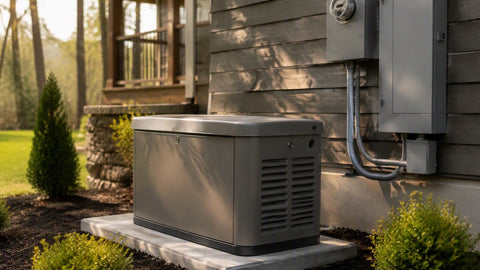
A 150kW natural gas standby generator is serious commercial infrastructure. At this power level you're backing up grocery stores, cold-storage warehouses, mid-size medical facilities, water and wastewater lift stations, and multi-tenant commercial buildings — places where an outage stops being an inconvenience and becomes a five-figure-per-day problem. Briggs & Stratton's commercial standby line has played in this class for years, and the 150kW natural gas configuration is one of the most-requested sizes we quote against the Generac and Cummins industrial lines.
I've walked facility managers through this exact purchase more times than I can count, and the pattern is always the same: the equipment decision takes a week, and the gas service, pad, and permit decisions take two months. This guide is built to compress both timelines — real specs and class data, the NEC math your electrician will run, fuel numbers your gas utility will ask about, and the installed-cost picture your CFO will want before signing.
The jump from 100kW to 150kW isn't just 50% more power — it's a different project category. At 100kW and below, many installs run at 240V with a single ATS and a modest gas service upgrade. At 150kW you start seeing 480V three-phase services, paralleling-ready switchgear options, and gas utilities that want a load letter before they'll commit to a service upgrade. None of that is a reason to shy away; it's a reason to plan earlier.
Choose 150kW when your calculated peak demand sits between roughly 95kW and 135kW with normal commercial load diversity. Below that, the 125kW class saves real money on equipment, gas plumbing, and feeder copper. Above it, you're into 175kW and 200kW industrial territory, where the per-kW equipment cost actually drops but the project complexity climbs. The worst outcome we see is a buyer who sizes 150kW for a 90kW load "for headroom" and then runs the engine at 25% load for every exercise cycle — chronic light loading on a gaseous engine invites wet-stacking-like maintenance issues over years of service.
Exact nameplate data varies by model year and configuration, so confirm against the factory spec sheet for the specific unit you order. The table below reflects the typical published characteristics of the Briggs & Stratton 150kW natural gas commercial standby class — use it for planning, and let the submittal drawings govern the final design.
| Characteristic | Typical Class Value | Why It Matters |
|---|---|---|
| Standby output | 150 kW / 187.5 kVA @ 0.8 PF | Sets the breaker, feeder, and ATS frame |
| Voltage options | 208V or 480V three-phase (120/240V 1-phase on select frames) | Match the building service, not the other way around |
| Engine class | Turbo-charged gaseous V-8 or inline-6, liquid-cooled | Turbo charging preserves altitude capacity |
| Operating speed | 1,800 RPM | Commercial longevity vs. 3,600 RPM light-duty sets |
| Fuel | Natural gas (LP vapor configurations common) | Unlimited runtime without refueling logistics |
| Sound level | ≈75–85 dB(A) at 7 m, enclosure dependent | Drives pad placement and property-line compliance |
| Footprint | Roughly 10–12 ft long × 4–5 ft wide with enclosure | Pad, rigging path, and clearance planning |
| Weight | ≈5,000–8,000 lbs wet, configuration dependent | Determines pad design and crane requirements |
Two of those rows drive most of the downstream cost. Voltage selection decides your conductor count and size — at 480V the same 150kW flows on 180A-class feeders, which is dramatically cheaper copper than the 416A-class feeders required at 208V. And weight decides whether your rigging plan is a telehandler or a 40-ton crane with a street closure permit.
Here's the math your electrical contractor will run, so you can follow the conversation and sanity-check the quote. Full-load current is power divided by voltage times the three-phase factor:
- At 208V three-phase: I = 150,000 ÷ (208 × 1.732) = 416.3 A
- At 480V three-phase: I = 150,000 ÷ (480 × 1.732) = 180.4 A
NEC 445.13 then requires generator feeder conductors rated at least 115% of nameplate current, NEC 240.6(A) supplies the standard overcurrent device sizes, and Table 310.16 (75°C copper column, the standard termination assumption) supplies the ampacities:
| Design Element | 208V System | 480V System |
|---|---|---|
| Full-load current | 416.3 A | 180.4 A |
| Min. conductor ampacity (×1.15, NEC 445.13) | 478.7 A | 207.5 A |
| Copper feeder (Table 310.16, 75°C) | Parallel 250 kcmil (2 × 255 A = 510 A) | 4/0 AWG (230 A) |
| Standard OCPD (NEC 240.6(A)) | 450–500 A frame | 200 A |
| Equipment grounding (Table 250.122) | 2 AWG CU (500 A OCPD) | 6 AWG CU (200 A OCPD) |
| Typical ATS class | 600 A | 200–225 A |
The practical takeaway: if your building has a 480V service, take the generator at 480V. The feeder savings alone — one set of 4/0 copper versus parallel 250 kcmil runs — frequently covers a meaningful slice of the gas service upgrade. If the building is 208V, you're committed to the heavy copper, and conduit fill, pull boxes, and labor all scale with it. Our NEC wire sizing guide has the full ampacity tables if you want to trace every row.
Don't size the ATS off the generator alone
If the generator feeds the entire service through a service-rated ATS, the switch must be sized to the utility service, not the generator output. A 150kW set backing up a 400A, 208V service needs a 400A service-rated ATS even though the generator only makes 416A — and that ATS must carry the utility's available fault current rating too. Mismatched fault-current ratings are a top-five reason commercial generator inspections fail.
A 150kW gaseous engine at full output is one of the largest gas appliances most commercial buildings will ever host. For utility conversations and operating-cost estimates, plan around 9–11 cubic feet of natural gas per kW-hour at full load, roughly 10 ft³/kWh as a midpoint, with part-load efficiency degrading below half load:
| Operating Point | Output | Est. NG Consumption | Cost per 8-hr Run @ $1.20/therm |
|---|---|---|---|
| 25% load | 37.5 kW | ≈450 ft³/hr | ≈$43 |
| 50% load | 75 kW | ≈825 ft³/hr | ≈$79 |
| 75% load | 112.5 kW | ≈1,200 ft³/hr | ≈$115 |
| 100% load | 150 kW | ≈1,500 ft³/hr | ≈$144 |
Full-load demand of roughly 1,500 ft³/hr is about 1.5 million BTU/hr — beyond what most existing commercial services can deliver without an upgrade. In my experience this is the single most common schedule risk on 150kW projects: the generator arrives in six weeks, and the gas utility quotes twelve weeks for the service upsize. Open the utility work order the same week you place the equipment order. Also confirm delivery pressure at the generator connection — most gaseous sets want a regulated 7–14 inches water column at the unit, and long shared runs with other appliances can sag below that under coincident load. If your site can't get adequate gas, LP vapor with on-site storage is the usual fallback; runtime then becomes a tank-sizing exercise instead of a utility conversation.
Kilowatts are abstract; buildings are not. Coverage below reflects the demand profiles we see most often when buyers call about this class:
| Facility Type | Typical Peak Demand | 150kW Coverage |
|---|---|---|
| Supermarket (~30,000–40,000 sq ft) | ≈100–150 kW | Full store with load management; refrigeration prioritized |
| Cold-storage warehouse (small) | ≈90–140 kW | Full coverage when compressors stagger-start |
| Medical clinic / urgent care | ≈60–110 kW | Full facility including HVAC |
| Hotel (60–100 rooms) | ≈90–140 kW | Full coverage or critical loads + corridors |
| Office building (~40,000 sq ft) | ≈80–130 kW | Full facility in most cases |
| Light manufacturing | ≈100–180 kW | Critical processes; largest motors may need shedding |
The motor-start caveat deserves emphasis: a 150kW set carries roughly 150kW of running load, but starting kVA on large across-the-line motors can demand two to three times running current for a few seconds. Facilities with 40HP+ compressors or pumps should plan staggered starts through the ATS or soft starters on the biggest motors. We've seen a properly programmed 150kW system carry a building that a poorly sequenced 200kW system couldn't — controls beat brute capacity.
Installed Cost: The Complete 2026 Picture

| Cost Component | Typical Range (2026) | Cost Driver |
|---|---|---|
| 150kW NG generator unit | $42,000 – $60,000 | Voltage configuration, enclosure level, lead time |
| ATS (service-rated, correct frame) | $6,000 – $14,000 | Amperage frame and fault-current rating |
| Concrete pad & crane set | $6,000 – $14,000 | Weight class, site access, street permits |
| Electrical (feeders, conduit, labor) | $12,000 – $30,000 | 208V vs 480V, run length, parallel sets |
| Gas service upgrade & plumbing | $5,000 – $18,000 | Utility-side work is the wildcard |
| Engineering, permits, commissioning | $4,000 – $10,000 | Load-bank test often specified at this size |
| Project total | $75,000 – $146,000 | Turnkey, straightforward to complex sites |
Context for that total: industry downtime studies routinely put commercial outage costs at $5,000–$20,000+ per hour for grocery, cold storage, and healthcare-adjacent operations. Most 150kW buyers we work with can name the single past outage that would have paid for the entire project. If you're evaluating ROI, start with your own revenue-per-hour and spoilage exposure rather than generic industry figures — the math usually isn't close.
A 150kW unit earns its keep in the ten minutes after the outage starts, but it survives on the schedule you keep for the other 8,700 hours of the year:
- Weekly self-exercise with verification — remote monitoring pays for itself at this class; see the monitoring and alarm accessories we stock.
- Oil, filters, and coolant on the engine schedule — annual minimums even with low run hours.
- Battery replacement at 3–4 years, load-tested annually — still the number-one no-start cause.
- Annual load-bank or building-load test — proving the set at 75%+ load exposes weak batteries, tired regulators, and fuel-pressure sag before an outage does.
- Cold-weather package in freezing climates — battery warmers and oil warmers from the cold weather kit category are inexpensive reliability insurance.
Every kilowatt rating on a spec sheet assumes standard conditions — 77°F at sea level. Real sites are rarely standard. The industry-standard derate conventions are roughly 1% of output per 100 feet of elevation for naturally aspirated gaseous engines, with turbo-charged engines typically holding full rating to somewhere between 1,500 and 3,000 feet before their own derate curve begins, and about 1% per 10°F above the rating temperature once ambient climbs past 77°F. Run the numbers on a realistic example: a naturally aspirated 150kW set at 4,000 feet on a 97°F afternoon could deliver barely 105–110kW. The same site with a turbo-charged engine might hold 135kW or better. If your project sits above 2,500 feet or in a genuinely hot climate, this conversation is not optional — it's the difference between a unit that carries the building in August and one that trips offline when you need it most. Pull the factory derate curves for your exact model and overlay your site conditions before finalizing the size.
The fuel decision at 150kW is usually made by the site, not the buyer — but here's the honest comparison for the cases where you do have a choice:
| Factor | Natural Gas | Diesel | Propane (LP) |
|---|---|---|---|
| Runtime limit | Unlimited (utility-fed) | Tank capacity (24–72 hr typical) | Tank capacity (sized to need) |
| Refueling logistics | None | Fuel contracts, polishing, testing | Supplier deliveries |
| Equipment cost | Baseline | Often 10–20% higher | Similar to NG |
| Maintenance burden | Lowest | Fuel system upkeep required | Low |
| Code preference | Accepted for most commercial | Preferred/required for some life-safety | Accepted; storage rules apply |
| Best for | Sites with robust gas service | No gas service; stored-fuel mandates | Rural sites without utility gas |
Our default recommendation at 150kW is natural gas wherever the utility can deliver adequate volume and pressure — the total cost of ownership over a 15-year life is almost always the lowest of the three. Diesel earns its premium where code or insurance requires stored fuel, and LP is the workhorse for rural sites beyond the gas main. You can compare configurations across our natural gas and propane generator categories.
A realistic 150kW project calendar, assuming no utility surprises:
- Weeks 1–2: Load study finalized from utility demand data, voltage configuration locked, equipment ordered, permits submitted, gas work order opened.
- Weeks 2–6: Pad engineered and poured with anchors set to the factory drawing; gas service upgrade scheduled; electrical rough-in staged.
- Weeks 6–10: Unit delivered and set by crane; gas and electrical connections completed; battery and block heater energized; network monitoring configured.
- Weeks 8–12: Commissioning — factory-authorized startup, load-bank or building-load test, transfer sequencing verification, AHJ inspections, owner training.
The two items that blow up this calendar are gas utility scheduling and switchgear lead times, in that order. Everything else is controllable. Buyers who start in spring routinely energize before storm season; buyers who start after the first major outage of the year wait in line with everyone else.
At 150kW, the generator is a 15-to-20-year asset, and the ownership experience is defined by service far more than by the spec sheet. Before choosing a brand, answer three questions for your specific address. Who is the factory-authorized service provider within 50 miles, and do they staff 24-hour emergency response? What is the realistic parts lead time for engine-side components — days or weeks? And does the warranty include labor, or parts only? Parts-only coverage on a commercial set is a discount in disguise; one emergency callout with a weekend rate can erase the savings. We source across brands precisely because the right answer changes by county — in some regions the Briggs & Stratton dealer network is the strongest option on the map, in others a competitor's industrial distributor has the deeper bench. Ask us and we'll tell you what we actually see in your area rather than reciting a brochure.
One more ownership line item buyers forget: monitoring subscriptions and controller firmware support. A 150kW set with remote monitoring will text you when it exercises, when it faults, and when the battery gets weak — that visibility is what turns "we think the generator works" into "we know it does." Budget for it from day one and fold it into the annual maintenance contract. And keep the commissioning report somewhere accessible: when a warranty claim or an insurance question comes up three years in, the documented load-test results from day one are the paper trail that settles the conversation in your favor.
How much does a Briggs & Stratton 150kW natural gas generator cost installed? Plan on $75,000–$146,000 turnkey in 2026, with the equipment itself running $42,000–$60,000. The swing factors are the electrical design voltage (480V is dramatically cheaper to wire than 208V), gas utility charges, and rigging access.
What size gas line does a 150kW generator need? Full-load consumption around 1,500 ft³/hr typically requires a dedicated run — often 2-inch or larger depending on run length and delivery pressure — plus a utility service upgrade on most commercial sites. Your gas utility and plumber size the final run; give them the generator's full-load BTU requirement early.
Should I choose 208V or 480V for a 150kW generator? Match the building service. If the building is 480V, absolutely choose 480V — full-load current drops from 416A to 180A, which roughly quarters your feeder copper cost. Never install a transformer just to change generator voltage unless no native configuration exists.
Can a 150kW generator run a grocery store? Yes, in most cases — a 30,000–40,000 sq ft supermarket typically peaks at 100–150kW. With compressor stagger-start programming and non-essential load shedding, full operation through multi-day outages is routine. Refrigeration always gets priority in the load sequence. The caveat is the starting surge on the biggest compressors: if your store runs multiple 40HP-plus refrigeration racks across-the-line, have the controls contractor sequence those starts through the transfer switch logic so the generator never sees them simultaneously.
How long will a 150kW natural gas generator run continuously? Indefinitely, subject to maintenance intervals — natural gas sets have no on-site fuel limit. Plan an oil-service stop per the engine schedule during extended events (many commercial engines call for service around every 200–500 run hours) and monitor coolant and oil daily during multi-day runs. We've supported customers through week-long outage events on natural gas sets; the units that come through clean are always the ones with fresh oil, a tested battery, and a tech who checked in at day three rather than day seven.
What's the lead time on a 150kW commercial generator in 2026? It moves with the market — we've seen eight weeks and we've seen eight months. Ask us for current availability when you're ready to quote; checking commercial standby inventory across brands often reveals a faster path than waiting on one model. Buyers with flexible voltage configurations and acceptable enclosure substitutions consistently get to an energized site weeks ahead of buyers locked to one exact model number on one specific factory production schedule slot.
Quote a 150kW System With Real Numbers
We source commercial standby generators, transfer switches, and install accessories across brands. Bring us your load profile and service voltage — we'll come back with equipment options and honest lead times.
Browse 150kW Generators