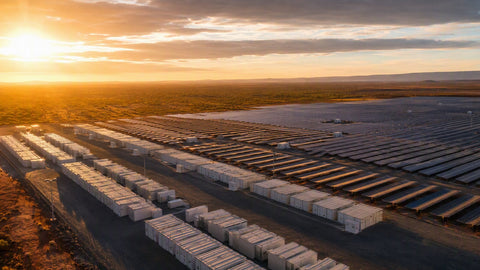
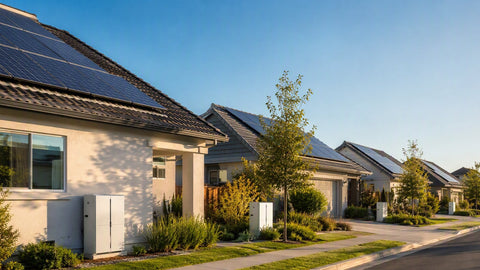
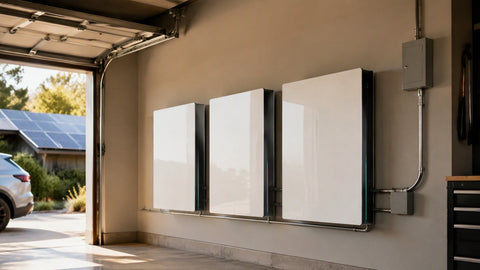
At the heart of every commercial solar-plus-storage system sits a single piece of equipment that determines whether the entire investment succeeds or fails: the hybrid inverter. The ATESS HPS100-US-220D is a 100kW, three-phase, all-in-one hybrid inverter purpose-built for the American market, with a 220V Delta output configuration and an integrated isolation transformer that eliminates the need for external step-up or step-down hardware. This isn't a universal inverter with a voltage setting changed in software; it's a purpose-engineered product for U.S. commercial and industrial energy systems.
This comprehensive guide covers everything you need to evaluate this inverter for your next project: ATESS's track record, technical specifications, scalability up to 800kW, programmable working modes, safety and compliance features, installation considerations, ideal applications, and the financial case for commercial solar-plus-storage.
Key Takeaways
- 100kW rated output (110kVA): Three-phase hybrid inverter with up to 97.6% conversion efficiency
- True all-in-one design: Inverter, charge controller, transfer switch, and isolation transformer in a single enclosure
- ≤10ms seamless transfer: Grid-to-backup switchover so fast most electronics won't register it
- Scalable to 800kW: Parallel up to 8 units with hot-backup redundancy, no single point of failure
- 220V Delta / 60Hz: Factory-configured for U.S. commercial electrical standards with integrated transformer
- Programmable modes: Self-consumption, peak shaving, backup, zero-export, and generator coordination
- 110kWp solar input: Dual MPPT channels (480V to 800V DC) for flexible PV array design
In This Guide:
- Who Is ATESS, and Why Trust Their Equipment?
- What Is the ATESS HPS100-US-220D?
- Key Technical Specifications & Performance
- Scalability: Growing With Your Business (Up to 800kW)
- Programmable Working Modes: Intelligence Built In
- Physical Design & Installation Considerations
- Ideal Applications & Use Cases
- Why a U.S.-Specific Model Matters
- The Financial Case for the HPS100-US-220D
- Safety, Protection & Compliance
- Why Buy From PES Supply?
- Frequently Asked Questions
Before evaluating any piece of hardware at this scale, it's worth understanding the manufacturer standing behind it. ATESS Power Technology Co., Ltd. was founded in 2017 as a subsidiary of the Growatt Group, one of the world's most recognized names in solar inverter technology. Headquartered in Shenzhen, China, ATESS operates from the GROWATT-ATESS Industrial Park, a purpose-built facility spanning over 31,600 square meters with 25,000 square meters dedicated to advanced manufacturing.
🏆 ATESS by the Numbers
Founded: 2017 (Growatt Group subsidiary) | Headquarters: Shenzhen, China | Global reach: 85+ countries across 5 continents
Facility: 31,600+ m² (25,000 m² manufacturing) | R&D team: 100+ engineers | R&D investment: ~15% of annual revenue
Product range: 5kW residential hybrid to megawatt-scale utility systems + EV charging solutions
The HPS series is the flagship line within ATESS's commercial hybrid inverter family, designed specifically for medium-to-large C&I applications and earning a reputation for reliability, flexibility, and seamless grid integration. The HPS100-US-220D variant takes all of that established engineering and adapts it specifically for American electrical standards and requirements.
The model designation tells the story: HPS100 refers to the 100kW power rating within the HPS platform, US indicates it's built to American specifications, 220 denotes the output voltage class, and the D suffix signifies the Delta winding configuration of the integrated transformer.
What sets this unit apart from many competing products is its truly all-in-one design. The HPS100-US-220D integrates four critical components into a single enclosure:
| Integrated Component | What It Replaces | Benefit |
|---|---|---|
| Hybrid Inverter | Standalone inverter cabinet | DC-to-AC conversion with 97.6% efficiency |
| Charge Controller | External charge management hardware | Coordinated solar + battery + grid management |
| Transfer Switch | External automatic transfer switch (ATS) | ≤10ms seamless grid-to-backup switchover |
| Isolation Transformer | External step-up/step-down transformer | 220V Delta output matched to U.S. commercial distribution, no external transformer needed |
For installers, this dramatically simplifies design and wiring. For building owners, it means fewer points of failure and a single vendor for support. The integrated transformer is particularly significant for U.S. deployments, many commercial buildings use 120/208V or 277/480V distribution with Delta configuration as a standard wiring topology. By including the transformer internally, ATESS eliminates external hardware that would otherwise add cost, complexity, and physical footprint.
Power Output & Efficiency
The inverter delivers a rated output of 100kW with an apparent power rating of 110kVA across three phases, suitable for large commercial loads. ATESS reports conversion efficiency up to 97.6%, meaning very little energy is lost during DC-to-AC conversion. For a commercial facility consuming hundreds of kWh per day, even a single percentage point of improved efficiency translates to thousands of dollars in savings over the system lifetime.
Solar PV Input
The HPS100-US-220D supports a maximum PV input of 110kWp with an MPPT voltage range of 480V to 800V DC. The unit features dual MPPT channels, each operating independently, allowing two separate solar strings with different orientations or tilt angles to run at their optimal power points simultaneously. This flexibility is especially valuable on complex commercial rooftops where shading or structural constraints prevent uniform panel orientation.
Battery Integration
Battery compatibility is defined by a voltage range of 400V to 600V DC. The system supports high-power charging and discharging for rapid response to load changes and utility signals. The inverter communicates with compatible battery management systems via RS485 and CAN bus protocols, ensuring coordinated and safe operation. This voltage range provides meaningful flexibility in selecting battery modules and configuring storage to match budget and performance requirements.
Seamless Transfer & Backup
One of the most critical performance metrics for any hybrid inverter is transfer time between grid-tied and off-grid modes. The HPS100-US-220D achieves this switchover in ≤10 milliseconds. Most electronic equipment won't even register a 10ms interruption, making this inverter suitable for backing up sensitive loads such as data centers, medical equipment, telecommunications infrastructure, and manufacturing control systems.
| Specification | Detail |
|---|---|
| Model | HPS100-US-220D |
| Rated Output Power | 100 kW |
| Apparent Power | 110 kVA |
| Max Conversion Efficiency | 97.6% |
| AC Output | 220V Delta, Three-Phase, 60Hz |
| Max PV Input | 110 kWp |
| MPPT Channels | 2 (independent) |
| MPPT Voltage Range | 480V to 800V DC |
| Battery Voltage Range | 400V to 600V DC |
| Battery Communication | RS485, CAN bus |
| Transfer Time (Grid ↔ Backup) | ≤10 ms |
| Parallel Capability | Up to 8 units (800 kW) with hot-backup redundancy |
| Overload Capability | 110% for 10 min / 120% for 1 min |
| Integrated Transformer | Yes, 220V Delta winding |
| Enclosure | Type 1 |
| Dimensions (W × H × D) | ~1200 mm × 1900 mm × 800 mm |
| Weight | ~923 kg |
| Operating Temperature | -25°C to +55°C |
| Cooling | Forced-air |
| Noise Level | <65 dB(A) at 1 meter |
| Surge Protection | Built-in Type II (lightning/surge) |
| Display | Touchscreen LCD |
| Communication | RS485, CAN bus (BMS/SCADA integration) |
| Generator Support | Remote start/stop via dry contact outputs |
| Working Modes | Self-consumption, peak shaving, backup, zero-export |
Perhaps the most forward-looking feature of the HPS100-US-220D is its ability to scale. The HPS platform supports paralleling of up to 8 units, meaning a single-inverter 100kW system can grow to 800kW without replacing the original equipment.
This is achieved through a hot-backup parallel architecture: if one inverter in a parallel configuration experiences a fault, the remaining units seamlessly assume the load. There is no single point of failure and no downtime.
💡 Pro Tip: Plan for Growth, Not Just Today
A manufacturer that starts with 100kW to offset peak demand charges today can add a second unit when they expand production next year, and a third when they add a new building the year after that. Each expansion leverages the existing infrastructure, wiring, and monitoring, avoiding the waste and cost of a complete system replacement. Our engineering team can help you design a phased deployment strategy. Get started with Quote My System →
The HPS100-US-220D isn't a passive piece of equipment. It's an intelligent energy management platform that can be programmed to operate in multiple modes depending on your facility's priorities and utility rate structure.
| Mode | How It Works | Best For |
|---|---|---|
| Self-Consumption | Prioritizes on-site solar use, stores excess in batteries, draws from grid only when necessary | Facilities with high daytime energy usage seeking maximum utility bill reduction |
| Peak Shaving | Discharges stored battery energy during anticipated demand peaks to flatten the load profile | Commercial accounts where demand charges represent 30 to 50% of the electricity bill |
| Backup | Keeps batteries charged and ready for emergency power during grid outages (≤10ms switchover) | Regions prone to severe weather, aging grid infrastructure, or rolling blackouts |
| Zero-Export | Ensures power flows only to connected loads, never back-feeds into the grid | Jurisdictions or interconnection agreements that prohibit grid export |
| Generator Coordination | Auto-starts backup generator via dry contacts, coordinates output with battery + solar, manages transition back to grid | Extended outage scenarios, remote sites, or facilities requiring multi-source redundancy |
⚡ Peak Shaving: The Hidden ROI Driver
For many commercial utility customers, demand charges based on the highest 15-minute peak draw during a billing cycle can represent 30 to 50% of the total electricity bill. A single spike, starting heavy machinery, running HVAC during a heat wave, can add hundreds or thousands of dollars to a monthly bill. The HPS100-US-220D's peak-shaving mode directly addresses this by discharging stored energy during anticipated peaks, effectively flattening the load profile and reducing recorded peak demand.
The HPS100-US-220D is housed in a Type 1 enclosure measuring approximately 1200mm × 1900mm × 800mm and weighing around 923 kg. While substantial, this is compact relative to what it replaces, without the integrated transformer, a comparable installation would require a separate inverter cabinet, standalone isolation transformer, additional wiring, and dedicated floor space for each component. The all-in-one design consolidates everything into a single footprint.
The front-panel touchscreen LCD simplifies parameter setting, system monitoring, and maintenance, technicians can view real-time performance data, adjust operating modes, and diagnose issues directly without a separate laptop or monitoring device. For remote monitoring, the inverter communicates via RS485 and CAN bus and integrates into broader building management or SCADA systems.
| Parameter | Detail | Practical Impact |
|---|---|---|
| Operating Temp Range | -25°C to +55°C | Suitable from upper Midwest winters to desert Southwest summers |
| Noise Level | <65 dB(A) at 1m | Roughly equivalent to normal conversation, no issues in most commercial environments |
| Cooling | Forced-air | Ensure adequate ventilation clearance per manufacturer guidelines |
| Footprint | ~1200mm × 800mm floor space | Single cabinet replaces 3 to 4 separate components, significant space savings |
The 100kW hybrid architecture, seamless backup, and parallel scalability to 800kW make the HPS100-US-220D suitable for a wide range of commercial and industrial deployments.
| Application | Why the HPS100-US-220D Fits |
|---|---|
| Manufacturing Facilities | Peak shaving + seamless backup protects production lines from costly downtime and demand charge spikes |
| Warehouses & Distribution Centers | Large flat roofs + high PV input (110kWp) offsets lighting, climate control, and material handling loads |
| Retail Centers & Office Buildings | Programmable modes optimize energy costs while providing tenants uninterrupted power during grid events |
| Agricultural Operations | Remote/unreliable grid areas can operate partially or fully off-grid with solar + battery + generator coordination |
| Campus Deployments (Universities, Hospitals, Military) | Scalable parallel architecture (up to 800kW) serves distributed loads across multiple buildings that grow over time |
| Data Centers & Telecom | ≤10ms transfer time ensures sensitive equipment never registers an interruption during grid events |
| Mining & Remote Industrial Sites | Replace expensive diesel generation with solar-plus-storage microgrids anchored by one or more HPS100 units |
The American electrical market has unique requirements that differ significantly from European, Asian, or African standards. Voltage levels, frequency specifications, wiring topologies, safety certifications, and interconnection standards all vary by country, and sometimes by state. A hybrid inverter that performs flawlessly in a European 400V/50Hz environment may be entirely unsuitable for a U.S. 208V or 480V/60Hz installation without significant modification.
⚠️ Don't Assume "Universal" Means U.S.-Ready
The HPS100-US-220D is factory-configured for U.S. electrical standards from the ground up: 220V Delta output aligned with common commercial distribution, integrated transformer handling voltage conversion internally, and 60Hz frequency matching the U.S. grid. This isn't a universal inverter with a software toggle; it's a purpose-engineered product for the American market. That means fewer compatibility issues, smoother permitting, and greater confidence that the equipment will perform as specified over its entire operational life.
Energy decisions at commercial scale are ultimately financial decisions. The HPS100-US-220D makes a strong economic argument through multiple compounding savings channels.
| Savings Channel | How It Works |
|---|---|
| Demand Charge Reduction | Peak-shaving mode discharges batteries during highest 15-minute peaks, flattening load profile and reducing the recorded peak that sets demand charges |
| Time-of-Use Arbitrage | Charge batteries during low-cost off-peak hours or from surplus solar; discharge during expensive on-peak windows |
| Federal ITC (30%) | Qualifying commercial solar+storage systems claim a significant tax credit on the total installed cost |
| MACRS Accelerated Depreciation | Depreciate the system cost over 5 years, front-loading the tax benefit and accelerating ROI |
| State/Local Incentives | Many states offer additional rebates, performance-based incentives, and property tax exemptions |
| Reduced Installation Cost | All-in-one design eliminates external transformer, separate ATS, and additional wiring, fewer components, less labor |
💡 Pro Tip: Typical Payback Period
When you combine ongoing energy savings with federal ITC, MACRS depreciation, and state incentives, the effective payback period on an HPS100-US-220D-based system can be as short as 4 to 6 years depending on local utility rates and consumption patterns. After payback, the system continues generating savings for the remainder of its 15 to 25-year operational life. Our team can help you model the economics for your specific facility contact us for a consultation.
The HPS100-US-220D incorporates comprehensive protection features designed to safeguard both the equipment and the facility it serves.
| Protection Feature | Detail |
|---|---|
| Type II Surge Protection | Built-in lightning and surge protection defends against transient voltage spikes |
| Overload Capability | 110% for 10 minutes / 120% for 1 minute, safety margin for motor starts and transient surges |
| Zero-Export Function | Ensures all power flows only to facility loads, never back-feeds into the grid during outages, protecting utility workers |
| Anti-Islanding Protection | Compliant with IEEE 1547 and relevant U.S. interconnection standards |
| Hot-Backup Redundancy | In parallel configurations, remaining units seamlessly assume load if one unit faults, no single point of failure |
PES Supply is an authorized distributor of ATESS products in the United States, every unit sold comes with full manufacturer warranty backing and technical support. We offer more than just equipment: our team provides product guidance, system design consultation, and ongoing support to ensure your energy investment delivers the returns you expect.
| What We Offer | Details |
|---|---|
| Authorized ATESS Distributor | Full manufacturer warranty + technical support on every unit |
| Fast Processing & Delivery | Orders processed within 72 hours, delivery within 5 to 7 business days on most orders |
| 30-Day Free Returns | No restocking or processing fees within 30 days |
| In-House Design Support | System design consultation, string sizing, inverter selection, and parallel configuration guidance |
| Complete System Solutions | Solar panels, batteries, racking, generators, EV chargers, single-source procurement across 50,000+ SKUs and 169 authorized brands |
| PowerLink Installer Portal | Streamlined ordering, account management, and volume pricing for EPCs and installers |
Related Products

ATESS Delta US standard 220V 100KW hybrid inverter (included tranformer) - ATESS HPS100-US-220D
View
Ready to Power Your Facility With the HPS100-US-220D?
Whether you're quoting a single 100kW inverter for a standalone project or specifying a multi-unit parallel system for a large commercial campus, our team is equipped to help you configure the right solution.
Quote My System Schedule a ConsultationWhat does the "220D" in HPS100-US-220D mean?
The "220" denotes the 220V output voltage class, and "D" indicates the Delta winding configuration of the integrated isolation transformer. This configuration aligns with standard U.S. commercial electrical distribution topologies, eliminating the need for an external step-up or step-down transformer.
How many HPS100-US-220D units can I parallel together?
Up to 8 units can be paralleled for a maximum system capacity of 800kW. The hot-backup parallel architecture means if one unit faults, the remaining units seamlessly assume the load, no single point of failure and no downtime. Each expansion leverages existing infrastructure and monitoring.
How fast is the grid-to-backup transfer?
The HPS100-US-220D achieves a seamless transfer in ≤10 milliseconds, fast enough that most electronic equipment won't register the interruption. This makes it suitable for backing up sensitive loads including data centers, medical equipment, telecom infrastructure, and manufacturing control systems.
What batteries are compatible with the HPS100-US-220D?
The inverter supports batteries within a 400V to 600V DC voltage range and communicates via RS485 and CAN bus protocols. This range provides flexibility in selecting battery modules from various manufacturers. Contact our team at PES Supply for a list of tested and recommended battery pairings, we carry a full range of energy storage systems.
Can the HPS100-US-220D work with a backup diesel generator?
Yes. The inverter supports remote control of diesel generators via dry contact outputs. In extended outage scenarios, the HPS100-US-220D can automatically start a backup generator, coordinate its output with the battery and solar systems, and manage the transition back to normal grid operation when power is restored, all without manual intervention.
Does the HPS100-US-220D support zero-export mode?
Yes. The zero-export function ensures that all generated and stored power flows only to the facility's loads, it never back-feeds into the grid. This is a critical compliance feature for U.S. installations where interconnection agreements or utility requirements prohibit grid export under certain conditions, and it protects the safety of utility personnel working on the lines.
Does PES Supply ship the HPS100-US-220D nationwide?
Yes. We ship commercial energy equipment to projects across the United States via freight carrier. Orders are typically processed within 72 hours with delivery in 5 to 7 business days. Contact our team at (888) 876-0007 for shipping quotes, lead times, and volume pricing on multi-unit orders.
What if I need help designing my commercial solar-plus-storage system?
Our in-house engineering team provides technical support for system design, including inverter selection, battery pairing, parallel configuration, string sizing, and code compliance review. Call us at (888) 876-0007, email [email protected], or use our Quote My System tool to get started.
About PES Supply
PES Supply is a nationwide electrical supply distributor offering premium Tier 1 solar panels inverters standby generators battery storage systems, and related electrical equipment. With a catalog of 50,000+ SKUs across 169 authorized brands and nationwide LTL freight delivery from our Louisville, Kentucky supply house, we deliver turnkey power solutions with live support and fast nationwide delivery.
📍 Location: 1507 Portland Ave, Louisville, KY, United States 📞 Phone: (888) 876-0007 | (502) 790-0600 📧 Email: [email protected] 🌐 Website: www.portlandiaelectric.supply
Article: The Complete Guide to the ATESS HPS100-US-220D 100kW Hybrid Inverter With Integrated Transformer
Category: Inverters / Commercial Solar + Storage Equipment
Last Updated: February 2026
Related Articles: G
Related Resources:
- Best Solar Panels 2026 — Buyer's Guide
- EG4 vs Tesla Powerwall
- Qcells vs Trina vs JA
- Solar Inverter Buyer's Guide
- Solar Battery Buyer's Guide
- 5kW Solar Kit
- 10kW Solar + Battery Kit
- Off-Grid Cabin Kit
- EG4 Batteries
- Qcells Solar Panels
- Trina Solar
- JA Solar
- REC Solar
- Mission Solar
- Sol-Ark Inverters
- SolarEdge Inverters
- Generac PWRcell
Calculate how much storage you need with our battery sizing calculator.
Check solar incentives available in your state.
Use our free solar system calculator to size your array.
Check out our Solar Panel Comparison Tool. Check out our Inverter Sizing Calculator.
Calculate your solar payback and 25-year savings with our Solar ROI Calculator. Follow our complete DIY solar installation guide for step-by-step instructions. Keep your system running at peak performance with our Solar Maintenance Guide.
Related Resources
- Solar System Calculator
- Battery Sizing Calculator
- Solar Panel Comparison Tool
- Inverter Sizing Calculator
- Solar ROI Calculator
- Solar Installation Guide
- Solar Maintenance Guide
- Solar Permitting Guide
- Battery Installation Guide
- NEC Code Compliance Guide
- Solar Panel Mounting Guide
- Grounding & Bonding Guide
- Solar Incentives by State
- Pro Account — Wholesale Pricing
- PowerLink Network — Contractor Program
Field notes from our C&I design team
- The 220D's integrated transformer is the feature I bring up first with contractors: one cabinet instead of four means one freight line, one pad, one conduit schedule — and one phone call if anything ever goes wrong.
- On a warehouse peak-shaving job we set the discharge trigger against the customer's compressor signature and watched a 40kW demand peak flatten to under 10kW the first billing cycle. The mode programming is genuinely usable, not brochureware.
- I tell every customer the same thing about this platform: plan the parallel buildout on day one even if you only buy one unit. The difference between a clean 800kW expansion and a switchgear rebuild is whether the day-one one-line reserved the bus capacity.
The integrated transformer delivers 220V Delta three-phase directly, which makes the output-circuit arithmetic straightforward — and at 100kW continuous, the numbers are large enough that switchgear and conduit decisions belong early in the design, not at rough-in. Following the NEC 690.8/705 continuous-duty convention:
| Step | Reference | Calculation | Result |
|---|---|---|---|
| Full-load output current | P = V × I × √3 | 100,000W ÷ (220V × 1.732) | 262.4A |
| Continuous-duty adjustment | NEC 690.8(B) / 705.28 convention | 262.4A × 1.25 | 328.0A |
| Overcurrent device | NEC 240.6(B) | Next standard size | 350A, 3-pole |
| Output conductors (75°C copper) | NEC 310.16 | Ampacity ≥ 328A | 500 kcmil Cu (380A) — single set per phase suffices |
| Equipment grounding conductor | NEC 250.122 | Sized to 350A OCPD | 3 AWG Cu minimum |
| Paralleled 8-unit buildout (800kW) | Same method | 2,099A × 1.25 = 2,624A | 3,000A-class switchboard — reserve the bus at day-one design |
Because the transformer is internal, there is no external secondary to protect — the output circuit runs straight to the facility distribution. Confirm with your engineer of record how the Delta secondary grounding is handled at the first disconnect, and verify that the facility's existing 208V/220V Delta loads and any high-leg configuration are documented on the one-line before release. The companion HPS100-US-220Y (Wye) variant covers services that need a Wye secondary instead.
What does the HPS100-US-220D model name mean?
HPS100 is the 100kW rating within ATESS's HPS hybrid platform, US marks the North American specification, 220 is the output voltage class, and D denotes the Delta winding of the integrated isolation transformer. The sibling HPS100-US-220Y provides a Wye secondary for services that require it.
What is actually integrated inside the cabinet?
Four functions ship in one enclosure: the hybrid inverter (97.6% peak efficiency), the solar charge-control stage with two independent MPPTs, an automatic transfer function with ≤10ms switchover, and the 220V Delta isolation transformer. It replaces what would otherwise be three or four separate pieces of equipment with their own pads, conduit, and failure points.
How many units can run in parallel?
Up to eight units for 800kW of combined capacity, with hot-backup redundancy so remaining units carry the load if one faults. Design the day-one switchgear and one-line for the intended final buildout to avoid a service rebuild during expansion.
Which batteries are compatible?
The unit communicates with battery management systems over RS485 and CAN bus across a 400–600V DC battery window. Compatible lithium banks from major manufacturers are supported; confirm the specific battery's CAN protocol profile with PES Supply or ATESS application engineering before pairing.
Does it really transfer to backup in 10 milliseconds?
The transfer specification is ≤10ms grid-to-backup switchover, fast enough that most sensitive loads — servers, controls, medical equipment on the protected bus — never register an interruption. Loads with extreme ride-through sensitivity should still be evaluated individually against their own power-supply hold-up specs.
What working modes can be programmed?
Self-consumption, peak shaving, backup, zero-export, and generator-coordination modes are all programmable, including remote generator start/stop via dry contacts. Mode programming is where most of the project's financial performance is won, so budget real commissioning time for it.
PES Supply carries a catalog of 50,000+ SKUs from 169 authorized brands. One PO, one invoice, every trade covered.
Need help sizing? Our team can calculate loads, select equipment, and source everything from one PO.
Call (502) 790-0600