2024: The Year Machine Learning Stopped Being a Slide in the Pitch Deck
For years, "AI in solar" was a conference-panel topic — interesting, aspirational, and safely in the future. In 2024 it became operational plumbing. The shift wasn't a single breakthrough; it was the convergence of cheap sensors, mature computer vision, and a labor market that made traditional truck-roll O&M economics untenable. Portfolio sizes kept growing while technician headcounts didn't, and the operators who thrived were the ones who let algorithms do the watching. This article documents what actually changed in solar operations and maintenance during 2024 — with the real performance numbers, costs, and failure modes — for installers, asset managers, and system owners deciding where these tools fit their own fleets.
I spent part of that year helping a commercial client untangle a 2 MW portfolio's alert queue: 4,000 alarms a month from a legacy monitoring system, 97% of them noise. The AI-based platform that replaced it cut actionable tickets to about sixty a month — and caught a failing central inverter three weeks before it would have taken 400 kW offline during the production season. That experience shaped everything below.
1. AI-Powered Fault Detection: From Alarm Floods to Actionable Tickets
Traditional SCADA and monitoring systems alarm on thresholds — voltage high, current low, communication lost. The result at portfolio scale is alert fatigue: thousands of notifications, most triggered by weather, grid events, or sensor hiccups, with real faults buried in the pile. Machine-learning fault detection inverts the approach: models trained on millions of operating hours learn each plant's normal behavioral envelope and flag deviations from itself, not from a static threshold. The practical results reported across the industry in 2024:
| Metric | Legacy Threshold Alarms | ML-Based Detection (2024 platforms) |
|---|---|---|
| Alerts per MW per month | 1,500–2,500 | 30–80 |
| False-positive rate | 90–97% | 10–25% |
| Median time-to-detect string faults | 7–30 days (often manual review) | < 24 hours |
| Inverter failure early warning | Usually none — detected at failure | 1–4 weeks of degradation signature |
| Analyst hours per 100 MW per month | 40–80 | 8–15 |
The compounding benefit is detection speed. A string fault that sits unnoticed for three weeks on a 500 kW commercial array loses roughly 600–900 kWh — small money. The same fault pattern across a 50-site portfolio, every month, is five figures a year. ML detection converts that silent leakage into a ticket queue a single technician can clear.
2. Drone Inspections Went From Annual Luxury to Routine Tool
Thermal drone inspections — infrared flyovers that spot hot cells, failed bypass diodes, and connector faults as heat signatures — existed for years as a premium service. In 2024, two things changed: drone and sensor costs fell hard, and computer-vision analysis matured enough to auto-classify anomalies against module-level maps. The economics flipped:
| Inspection Method | Cost per MW | Coverage Quality | Turnaround |
|---|---|---|---|
| Manual I-V curve tracing (sampled) | $800–$1,500 | 5–10% of modules, sampled | Days to weeks |
| Handheld thermal (walked rows) | $400–$700 | High but slow; human-error prone | Days |
| Drone + AI classification (2024) | $100–$250 | 100% of modules, geo-tagged | 24–72 hours |
Full-population inspection changes the maintenance philosophy. Sampled inspection tells you a site is "probably fine"; complete thermal mapping tells you module 7 in string 14 has a hot bypass diode, with a pin on the layout map and a severity grade. Warranty claims that once required argument now arrive with photographic and thermal evidence attached — manufacturers process them faster when the data is unimpeachable.
3. Predictive Maintenance Replaced the Calendar
Scheduled maintenance answers the wrong question. "Has it been six months?" matters less than "is anything actually degrading?" Predictive platforms fuse operating telemetry — thermal trends, vibration on trackers, inverter efficiency drift, string current signatures — into remaining-useful-life estimates, and route technicians to the assets that need them. The 2024 results across large portfolios:
| O&M Approach | Annual Cost per MW | Unplanned Downtime | Availability |
|---|---|---|---|
| Reactive (fix what breaks) | $8,000–$12,000 | High; failures cascade | 96–97.5% |
| Calendar-based preventive | $11,000–$16,000 | Moderate | 98–99% |
| ML predictive (2024 fleets) | $9,000–$13,000 | Low; failures pre-empted | 99.3–99.7% |
The availability line is where the money hides. On a 1 MW commercial site producing 1.5 GWh a year at a $0.12 blended value, each availability point is worth roughly $1,800 annually — the jump from reactive to predictive pays for the software subscription several times over before counting labor savings.
4. String-Level and Module-Level Monitoring Became the Default
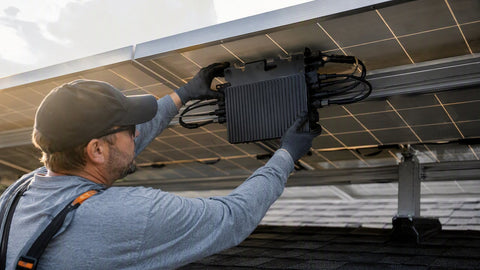
Granularity kept marching downward through the system hierarchy. Where 2019 monitoring reported plant-level totals, 2024's new installations overwhelmingly shipped with string-level current sensing at minimum, and module-level power electronics — microinverters and optimizers — pushed per-panel data into the mainstream residential and small-commercial market. The operational consequence: the spatial resolution of a fault alert matched the spatial resolution of the repair. "Site 4 is underperforming" became "string 7, modules 3 through 5, shading or soiling pattern consistent with vegetation growth." Owners of module-level systems have had this visibility for years via platforms tied to microinverter fleets and optimizer systems; 2024 was the year the rest of the market caught up.
5. Autonomous Cleaning Robots Found Their Niche
Soiling — dust, pollen, agricultural residue, bird fouling — costs arrays 3–7% of annual production in average climates and 15%+ in arid, dusty ones. Robotic cleaning crossed the viability line in 2024 for utility-scale and large flat commercial arrays: waterless brush robots running nightly routes, scheduled by soiling sensors rather than calendars. The math at scale:
| Cleaning Strategy | Annual Cost (10 MW site) | Soiling Loss After | Net Position vs. No Cleaning |
|---|---|---|---|
| No cleaning (4% avg loss) | $0 | ≈ 4% | −$72,000/yr lost production @ $0.12 |
| Manual crews, 4×/yr | $60,000–$90,000 | ≈ 2% | +$36,000 recovered − cost ≈ breakeven to −$54k |
| Robotic fleet, nightly (waterless) | $35,000–$55,000 amortized | ≈ 1% | +$54,000 recovered − cost ≈ +$0–$19k |
Robots don't win everywhere — rain-washed climates with light soiling still favor nature — but on dusty sites the nightly-clean regime holds soiling losses near 1% without water trucks or crew logistics, and the robots double as inspection platforms, logging module-condition imagery on every pass.
6. ML Energy Forecasting Grew Teeth
Forecasting moved from a scheduling convenience to a revenue-critical function as more markets exposed solar to real-time pricing and imbalance penalties. The 2024 generation of forecasting models — blending satellite nowcasting, sky-camera imagery, numerical weather prediction, and plant-specific learning — delivered measurable accuracy gains:
| Forecast Horizon | Persistence/Statistical Baseline (MAE) | 2024 ML Models (MAE) | Why It Pays |
|---|---|---|---|
| Intra-hour (5–60 min) | 8–12% | 3–5% | Battery dispatch, ramp control |
| Day-ahead | 10–15% | 5–8% | Market bidding, imbalance penalties |
| Week-ahead | 15–20% | 9–13% | Maintenance scheduling, crew routing |
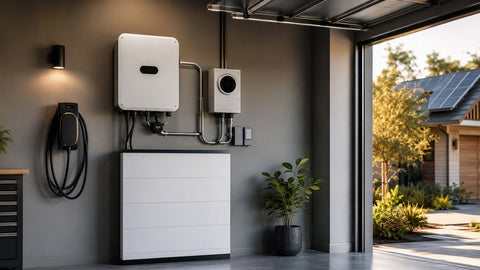
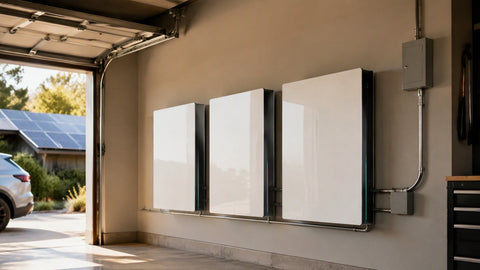
Pair forecasting with storage and the value multiplies: a battery that knows tomorrow's curve buys cheap, sells dear, and reserves capacity for the evening ramp. The residential version of this logic is already shipping in hybrid systems — see the hybrid inverter collection and our energy storage explainer for how grid-integrated batteries put forecast-driven dispatch in a garage-sized package.
What This Means for Installers and Asset Managers
Four operational shifts follow directly. First, monitoring granularity is now a sales specification, not an upsell: systems specified with string-level or module-level data retain more value and cost less to service. Second, service contracts should be priced against ML-filtered alert volumes — a portfolio generating sixty actionable tickets a month is a different staffing model than one generating four thousand alarms. Third, drone thermography belongs in the annual budget of every commercial array above a few hundred kW; at $100–$250 per MW it is the cheapest warranty-protection money in the industry. Fourth, data hygiene became an asset-management competency: consistent naming, clean metadata, and intact time series are what make the models work — garbage in, gospel out is the failure mode of 2024's tools.
Questions to Ask Before Buying an "AI O&M" Platform
The label is cheap; the capability is not. Ask vendors: What is your false-positive rate on a portfolio my size, and will you contract to it? Which fault classes does the model actually detect — string outages, soiling, diode failures, inverter drift, tracker stalls — and which does it merely alarm on? How does the platform handle my specific inverter and datalogger mix? What does the alert-to-work-order pipeline look like, and does it integrate with the CMMS we already use? And the killer question: show me a case where the system caught a failure before production loss. Vendors with real models have that story with dates and serial numbers; vendors with dashboards have screenshots.
The Road Ahead
The direction set in 2024 only steepens from here: module-level data becoming universal, inspection drones folding into robotic cleaning fleets, forecasting fusing with battery dispatch until the distinction between "monitoring" and "trading" blurs. For owners, the strategic takeaway is to buy hardware ecosystems with open data access — the analytics layer evolves annually, and the system that traps your data traps your options. Spec the sensors, keep the data, and let the software keep improving around a physical plant that will stand for twenty-five years. That combination — durable hardware, open data, learning software — is what transformed solar O&M in 2024, and it is the template every new installation should be built on.
The Data Infrastructure Nobody Budgeted
Every capability described above rides on an unglamorous foundation: sensors, dataloggers, and communications links that actually stay alive. The operators who got full value from 2024's AI tools were the ones who had invested in the plumbing — revenue-grade metering, string-level sensing, and redundant communications through hardware like the monitoring and communications gear and gateway devices that move plant data to the cloud reliably. The failure pattern I see in the field is consistent: a six-figure analytics subscription fed by a $40 cellular modem on its last legs, dropping data precisely during the grid events that matter most. Budget the data layer at 1–2% of project capex and maintain it like production equipment, because that is what it has become.
What Machine Learning Did Not Change
Intellectual honesty requires the counter-list. ML did not eliminate truck rolls — it made them rarer and better targeted, but a failed bypass diode still requires a human on a ladder. It did not make bad hardware good; analytics detect failures, they don't prevent poor connectors from failing. It did not remove the need for design quality — the fleets with the cleanest data and fewest anomalies are still the ones that were engineered and installed correctly on day one. And it did not make O&M optional: vegetation grows, torque relaxes, and rodents remain committed to chewing PV wire regardless of how sophisticated the monitoring stack is. I remain convinced the winning formula is boring: quality components from the panel and inverter catalogs, installed to spec, watched by good software, serviced on evidence rather than calendar.
Cybersecurity: The 2024 Wake-Up Call
As fleets became more connected, they became more exposed, and 2024 brought the industry's security conversation from IT departments into O&M budgets. Distributed energy resources are grid-critical infrastructure in aggregate, and several high-profile vulnerability disclosures pushed operators toward network segmentation, certificate-based device authentication, and vendor patch SLAs as procurement requirements. For buyers, the new due-diligence questions: Does the monitoring vendor publish a security policy and patch cadence? Can devices be isolated on a dedicated network segment? What happens to plant control if the cloud service disappears? The answers belong in the O&M contract next to the availability guarantee.
Building the Internal Business Case
For asset managers pitching these tools upstairs, the arithmetic that worked in 2024 was simple: availability gain plus labor reduction minus subscription cost. A 20 MW portfolio gaining 1.5 availability points recovers roughly 450 MWh a year — $54,000 at $0.12 — and cutting one full-time-equivalent of alert-triage labor is worth another $60,000–$85,000. Against platform costs that run well under $1,000 per MW-year at portfolio scale, the return is not close. The softer benefits — warranty claims that sail through with thermal evidence, failures caught in the cheap stage, investors who receive credible availability reporting — stack on top for free. I have yet to see an honest model where the numbers fail; I have seen several where the platform was bought and never properly configured, which is an implementation failure, not a technology one.
The Vendor Landscape Consolidated
2024 also reshuffled who provides these capabilities. Pure-play monitoring vendors absorbed analytics startups, inverter manufacturers bundled fleet analytics into their platforms, and independent O&M providers rebranded around "data-driven" service. For buyers, consolidation cuts both ways: integration improved — one platform covering monitoring, analytics, and work orders genuinely reduces swivel-chair labor — but switching costs rose, making the data-portability question at contract time more important than the demo. Insist on exported, timestamped, plant-level data in an open format as a contract term. The platform is a subscription; the data is yours.
Case Numbers: A 2024 Portfolio Retrofit
One concrete example ties the threads together. A 14-site, 6.5 MW commercial portfolio moved from threshold-based monitoring to an ML platform in early 2024, added annual drone thermography, and shifted two sites to predictive service routing. Twelve-month results: actionable tickets fell from about 1,100 per quarter to 190; three inverter failures were pre-empted during planned truck rolls instead of emergency calls; the thermal survey caught 47 module-level defects, 39 of which were processed as warranty claims with drone imagery attached; and fleet availability rose from 97.9% to 99.4% — roughly 160 MWh of recovered annual production, worth about $19,000 at their blended rates, before counting labor savings and warranty recoveries. The tooling cost less than a third of the recovered value. Owners evaluating their own portfolio's upside can model production value with the ROI calculator and extend asset life with the practices in our system maintenance guide.
Getting Started at Any Scale
The entry point scales down gracefully. A single commercial rooftop needs, at minimum: module- or string-level monitoring with alerts someone actually reads, an annual drone thermal pass, and a service relationship priced against evidence-based dispatch. A residential system needs the monitoring that ships with modern module-level electronics, configured with alerts turned on — the single most skipped step in the industry. And every owner, at every scale, benefits from the same discipline 2024's best operators demonstrated: instruments before opinions, data before dispatch, and maintenance money spent where the evidence points. The machines got smarter; the winning behavior stayed human.
Standards and Interoperability: The Quiet Enabler
None of 2024's analytics progress works without interoperability, and the industry's boring plumbing standards carried the load: Modbus and SunSpec profiles for device telemetry, IEC 61850 at the utility scale, and API layers that let third-party platforms ingest mixed fleets. The operational lesson for buyers is to specify open protocols at procurement. A fleet locked into a proprietary data format is a fleet whose analytics options end with the vendor's roadmap; a fleet publishing standard telemetry can adopt whatever the market invents next. This is the same open-ecosystem argument that applies at residential scale — choose monitoring platforms that export your data, because the software will change several times over a 25-year plant life.
Looking Past 2024
The trajectory set during 2024 continued to steepen afterward: module-level data pushed toward universality, inspection and cleaning robots began merging into single platforms, and forecasting fused with battery dispatch until "monitoring" and "energy trading" started describing the same software. The durable lesson of the transformation year is not any single tool — it is the operating philosophy: instrument thoroughly, keep your data open and portable, and spend maintenance money where evidence points instead of where the calendar says. Operators who adopted that philosophy in 2024 compounded their advantage every quarter since; those who waited are now buying the same tools against a larger backlog of undiagnosed losses.
The Workforce Shift Behind the Software
One underappreciated 2024 change was human: the solar technician role began migrating from wrench-first to data-first. Crews that once drove routes on a schedule now dispatched against anomaly tickets with severity grades, photos, and predicted parts lists attached. Training programs followed — thermography interpretation, string-tracing diagnostics, and platform administration entered curricula that used to stop at torque specs and lockout procedures. For asset owners, the practical effect is a service visit that arrives knowing what is broken; for the workforce, it is a trade that got more skilled and more durable at the same time. The operators who invested in that training early reported an unexpected bonus: retention improved, because technicians given diagnostic tools and interesting problems stopped leaving for the construction trades — a workforce dividend no vendor brochure mentioned. The industry entered 2024 short of technicians; it exited with a more compelling career to sell, which may prove to be the year's most consequential outcome of all for an industry built on field labor and kept honest by field results.
Frequently Asked Questions
How did AI change solar maintenance in 2024? Machine-learning platforms replaced static threshold alarms with behavioral models, cutting false positives from 90%+ down to 10–25%, detecting inverter failures weeks early, and reducing analyst workloads by 70–80% across large portfolios.
Are drone inspections worth it for commercial solar arrays? Yes. Drone thermography with AI classification costs $100–$250 per MW, inspects 100% of modules with geo-tagged anomaly maps, and typically pays for itself by catching faults and strengthening warranty claims.
What is predictive maintenance for solar plants? It replaces calendar-based service with remaining-useful-life estimates from telemetry — thermal trends, efficiency drift, current signatures — routing technicians to assets that are actually degrading and lifting fleet availability above 99.3%.
How much production does soiling cost a solar array? Typically 3–7% annually in average climates and over 15% in arid, dusty regions. Robotic nightly cleaning on large sites holds losses near 1% at costs that beat manual crews.
Do small residential systems benefit from these tools? Yes, through module-level electronics: microinverter and optimizer platforms deliver per-panel monitoring and automated alerts that bring portfolio-grade visibility to a single rooftop.
How accurate is AI solar production forecasting? 2024-generation ML models achieve roughly 3–5% mean absolute error intra-hour and 5–8% day-ahead — accuracy that directly converts to battery dispatch revenue and avoided imbalance penalties.