The Advantages of Solar Power, Measured Instead of Marketed
Solar power's advantages are usually described in adjectives — clean, green, sustainable. Adjectives don't pay mortgages. What follows is the same list expressed in numbers: the dollars, kilowatt-hours, percentage points, and code sections that explain why solar has grown from a niche technology into the majority of new electrical generation capacity added in the United States year after year. Whether you are a homeowner staring at a $220 monthly bill or a facilities manager defending a capital request to a CFO, the advantages below are the ones that survive spreadsheet scrutiny.

Advantage 1: Electricity at a Locked-In Price for 25 Years
Every other way of buying electricity rents it. Rates rise — the long-run national average is roughly 2.5–3% annual escalation, with many utilities running hotter in recent years. Solar inverts the arrangement: you pay once for the equipment, then harvest energy at a fixed, known cost for the life of the asset. That cost is the levelized cost of energy (LCOE), and the math is simple division:
| System Type | Net Cost After 30% ITC | 25-Yr Production (per kW installed) | Effective LCOE |
|---|---|---|---|
| Residential rooftop ($2.75/W gross) | ≈ $1.93/W | ≈ 32,000 kWh @ 4.5 PSH, 0.80 PR, 0.5%/yr degradation | ≈ $0.060/kWh |
| Commercial 100 kW ($2.10/W gross) | ≈ $0.90–$1.05/W after ITC + MACRS | ≈ 30,800 kWh | ≈ $0.032/kWh |
| Utility-scale reference | ≈ $0.70–$0.90/W net | ≈ 34,000 kWh (tracking, high-PSH) | ≈ $0.023/kWh |
Hold those numbers against retail rates of $0.12–$0.30/kWh depending on state and the advantage is not subtle: solar energy produced on your own property costs a third to a fifth of what the utility charges — and the gap widens every time the utility files a rate case. Run your own address through the solar ROI calculator to see your local version of this table.
Advantage 2: Energy Independence With Real Teeth
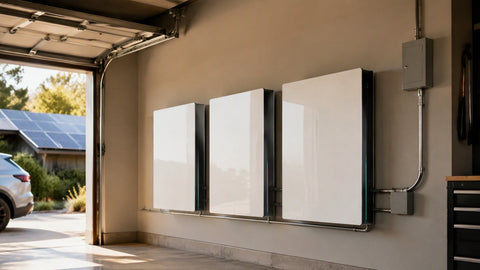
Independence comes in layers. At the grid-tie level, solar shrinks your exposure to rate hikes, fuel-cost adjustments, and the policy whims of distant regulators — every kilowatt-hour you produce is one you never buy. Add storage and the meaning deepens: a battery-backed home keeps refrigeration, medical devices, communications, and lighting alive through outages that darkened the neighborhood. At the national scale, the same logic applies to fuel imports and supply chains — sunlight requires no tanker, no pipeline, and no refinery. For homeowners weighing the backup layer, our battery backup runtime calculator and the energy storage catalog turn the abstract comfort into concrete hours of runtime.
Advantage 3: Equipment That Keeps Getting Better and Cheaper
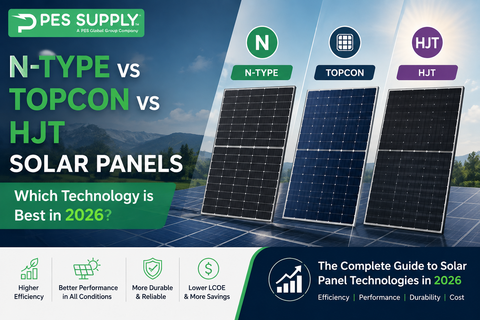
Few technologies improve on solar's curve. Module prices have fallen roughly 90% since 2010 while nameplate efficiency climbed from the mid-teens to the low twenties, and the current n-type generation delivers slower degradation on top:
| Era | Typical Module Wattage (residential format) | Module Efficiency | Warranted Degradation |
|---|---|---|---|
| 2010 | ≈ 220 W | ≈ 14% | ≈ 0.7%/yr after year 1 |
| 2016 | ≈ 290 W | ≈ 17% | ≈ 0.6%/yr |
| 2021 | ≈ 400 W | ≈ 20% | ≈ 0.5%/yr |
| 2026 (n-type TOPCon/HJT) | ≈ 450–590 W | ≈ 22–23.5% | ≈ 0.4%/yr, 30-yr warranties common |
The practical consequence: an array bought today produces more energy per square foot, degrades more slowly, and carries longer warranties than anything available five years ago — at a lower real price. Browse the current generation in the n-type panel collection and the full solar panel catalog.
Advantage 4: Emissions Reduction You Can Audit
Solar's environmental case is strongest when stated in arithmetic rather than imagery. Against the US grid average of roughly 0.85 lb of CO₂ per kWh:
| Array Size | Annual Production (4.5 PSH, 0.80 PR) | Annual CO₂ Avoided | 25-Year CO₂ Avoided | Equivalent |
|---|---|---|---|---|
| 7.2 kW residential | ≈ 9,460 kWh | ≈ 3.6 t | ≈ 83 t | ≈ 18 car-years |
| 13.9 kW large residential | ≈ 18,300 kWh | ≈ 7.0 t | ≈ 161 t | ≈ 35 car-years |
| 100 kW commercial | ≈ 131,400 kWh | ≈ 51 t | ≈ 1,160 t | ≈ 252 car-years |
Equivalents use the standard 4.6 metric tons of CO₂ per passenger car per year. These figures feed household carbon accounting, corporate ESG reports, and — increasingly — the regulatory compliance frameworks spreading through state energy codes. Unlike purchased offsets, rooftop generation is verifiable: the monitoring platform logs every kilowatt-hour with a timestamp.
Advantage 5: Near-Zero Maintenance on a 25-Year Asset
A photovoltaic array has no moving parts. There is nothing to lubricate, nothing to tune, nothing that wears against anything else. The entire maintenance regime for a residential system is a twice-yearly visual inspection, an occasional rinse where soiling demands it, and a monitoring alert setup that watches production for you. Inverters — the one component with fans and capacitors — may need a service event around years 8–15; modules routinely outlive their 25–30-year warranties. Compare that to any other machine in your life that produces value daily: your car, your HVAC, your refrigerator all demand more attention and deliver shorter lives. The system maintenance guide covers the full checklist in one page.
Advantage 6: Scalability From Cabin to Campus
Solar is modular in a way no other generation technology matches. The same module technology powers a 400W cabin kit, a 7 kW home, a 100 kW warehouse, and a 500 MW utility plant — only the count changes. That modularity means buyers can start at the size today's budget allows and expand later, provided the design anticipates growth: oversize the conduit, leave rail space, choose inverter platforms with headroom. We stock the whole ladder, from off-grid cabin kits through grid-tie packages to commercial-scale equipment, and the design discipline is identical at every rung.
Advantage 7: Property Value and Marketability
Owned solar systems increase home value — the consistent finding across major resale studies is a premium in the range of 3–4%, and commercial buildings capitalize reduced operating expenses directly into appraised value at the property's cap rate. The mechanism is intuitive: a buyer is purchasing lower monthly costs for the next two decades. Two conditions protect the premium: the system must be owned (leases complicate transactions), and documentation must transfer — permits, warranties, and production history. Keep the folder.
Advantage 8: A Hedging Instrument for Households and Businesses
Financially, a solar array behaves like a long-dated, inflation-protected bond that pays its coupon in kilowatt-hours. The returns don't correlate with stock markets, interest-rate cycles, or fuel commodities — they correlate with sunshine, which has the most stable long-run statistics of any input in the economy. For businesses, that diversification shows up as operating-cost stability that competitors without solar don't have; for households, it is one of the only investments that pays you back in a bill you were going to owe anyway.
Where Portlandia Electric Supply Fits
We are a wholesale distributor, which shapes what we can do for you: component-level expertise, real inventory, and quotes built from the equipment up rather than the financing down. Contractors source full job packages — modules, inverters, racking, wire, and balance-of-system — with compatibility verified before the truck leaves. Owner-builders get the same bill-of-material discipline plus honest guidance about which parts of the job genuinely need a licensed electrician. And when the question is whether a project pencils at all, we would rather run the numbers with you and say "not yet" than sell you a system that underperforms its promise. Start with the system size calculator, then bring us the result.
The Incentive Stack: Where the First 30–50% Comes From

Solar's economics rest partly on policy, so understand the stack before you bank on it:
| Incentive Layer | Typical Value | Who Qualifies |
|---|---|---|
| Federal Investment Tax Credit (residential) | 30% of installed cost | Homeowners with tax liability |
| Federal ITC (commercial) + bonus adders | 30–40%+ of installed cost | Businesses; domestic content/energy community bonuses |
| MACRS accelerated depreciation | ≈ 20–25% of cost (bracket-dependent) | Commercial owners |
| State rebates / tax credits | $0–$5,000+ or % of cost | Varies by state |
| Utility rebates / performance incentives | $0–$0.30/W or per-kWh payments | Varies by utility |
| Net metering / net billing | Export credit, retail to avoided-cost | Utility-territory dependent |
Two disciplines protect you here: confirm every incentive's current status at signing time — programs open, close, and exhaust funding — and never let a quote blur the line between a tax credit (real dollars at filing) and a rebate (real dollars from a program). The state incentives page tracks the current landscape, and your CPA owns the tax-liability question, not your installer.
The Disadvantages, Honestly Stated
A champion guide earns trust by stating the other side plainly. Solar's real limitations: it produces nothing at night and less in winter, so grid connection or storage remains part of the equation; the capital cost, even after incentives, is a five-figure commitment that cheap financing can obscure but not erase; production depends on your specific site — shade, orientation, and local weather rule the outcome; and policy risk is real — net metering rules have been revised downward in several major markets, which is why self-consumption design and storage-readiness matter more each year. None of these negate the advantages above; all of them argue for honest modeling over brochure projections. I have sat across from homeowners sold 110% offset systems in net-billing territories where exports earn three cents — the array worked perfectly and the economics still disappointed, because somebody modeled the sale instead of the tariff.
Solar and the Grid: Duck Curves, Storage, and Virtual Power Plants
At the grid scale, solar's midday flood of power has reshaped wholesale markets — the famous duck curve of net demand. That shift is why storage has become solar's fastest-growing companion: batteries move noon energy into the expensive evening ramp, and aggregated fleets of home batteries now participate in grid services as virtual power plants, paying owners for the privilege. For the individual buyer, the practical reading is simple: pairing solar with storage increasingly earns its keep twice — once in resilience, once in arbitrage or program revenue. Our energy storage explainer covers the technology layer, and the 10 kWh battery class is the residential workhorse size.
How to Evaluate a Solar Quote in Fifteen Minutes
Every quote reduces to five numbers, and asking for them exposes quality instantly. One: DC system size in kW and the specific module model. Two: year-one production estimate in kWh with the performance ratio and shading assumptions stated — anything without a stated PR is a guess wearing a tie. Three: gross cost per watt, so you can compare bids apples-to-apples. Four: incentive assumptions itemized — which credit, which rebate, whose tax bracket. Five: degradation-adjusted lifetime production, because year twenty-five matters as much as year one. A bidder who answers all five crisply has done the engineering; one who answers with adjectives has done the marketing. Get component-level transparency any time from our catalog — complete kits show exactly what a system contains and what each part costs.
A Regional Reality Check: Solar in Cloudy Country
Because we operate from the Pacific Northwest, let me answer the region's favorite objection directly. Portland and Seattle average 3.5–4.0 peak sun hours — less than Phoenix, more than Germany, which built one of the world's great solar fleets on that resource. Our long summer days partially compensate for gray winters: June production in the Willamette Valley rivals much sunnier regions because sixteen-hour days stack up kilowatt-hours. A 7 kW array here still produces roughly 8,000 kWh a year and pays back in a timeframe that pencils against our rising utility rates. I have told hundreds of local customers the same thing: wait for a sunny climate and you will wait forever; size for your actual climate and the system works fine — I have the monitoring data from my own customers' arrays to prove it.
The Economic Multiplier Beyond Your Own Meter
Cost Savings from Solar Adoption
Solar spending circulates differently than utility spending. A dollar sent to the utility mostly leaves the region; a dollar spent on a solar installation pays local designers, electricians, rack crews, and distributors, with only the equipment cost leaving town. The industry has consistently ranked among the fastest-growing employment categories in energy, and the jobs are the kind communities want — skilled, licensed, and impossible to offshore. For business owners, there is a quieter multiplier: the savings solar generates are recurring free cash flow that gets reinvested in payroll, inventory, and expansion. The array on the roof is a cost center that retired itself.
Storage Completes the Picture
Every solar advantage in this article sharpens when batteries join the system. Self-consumption rises toward 100% in net-billing territories where exports pay poorly. Outage protection turns a bill-saving asset into a resilience asset. Demand-charge management unlocks for commercial tariff payers. And time-of-use arbitrage — storing noon power, deploying it at 7 PM peak rates — adds a revenue layer that pure solar cannot touch. Storage is not required for solar to pencil; it is the upgrade that makes an already-strong investment defensive against every policy change a utility commission can dream up. Start with the battery and storage catalog, size it with the battery sizing guide, and sanity-check runtime with the backup runtime calculator.
Four Myths, Four Numbers
"Solar doesn't work in cold climates." Cells run more efficiently cold — voltage rises as temperature drops, and a clear 25°F day out-produces a hot 95°F day at equal irradiance. "Panels need constant cleaning." Monitoring data from thousands of arrays shows rain-washed climates lose 1–3% annually to soiling; clean when data says so, not when a salesman says so. "Solar is too expensive without subsidies." Unsubsidized utility-scale solar's LCOE undercuts new fossil generation in most of the country — incentives accelerate adoption, they don't create the economics. "The technology will be obsolete in five years." I have been hearing this one for fifteen years from people who paid retail electricity rates the entire time; a 2026 array at 22% efficiency keeps producing for three decades regardless of what 2031's panels can do.
Solar and the Fully Electric Home
The advantages multiply again when solar meets electrification. Every gas appliance swapped for electric — heat pump, induction range, heat-pump water heater, EV — converts a fuel bill into a load your array can serve at 4–6 cents per kWh. A household that electrifies fully and covers it with solar has effectively capped its energy costs across heating, cooking, hot water, and driving for decades. The sequencing matters: install solar sized for the loads you plan to have, not just the loads you have today. An EV adds roughly 2,500–4,000 kWh a year; a heat pump in a heating climate adds 3,000–6,000. Size the array for the destination, and the system calculator handles the arithmetic.
A Note on Timing
Every advantage listed in this article has been true for years and gets modestly better each year — which creates the perpetual temptation to wait for next year's panels and next year's prices. The fifteen-year verdict on waiting is unambiguous: those who installed at 2015's "high" prices have already recovered their capital, while the waiters paid retail the entire decade. The right question was never "will solar get cheaper?" — it always did — but "does it pay at today's price?" For most properties in most states, today's answer is yes by a wide enough margin that waiting is the expensive option. And the timing question has a second half that favors acting: incentives and net-metering terms are richest for the systems installed before the next rule revision, not after it. Early adopters keep getting grandfathered; patient adopters keep getting the new, less generous terms — a pattern that has repeated across enough states now to qualify as policy law rather than coincidence.
The Policy Horizon: What to Watch
Solar economics ride partly on policy, so owners should track three moving pieces. Net-metering rules: export compensation is being restructured state by state, generally toward lower export rates — which strengthens the case for self-consumption design and storage rather than weakening the case for solar. Tax policy: the federal credit's level and transferability rules are set by statute and have proven durable across administrations, but bonus adders and direct-pay mechanics evolve. Interconnection queues: at the utility-scale level, connection backlogs are the industry's binding constraint, which matters to distributed buyers only indirectly — through equipment pricing and installer capacity. None of these shift the fundamentals on your roof: the fuel is free, the asset lasts decades, and the retail rate it displaces keeps climbing. Buyers who internalize those three constants find the policy headlines interesting rather than frightening — which is exactly the right relationship to have with them, in this industry or any other.
Frequently Asked Questions
What is the biggest advantage of solar power? Economics: solar locks in electricity at 3–6 cents per kWh for 25 years against utility rates of 12–30 cents that rise annually. The environmental benefits ride along on an investment that already pays for itself.
Do solar panels work in cloudy or northern climates? Yes. Panels produce from daylight, not just direct sun — diffuse light on overcast days still generates meaningful power. The Pacific Northwest averages about 3.8 peak sun hours daily; a 7.2 kW array there produces roughly 8,000 kWh a year.
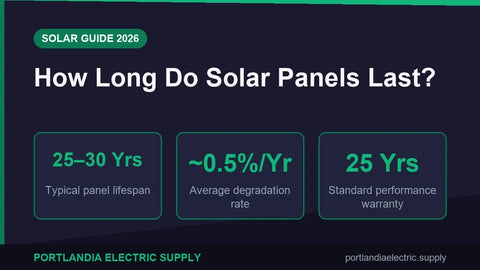
How long do solar panels last? Modern modules carry 25–30 year performance warranties and routinely operate beyond them. Expect about 87–90% of original output at year 25 with current n-type technology.
What happens to solar panels at the end of their life? Modules are roughly 80% glass and aluminum by weight — both conventionally recyclable — and dedicated PV recycling programs recover silicon, silver, and copper. Recycling infrastructure is scaling alongside the first large wave of retirements.
Does solar work during a power outage? Standard grid-tie systems shut down with the grid for line-worker safety. Battery-backed systems with appropriate transfer equipment keep critical loads powered through outages.
How much can solar actually save on a typical home? A 7–10 kW system offsetting most of a $150–$250 monthly bill saves $1,800–$3,000 a year at current rates — $45,000–$90,000 over 25 years at 3% rate escalation, against a net post-credit cost typically under $20,000.