What a 7 kW Ground-Mounted Grid-Tie System Actually Is
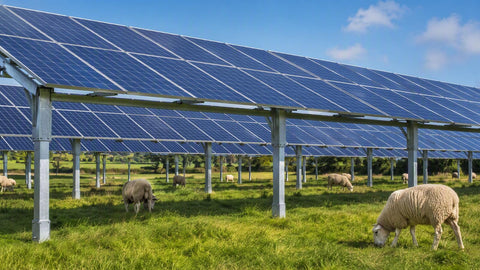
A 7 kW ground-mounted grid-tie system is sixteen to eighteen solar modules on a steel rack anchored to the earth behind your house or barn, wired through a string inverter, and connected to your main panel so every kilowatt-hour offsets power you would otherwise buy. No batteries, no generator, no off-grid complexity — the utility acts as your storage, crediting you for surplus production and selling you power back at night. It is the simplest, cheapest, most reliable configuration in residential solar, and ground mounting makes it better: perfect tilt, perfect azimuth, natural airflow cooling the modules, and no roof penetrations to leak at year nine.

I have put in ground mounts on clay, on sand, on glacial till that fought every pier, and the constant across all of them is this: the array that sits exactly where the sun wants it will out-produce a compromised roof array every single month of its twenty-five-year life. If you have the space — a 7 kW array needs roughly 400–450 square feet of unshaded ground — this is the configuration to beat.
System Anatomy: The Bill of Materials
Here is the complete major-component list for a reference 7.2 kW build — sixteen 450W modules feeding a single 6–7.6 kW string inverter:
| Component | Specification | Quantity | Typical Cost Range |
|---|---|---|---|
| PV modules, 450W class | 144 half-cell mono or TOPCon, 25-yr warranty | 16 | $2,700–$3,500 |
| String inverter | 6.0–7.6 kW, 2 MPPT inputs, 600V max | 1 | $1,300–$2,100 |
| Ground-mount racking | Steel or aluminum, 2 rows × 8, 30° tilt | 1 kit | $1,700–$2,600 |
| Foundations | Driven posts or concrete piers, site-specific | 6–8 | $600–$1,400 |
| PV wire, ground wire, MC4 | 10 AWG PV wire, 6 AWG GEC | Job lot | $350–$600 |
| Combiner/disconnects, breakers | DC disconnect, 2P AC breakers, surge protection | 1 set | $400–$800 |
| Trenching & conduit (30 ft example) | 1.25 in. PVC, 24 in. burial typical | 1 run | $400–$900 |
| Hardware total | $7,450–$11,900 |
The Role of String Inverters in a Grid-Tie System
Benefits of String Inverters for Large Solar Systems
Source modules from the 400–459W panel collection or step up to the 460–549W class to shrink the array footprint; string inverters live in our string inverter catalog, and complete ground rack kits are under solar mounting systems. For a pre-engineered ground-mount kit at larger scale, look at the PES Sinclair Sky Rack ground-mount kit — the racking logic scales down cleanly to residential.
String Sizing: The NEC 690.7 Cold-Weather Math
String design is where ground-mount projects die at inspection. Module open-circuit voltage rises as temperature falls, and NEC 690.7 requires the maximum system voltage to be calculated at the site's record low using Table 690.7(A) correction factors — 1.10 at 0°C, 1.14 at −10°C, 1.18 at −20°C. The ceiling is 600V DC for one- and two-family dwellings. Here is the worked math for a 450W module with a 39.2V Voc at a site with a −10°C design minimum:
| Modules in Series | String Voc @ STC | Corrected Voc @ −10°C (×1.14) | Compliant Under 600V? |
|---|---|---|---|
| 8 | 313.6 V | 357.5 V | Yes — comfortable margin |
| 10 | 392.0 V | 446.9 V | Yes |
| 12 | 470.4 V | 536.3 V | Yes — watch inverter MPPT window |
| 13 | 509.6 V | 580.9 V | Yes — last safe count |
| 14 | 548.8 V | 625.6 V | No — exceeds 600V |
| 16 | 627.2 V | 715.0 V | No — fails inspection |
The answer for our 7.2 kW build is two strings of eight — 3.6 kW per string, 357V worst-case, landing squarely in the inverter's MPPT operating window with voltage margin to spare. At a warmer site with a 0°C design minimum (factor 1.10), thirteen modules would survive the math, but two balanced strings of eight give the inverter's dual MPPTs one string each — better shade isolation and simpler wire pulls. Our solar wire and cable guide covers the conductor side of this design.
Conductor and Breaker Sizing: NEC 690.8
NEC 690.8 treats PV source circuits as continuous loads and applies two 125% factors: circuit current is Isc × 1.25, and conductors/overcurrent devices must carry that current × 1.25 again — effectively Isc × 1.56. With a module Isc of 14.6A:
| Design Step | Calculation | Result |
|---|---|---|
| Maximum circuit current | 14.6 A × 1.25 | 18.25 A |
| Minimum conductor/OCPD rating | 14.6 A × 1.56 | 22.8 A |
| Standard breaker (NEC 240.6) | Next size up from 22.8 A | 25 A |
| Conductor, 75°C THHN/PV wire | 10 AWG rated 35 A (NEC 310.16) | 10 AWG — ample margin |
| Grounding electrode conductor | Per NEC 250.66 for this service class | 6 AWG copper |
On the AC side, a 7.2 kW inverter outputs 30A at 240V; the 125% continuous factor demands 37.5A conductors and lands on a 40A two-pole breaker with 8 AWG copper (50A at 75°C per NEC 310.16). Cross-check every step against the NEC wire ampacity chart and the NEC 690 disconnect guide — your AHJ will.
Why Ground-Mounted Beats the Roof (When You Have the Land)
Roof arrays inherit the roof's compromises: whatever pitch the builder chose, whatever azimuth the lot forced, whatever shade the neighbor's fir tree throws at 4 PM. A ground mount chooses everything. Set tilt at your latitude (roughly 30–40° across most of the continental US) and azimuth at true south and you gain 10–25% annual production over a poorly oriented roof plane — free energy from geometry. Modules also run cooler with open airflow underneath, and every 10°C of cell temperature costs roughly 3.5–4% of instantaneous power through the temperature coefficient. Maintenance becomes a ground-level task: snow removal with a soft brush, visual inspections without a ladder, and no roof tear-off bill when the shingles need replacing. The honest counterpoints are land use, trenching cost, foundations, and occasionally a pickier permitting conversation about setbacks.
Production Expectations by Region
Using the reference 7.2 kW array at an 0.80 performance ratio, annual production scales with your peak sun hours (PSH):
| Region Type | Avg. PSH | Annual Production (7.2 kW × PSH × 365 × 0.80) | Value @ $0.16/kWh |
|---|---|---|---|
| Pacific Northwest | 3.8 | ≈ 7,990 kWh | ≈ $1,280 |
| Mid-Atlantic / Midwest | 4.2 | ≈ 8,830 kWh | ≈ $1,415 |
| California (inland) | 5.5 | ≈ 11,570 kWh | ≈ $1,850 |
| Southwest desert | 6.5 | ≈ 13,670 kWh | ≈ $2,190 |
A 7.2 kW system covers the majority of an average American home's ~10,500 kWh annual consumption in most regions — run your own roof-line numbers through the solar system size calculator and sanity-check bill coverage against twelve months of utility statements, not one good month.
Installation Sequence: How the Build Actually Goes
A ground-mount build runs in a predictable order, and knowing it keeps you ahead of the inspector rather than behind:
- Site layout and shading study. Stake the array footprint, check southern horizon obstructions at winter solstice angles, confirm setbacks with the AHJ before you order steel.
- Permits and interconnection application. Submit both early — the utility clock is usually the long pole.
- Foundations. Driven posts where soil allows; concrete piers where it doesn't. Get the row spacing right to the racking drawing, not the tape measure's mood.
- Racking assembly. Rails squared and torqued to spec; this is the skeleton everything else trusts for 25 years.
- Module mounting and string wiring. Two strings of eight, home runs in UV-rated conduit, MC4 connections made with the correct die — not pliers.
- Trench and wire pull. PV conductors and ground to the inverter location; burial depth per NEC 300.5 (typically 24 in. for PVC under residential driveways, 18 in. otherwise — confirm locally).
- Inverter, disconnects, and panel tie-in. AC disconnect within sight of the inverter, dedicated 40A two-pole breaker, labeling per NEC 690.54 and 705.10.
- Inspection, utility witness, permission to operate. Then — and only then — flip it on.
Installation Process: Step-by-Step
I've watched DIY builders save $4,000 on labor and lose $6,000 to a failed inspection plus a re-trench. The two steps that fail most often are foundation squareness and labeling — both cheap to get right and expensive to redo. The solar installation guide expands each step, and grounding specifics are in our grounding and bonding guide.
Costs, Incentives, and Payback
Conclusion: A Smart Investment in Clean Energy
Turnkey installed pricing for a 7.2 kW ground-mount typically runs $2.60–$3.40 per watt — $18,700–$24,500 — reflecting the foundation and trenching premium over rooftop work. The 30% federal Investment Tax Credit (residential clean energy credit) pulls $5,600–$7,350 back at tax time, and state or utility rebates stack in many territories. Against the production table above, simple payback lands between 9 and 13 years in average-rate states and 6 to 8 years where rates exceed 22 cents — then the array produces essentially free power for another fifteen-plus years. Model your exact scenario on the ROI calculator and check the state incentives page for programs in your zip code.
Who This System Fits — and Who It Doesn't

The 7 kW ground-mount sweet spot: a homeowner with a quarter-acre or more of usable, unshaded land, a 200A service panel with breaker space, annual consumption between 8,000 and 12,000 kWh, and a roof that is old, shaded, or wrong-facing. Poor fits: small urban lots, heavy tree cover the owner won't trim, and homes with consumption far above 12,000 kWh where 7 kW is a partial solution at best — size up to the larger grid-tie packages instead. If your situation leans toward backup power rather than bill reduction, the honest pivot is a hybrid inverter plus storage from the battery collection — a grid-tie string system alone goes dark in an outage.
Tilt and Orientation: Free Energy From Geometry
Ground mounting's superpower is choosing your angles. Annual production peaks when tilt roughly equals latitude, but the trade-off table below shows how forgiving the curve is — and how much a seasonal adjustment or a winter-biased tilt buys you:
| Tilt Strategy (40°N example) | Annual Yield vs. Optimum | Winter Yield vs. Optimum | Notes |
|---|---|---|---|
| Latitude tilt (40°) | 100% | 100% | Best all-around fixed choice |
| Latitude − 15° (25°) | ≈ 97% | ≈ 88% | Summer-biased; sheds snow poorly |
| Latitude + 15° (55°) | ≈ 95% | ≈ 110% | Winter-biased; great for battery systems |
| Seasonally adjustable | ≈ 104–106% | ≈ 112% | Two adjustments/yr; cheap on ground racks |
| Azimuth 30° off south | ≈ 97–98% | ≈ 96% | Cosine losses are gentle |
| Azimuth 90° off (due east/west) | ≈ 82–84% | ≈ 80% | Sometimes still right for load-matching |
The adjustable-tilt row deserves attention: loosening eight bolts twice a year for a 4–6% production gain is the cheapest kilowatt-hours in the industry, and it is only possible because the array is standing in your yard instead of bolted to your shingles. On our 7.2 kW reference in a 4.2 PSH climate, that adjustment habit is worth roughly 350–530 kWh a year — $55–$85 annually at sixteen cents, every year, forever.
Wind, Snow, and the Structural Conversation
A ground array is a sail the building code takes seriously. Racking systems carry engineering certifications for specific wind speeds (commonly 90–140 mph ratings) and ground snow loads (typically 20–70 psf classes), and your permit set must match the rack's letter to your site's design values. Three field rules I enforce on every build: never mix foundation depths on the same rack line; never skip the racking manufacturer's torque spec on module clamps — under-torqued modules walk in wind, over-torqued frames crack glass at the edge; and in snow country, set the bottom edge of the lower row at least 18–24 inches above grade so shed snow has somewhere to go without burying the modules that made it. The racking systems guide compares the major rack families, and hardware is stocked under racking hardware kits.
Monitoring and Maintenance: The Quiet Years
After commissioning, a grid-tie string system asks for almost nothing — which is exactly why small problems hide. Set the inverter's monitoring to alert on: daily production below a weather-adjusted threshold, either MPPT string reading zero, and ground-fault or arc-fault events. Walk the array twice a year looking for loose clamps, chewed wire (rodents adore PV insulation — specify proper PV wire and consider critter guard), vegetation creeping into the shade line, and post-winter foundation heave. Clean only when monitoring proves soiling losses above 3–4%; in most rain-washed climates, nature does the job for free. A 7 kW string inverter will likely need one fan or capacitor service event somewhere in years 8–15 — a $150–$400 repair, not a system crisis. Keep a printed one-line diagram and the string map taped inside the inverter enclosure door; the technician you hire in year twelve will silently thank you.
Five Ground-Mount Mistakes I Keep Seeing
First, placing the array where it is convenient rather than where it is sunny — forty extra feet of trench is a few hundred dollars; permanent shade is a permanent payback extension. Second, undersizing conduit: pulling four 10 AWG conductors through 3/4-inch conduit around two bends is a afternoon you will remember unhappily; run 1.25-inch and sleep well. Third, ignoring frost heave in foundation design north of the freeze line. Fourth, forgetting the AC disconnect sight-distance rule and paying for a return inspection trip. Fifth, skipping the shading study because "the trees are small" — trees grow at roughly a foot a year, and a 7 kW array is a 25-year asset. Model the year-fifteen shade line, not the year-one shade line.
Choosing the String Inverter: What the Spec Sheet Hides
Four numbers on a string inverter datasheet decide whether your 7 kW build sings or sulks. First, MPPT count: two independent trackers let each of your two strings find its own maximum — non-negotiable for split-orientation or unevenly shaded arrays. Second, the MPPT voltage window: your 357V worst-case string must sit comfortably inside it at both hot low-voltage and cold high-voltage extremes. Third, maximum output current versus your planned breaker — the inverter's 30–32A output must land on conductors sized at 125%, as calculated above. Fourth, the warranty and the service network behind it: ten years is the floor, twenty-five is available, and a US-based support line that answers matters more at year nine than a tenth of a percent of CEC efficiency ever will. Compare options in our string inverter catalog; established brands like SMA, Fronius, and SolarEdge all field proven units in this class, and I have personally stood in a snowy yard at 7 AM watching a quality inverter wake up a frozen array without complaint while a bargain unit down the road was still throwing ground-fault codes.
String Inverter vs. Microinverter on a Ground Mount
Why String Inverters Are Still the Industry Standard
Because ground mounts usually enjoy clean, uniform sun, the string inverter is the natural choice — one MPPT per string, one wall-mounted box to service, and the lowest cost per watt of any architecture. Microinverters earn their premium on ground mounts only in specific cases: heavy shading from nearby structures, plans to expand the array in mismatched stages, or an owner who simply wants per-module data. For the standard two-string 7 kW build in open field, I recommend the string inverter nine times out of ten and put the $1,500–$2,500 saved toward better foundations — the component that actually determines whether your array is still straight in year twenty.
Battery-Ready Design: Cheap Now, Expensive Later
Even if storage is not in this year's budget, three decisions made today keep the door open. Install the inverter where a future battery can land within ten cable-feet. Pull an empty spare conduit in the trench while it is open — the trench is the expensive part, conduit is pennies per foot. And choose an inverter ecosystem with a documented AC-coupled storage path, so adding a 10 kWh-class battery later is a wiring project, not a forklift replacement of your inverter. Owners who skip these steps typically pay $1,500–$3,000 in retrofit friction when the battery day finally comes — and it comes for most of them within five years, as energy storage pricing keeps falling.
The Resale and Legacy Angle
A ground-mounted array is a visible, documented home improvement at sale time — appraisers and buyers can see it, the permits and production history transfer with it, and owned systems consistently support sale premiums in the 3–4% range across major resale studies. Unlike a roof array, the ground mount carries no roof-warranty entanglements and no removal anxiety when the shingles eventually need replacement. Keep the commissioning report, the permit sign-offs, and annual production exports in a single folder; that folder converts "the seller says it works great" into proof, and proof is what appraisers can actually capitalize.
The Warranty Stack, Read Properly
A 7 kW system carries four distinct warranties that buyers routinely conflate: the module product warranty (workmanship, typically 15–25 years on current panels), the module performance warranty (output retention, 25–30 years), the inverter warranty (10 years standard, extendable to 20–25), and the installer's workmanship warranty covering roof or rack penetrations and wiring (1–10 years, installer-dependent). Each has a different claimant process, and only one of them — the installer's — covers the labor to diagnose and swap a failed component under the others. Get all four in writing at contract, with the labor question answered explicitly.
Frequently Asked Questions
How much does a 7 kW ground-mounted solar system cost? Hardware runs roughly $7,500–$12,000; turnkey installed pricing is typically $2.60–$3.40 per watt, or $18,700–$24,500 before the 30% federal tax credit and any state incentives.
How many panels are in a 7 kW system? Sixteen 450W modules make 7.2 kW; thirteen 550W modules make 7.15 kW. Panel wattage sets the count — the target is the DC array size, not a magic panel number.
How much land does a 7 kW ground mount need? Plan for 400–450 square feet of array footprint — a two-row rack roughly 34 feet wide by 13 feet deep — plus unshaded southern exposure and trench access to the house.
How much power does a 7 kW system produce per day? Daily production equals 7.2 kW × local peak sun hours × 0.80: about 22 kWh in the Pacific Northwest, 30 kWh in the Midwest, and up to 37 kWh in the desert Southwest.
Can I install a ground-mount system myself? Mechanically, yes — many owners build the rack and set modules themselves. Electrically, most jurisdictions require licensed work for the panel tie-in and utility interconnection, and DIY mistakes at the string-sizing or grounding steps are the most common inspection failures we see.
Do ground-mounted panels produce more than roof panels? Typically 10–25% more, because tilt and azimuth are optimized and open airflow keeps cells cooler. The gain easily covers the racking premium when land is available.