In today's competitive landscape, businesses across every industry face mounting pressure to reduce operating costs, improve sustainability credentials, and future-proof their operations against rising energy prices. Commercial solar energy offers a powerful solution that addresses all three challenges simultaneously-delivering substantial cost savings while demonstrating genuine environmental leadership.
With energy costs continuing to rise and solar technology becoming more affordable and efficient than ever, the question is no longer whether your business should go solar-it's how soon you can start saving. This comprehensive guide walks you through everything you need to know about adopting solar energy for your business, from the financial benefits and available incentives to ROI calculations and the installation process.
🏢 Key Takeaways
- Cost Reduction: Commercial solar systems typically reduce electricity bills by 50-75%, translating to thousands in annual savings
- Tax Benefits: The 30% federal ITC plus MACRS depreciation can cover 50-70% of your total solar investment
- Fast Payback: Most commercial systems achieve payback in 3-5 years, then generate pure profit for 20+ more years
- 25-Year ROI: A typical 100 kW commercial system can generate $500,000+ in net savings over its lifetime
- Property Value: Commercial properties with solar see an average 3-4% increase in property value
In This Guide:
- Why Solar Is the Smartest Investment for Your Business
- Key Benefits of Commercial Solar Energy
- Financial Incentives & Tax Benefits
- Return on Investment: What the Numbers Look Like
- Commercial Solar System Sizing & Costs
- How Commercial Solar Installation Works
- Industries That Benefit Most from Solar
- Financing Options for Business Solar
- Frequently Asked Questions
Commercial solar has emerged as one of the highest-ROI capital investments a business can make. Unlike most business expenses that simply disappear, solar generates returns for 25-30+ years while simultaneously reducing one of your largest recurring costs. Here's why forward-thinking businesses are making the switch:
| Business Challenge | How Solar Solves It | Impact |
|---|---|---|
| Rising Energy Costs | Generate your own electricity at a fixed cost | 50-75% reduction in electricity bills |
| Unpredictable Expenses | Lock in energy costs for 25+ years | Stable, predictable operating costs |
| High Tax Burden | 30% ITC + MACRS accelerated depreciation | 50-70% of system cost offset by tax benefits |
| ESG/Sustainability Pressure | Visible, measurable clean energy commitment | Enhanced brand reputation, stakeholder approval |
| Asset Optimization | Turn unused roof space into a revenue generator | 3-4% increase in property value |
The Business Case in One Sentence
Commercial solar typically pays for itself in 3-5 years, then generates essentially free electricity for another 20-25 years-turning a one-time investment into decades of pure profit while reducing your carbon footprint and enhancing your brand's sustainability credentials.
The advantages of commercial solar extend far beyond simple energy cost reduction. Here's a comprehensive look at how solar benefits your business across multiple dimensions:
Financial Benefits
| Benefit | Description | Typical Impact |
|---|---|---|
| Slash Energy Costs | Generate your own electricity instead of buying from the utility | 50-75% reduction in electricity bills |
| Lock In Energy Rates | Solar costs are fixed; utility rates rise 2-4% annually | Predictable costs for 25+ years |
| Tax Benefits | Federal ITC + MACRS depreciation reduce net cost dramatically | 50-70% effective cost reduction |
| Boost Property Value | Solar-equipped properties command premium valuations | 3-4% increase in property value |
| Net Metering Revenue | Sell excess energy back to grid for credits | Further reduces effective energy costs |
Strategic & Operational Benefits
| Benefit | Description |
|---|---|
| ESG & Sustainability Leadership | Demonstrate measurable environmental commitment to customers, partners, investors, and employees. Solar is visible proof of your sustainability values. |
| Energy Independence | Reduce reliance on utility companies and insulate your business from grid volatility, rate hikes, and supply disruptions. |
| Competitive Advantage | Lower operating costs enable more competitive pricing or higher margins. Green credentials increasingly influence B2B and B2C purchasing decisions. |
| Employee & Customer Appeal | Sustainability-conscious employees and customers prefer companies that align with their values. Solar makes your commitment visible. |
| Hedge Against Inflation | Energy is one of the most inflation-sensitive business costs. Solar locks in your rate, protecting margins from future price increases. |
💡 Pro Tip: The ESG Multiplier
Beyond direct financial returns, solar delivers significant "soft" value. Many businesses report that their solar installation has become a marketing asset, appearing in sustainability reports, customer communications, employee recruitment materials, and investor presentations. This brand value is difficult to quantify but often exceeds expectations.
One of the most compelling reasons businesses are going solar right now is the unprecedented level of financial incentives available. When properly structured, these incentives can offset 50-70% of your total solar investment, dramatically accelerating your payback period and boosting lifetime ROI.
Available Incentives for Commercial Solar
| Incentive | Benefit | Details |
|---|---|---|
| Federal Investment Tax Credit (ITC) | 30% of system cost | Dollar-for-dollar reduction in federal tax liability. Available through 2032, then steps down to 26% (2033) and 22% (2034). |
| MACRS Depreciation | 85% in Year 1 | Modified Accelerated Cost Recovery System allows 5-year depreciation with bonus depreciation front-loading most benefit in Year 1. |
| State & Local Incentives | Varies by location | Many states offer additional tax credits, rebates, grants, and performance-based incentives that stack on top of federal benefits. |
| Net Metering | Credits for excess power | Sell unused solar energy back to the grid and receive credits on your utility bill, further reducing energy costs. |
| USDA REAP Grants | Up to 50% of cost | Rural businesses may qualify for USDA Rural Energy for America Program grants covering up to 50% of project costs. |
| ITC Adders (Bonus Credits) | +10-20% additional | Additional ITC percentage for domestic content, energy communities, or low-income locations under IRA provisions. |
Understanding MACRS Depreciation
MACRS (Modified Accelerated Cost Recovery System) allows businesses to depreciate solar equipment over 5 years instead of the system's actual 25-30 year lifespan. Combined with bonus depreciation provisions, this front-loads significant tax savings into Year 1.
| Year | Depreciation Rate | With Bonus Depreciation (2026) |
|---|---|---|
| Year 1 | 20% | ~85% of depreciable basis (with 80% bonus depreciation) |
| Year 2 | 32% | Remaining balance under standard MACRS |
| Years 3-5 | 19.2% / 11.5% / 11.5% | Remaining balance under standard MACRS |
| Year 6 | 5.76% | Final depreciation amount |
⚠️ Important: ITC Reduces Depreciable Basis
When calculating MACRS depreciation, you must reduce the system cost by 50% of the ITC claimed. For example, if your system costs $180,000 and you claim a $54,000 ITC (30%), your depreciable basis is $180,000 - $27,000 = $153,000. Always consult a tax professional to optimize your specific tax situation.
Combined Incentives Can Cover 50-70% of Your Investment
When you combine the 30% federal ITC, MACRS accelerated depreciation, and available state/local incentives, businesses typically see 50-70% of their total solar investment offset by tax benefits and incentives. This dramatically shortens the payback period to as little as 3-5 years-after which your system generates essentially free electricity for another 20+ years.
Let's examine realistic ROI scenarios for commercial solar installations at different scales. These examples demonstrate why solar has become one of the highest-ROI capital investments available to businesses.
Sample ROI: 100 kW Mid-Sized Commercial System
Example: Mid-Sized Business ROI Analysis
| System Size | 100 kW |
| Estimated System Cost | $180,000 |
| Federal ITC (30%) | −$54,000 |
| MACRS Tax Savings (est.) | −$35,000 |
| Net Cost After Incentives | $91,000 |
| Annual Energy Savings | $24,000 – $30,000 |
| Payback Period | 3-4 years |
| 25-Year Net Savings | $500,000+ |
*Assumes $0.15/kWh commercial rate, 3% annual utility rate increase, 0.5% annual panel degradation. Actual results vary by location and usage.
ROI Comparison by System Size
| System Size | Gross Cost | Net Cost* | Annual Savings | Payback | 25-Year ROI |
|---|---|---|---|---|---|
| 50 kW | $100,000 | $50,000 | $12,000-$15,000 | 3-4 years | $250,000+ |
| 100 kW | $180,000 | $91,000 | $24,000-$30,000 | 3-4 years | $500,000+ |
| 250 kW | $400,000 | $200,000 | $55,000-$70,000 | 3-4 years | $1.1M+ |
| 500 kW | $700,000 | $350,000 | $100,000-$130,000 | 3-4 years | $2M+ |
*Net cost after 30% ITC and estimated MACRS tax savings
After Payback: Pure Profit
Once your system achieves payback (typically 3-5 years), every dollar of energy savings flows directly to your bottom line. Over 25 years, a commercial solar system can generate $250,000 to $2,000,000+ in net savings depending on size-making it one of the highest-ROI capital investments available to businesses.
Commercial solar costs scale differently than residential systems due to economies of scale-larger systems have lower costs per watt. Here's what to expect at various system sizes:
Commercial Solar Pricing by System Size
| System Size | Cost Per Watt | Total Cost Range | Typical Business Type |
|---|---|---|---|
| 25-50 kW | $2.00 – $2.50 | $50,000 – $125,000 | Small retail, offices, restaurants |
| 50-100 kW | $1.80 – $2.20 | $90,000 – $220,000 | Mid-sized businesses, small warehouses |
| 100-250 kW | $1.60 – $2.00 | $160,000 – $500,000 | Large facilities, manufacturing |
| 250-500 kW | $1.40 – $1.80 | $350,000 – $900,000 | Industrial, large commercial |
| 500+ kW | $1.20 – $1.60 | $600,000+ | Large industrial, distribution centers |
💡 Pro Tip: Right-Size Your System
The optimal commercial solar system typically offsets 70-100% of your electricity consumption. Review 12-24 months of utility bills and consider future growth plans. Our team can help analyze your usage patterns and design a system sized perfectly for your business needs. Request a free assessment.
Going solar doesn't have to be complicated. A well-managed commercial installation follows a clear process designed to minimize disruption to your operations while maximizing system performance and ROI.
The Commercial Solar Installation Process
| Phase | Step | What Happens | Timeline |
|---|---|---|---|
| 1 | Site Assessment & Energy Audit | Solar experts evaluate your property, energy usage, roof condition, and electrical infrastructure to design an optimal system | 1-2 weeks |
| 2 | Custom System Design & Proposal | Tailored solar solution with detailed financial projections, estimated savings, incentive breakdowns, and ROI timeline | 1-2 weeks |
| 3 | Permitting & Approvals | All permits, utility interconnection applications, and municipal approvals handled for you | 2-6 weeks |
| 4 | Professional Installation | Licensed, experienced installation team gets your system up and running with minimal disruption to operations | 2-4 weeks |
| 5 | Inspection & Activation | Final inspections, utility approval, and system activation-you start generating power and savings | 1-2 weeks |
| 6 | Monitoring & Ongoing Support | Real-time performance monitoring and ongoing maintenance support to ensure maximum output year after year | 25+ years |
Total timeline from initial assessment to power generation: Typically 8-14 weeks for most commercial installations, though larger or more complex projects may take longer.
Minimal Business Disruption
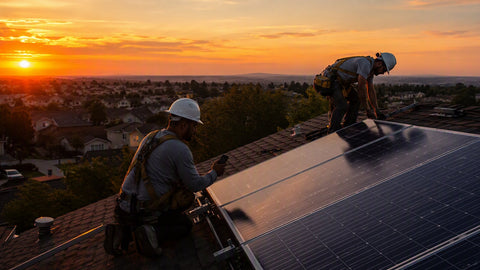
Professional commercial solar installers are experienced in working around business operations. Most installation work occurs on the roof, away from daily activities. Electrical connections typically require only brief, scheduled downtime. Many businesses report that the installation process was far less disruptive than expected.
Solar energy works for virtually any business, but certain industries see especially strong returns due to their energy profiles, facility characteristics, or available incentives:
| Industry | Why Solar Works Well | Key Benefits |
|---|---|---|
| Manufacturing & Warehousing | High energy consumption + large flat rooftops = ideal candidates | Offset significant operational energy costs; large roof area maximizes system size |
| Retail & Hospitality | High visibility for sustainability marketing + consistent energy demand | Reduce overhead while marketing green commitment to eco-conscious consumers |
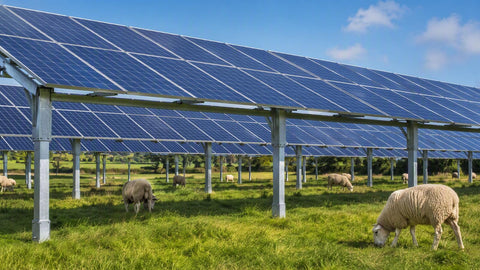
| Agriculture & Farming | Open land for ground-mount systems + USDA REAP grant eligibility | Up to 50% grant coverage; dual-use land for farming + energy production |
| Office Buildings & Tech | Corporate sustainability goals + ESG reporting requirements | Meet climate commitments; attract sustainability-minded employees and clients |
| Healthcare Facilities | Critical power needs + 24/7 energy demand | Reduce costs in an industry where uninterrupted, reliable power is essential |
| Schools & Nonprofits | Tax-exempt status works with PPAs + large roof areas + community visibility | Redirect energy savings toward mission; educational opportunity for students |
| Cold Storage & Food Processing | Extremely high energy consumption for refrigeration | Massive savings potential due to high baseline energy costs |
💡 Pro Tip: The Higher Your Energy Costs, the Better Solar ROI
Businesses with high energy consumption, expensive utility rates, or demand charges see the fastest payback periods. If your monthly electricity bill exceeds $1,000, solar almost certainly makes financial sense. If it exceeds $5,000, solar should be a top priority.
Don't have capital available for a cash purchase? Multiple financing options make commercial solar accessible regardless of your balance sheet. Each approach offers different benefits depending on your financial goals and tax situation.
Commercial Solar Financing Comparison
| Option | How It Works | Best For |
|---|---|---|
| Cash Purchase | Pay upfront, own the system outright, receive all incentives and tax benefits | Businesses with available capital seeking maximum ROI and tax benefits |
| Commercial Solar Loan | Finance the system, own it, keep tax credits; monthly payments often less than energy savings | Businesses wanting ownership benefits without upfront capital outlay |
| Solar Lease | Fixed monthly payments to use the system; third party owns equipment and handles maintenance | Businesses wanting predictable costs with no ownership responsibilities |
| Power Purchase Agreement (PPA) | Pay only for electricity generated at a fixed rate (typically below utility); no upfront cost | Tax-exempt organizations or businesses preferring operational expense vs. capital expense |
| PACE Financing | Property-assessed financing repaid through property taxes; stays with building if sold | Commercial property owners seeking long-term, transferable financing |
$0 Down Options for Every Business
Through Power Purchase Agreements (PPAs) and solar lease options, many businesses can go solar with zero capital outlay. You simply pay a fixed rate for the energy your system produces-typically lower than your current utility rate-and start saving from day one. For tax-exempt organizations like nonprofits and schools, PPAs are particularly attractive since they can't use tax credits directly.
Related Products


Ready to Power Your Business with Solar?
Contact PES Supply today for a free, no-obligation commercial solar consultation. Our team will analyze your energy usage, assess your facility, and provide a detailed proposal showing exactly how much your business can save.
Request Free Assessment Browse Commercial Solar PanelsIs my commercial roof suitable for solar?
Most commercial roofs are excellent candidates for solar. Whether you have a flat roof (most common for commercial buildings), pitched roof, or even a parking structure, modern mounting systems are designed to work with virtually any configuration. Flat roofs actually offer advantages-panels can be tilted to optimal angles and ballasted (weighted) rather than penetrating the roof membrane. Our free site assessment will evaluate your roof condition, available space, structural capacity, and shading factors to determine the best approach for your building.
What about cloudy days or winter months?
Solar panels produce energy even on cloudy days-they need light, not direct sunshine. Modern panels are highly efficient across a range of weather conditions, typically producing 10-25% of rated output on overcast days. Additionally, net metering allows you to bank excess energy generated during peak production periods (sunny days, summer months) to offset lower-production periods. Systems are designed based on annual production averages, accounting for seasonal variation. Many successful commercial installations operate in cloudy climates like the Pacific Northwest, Germany, and the UK.
What maintenance is required for commercial solar?
Commercial solar systems are remarkably low-maintenance. With no moving parts, they require only occasional cleaning (rain often handles this) and an annual inspection. Most quality systems come with 25-30 year warranties on panels and 10-25 year warranties on inverters. Real-time monitoring systems alert you to any performance issues immediately. Total maintenance costs typically run $500-$1,500 annually for commercial systems-a tiny fraction of the energy savings generated.
Can my business go solar with no upfront cost?
Yes. Through Power Purchase Agreements (PPAs) and solar lease options, many businesses can go solar with zero capital outlay. With a PPA, a third party owns and maintains the system on your property; you simply pay a fixed rate for the electricity produced-typically 10-30% lower than your current utility rate. You start saving from day one with no upfront investment, no maintenance responsibilities, and no performance risk. PPAs are particularly popular with tax-exempt organizations like nonprofits and schools that can't directly benefit from tax credits.
How long does commercial solar installation take?
The total timeline from initial assessment to power generation is typically 8-14 weeks for most commercial installations. This includes site assessment and design (2-4 weeks), permitting and approvals (2-6 weeks), and physical installation (2-4 weeks). Larger or more complex projects may take longer. The actual on-site installation work for a typical commercial system takes 2-4 weeks and is designed to minimize disruption to your business operations. Most work occurs on the roof, away from daily activities.
What happens if we sell the building or relocate?
If you own the solar system, it transfers with the property and typically increases the sale price by 3-4% (often more than the system's remaining value). Solar-equipped properties sell faster because buyers value the locked-in energy savings. If you have a PPA or lease, these agreements can usually be transferred to the new property owner, or in some cases, bought out. The specifics depend on your contract terms-our team can help you understand your options before you commit.
What if my business has seasonal or variable energy usage?
Solar works well even with variable energy usage. Net metering allows you to bank credits during low-usage periods for use during high-demand times. Systems are designed based on your annual usage profile, not just peak periods. For businesses with extreme seasonal variation, system sizing considers your average annual consumption and net metering policies. In some cases, adding battery storage can help capture excess production for later use. Our design team analyzes your 12-24 month usage history to optimize system sizing for your specific patterns.
How do I know if solar makes financial sense for my business?
A few quick indicators suggest strong solar ROI: monthly electricity bills over $1,000, available roof or ground space, a profitable business that can use tax credits, and plans to remain in the location for 5+ years. However, the only way to know for certain is a detailed analysis of your specific situation. PES Supply offers free, no-obligation commercial solar assessments that include site evaluation, custom system design, financial projections, and ROI analysis-giving you all the information you need to make an informed decision.
Commercial solar has evolved from a "nice-to-have" sustainability initiative to a strategic business imperative. With 50-70% of system costs offset by tax incentives, 3-5 year payback periods, and 25-year net savings often exceeding $500,000, solar delivers ROI that few other capital investments can match-while simultaneously reducing your carbon footprint, enhancing your brand, and protecting your business from rising energy costs.
The combination of historically low equipment costs, generous federal and state incentives, and rising utility rates creates a uniquely favorable moment for commercial solar adoption. Every month you wait is a month of savings lost-and with the federal ITC scheduled to step down after 2032, the time to act is now.
Summary: Commercial Solar in 2026
Cost reduction: 50-75% lower electricity bills. Tax benefits: 50-70% of system cost offset by incentives. Payback period: 3-5 years. 25-year savings: $250,000 to $2,000,000+ depending on system size. Additional benefits: Property value increase, ESG leadership, energy independence, competitive advantage.
About PES Supply
PES Supply is a nationwide electrical supply distributor offering premium Tier 1 commercial solar panels, inverters, standby generators, and related electrical equipment. We partner with businesses across all industries to design and supply commercial solar solutions that maximize ROI while meeting sustainability goals.
📍 Location: 1507 Portland Ave, Louisville, KY, United States 📞 Phone: +1 888-876-0007 🌐 Website: www.portlandiaelectric.supply
Article: Solar Energy for Business: The Complete Guide to Commercial Solar
Category: Commercial Solar / Business Solutions
Last Updated: February 2026
Related Articles: Solar Energy Cost Guide | Commercial Solar Tax Credits Explained | Solar ROI Calculator Guide
Related Resources:
- Best Solar Panels 2026 - Buyer's Guide
- EG4 vs Tesla Powerwall
- Qcells vs Trina vs JA
- Solar Inverter Buyer's Guide
- Solar Battery Buyer's Guide
- 5kW Solar Kit
- 10kW Solar + Battery Kit
- Off-Grid Cabin Kit
- EG4 Batteries
- Qcells Solar Panels
- Trina Solar
- JA Solar
- REC Solar
- Mission Solar
- Sol-Ark Inverters
- SolarEdge Inverters
- Generac PWRcell
Calculate how much storage you need with our battery sizing calculator.
Check solar incentives available in your state.
Use our free solar system calculator to size your array.
Check out our Solar Panel Comparison Tool. Check out our Inverter Sizing Calculator.
Calculate your solar payback and 25-year savings with our Solar ROI Calculator. Follow our complete DIY solar installation guide for step-by-step instructions. Keep your system running at peak performance with our Solar Maintenance Guide.
Related Resources
- Solar System Calculator
- Battery Sizing Calculator
- Solar Panel Comparison Tool
- Inverter Sizing Calculator
- Solar ROI Calculator
- Solar Installation Guide
- Solar Maintenance Guide
- Solar Permitting Guide
- Battery Installation Guide
- NEC Code Compliance Guide
- Solar Panel Mounting Guide
- Grounding & Bonding Guide
- Solar Incentives by State
- Pro Account - Wholesale Pricing
- PowerLink Network - Contractor Program
Related reading: ITC Safe Harbor & Commence-Construction: What Solar Buyers Must Know After the Residential Credit Sunset — the latest on federal ITC safe harbor rules, the June 2026 court ruling, and what the residential credit sunset means for buyers and installers.