Oklahoma City runs on weather extremes. The same metro that logs 235 sunny days a year — more than Phoenix's average in some datasets — also sits in the heart of tornado alley, rides out ice storms that drop limbs across distribution lines, and bakes under August heat that pushes air conditioners to their nameplate ratings for weeks at a time. That combination makes OKC one of the most genuinely compelling markets in the country for solar, battery storage, and backup generation: abundant resource, real resilience risk, and electricity rates that keep the payback math honest. This is the complete picture for Oklahoma City homeowners, contractors, businesses, and utilities — what works here, what it costs, and how PES Supply supports projects across the metro from Edmond to Moore to Yukon.

I have helped spec equipment for OKC-area projects ranging from a 6 kW starter array on a ranch-style home in Midwest City to containerized battery systems for commercial sites near the I-40 corridor. The questions are always the same three: will solar survive the hail, what happens when the grid goes down, and does it actually pay? Let us take them in order, with numbers.
Oklahoma City's solar resource, quantified
Oklahoma City averages roughly 5.2 peak sun hours per day on an annual basis — spring and fall run higher, December bottoms near 3.5, and July peaks above 6.5. A fixed south-facing array at latitude tilt converts that into approximately 1,550–1,650 kWh per installed kW per year after real-world losses, comfortably ahead of the national average and competitive with much of the Southwest at a fraction of the land cost.
| System size | Roof area needed | Est. annual production (OKC) | Homes it matches |
|---|---|---|---|
| 5 kW (12 × 440 W) | ~250 sq ft | ~7,900 kWh | Efficient 1,400 sq ft home, gas heat |
| 8 kW (19 × 440 W) | ~400 sq ft | ~12,600 kWh | Average 2,000 sq ft home with central AC |
| 12 kW (28 × 440 W) | ~600 sq ft | ~19,000 kWh | Large home, all-electric or one EV |
| 16 kW (37 × 440 W) | ~800 sq ft | ~25,300 kWh | All-electric + EV + shop/pool loads |
Against OG&E residential rates that have climbed into the $0.12–$0.14/kWh range with riders, an 8 kW system producing 12,600 kWh displaces roughly $1,600–$1,750 per year at full retail offset. Oklahoma is a net-metering state with utilities offering credit structures that vary by provider — OG&E and PSO both serve the metro under tariff structures that credit exports below retail but well above zero, which shapes system sizing toward self-consumption with modest export rather than the oversized export-maximizing arrays of older markets.
The hail question, answered with engineering
Every OKC solar conversation eventually arrives at hail, and it deserves a straight answer rather than reassurance. Modern residential modules are certified to UL 61730 / IEC 61215 impact testing: a 25 mm (one-inch) ice ball at 23 m/s — about 51 mph. Oklahoma's worst hail events exceed that, which is why module selection and insurance both matter here. Panels with 3.2 mm tempered glass and the newer hail-rated test sequences (some manufacturers now test to 35–45 mm impacts) cost a few cents more per watt and are the correct spec for this metro. On the insurance side, standard homeowner policies in Oklahoma typically cover rooftop solar as part of the dwelling; the conversation to have with your agent before installation is about premium impact and deductible structure, not about whether coverage exists.
| Hail event class | Stone size | Module test standard coverage | Real-world expectation |
|---|---|---|---|
| Common OKC spring storm | ≤1 inch | Fully covered by UL 61730 testing | No damage expected |
| Severe warned storm | 1–1.75 inch | Covered by premium hail-tested modules | Rare cosmetic damage possible |
| Historic event (2010-class) | 2+ inch | Beyond certification | Insurance claim territory — like the roof itself |
The perspective I give every customer: in the May 2010 hailstorm that hammered the northwest metro, roofs, vehicles, and windows were destroyed wholesale — solar arrays in the path fared about like the roofs under them, no better and no worse. You do not skip a roof because of hail risk; you insure it. Solar is the same calculation.
Backup power is not optional thinking in OKC
Oklahoma City's outage profile is driven by ice and wind, not heat-shedding events. The October 2020 ice storm left over 400,000 OG&E customers without power, some for more than a week. That event reshaped how this metro thinks about resilience, and it is why the majority of systems we help spec for OKC now include either battery storage or generator backup — usually both, in layers.
| Resilience layer | What it covers | Typical OKC cost | Runtime character |
|---|---|---|---|
| Portable generator (7.5–10 kW) | Fridge, furnace blower, lights, outlets via extension or interlock | $900–$2,000 | As long as gasoline lasts; refuel daily |
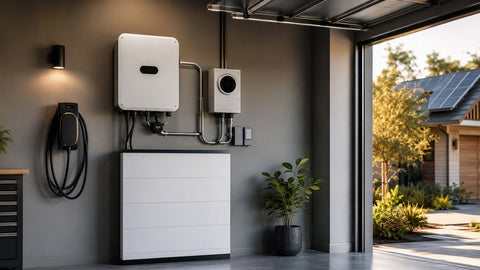
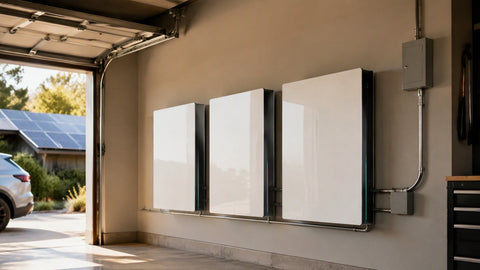
| Home battery (10–14 kWh) | Essential loads, silent and instant | $8,000–$13,000 installed | Overnight; recharges from solar daily |
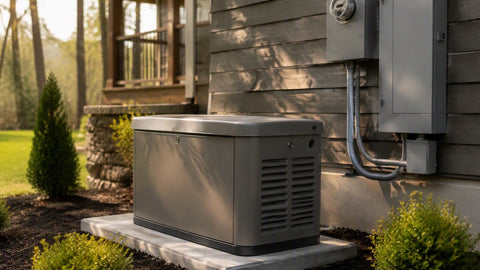
| Standby generator (18–26 kW, NG) | Whole home including AC | $10,000–$16,000 installed | Indefinite on natural gas service |
| Solar + battery + standby generator | Everything, in sequence | Combined system design | Solar carries days, battery nights, generator the gaps |
The layered approach is not overkill here — it is the architecture that matches the actual failure modes. Ice storms kill the grid for days while delivering gray skies that cut solar output to 10–25% of normal; a solar-plus-battery system alone stretches but eventually empties. Natural gas service, buried and pressure-fed, historically stays live through ice events that take down overhead electric lines, which is why the standby generator is the anchor of the deep-outage plan. Fuel math for the standby units: an 18 kW natural-gas unit at half load consumes roughly 180–220 cubic feet per hour, and at Oklahoma gas prices that is about $1.50–$2.50 per hour of whole-home power — cheap insurance when the alternative is a cold, dark house in single-digit wind chills.
What the code math looks like on OKC jobs
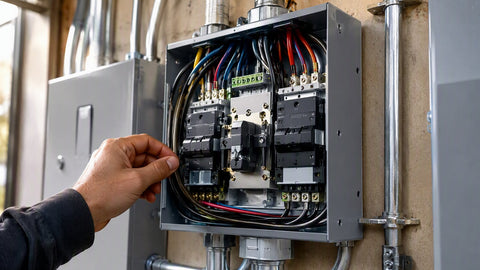
Oklahoma City permits under the NEC as adopted by the state, and the calculations that matter are the same ones inspectors check everywhere — but ice-load and wind considerations add local flavor to racking specs. For the electrical side, an 8 kW inverter on a 200 A service: output current 8,000 ÷ 240 = 33.3 A, designed at 125% continuous per NEC 705.28 gives 41.7 A, requiring 8 AWG copper (50 A at 75°C per NEC Table 310.16) and a 45 A or 50 A breaker from NEC 240.6(A). The 120% busbar rule (705.12) allows 40 A of solar on a standard 200/200 panel — the 8 kW inverter at a 45 A breaker technically exceeds it, which is why we so often spec a 7.6 kW inverter at a 40 A breaker, a supply-side tap, or a 225 A busbar panel on OKC jobs. On the structural side, OKC's 115+ mph design wind speeds and the practical reality of straight-line wind events mean we specify racking systems with published wind-load engineering at the actual exposure category, every time — the difference in rail and clamp cost is trivial against the cost of finding out the other way.
Summer cooling: where OKC solar earns its keep
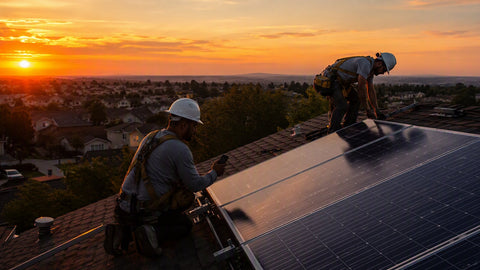
The metro's peak electricity demand arrives on August afternoons when every air conditioner from Edmond to Norman is running flat-out — which is precisely when a solar array produces its maximum output. A 3.5-ton central AC draws roughly 4–4.5 kW while its compressor runs, and an 8 kW array at 1 PM in July is delivering 6.5–7 kW of real, temperature-derated power. The alignment is close to perfect: the load exists because the sun is shining. This coincidence is the quiet engine of OKC solar economics — even at Oklahoma's moderate rates, self-consumed summer kilowatt-hours avoid retail purchases at the exact hours the grid is most stressed. The one caution we give every customer: a west-facing plane outperforms south here for bill reduction, because the AC load persists into the 4–7 PM window when south-facing production is fading. Splitting the array across south and west planes sacrifices a few percent of annual kilowatt-hours and buys noticeably better late-afternoon coverage — a trade we recommend on most OKC roof layouts.
Who we serve across the metro
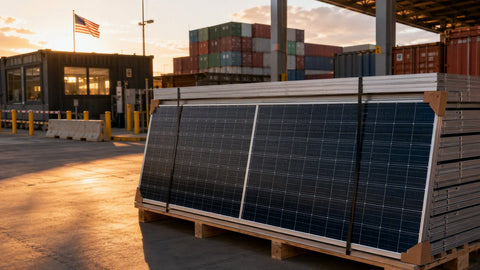
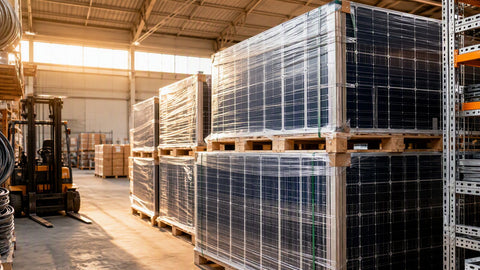
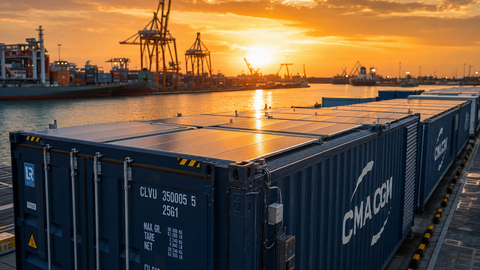
Homeowners get kit-level support: complete solar packages sized to actual bills, battery systems matched to overnight loads, and generators with transfer equipment that a licensed local electrician can install without callbacks. Contractors get what keeps crews moving — pallet-priced modules, same-week delivery on racking and BOS, and a wholesale counter that understands a job schedule. Businesses along the I-35 and I-40 corridors get commercial-scale procurement: three-phase inverters, carport steel, and C&I battery blocks with the freight logistics handled. Utilities and developers working Oklahoma's growing renewable pipeline get container-scale supply and the documentation packages that procurement departments require. The common thread is inventory depth: when a hail event rolls through and every roofer in the metro is suddenly rebuilding arrays, the supplier with stock on the ground is the only one whose phone calls matter.
Financing and incentives for Oklahoma projects

The 30% federal Investment Tax Credit applies to solar and to battery storage, whether grid-tied or paired, and remains the anchor incentive for OKC projects. Oklahoma's state-level incentives are modest compared to coastal markets, but the combination of low installation labor costs, cheap roof work, and the federal credit produces effective costs that surprise people: an 8 kW system at $2.40–$2.90/W installed nets to $13,400–$16,200 after the credit, against $1,600+ of annual value — paybacks in the 8-to-10-year band with 15 years of warranty-covered life beyond. Financing through local credit unions and national solar lenders is routine; our financing pre-qualification path exists precisely so customers can compare a loan payment against an OG&E bill with real numbers rather than brochure math.
Commercial solar along the I-35 and I-40 corridors
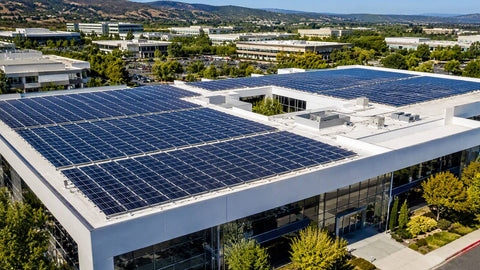
OKC's commercial stock is flat-roofed, slab-on-grade, and blessed with parking lots that double as solar real estate — a combination built for ballasted rooftop and carport arrays. The economics run through the same federal stack as everywhere else (30% ITC plus MACRS), with Oklahoma's relatively low labor and structural costs pulling installed pricing toward the bottom of national ranges.
| OKC commercial scenario | System size | Installed cost (pre-incentive) | Net after ITC + MACRS (est.) | Year-1 production |
|---|---|---|---|---|
| Strip retail / office, rooftop | 75 kW | $165,000–$200,000 | $86,000–$104,000 | ~119,000 kWh |
| Warehouse, ballasted rooftop | 250 kW | $475,000–$575,000 | $247,000–$299,000 | ~396,000 kWh |
| Distribution center + carport | 500 kW | $900,000–$1.15M | $468,000–$598,000 | ~792,000 kWh |
| Manufacturing, rooftop + ground | 1 MW | $1.7M–$2.1M | $884,000–$1.09M | ~1.58 GWh |
At OG&E commercial blended rates near $0.09–$0.11/kWh, the 250 kW warehouse case displaces roughly $36,000–$44,000 of annual purchases — a sub-seven-year simple payback on the net cost, with demand-charge savings available where the facility peaks during daylight. Oklahoma's demand charges run lower than coastal markets, which means OKC commercial solar lives and dies on energy offset; design to the kWh, not the kW.
EV charging in a truck town
Oklahoma City is pickup country, and the EV transition here looks like F-150 Lightnings and Silverado EVs parked in driveways with 240 V circuits — each one adding 4,000–6,000 kWh of annual household load when it replaces a daily-driver gas truck. A Level 2 home charger on a 40 A circuit draws 7.7 kW and adds 30–40 miles of range per hour overnight; on the NEC side that continuous load needs a 50 A breaker and 6 AWG copper (65 A at 75°C per Table 310.16), one of the most commonly undersized circuits we get calls about. For solar owners, the pairing is natural: shift charging to midday on weekends or work-from-home days and the truck drinks straight from the array. Commercial and fleet charging is arriving along the corridor interchanges, and the sites that pair canopies with solar get the shade, the power, and the marketing photo in one structure.
Permitting and inspection in the OKC metro
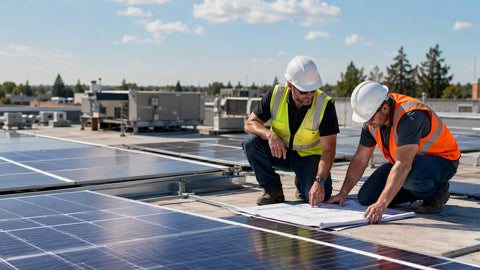
The City of Oklahoma City and the surrounding municipalities — Edmond, Norman, Moore, Yukon each run their own permit desks — process residential solar under the adopted NEC cycle with the usual plan-set requirements: site plan, single-line diagram, structural attachment details, and equipment cut sheets. Turnaround in the metro runs one to three weeks for residential plan check, faster than most major metros, and inspectors here are pragmatic — they check the 120% rule math, the rapid-shutdown labels, and the grounding continuity, and they pass jobs that get those right. The recurring corrections I hear about from installers: missing placards at the meter, ground-fault labels in the wrong location, and conduit runs that violate the working-clearance space in front of the panel. All three are $0 fixes on paper and half-day fixes on ladders.
Why Oklahoma's grid context favors the prepared
Oklahoma generates a larger share of its electricity from wind than almost any state — over 40% in recent years — which makes the regional grid both cleaner and more variable than most. For OKC customers the practical consequence is rate pressure in both directions: wind keeps wholesale energy cheap, while storm hardening and ice-storm recovery costs keep showing up in riders. Solar-plus-storage at the customer level is the hedge against both — it caps your exposure to the riders while letting you enjoy the wind-driven cheap hours. The customers who think of their rooftop array and their battery as a personal grid-independence layer, rather than as a gadget, are the ones whose December ice-storm stories end with "we barely noticed."
OKC's housing stock is secretly solar-friendly
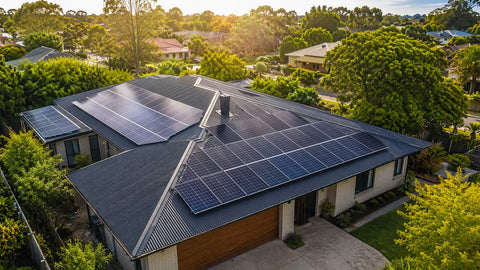
Post-war ranch homes dominate the metro's neighborhoods — single-story, low-pitch, asphalt-shingle roofs with long uninterrupted south and west planes. That is close to the ideal solar roof: cheap to rack, easy to flash, and simple to engineer for wind. The housing stock's one quirk is electrical: plenty of 1960s–1970s panels are 100 A or 125 A services feeding homes that have since added central AC, and those panels hit their limits the moment solar, a battery, and an EV circuit arrive together. Panel upgrades in the metro run $1,800–$3,200 through local electricians, and bundling the upgrade with the solar permit is the standard play — one inspection, one utility disconnect, done. Homes built after 2000 in Edmond and the northwest growth corridors typically have 200 A services and skip that step entirely.
How a project actually flows with PES Supply
The sequence we run with OKC customers is deliberately boring. First, twelve months of bills — we size from kWh, never from square footage guesses. Second, a roof and panel check: photos of the main panel's label and the roof planes answer 90% of feasibility questions in an afternoon. Third, equipment selection against the budget and the resilience goals, which is where the solar-versus-generator-versus-both conversation gets settled with the tables above rather than with opinions. Fourth, delivery coordinated to the install schedule — residential kits by freight with liftgate, commercial orders on flatbeds with site coordination. Fifth, commissioning support: our team answers the NEC-math and setpoint questions that come up during inspection week, because a fast answer at that stage is the difference between a finished job and a rescheduled inspector. Boring, repeatable, and fast is the entire point.
Frequently asked questions
Is solar worth it in Oklahoma City? Yes. OKC averages about 5.2 peak sun hours daily, producing roughly 1,550–1,650 kWh per kW per year. An 8 kW system offsets around $1,600–$1,750 annually at current OG&E rates, with 8–10 year paybacks after the 30% federal tax credit.
Can solar panels survive Oklahoma hail? Certified modules withstand one-inch hail at 51 mph; premium hail-tested modules handle larger stones. Events beyond that damage roofs generally, not just solar — which is what homeowner's insurance is for. Spec hail-tested glass in this market and confirm coverage with your agent.
What size generator does an OKC home need for ice storms? A 7.5–10 kW portable unit covers essentials; an 18–26 kW natural-gas standby unit runs the whole house including central heat. Natural gas service historically survives ice events that down overhead electric lines, making NG standby units the deep-outage anchor.
Does Oklahoma have net metering? Oklahoma utilities including OG&E and PSO offer export credit structures, generally below full retail. System designs in this market favor self-consumption with battery storage rather than oversized export arrays.
How much does a whole-home backup system cost in Oklahoma City? A battery-based essential-loads system runs $8,000–$13,000 installed; a natural-gas standby generator with automatic transfer switch runs $10,000–$16,000. Many OKC homes layer both for multi-day ice-storm resilience.
Does PES Supply deliver to Oklahoma City? Yes — we ship solar kits, batteries, generators, and BOS components across the OKC metro including Edmond, Norman, Moore, Yukon, and Midwest City, with freight coordination for commercial and pallet-scale orders.
The bottom line
Oklahoma City is a market where the resource, the risk, and the rates all point the same direction: strong sun, real outage exposure, and honest payback math. Build the array for hail country, layer the resilience for ice country, size everything to the actual bill, and the system takes care of itself for decades. That is what complete energy solutions look like here — and it is what we stock, ship, and support across the metro every single week, from single residential kits to commercial flatbeds, through hail season and ice season alike, for homeowners wiring their first array and contractors outfitting their hundredth. When the next ice warning hits the forecast, the prepared households in this metro will barely look up from their coffee while the neighborhood goes dark — and that is the standard everything here is built to, storm after storm, year after year, for every household that chose to be ready before the sirens sounded, and for every one that will choose it after.
PES Supply serves Oklahoma City with solar panels, complete solar kits, hybrid inverters, 10 kWh batteries, standby generators, 14–17 kW standby units, and transfer switches. Local resources: Oklahoma City power solutions, system calculator, incentives by state, generator sizing guide, financing pre-qualification, and whole-house generator sizing.