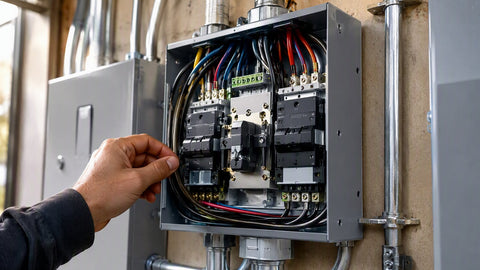
A 48V chargeverter — the class of device popularized by the EG4 Chargeverter and similar high-current battery chargers — converts AC power from a generator or the grid into precisely controlled DC power to charge a 48-volt battery bank. It sits in the gap between two worlds that off-grid and hybrid system owners know too well: the inverter-charger that cannot keep up, and the generator that has hours to give. If you run a 48V LiFePO4 bank with solar, a chargeverter is the tool that turns any AC source into a bulk-charging firehose — 100 amps of DC at the turn of a dial, independent of your inverter's charger, weatherproof enough to live in the generator shed, and cheap compared to a second inverter.

I first appreciated what these boxes do during an ice-storm outage in February. A customer's 12 kW inverter-charger had faulted on generator frequency drift, his batteries were at 18%, and his solar was buried under sleet. We plugged a chargeverter straight into his 9 kW portable generator, set 80 A, and put 5 kWh into the bank in about an hour while his inverter sat there doing nothing. That experience — the charger that works when the fancy equipment will not — is why we recommend them so often.
What a chargeverter actually is
Strip the marketing away and a 48V chargeverter is a high-power AC-to-DC battery charger with adjustable output. The defining specifications of the class:
- Output: nominally 48 V DC, adjustable across roughly 40–60 V, at up to 100 A — about 5.1 kW of charging power.
- Input: 120/240 V AC, tolerant of the ugly, drifting power that portable generators produce — this tolerance is the entire point of the device.
- Control: user-set current limit and voltage setpoints, so you match the charger to both the generator's capacity and the battery bank's acceptance rate.
- Chemistry support: voltage windows that cover LiFePO4 (typically 54–57.6 V absorption, 54 V float), lead-acid (57.6–59 V absorption), and AGM profiles.
It differs from a DC-DC converter — the name confuses people constantly. A DC-DC converter moves power between DC buses, say 12 V to 48 V. A chargeverter starts from AC. And it differs from your inverter's built-in charger in the way that matters most in the field: it does not care about waveform quality, frequency stability, or synchronization. Generator putting out 63 Hz at 118 V with a ragged sine wave? The chargeverter eats it and makes clean, current-limited DC.
Why 48V became the standard these devices serve
The 48 V nominal battery bank won the residential and light-commercial storage market for one fundamental reason: current. Power is voltage times current, so every doubling of system voltage halves the current for the same watts — and current is what drives wire size, heat, losses, and cost.
| Power level | Current at 12 V | Current at 24 V | Current at 48 V | Practical consequence at 12 V |
|---|---|---|---|---|
| 1,000 W | 83 A | 42 A | 21 A | Manageable; 4 AWG copper |
| 3,000 W | 250 A | 125 A | 63 A | 4/0 cable territory; heavy and hot |
| 5,000 W | 417 A | 208 A | 104 A | Parallel 4/0 runs; impractical |
| 8,000 W | 667 A | 333 A | 167 A | Not a DIY system anymore |
| 12,000 W | 1,000 A | 500 A | 250 A | Essentially impossible at 12 V |
At 48 V, a whole-home 12 kW inverter draws 250 A — serious but workable with 4/0 copper and proper lugs. At 12 V the same load demands 1,000 A, which no sensible person wires in a residence. That is why every serious home battery line — server-rack LiFePO4, wall-mount units, the whole category — standardized on 48 V nominal (16 LiFePO4 cells at 3.2 V, or 51.2 V nominal in the modern nomenclature), and it is why the chargeverter class exists at this voltage.
Sizing the charger to the battery bank
LiFePO4 banks accept charge at 0.5 C comfortably — half their amp-hour rating in amps — and most are rated for 1 C maximum. Charging below the acceptance rate wastes generator runtime; charging above it trips BMS protection or shortens cell life. The matching table:
| Battery bank | Capacity | Recommended charge current (0.5 C) | Chargeverter setting | Empty-to-full time (est.) |
|---|---|---|---|---|
| 1 × 5.12 kWh (100 Ah) | 5.12 kWh | 50 A | 50 A | ~2.2 hours |
| 2 × 5.12 kWh | 10.24 kWh | 100 A | 100 A | ~2.2 hours |
| 3 × 5.12 kWh | 15.36 kWh | 150 A ideal | 100 A (max) | ~3.3 hours |
| 6 × 5.12 kWh | 30.7 kWh | 300 A ideal | 100 A, or 2 units at 200 A | ~6.6 / 3.3 hours |
| 2 × 14.3 kWh wall-mount | 28.6 kWh | 280 A ideal | 100 A, or 2 units | ~6.2 / 3.1 hours |
The pattern: one 100 A chargeverter is well matched to one or two 5 kWh batteries. Larger banks either accept longer generator runs or justify a second chargeverter — and since these units cost a fraction of another inverter, doubling up is common practice among the off-grid customers we supply. Add 10–15% to the empty-to-full estimates for the absorption tail; LiFePO4's flat voltage curve keeps the taper short, but it is not zero.
Sizing the generator to the charger
The other half of the pairing is the AC source. A chargeverter at full 100 A output draws about 5.4–5.8 kW of AC input after conversion losses of roughly 8–12%. Generator sizing must respect two rules: continuous loads should run at 70–80% of rated watts for longevity, and a generator's surge rating is irrelevant here because a battery charger is a steady resistive-style load with no motor-starting spike.
| Chargeverter setting | DC output | AC input draw (est.) | Minimum generator (continuous) | Comfortable generator |
|---|---|---|---|---|
| 40 A | ~2.0 kW | ~2.3 kW | 3,000 W | 4,000 W inverter generator |
| 60 A | ~3.1 kW | ~3.5 kW | 4,500 W | 6,000–7,000 W |
| 80 A | ~4.1 kW | ~4.7 kW | 6,000 W | 8,000–9,000 W |
| 100 A | ~5.1 kW | ~5.8 kW | 7,500 W | 9,000–12,000 W |
| 2 units @ 100 A | ~10.2 kW | ~11.6 kW | 15,000 W | 18–22 kW standby |
Fuel math follows directly. A gasoline portable generator at 50% load burns roughly 0.5–0.7 gallons per hour producing 3–4 kW; at the 80 A setting you are delivering about 4.1 kWh into the battery per hour, so a gallon of gasoline buys you roughly 6–8 kWh of stored energy. Propane runs about 20% less dense in energy; a 20 lb cylinder holds about 4.7 gallons-equivalent and will feed a mid-size generator at charging load for five to seven hours. I keep the arithmetic on a card in the trailer: gallons times six is your ballpark kWh. It has never once been optimistic enough to get me in trouble.
Wiring the DC side without burning anything down
One hundred amps of DC is unforgiving. Undersized cable, a loose lug, or a missing fuse turns a charging session into a fire risk, and 48 V arcs sustain themselves far better than 12 V arcs do. The NEC ampacity math, using Table 310.16 at 75°C copper and the standard breaker sizes of 240.6(A):
| Charge current | Design current (× 1.25 continuous) | Minimum copper (75°C, NEC 310.16) | OCPD (NEC 240.6) | Notes |
|---|---|---|---|---|
| 40 A | 50 A | 8 AWG (50 A) | 50 A | Minimum sensible install |
| 60 A | 75 A | 4 AWG (85 A) | 80 A | Common portable setup |
| 80 A | 100 A | 3 AWG (100 A) / 2 AWG (115 A) | 100 A | 2 AWG preferred for margin |
| 100 A | 125 A | 1 AWG (130 A) / 1/0 (150 A) | 125 A | 1/0 if runs exceed 10 ft |
| 2 × 100 A combined | 250 A | 250 kcmil (255 A) or 4/0 per unit | 250 A | Fuse each unit separately at 125 A |
Three field rules I enforce on every install. First, the fuse or breaker goes within seven inches of the battery positive terminal — the cable run from battery to fuse is the unprotected portion, and it should be as short as physically possible. Second, torque every lug to spec and re-check after the first charge cycle; thermal cycling walks loose connections, and a resistive joint at 100 A is a heater. Third, use a Class T fuse or listed DC-rated breaker, not an AC breaker — interrupting DC arcs requires devices rated for it, and Class T's 20,000 A interrupting capacity matches what a large LiFePO4 bank can deliver into a dead short.
Voltage setpoints for LiFePO4 banks
The settings that work, distilled from the major 16-cell LiFePO4 battery lines we support: bulk/absorb at 56.0–56.8 V (3.50–3.55 V per cell), float at 54.0–54.4 V, and charge termination when current tapers below roughly 2–5% of bank capacity. Never exceed 58.4 V (3.65 V/cell absolute maximum) — the BMS will disconnect first, and repeated BMS disconnects under charge are hard on both the charger and the contactors. Equalization modes belong to lead-acid; disable them entirely for lithium. Temperature below freezing is the other hard rule: LiFePO4 cells cannot accept charge below 0°C without permanent lithium plating, so either the battery's BMS has low-temperature cutoff (verify that it does) or the chargeverter lives where it and the batteries stay warm.
The integration patterns that work
Three architectures cover nearly every installation we see. The generator-companion pattern: chargeverter hardwired or cord-connected to a dedicated generator, feeding the DC bus directly — the inverter keeps running the house from battery while the chargeverter refills it, which means the generator can be sized to the average load instead of the peak. The grid-assist pattern: grid AC feeds the chargeverter during cheap off-peak hours or before forecast storms, pre-loading the batteries without cycling the inverter's transfer switch. And the solar-supplement pattern: in a string of dark winter days, a few generator hours through the chargeverter replaces what the array could not make, at a fraction of the fuel cost of running the generator around the clock. That last pattern is where the money is — generator-as-backup-to-solar uses roughly a quarter of the fuel of generator-as-primary-source, because you run it at efficient charging load for two hours instead of at wasteful partial load all night.
The AC side: plugs, cords, and inlet boxes
The DC math gets all the attention, but the AC connection is where I find the sketchy field work. A 100 A charge setting draws roughly 24 A at 240 V, so the supply circuit needs 10 AWG copper on a 30 A breaker minimum — the same class of circuit as an electric dryer. Most units accept a 240 V receptacle connection (L14-30 or L6-30 class) or hardwired input. Three rules hold here too. Use a proper transfer or interlock arrangement if the chargeverter shares a generator with backed-up house loads; backfeeding through a dryer outlet is how people get hurt. Keep cord runs under 50 feet or step up a gauge, because voltage sag at the charger's input steals output capacity exactly when the generator is working hardest. And never size the generator connection from the chargeverter's nameplate alone — if you plan to run the well pump while charging, the generator and its wiring must serve the sum, not each load's fantasy number.
A charging workflow that protects the batteries
The sequence we train customers on, refined over a lot of cold mornings. Check battery state of charge and cell temperature first — below 5°C, delay the session or warm the bank. Start the generator and let it stabilize for two minutes before connecting any load; the first sixty seconds of a cold generator's output are the dirtiest power it will ever make. Connect the chargeverter, start at half your target current, watch the DC voltage climb onto the bank's plateau, then walk the current up to the final setting. During the session, the battery bank voltage tells you almost nothing about state of charge on LiFePO4 — the curve is that flat — so track amp-hours in or trust the BMS percentage, not the voltmeter. End the session when the charge current tapers or when the bank reaches 95–100%; the last few percent take disproportionate time and generator fuel. Shut down in reverse order: charger off, then generator. That workflow, followed exactly, has kept every bank I have managed out of trouble.
Chargeverter versus a bigger inverter-charger
The honest comparison customers ask for: why not just buy an inverter with a bigger built-in charger? Sometimes you should — if you are designing a new system from scratch, a 12 kW hybrid with a 200 A charger elegantly solves everything in one box. But three scenarios favor the separate chargeverter decisively. Retrofitting an existing system: adding a chargeverter costs a fraction of swapping the inverter and requires no rewiring of the AC side. Generator-hostile environments: portable generators with unstable frequency fault sensitive inverter-chargers out of charge mode constantly, while the chargeverter's tolerance is the reason it exists. And redundancy: a separate charger means a failed inverter does not strand you with a dead bank and a working generator, a failure mode I have watched turn a two-day outage into a very expensive hotel stay. In resilient-system design, diversity of charging paths is not a luxury; it is the design.
Maintenance and the faults that actually happen
These units are simple, and their failure modes are correspondingly few. Fan filters clog in dusty generator sheds — clean them quarterly or the thermal derating will silently cut your charge rate in half, which looks exactly like a weak battery until you check. Input breakers nuisance-trip on generator inrush at connection; pre-charging at low current setting eliminates it. Output lugs loosen with thermal cycling, as covered above — torque, ride one session, re-torque. And the most common "failure" of all: a BMS that disconnected the bank for low-temperature or over-voltage protection, presenting as a charger that produces nothing. The diagnostic order that saves trips: confirm AC input present, confirm the unit's output voltage at its own terminals with no battery connected, then look at the battery's BMS state. Nine times in ten the charger is innocent.
Understanding the 48V voltage window
Part of using any charger well is knowing what the numbers on the display mean. A "48 V" LiFePO4 bank is actually 51.2 V nominal — sixteen 3.2 V cells in series — and its working range spans roughly 44.8 V at genuine empty (2.8 V per cell) to 58.4 V at the absolute full-charge ceiling (3.65 V per cell). In daily operation you will see the bank sit between 50 and 54 V for about 90% of every cycle, because LiFePO4's discharge curve is famously flat across the middle of its capacity. That flatness is why voltage-based state-of-charge guesses fail so badly on lithium, and why the chargeverter's current reading tells you more: at a steady 100 A into a healthy bank, every six minutes is another kilowatt-hour stored, regardless of what the voltmeter claims. Learn to think in amp-hours and watts on these systems and the voltage display becomes what it should be — a safety indicator, not a fuel gauge. One more display habit worth building: note the resting voltage thirty minutes after every charge session ends. A bank that settles at 53.4–53.8 V after a full charge is behaving exactly as healthy LiFePO4 should. One that sags below 53 V within the half-hour, session after session, is telling you a cell group is drifting out of balance — catch that trend early and a balancing cycle fixes it; catch it late and you are shopping for replacement cells.
Frequently asked questions
What is a 48V chargeverter used for?
It converts AC power from a generator or the grid into controlled DC current — up to about 100 A at 48 V nominal — to charge 48 V battery banks. Off-grid and hybrid system owners use it as a fast, inverter-independent charging path when solar cannot keep up.
How long does a chargeverter take to charge a 10 kWh battery? At the full 100 A setting (about 5.1 kW DC output), a depleted 10.24 kWh bank charges in roughly 2.2 hours including the absorption tail. Two 100 A units halve that for larger banks.
What size generator do I need for a 100 A chargeverter? Full output draws about 5.8 kW of AC input. A 7,500 W generator is the floor; 9,000–12,000 W is the comfortable range for continuous duty. You can also dial the chargeverter down to 60–80 A to match a smaller generator.
What wire size do I need for 100 A DC charging? Design current is 125 A (100 × 1.25 continuous factor). Use 1 AWG copper minimum at 75°C ampacity, stepping to 1/0 for runs over 10 feet, protected by a 125 A Class T fuse or DC-rated breaker within seven inches of the battery terminal.
Can a chargeverter charge lithium (LiFePO4) batteries? Yes — set bulk/absorb to 56.0–56.8 V, float to 54.0–54.4 V, and disable any equalization mode. Verify the battery BMS includes low-temperature charge cutoff before charging below freezing.
Is a chargeverter the same as a DC-DC converter? No. A chargeverter is an AC-to-DC battery charger. A DC-DC converter moves power between DC buses at different voltages. The names sound alike but the devices solve different problems.
The bottom line
A 48V chargeverter is the least glamorous and most useful box in a battery-based system: a hundred amps of charging that does not care how ugly the generator power is, sized with simple arithmetic and wired with serious cable. Match it to your bank at 0.5 C or less, match the generator to the setting at 80% continuous, fuse it properly within seven inches of the battery, and it will quietly rescue more outages than any other single component you own.
Portlandia Electric Supply stocks the full 48V ecosystem: 48V batteries, LiFePO4 batteries, server rack batteries, EG4 equipment, 48V inverters, portable generators, standby generators, and fuses and protection. Related guides: battery sizing calculator, home battery bank sizing, generator sizing, NEC wire sizing, wire ampacity chart, and generator fuel consumption calculator.