AI-Driven Solar Inverter: Making Solar Energy Smart for the Grid
Machine learning, IEEE 1547 grid support, predictive maintenance, and what actually changes on the roof and in the load center.

A solar inverter used to have one job: turn DC into AC and stay out of the way. That era is over. Modern inverters are grid-interactive computers that happen to move power. They shape voltage, absorb or inject reactive power, ride through faults, throttle output on command, and increasingly run machine-learning models that forecast production and flag failing hardware weeks before a human would notice. If you are sizing, specifying, or buying a system this year, the inverter is no longer a commodity line item — it is the control layer of the whole plant.
This guide breaks down what "AI-driven" really means in inverter hardware, which grid functions are mandated by code versus enabled by software, how predictive maintenance actually works in the field, and how to size conductors and breakers correctly for these systems using NEC 690.7 and 690.8. Every calculation below is worked out in the open so you can check our math against your own plans.
Field note from our quoting desk
- I've commissioned enough residential and light-commercial sites to say this plainly: the inverters that earn their keep are the ones whose monitoring actually gets watched. AI alerts only pay off if someone acts on them.
- Last spring we traced a 9% production shortfall on a 24-module array to a single optimizer reporting rising resistance — the platform flagged it three weeks before the string would have faulted. That one alert paid for the monitoring subscription for the year.
- When a customer asks me whether they need a "smart" inverter, my answer is always the same: if your utility has any interconnection screens beyond a simple net-metering agreement, you already need one.
Marketing departments stretch the term, but in shipping hardware there are four concrete capabilities that justify the label:
1. Production and load forecasting. The inverter or its cloud platform ingests irradiance history, weather forecasts, and your consumption patterns, then predicts tomorrow's generation curve hour by hour. That forecast drives battery dispatch decisions: charge from solar now, or wait for cheap off-peak grid power? Without a forecast, storage systems fall back to crude timers and leave money on the table.
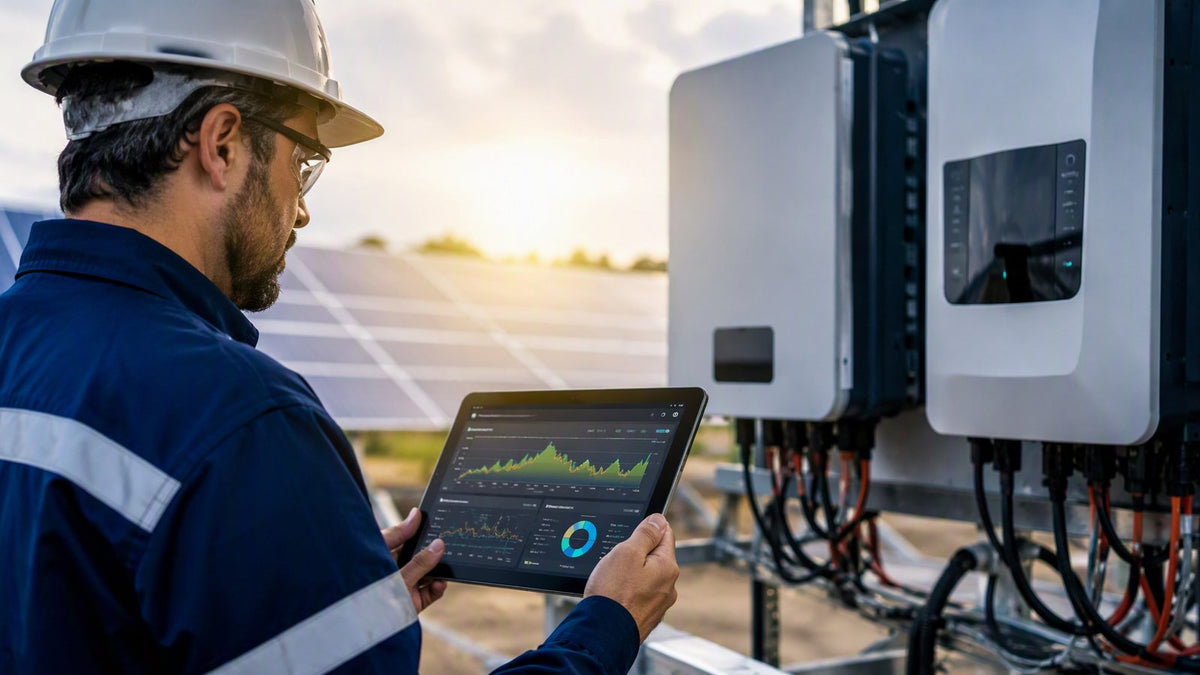
2. Anomaly detection. Machine-learning models learn each string's normal IV-curve behavior. When a module, optimizer, or connector drifts out of its learned envelope — rising series resistance, clipping outside expected hours, temperature signatures that don't match neighbors — the system raises a diagnostic alert. This is predictive maintenance in practice, and it works best at module level, which is why microinverter and optimizer architectures have a data advantage over bare string inverters. Our microinverter vs. string inverter comparison covers that trade-off in detail.
3. Adaptive MPPT and shade response. Modern maximum power point trackers re-sweep the IV curve on adaptive intervals rather than fixed ones, and some use learned shade profiles of the specific array to avoid getting trapped on local maxima. The gain over legacy algorithms is a few percentage points of annual yield on partially shaded sites — small on paper, real on the bill.
4. Grid-service response. AI-driven inverters participate in utility demand-response and virtual power plant programs, dispatching stored energy or curtailing output in response to price or grid-stability signals. This is where inverters stop being appliances and start being grid assets.
Confusion about smart inverters usually starts here. Some functions are mandatory under IEEE 1547-2018 (the interconnection standard now adopted across most U.S. jurisdictions through UL 1741 SB certification). Others are optional grid services you can monetize. Know which column your project needs before you spec hardware.
| Function | What It Does | Status Under IEEE 1547-2018 | Why It Matters on Site |
|---|---|---|---|
| Volt-Var (Q(V)) | Absorbs or injects reactive power to hold local voltage in band | Mandatory capability (Category B) | Keeps feeders stable on high-penetration solar streets; prevents nuisance overvoltage trips at midday |
| Volt-Watt (V(W)) | Curtails real power when voltage rises above setpoint | Mandatory capability | Protects distribution transformers; occasionally trims your peak production on weak feeders |
| Frequency-Watt (droop) | Adjusts output proportionally to grid frequency deviation | Mandatory capability | Fleets of inverters acting together stabilize grid frequency faster than spinning reserves |
| Ride-through (Cat I–III) | Stays online through defined voltage/frequency disturbances instead of tripping | Mandatory (category set by utility) | Prevents mass simultaneous dropout of distributed solar during grid events |
| Ramp-rate control | Limits how fast output can change (default 100%/min normal, 10%/min enter-service) | Mandatory capability | Smooths cloud-edge transients that otherwise flicker the feeder |
| Scheduled dispatch / VPP response | Charges or discharges storage on external price or grid signals | Optional, program-based | Revenue: VPP participants in active markets commonly earn a few hundred to over a thousand dollars per battery per year |
| Forecast-driven self-consumption | Uses ML forecasts to pre-charge or pre-discharge batteries ahead of weather and rate windows | Optional, platform-based | Routinely lifts self-consumption 10–20 points over static scheduling on time-of-use rates |
The practical takeaway: any UL 1741 SB-certified inverter already contains the mandatory grid-support firmware. What separates an "AI-driven" platform is the optional layer — forecasting, anomaly detection, and fleet dispatch. If your utility interconnection agreement references IEEE 1547-2018 screens or a smart-inverter tariff, confirm the exact certification listing on the inverter's spec sheet before ordering. Our NEC code compliance guide and solar permitting guide walk through the paperwork side.
AI features don't change the code math. Conductors and overcurrent devices still size off worst-case voltage and current, and getting this wrong is the most common reason plans get red-tagged. Here is a fully worked example using representative datasheet values for a current 550W-class residential module: short-circuit current (Isc) 13.9A, open-circuit voltage (Voc) 49.6V.
| Step | Code Reference | Calculation | Result |
|---|---|---|---|
| Maximum circuit current | NEC 690.8(A)(1) | Isc × 1.25 = 13.9 × 1.25 | 17.4A |
| Continuous-duty adjustment | NEC 690.8(B)(1) | 17.4 × 1.25 (equivalently Isc × 1.56) | 21.7A |
| Overcurrent device selection | NEC 240.6(B) / 690.9 | Next standard size above 21.7A | 25A breaker |
| Conductor ampacity (75°C, THWN-2 copper) | NEC 310.16 | Must carry ≥ 21.7A at 75°C | 10 AWG (35A) — comfortable margin |
| String Voc at design low temp | NEC 690.7(A) | 12 modules × 49.6V = 595.2V; −10°C correction factor 1.14 → 595.2 × 1.14 | 678.5V — exceeds 600V residential limit; split string or shorten to 11 (622.6V, still over) — design dictates 10 modules (565V) or a 1000V-rated commercial system |
That last row is the one that bites people. A string that looks fine at STC becomes a code violation on a cold January morning. Smart inverters with wide MPPT windows give you layout flexibility, but the correction-factor math is not negotiable. Run your own numbers with our inverter sizing calculator and solar system calculator before you commit a layout to the permit set.
| Capability | Conventional String Inverter | AI-Driven / Smart Platform |
|---|---|---|
| MPPT behavior | Fixed-interval IV sweeps; vulnerable to shade traps | Adaptive sweep timing; learned shade profiles per array |
| Monitoring granularity | System-level or string-level totals | Module-level with per-device health signatures |
| Fault detection | Trip codes after failure occurs | Drift alerts weeks ahead of hard failure |
| Battery dispatch | Static schedules or SOC thresholds | Forecast-driven charge/discharge against rates and weather |
| Grid services | IEEE 1547 mandatory set only | Mandatory set plus VPP/demand-response enrollment |
| Firmware path | Rare updates, manual service visits | Continuous OTA updates; new functions ship to installed base |
| Best fit | Simple net-metered arrays, full sun, no storage | Storage-coupled systems, TOU rates, shade, VPP markets, commercial monitoring obligations |
Two platforms we move a lot of product through illustrate the category well. The SolarEdge SE3800H uses DC optimizers for module-level data, while the SolarEdge Energy Hub 11.4kW adds battery-ready hybrid architecture with forecast-aware dispatch. Both are UL 1741 SB certified, which is the checkbox your AHJ and utility care about first.
Predictive Maintenance in Practice, Not in Brochures

Predictive maintenance is the AI claim we can verify from the field. Here is how the pipeline actually works on a monitored site:
- Data collection: Module-level electronics report voltage, current, and temperature per device, typically at 5–15 minute resolution. String inverters report per-MPPT or per-string.
- Baseline learning: The platform builds expected performance envelopes per device, normalized for irradiance and temperature. This takes a few weeks of clean data after commissioning.
- Drift detection: A connector with rising resistance, a bypass diode running hot, a module degrading faster than siblings — each produces a signature that deviates from the learned envelope before it produces a hard failure.
- Alert triage: Good platforms rank alerts by production impact so you roll a truck for the 9% string problem, not the 0.4% cosmetic variance.
The economics are straightforward. A single diagnostic truck roll typically runs $150–$400. Catching a failing optimizer under warranty before it takes a string offline converts an emergency call into a scheduled warranty swap. Across a portfolio of monitored systems, fleets commonly report double-digit percentage reductions in unplanned downtime — the exact figure depends on how disciplined the operator is about acting on alerts. Software detects; humans still wrench.
Pair predictive monitoring with a physical maintenance rhythm — our solar maintenance guide lays out the inspection cadence we recommend to installers.
Take a representative 10kW array with 13.5kWh of battery storage on a time-of-use tariff: off-peak $0.12/kWh, on-peak (4–9 PM) $0.34/kWh, summer production 1,500kWh per installed kW per year. The numbers below are illustrative — plug in your own rates with the solar ROI calculator — but the arithmetic shows why dispatch intelligence matters.
| Dispatch Strategy | Daily On-Peak Grid Purchase | Daily Cost | Annual Difference |
|---|---|---|---|
| No battery, net export at off-peak value | 11.0 kWh × $0.34 | $3.74/day on-peak alone | Baseline |
| Static battery schedule (charge solar noon, discharge 5 PM) | 6.5 kWh × $0.34 (evening load exceeds stored energy) | $2.21/day | Saves ~$560/yr vs baseline |
| Forecast-driven dispatch (pre-charges ahead of cloudy windows, holds reserve into peak) | 4.5 kWh × $0.34 average across seasons | $1.53/day | Saves ~$810/yr vs baseline, ~$250/yr more than static |
The gap between row two and row three is the AI premium on this single site: roughly $250 a year on a residential bill, and it scales with rate spread and battery capacity. On commercial demand-charge tariffs, where a single 15-minute peak sets the monthly charge, forecast-driven peak shaving is worth an order of magnitude more. That is why storage-coupled commercial projects almost never ship without an intelligent energy management layer anymore. If you're scoping storage, start with the battery sizing calculator and our solar battery buyer's guide.
Solar forecasting stacks three data layers. The first is physical: satellite-derived irradiance and numerical weather prediction give a cloud-cover and irradiance curve for your coordinates. The second is site-specific: the platform corrects the generic forecast against your array's measured history — orientation, tilt, shade horizon, soiling rate — until its predictions match your roof rather than your ZIP code. The third is behavioral: load forecasting learns your household or facility rhythm, because a storage dispatch decision is only as good as the consumption curve it's dispatching against.
Where do these models fail? Predictably, in three places. First, convective summer storms: fast-building cumulus clouds defeat satellite persistence models, and production can drop 80% in ninety seconds. Good platforms handle this by keeping a battery reserve floor rather than trusting the forecast to the last kilowatt-hour. Second, snow: most models treat snow cover as a binary loss, but real shedding behavior depends on tilt, glass coating, and frame design — expect forecast error to spike for days after a storm until the model re-learns. Third, rate changes: when a utility restructures its time-of-use windows, learned dispatch schedules go stale. After any tariff change, force a few weeks of manual oversight while the platform re-trains.
None of this is a reason to avoid the technology. It's a reason to buy platforms that show their work — the ones that let you see the forecast, the confidence band, and the dispatch decision, rather than a black box that just does things to your battery at 3 AM.
A quiet architectural war is running inside this product category. Cloud-centric platforms stream your data to a data center, run the heavy models there, and send decisions back down. Edge-centric designs put the inference on the inverter or a local energy manager, using the cloud mainly for fleet learning and updates. Each has real consequences:
- Outage behavior: During a grid outage — exactly when intelligence matters most — internet often goes down with it. Edge-capable systems keep dispatching against the islanded microgrid; cloud-dependent ones fall back to last-known schedules. If backup performance is your reason for buying storage, ask this question explicitly before you sign.
- Latency: Frequency response and sub-second grid services can only run at the edge. Cloud round-trips are fine for hourly dispatch and worthless for regulation services.
- Data gravity: Module-level data at 5-minute resolution from a 100-module site is roughly 30,000 data points a day. Cloud platforms absorb this trivially; local-only displays often aggregate and discard it. If long-term degradation analysis matters to you, confirm the retention policy.
- Cybersecurity: Every cloud-connected inverter is a network endpoint on your premises. Look for platforms with signed firmware, TLS-pinned communications, and a published vulnerability-disclosure policy. Utilities increasingly audit this on commercial interconnections.
Our house recommendation for mixed residential work: hybrid architectures that keep real-time control and outage logic at the edge, and push forecasting, reporting, and fleet learning to the cloud. You get resilience and intelligence without betting the backup promise on a cable modem.
Most smart-inverter problems we troubleshoot trace back to a rushed commissioning hour, not bad hardware. The sequence that keeps our callback rate near zero:
- Verify the physical layer first: Torque every DC connection to spec, confirm polarity per string with a meter before the inverter ever sees it, and megger long runs on commercial jobs. AI diagnostics are only as good as the connections they're watching.
- Map before you energize: Scan or enter every module serial into the layout map while you're still on the roof. A monitoring platform with a guessed layout is a diagnostic platform that lies to you for the next twenty years.
- Load the grid profile: Select the exact IEEE 1547-2018 / UL 1741 SB grid profile your utility specified in the interconnection approval — not the shipping default. Wrong-profile energization is an instant failed inspection in many jurisdictions.
- Witness the first MPPT sweep: Watch each MPPT channel find its operating point and compare against expected string voltage. A channel hunting outside its predicted band means a wiring or mapping error, not an inverter fault — fix it now, not after the customer calls.
- Set the reserve floor and rate plan on day one: Storage systems ship with generic defaults. Enter the customer's actual tariff windows and backup reserve preference before you leave the driveway, or the first month's bill becomes your problem.
- Hand over the app with a five-minute tour: Show the owner what normal looks like — daily curve, battery state of charge, where alerts appear. Customers who know what normal looks like stop calling about normal.
- Certification first: UL 1741 SB listing, and confirm your utility's specific interconnection requirements before selecting a model. The solar installation guide covers the sequence from design to inspection.
- Architecture match: Module-level electronics (microinverters or optimizers) if you want the deepest AI diagnostics; string-plus-storage hybrids if simplicity and serviceability rank higher.
- Monitoring terms: Ask what data resolution is included, how long the platform stores history, and what the subscription costs after any included period ends.
- VPP compatibility: If your utility or a third-party aggregator runs a battery program, confirm the inverter platform is on their approved list before you buy.
- Incentive stack: Storage-coupled smart systems often qualify for state and utility programs beyond the federal credit — check our solar incentives by state tracker.
- Compare modules too: Inverter intelligence can't rescue a bad array. Our solar panel comparison keeps the panel side honest.
Need a system quote built around a smart inverter architecture? Request a quote and our team will size the array, storage, and inverter together — for contractor pricing across 50,000+ SKUs.
Does an AI-driven inverter work without internet?
Yes for core operation — DC/AC conversion, MPPT, and mandatory IEEE 1547 grid-support functions run locally on the inverter firmware with no connection required. What you lose offline is the AI layer: forecasting, fleet dispatch, remote alerts, and OTA firmware updates. Most platforms buffer data locally and sync when connectivity returns.
Is UL 1741 SB the same as a "smart inverter"?
UL 1741 SB is the certification that tests smart-inverter grid functions against IEEE 1547-2018. Every inverter with that listing is a smart inverter in the regulatory sense. "AI-driven" adds forecasting, anomaly detection, and dispatch optimization on top of that certified baseline.
How much more does an AI-driven platform cost?
Module-level architectures typically add $0.10–$0.25 per watt over a bare string inverter, and some platforms carry monitoring subscriptions after an included period. The payback comes from avoided truck rolls, higher self-consumption, and VPP revenue — on storage-coupled TOU sites the premium commonly recovers in two to four years.
Will Volt-Var or Volt-Watt curtailment cut my production?
Volt-Var trades a small amount of real power capacity for reactive power support, usually invisible on your bill. Volt-Watt only curtails when local voltage exceeds setpoints — on healthy feeders that is rare; on weak rural feeders at midday it can trim peak output a few percent. Your utility's interconnection study identifies whether your site is at risk.
Can my existing inverter join a virtual power plant?
Only if the inverter and its battery are on the VPP aggregator's approved equipment list and support the dispatch protocol they use. Check with the program operator first — retrofitting an incompatible system usually means replacing the inverter or adding a gateway, which rarely pencils out.
Do smart inverters change my NEC wire sizing?
No. Conductors and overcurrent devices still size from NEC 690.8 (125% of maximum current, then 125% continuous adjustment) and voltage limits from NEC 690.7 with cold-weather correction. Smart features change what the system earns and how it's monitored, not the copper you pull.