A 10kW off-grid solar system with lithium battery storage is the point where a property stops depending on the utility at all. Done right, it produces 30–50 kWh of usable energy per day, carries a household through one to three days of autonomy without sun, and starts heavy motor loads like well pumps and air conditioners without flinching. Done wrong, it undersizes the battery bank, trips the inverter every time the well pump kicks on, or runs battery cables that can't carry the current the inverter demands. This guide walks through the actual math we use when engineering 10kW off-grid packages: array sizing from your daily load, battery bank sizing by days of autonomy, inverter surge sizing for motor loads, and NEC 310.16/240.6 conductor and breaker selection. Every number below is computed, not estimated.

What a 10kW Off-Grid Solar System Actually Produces
Nameplate watts are not delivered kilowatt-hours. A 10,000W array's daily energy yield depends on your site's peak sun hours (PSH) and the system derate factor that accounts for temperature losses, soiling, wiring voltage drop, charge controller and inverter conversion efficiency, and battery round-trip losses. We use a combined derate of 0.80–0.85 for off-grid systems because the energy passes through more conversion stages than a grid-tie system.
Components of a 10kW Solar Power System
Worked example: a 10kW array in a region averaging 4.5 peak sun hours, at a 0.85 derate, delivers 10 × 4.5 × 0.85 = 38.25 kWh per day. In the Pacific Northwest at 3.5 PSH winter average, the same array delivers 10 × 3.5 × 0.85 = 29.75 kWh per day. That spread — roughly 30 to 38 kWh — is why the array and battery bank must be sized from your load profile first, not the other way around. For a quick pass at your own numbers before you call us, run the solar system size calculator, then come back here for the off-grid-specific corrections.
The average U.S. household uses about 30 kWh per day, but off-grid homes are rarely average. Propane or wood typically carries space heating, water heating, and cooking, which drops electrical demand to 15–25 kWh per day. A fully electric off-grid home with a heat pump and induction range can hit 35–45 kWh per day in winter. Know which profile you are before sizing anything.
Installer note: The first thing I ask an off-grid customer for is a kill-a-watt week on their biggest circuits, not their utility bill. Bills tell you monthly totals; off-grid design lives and dies on the daily peak and the overnight baseload. I've seen a "30 kWh/day" customer turn out to be 18 kWh/day with a 9 kW evening spike — that profile needs a bigger inverter, not a bigger array.
Seasonal production shape matters as much as the daily total. Most fixed-tilt arrays in the continental U.S. produce 40–60% more energy in July than in December, while off-grid loads often run flat or peak in winter when heating equipment and longer lighting hours stack up. Closing that seasonal gap is done three ways, in order of cost-effectiveness: tilt the array closer to latitude-plus-15 degrees for winter bias, oversize the array 20–30% beyond the table value, or accept generator runtime during the darkest weeks. Most of our installs combine a modest array oversize with a generator, because panels are cheap and generator hours are not.
Core Components of a 10kW Off-Grid System
Four subsystems have to be sized to work together. Mismatched components are the most common failure mode we see in DIY off-grid builds.
Hybrid Inverters vs. Standard Inverters
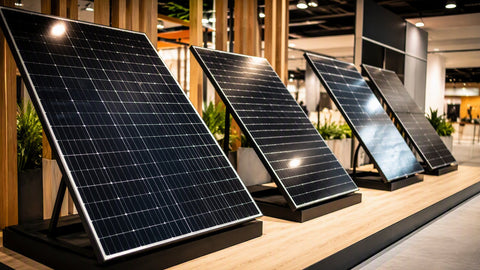
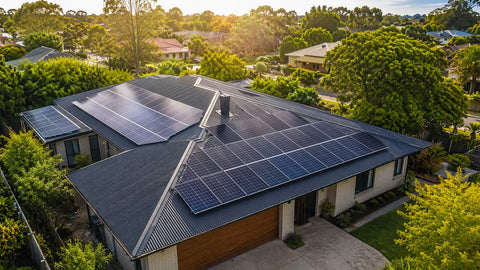
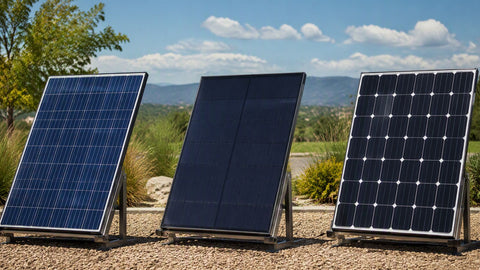
- Array: 10,000W of PV, typically 22–23 modules at 440–460W each or 18 modules at 550W. Modules in the 400–459W class are the current sweet spot for residential off-grid — manageable one-person handling at 47–53 lbs, and high enough wattage that racking and wiring costs stay proportional.
- Charge control: MPPT controllers, usually two or three paralleled units sized at 80–100A each on a 48V battery bus. The MPPT vs PWM question is settled for a system this size — PWM would waste 20–30% of the array. Details in MPPT vs PWM charge controllers.
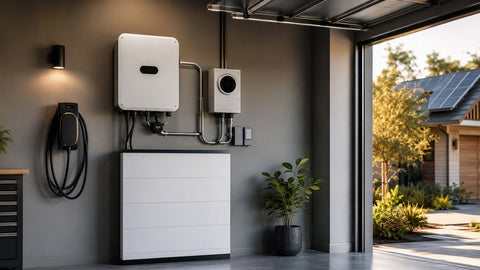
- Inverter: a 10kW–12kW low-frequency hybrid or off-grid inverter with a 48V battery input and 120/240V split-phase output. Surge rating matters as much as continuous rating; see the surge table below. Our 10–12kW hybrid inverter collection is where most builds land. For the hybrid-vs-off-grid distinction, see how hybrid solar inverters work.
- Battery bank: lithium iron phosphate (LiFePO4), 48V nominal, sized in kWh from your autonomy target — worked out in the table below. Banks in the 15–30kWh range are the starting point; most 10kW builds end up at 30–60kWh installed.
Array Sizing for Off-Grid Autonomy
Off-grid array sizing runs backwards from the load. The formula:
Required array (kW) = Daily load (kWh) ÷ (Peak sun hours × Derate)
Using a 0.85 derate, the table below shows the array size needed to fully recharge the battery and carry the load each day. For off-grid, you should size against your winter PSH, not your annual average — an array sized on annual average will under-produce for three to four months straight.
| Daily load (kWh) | Array @ 3.5 PSH (kW) | Array @ 4.0 PSH (kW) | Array @ 4.5 PSH (kW) | Array @ 5.0 PSH (kW) |
|---|---|---|---|---|
| 20 | 6.72 | 5.88 | 5.23 | 4.71 |
| 25 | 8.40 | 7.35 | 6.54 | 5.88 |
| 30 | 10.08 | 8.82 | 7.84 | 7.06 |
| 35 | 11.76 | 10.29 | 9.15 | 8.24 |
| 40 | 13.45 | 11.76 | 10.46 | 9.41 |
Read it this way: a 30 kWh/day household at 4.5 PSH needs only a 7.84kW array — a 10kW array gives that household roughly 28% headroom, which is exactly the margin you want for battery recharge after a cloudy day and for running daytime loads while the bank is still charging. At 3.5 PSH, the same 30 kWh/day load needs 10.08kW — meaning a 10kW array is the minimum, and a generator for winter gap days becomes part of the design. This is also why we push customers to oversize controllers: charging headroom is useless if the controller clips it. Sizing math is in our charge controller sizing guide.
Battery Bank Sizing by Days of Autonomy

The battery bank is the most expensive line item and the most commonly undersized. The formula:
Usable bank (kWh) = Daily load (kWh) × Days of autonomy ÷ Depth of discharge
LiFePO4 banks are routinely specified at 90% usable depth of discharge (DoD) — and holding to an 80% daily DoD is one of the habits that doubles cycle life, as covered in how to extend solar battery life. The table below uses 90% DoD and shows installed bank size in kWh. Numbers in parentheses are the count of 15.36kWh server-rack modules required, rounded up.
| Daily load (kWh) | 1 day autonomy | 1.5 days | 2 days | 3 days |
|---|---|---|---|---|
| 20 | 22.2 kWh (2) | 33.3 kWh (3) | 44.4 kWh (3) | 66.7 kWh (5) |
| 25 | 27.8 kWh (2) | 41.7 kWh (3) | 55.6 kWh (4) | 83.3 kWh (6) |
| 30 | 33.3 kWh (3) | 50.0 kWh (4) | 66.7 kWh (5) | 100.0 kWh (7) |
| 35 | 38.9 kWh (3) | 58.3 kWh (4) | 77.8 kWh (6) | 116.7 kWh (8) |
| 40 | 44.4 kWh (3) | 66.7 kWh (5) | 88.9 kWh (6) | 133.3 kWh (9) |
Two design rules fall out of this table. First, one day of autonomy is a grid-tie-with-backup number, not an off-grid number — one cloudy day shouldn't be an emergency, so we start at 1.5 days and prefer 2. Second, notice how the 30 kWh/day row lands: a 2-day bank is 66.7 kWh, or five 15.36kWh modules. That is a realistic mid-range off-grid install, and it's why a "10kW solar kit with one 15kWh battery" is a starter system, not a whole-home solution. For the full walkthrough of this sizing method, see our home battery bank sizing guide and solar battery sizing for off-grid living. If you're weighing battery brands at this scale, the Generac PWRcell cost guide is a useful price benchmark even though PWRcell is primarily a grid-tied product.
Installer note: I tell every customer the same thing: buy the bank for your worst week, not your average day. A customer in Idaho sized for 1.5 days of autonomy, hit a five-day inversion fog in January, and ran his generator 40 hours that week. We added two more 15.36kWh modules the following summer and his generator runtime the next winter was under 10 hours. Battery is cheaper than diesel and wear, every time.
Inverter Sizing: Continuous Load and Surge
A 10kW inverter rating is a continuous number. Motor loads — well pumps, refrigerators, freezers, compressors — draw two to three times their running watts for a few seconds at startup, and an inverter that can't cover the surge either trips or sags the whole house voltage. The sizing rule we use:
Required surge (W) = (Running total of all simultaneous loads − Running watts of largest starting motor) + Surge watts of largest starting motor
| Load | Running watts | Typical surge multiplier | Surge watts |
|---|---|---|---|
| Refrigerator (modern, 21 cu ft) | 700 | 3× | 2,100 |
| Chest freezer | 500 | 3× | 1,500 |
| Well pump, 1 HP | 750 | 3× | 2,250 |
| Mini-split heat pump, 1.5 ton (inverter-driven) | 1,500 | 1.5× | 2,250 |
| Central A/C, 3 ton (no soft start) | 3,500 | 3× | 10,500 |
| Microwave, 1,200W class | 1,200 | 1.5× | 1,800 |
| Lighting + electronics (whole house) | 800 | 1× | 800 |
Worked example: it's evening, the lights and electronics (800W), refrigerator (700W), and microwave (1,200W) are running — 2,700W coincident load. The 1 HP well pump starts: 2,700 + 2,250 = 4,950W instantaneous. A 10kW inverter with a 20kW surge rating covers that with room to spare. But add a 3-ton central A/C without a soft starter and the picture changes: lights, fridge, and A/C running is 5,000W; if the well pump starts on top of that, you need 7,250W plus headroom — and if the A/C compressor itself restarts while other loads run, you're looking at 3,500 running elsewhere + 10,500 surge = 14,000W. That scenario is why we either put a soft starter on the compressor or step up to a 12kW inverter with 24kW+ surge on fully electric builds.
Complete Off-Grid Solar Kits
Choosing the Right Inverter for Your System
Inverter-driven mini-splits change this calculus completely — a 1.5× surge multiplier instead of 3× — which is one reason they dominate off-grid HVAC. For inverter selection by brand and feature set, see our inverter picks for 2025. Smaller-system builders working through the same battery arithmetic can cross-check with how many batteries a 4,000W system needs — the math scales linearly.
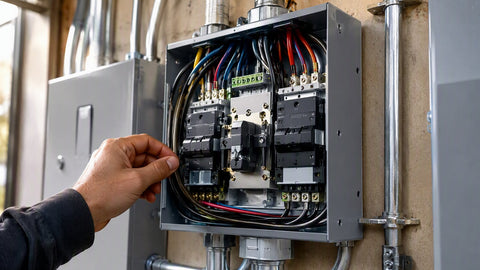
Installer note: The single most common service call I get on DIY off-grid systems is "the inverter faults when the well pump starts." Nine times out of ten it's not the inverter — it's a 200-amp-class battery cable run on a 10kW inverter, or a battery bank whose BMS discharge limit is below what the inverter can pull. A 10kW inverter at 48V draws over 250A at full load; if your three battery modules each have a 100A BMS limit, the bank chokes at 300A before voltage sag even starts. Check the bank's aggregate discharge rating before you blame the inverter.
Wire and Breaker Sizing: NEC 310.16 and 240.6
The battery-to-inverter DC run is the heaviest current path in the system. At 48V, amps climb fast: a 10kW inverter at full output, at the 44V low-battery cutoff and 85% inverter efficiency, draws 10,000 ÷ 44 ÷ 0.85 = 267A. NEC treats this as a continuous load, so conductors and overcurrent devices are sized at 125%: 267 × 1.25 = 334A. Conductor ampacities below are copper at 75°C termination rating from NEC Table 310.16; breaker sizes are standard ratings from NEC 240.6(A), applying 240.4(B) next-higher-standard-size rules where the conductor ampacity doesn't land exactly on a standard breaker size.
| Inverter size (48V) | Full-load amps @ 44V, 85% eff. | ×125% continuous | Breaker (240.6) | Min. copper conductor (310.16, 75°C) |
|---|---|---|---|---|
| 3 kW | 80 A | 100 A | 100 A | 2 AWG (115 A) |
| 5 kW | 134 A | 167 A | 175 A | 2/0 AWG (175 A) |
| 8 kW | 214 A | 268 A | 300 A | 300 kcmil (285 A) |
| 10 kW | 267 A | 334 A | 350 A | 400 kcmil (335 A) |
| 12 kW | 321 A | 401 A | 450 A | 600 kcmil (420 A) |
Read the 10kW row carefully: 400 kcmil copper is a serious cable, and voltage drop on anything longer than a few feet makes it worse. This is the practical argument for keeping the inverter within 10 feet of the battery bank and for buying inverters with parallel battery inputs so the current splits across two smaller conductors. On the AC side, the same 10kW inverter at 240V delivers 41.7A; at 125% that's 52A, so a 60A breaker and 6 AWG copper (65A at 75°C) feed the main panel. For the ampacity charts behind these rows, see our NEC wire ampacity chart and the deeper NEC wire sizing guide. Disconnect and overcurrent device placement for the PV side follows NEC 690, covered in our solar disconnect and OCPD guide.
Installer note: Don't let anyone talk you into aluminum on the battery-to-inverter run to save money. Aluminum at these currents means 600 kcmil class conductors, bigger lugs, antioxidant compound, and re-torque maintenance — and any savings evaporate the first time a lug creeps loose and takes out an inverter input stage. Copper, short runs, torqued to spec with a calibrated wrench. That's the job.
Generator Backup: Planning for the Worst Week
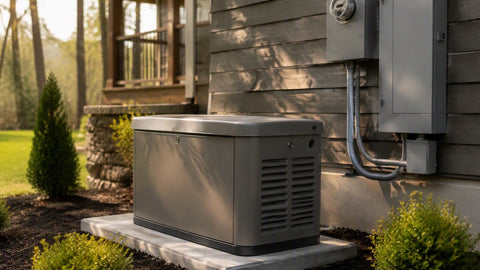
Even a correctly sized 10kW off-grid system benefits from a generator input. The battery bank handles days of autonomy; the generator handles weeks of weather. Most off-grid inverters in the 10–12kW class accept a generator AC input and pass 60–100A of charging current back to the battery bank while carrying house loads. A 10–14kW standby or portable unit is the matched size — big enough to charge the bank at full rate and run the house simultaneously, small enough not to wet-stack under light load. Options live in our 10–14kW standby generator collection, and the sizing logic mirrors our whole-home generator sizing guide.
What a 10kW Off-Grid System Runs — and What It Costs
With 30–38 kWh of daily production and a 2-day battery bank, a 10kW off-grid system comfortably runs: a full-size refrigerator and freezer, a well pump, a mini-split heat pump or two, lighting, electronics, laundry (cold wash, heat-pump dryer), and a microwave — simultaneously, with surge margin. It runs a 3-ton central A/C only with a soft starter and load management, and it does not run electric resistance heat, a tank water heater, or a range at full tilt alongside everything else. Fuel-fired appliances for the big thermal loads remain the standard off-grid architecture for good reason.
On cost: a complete 10kW off-grid install — array, racking, three MPPT controllers, 10–12kW inverter, 45–60kWh of LiFePO4 storage, balance of system, and labor — typically lands in the $45,000–$75,000 range before incentives, with the battery bank representing roughly a third of that total. The 30% federal residential clean energy credit applies to the full installed cost including storage, which is a material part of the payback math on a system this size.
Battery longevity is the other half of the economics. LiFePO4 cells rated for 6,000+ cycles at 80% DoD translate to 15+ years of daily cycling, and charging habits matter — the reasoning behind the 20–80% battery rule applies to stationary storage just as it does to phones and EVs.
One line item buyers consistently miss is balance-of-system cost at this scale. The DC cabling, disconnects, breakers, and busbars for a 350A-class battery circuit, plus three MPPT controllers, grounding, and rapid-shutdown hardware, add $4,000–$8,000 before labor. Ground mounting adds trenching and concrete. Budget the full system, not the kit sticker price, and compare quotes on installed cost per stored-and-delivered kWh rather than per nameplate watt — that metric exposes undersized battery banks immediately, because a cheap quote with one 15kWh module looks fine per watt and terrible per delivered kWh.
Frequently Asked Questions
How many solar panels does a 10kW off-grid system need?
Divide 10,000W by the module wattage: 22–23 panels at 440–460W each, 20 panels at 500W, or 18 panels at 550–560W. Plan roof or ground-mount space for roughly 500–600 square feet of array area.
How many lithium batteries do I need for a 10kW off-grid system?
Size from your daily load and autonomy target, not the inverter rating. For a 30 kWh/day household wanting 2 days of autonomy at 90% DoD, you need 66.7 kWh installed — five 15.36kWh LiFePO4 modules. One day of autonomy (three modules) is the practical minimum for true off-grid use.
Can a 10kW off-grid solar system run a whole house?
Yes, for a typical efficient home using 20–35 kWh per day, including refrigeration, well pump, mini-split HVAC, and standard appliances. Fully electric homes with resistance heat or a 3-ton central A/C need either a soft starter and load management or a step up to 12–15kW of inverter capacity.
What size inverter do I need for a 10kW solar array?
Match the inverter to your load, not the array. A 10kW continuous / 20kW surge low-frequency inverter covers most households; add the running watts of everything that can operate simultaneously, then add the surge draw of your largest motor. If that number exceeds about 14kW, move to a 12kW unit.
How long will a 15.36kWh lithium battery run a house?
At 90% DoD, one 15.36kWh module delivers about 13.8 kWh. A house drawing a 1 kW average load runs about 14 hours on one module; a house drawing 30 kWh per day drains one module in about 11 hours. That's why off-grid banks are built from multiple modules — runtime scales with the count.
Do I need a backup generator with a 10kW off-grid system?
In most climates, yes. The battery bank covers one to three days of autonomy, but extended cloudy weather in winter — especially at northern latitudes with 3.5 or fewer peak sun hours — will outrun any economically sized bank. A 10–14kW generator integrated through the inverter's AC input is the standard safety net.