PES Refrigerant Subscription Program: Recurring Pallet Delivery for HVAC Contractors
Quarterly pallet delivery, locked contractor pricing, priority hazmat routing, and cash-flow-friendly cylinder deposits.

Refrigerant demand for a growing HVAC contractor is predictable in aggregate and lumpy in detail. A five-truck residential/light commercial shop in the Midwest typically burns 240-320 lb of R-410A per month at seasonal peak and 80-120 lb per month in shoulder seasons. On paper this is 6-10 cylinders a month; in practice the shop orders 1-3 cylinders on demand from three different distributors at three different prices, taking a $22-45 freight hit on each order and paying above-tier prices because no single order hits the pallet-tier break.
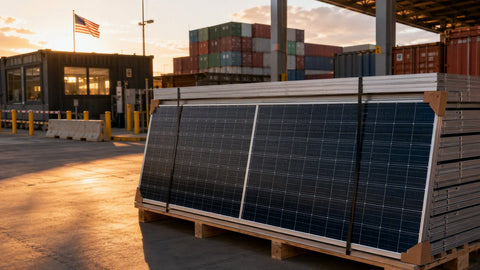
The PES Refrigerant Subscription Program consolidates this into a quarterly pallet delivery at locked contractor pricing. Instead of 24-36 spot orders per year, the shop places one recurring commitment (typically for a mix of R-410A, R-134a, R-454B, and reclaim credits) and PES delivers a rolling 3-month inventory on a scheduled cadence. The economics compound: bulk pricing, single freight, priority hazmat routing, and a locked price that hedges against AIM Act cap step-downs.
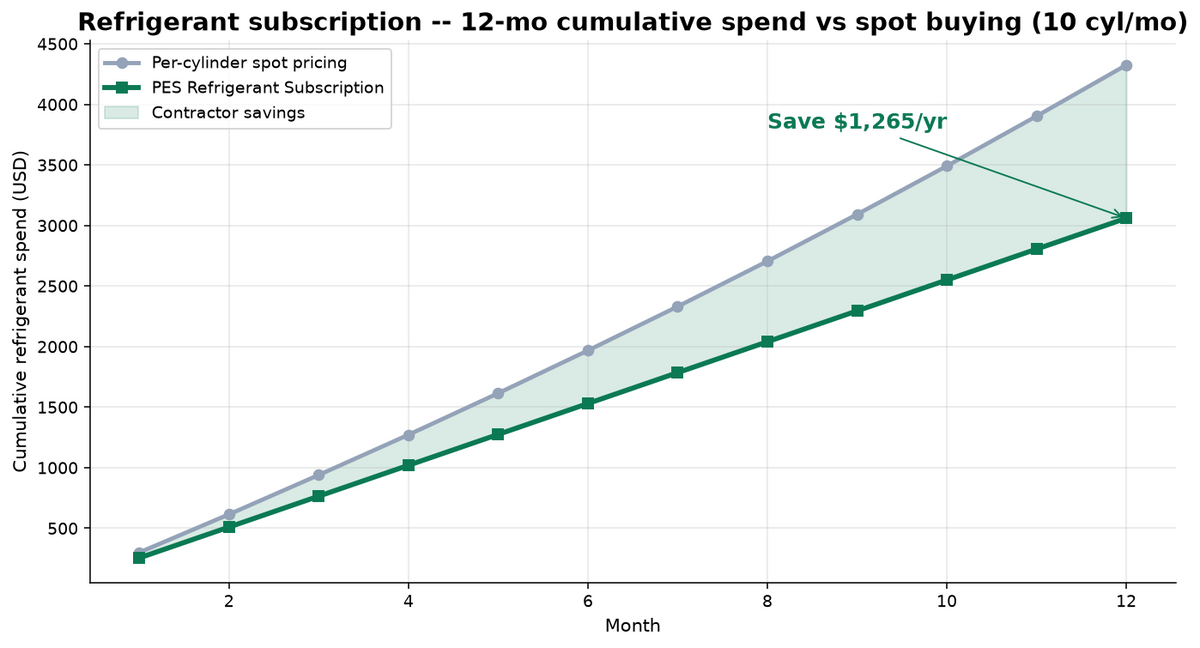
The chart above shows the 12-month cumulative spend model for a mid-size shop buying 10 cylinders/month at spot pricing vs the subscription tier. The savings compound over the year and typically total $1,000-1,800 per truck annually.
| Tier | Quarterly volume | Delivery cadence | Contractor price/lb R-410A | Price/lb R-454B | Included services |
|---|---|---|---|---|---|
| Bronze | 20-40 cyl / quarter | Quarterly | $8.94 | $20.20 | Base tier, single-drop freight |
| Silver | 40-80 cyl / quarter | Bi-monthly | $8.62 | $19.75 | Priority hazmat routing, dedicated freight desk |
| Gold | 80-160 cyl / quarter | Monthly | $8.30 | $19.10 | Locked 12-mo pricing, reclaim credit acceleration |
| Platinum | 160+ cyl / quarter | Bi-weekly | $8.05 | $18.60 | White-glove delivery, on-site cylinder swap, AR terms 45-day |
The largest single working-capital line for a contractor buying refrigerant is the cylinder deposit. A 40-cylinder pallet of refillable 25 lb R-410A carries $3,000-5,000 in cylinder deposits at $75-125 per cylinder. Across four quarterly pallets a year, a shop can have $12,000-20,000 tied up in deposit float. This is uncomfortable for a small business but not a dealbreaker.
The subscription program smooths this in two ways. First, subscription tiers unlock rolling deposit float -- the empty cylinders from the last delivery are picked up on the same truck that drops the next delivery, so the deposit rolls forward without a cash gap. Second, reclaimed refrigerant recovered from customer systems (R-22, R-410A, R-134a) is credited back to the subscription account at $2-4/lb on AHRI 700-compliant returns, offsetting the next quarter's spend.
A shop on the Gold tier that recovers 40-60 lb/month of used refrigerant will typically see a $1,200-2,400 annual reclaim credit applied to their subscription balance. This is meaningful additional margin that spot-buyers usually don't capture because their reclaim volume is too small to justify the paperwork.
-
1
Baseline your last 12 months of refrigerant purchases
Pull your last 12 months of refrigerant purchase orders across all distributors. Total the lb by refrigerant type. This gives PES the baseline for tier assignment. Most shops discover they're spending 15-30% more than expected because purchases are spread across multiple vendors.
-
2
Choose a tier and delivery cadence
Based on your baseline, PES's team recommends a tier. Most 3-8 truck shops land at Bronze or Silver; 8-20 truck shops at Silver or Gold; large regional players at Platinum. The delivery cadence should match your average cylinder burn rate so that inventory never exceeds 60 days on hand.
-
3
Set up scheduled delivery windows and hazmat routing
Your account manager coordinates with XPO, Estes, or Old Dominion (whichever has the best rate to your commercial address) and schedules a recurring delivery window -- typically a specific weekday, alternating weeks. You get advance notice 48 hours before delivery and a full BOL with cylinder serial numbers.
-
4
Establish reclaim credit protocol
PES provides pre-labeled reclaim cylinders that ride your service trucks. When they're full, you schedule a return LTL pickup (or drop at a nearby XPO/Estes terminal). PES weighs and tests each returned cylinder against AHRI 700 and credits your subscription balance at the current reclaim rate.
-
5
Activate the portal for compliance and re-order visibility
The Axis portal at axis.pesdistribution.com shows all cylinder serial numbers by refrigerant, current inventory on hand, reclaim credit balance, upcoming deliveries, and next-tier eligibility. Compliance recordkeeping under 40 CFR 82.166 is auto-generated as PDF reports on demand.
| Metric | Spot buying | Subscription (Silver) | Annual difference |
|---|---|---|---|
| Annual refrigerant volume | 3,000 lb | 3,000 lb | - |
| Blended per-lb cost | $10.85 | $8.62 | -20.6% |
| Refrigerant COGS | $32,550 | $25,860 | -$6,690 |
| Freight cost | $2,640 (12 orders) | $980 (6 deliveries) | -$1,660 |
| Cylinder deposit float (avg) | $1,850 | $980 (rolling) | -$870 working capital |
| Reclaim credit captured | $0-350 | $1,650 | +$1,300 |
| Total annual saving | - | - | ~$9,650 |
Is there a minimum commitment for the subscription program?
Can I pause or skip a quarterly delivery?
What happens if refrigerant prices go up mid-contract?
Can I change my refrigerant mix quarter-to-quarter?
How does the program handle A2L refrigerants like R-454B?
Is there a signup fee?
The largest cash-flow benefit of the subscription program isn't the per-lb pricing discount -- it's the smoothing of refrigerant purchases into a predictable monthly or quarterly rhythm. Contractors buying refrigerant on-demand experience seasonal cash-flow swings tied to service season. A 5-truck residential shop can spend $3,500 on refrigerant in April, $8,200 in July at the peak, and $1,900 in November. Working capital planning has to accommodate the July spike.
Subscription contractors on the Gold tier receive locked pricing on quarterly deliveries scheduled evenly through the year. The May and November deliveries carry the same lb volume as the August delivery; the shop's cash outflow smooths out. Combined with the reclaim credit acceleration on subscription accounts, the working capital swing on refrigerant compresses by 60-70% compared to on-demand purchasing.
For shops on net-30 or net-45 terms, this smoothing also improves the line-of-credit relationship. Banks look at seasonality when sizing lines of credit, and a predictable refrigerant expense (recurring at consistent intervals) reads as lower risk than lumpy on-demand purchases.
Recovered refrigerant is a legitimate revenue line for HVAC contractors, and the subscription program formalizes its capture. Every service call that involves refrigerant recovery generates 1-8 lb of recovered refrigerant -- some going to disposal, some to reclaim, some to reuse in the same system.
Under EPA rules, recovered refrigerant that meets AHRI 700 purity standards can be reclaimed and resold. PES's reclaim program pays $2-4/lb on qualifying recovered R-410A, R-22, and R-134a. For a 5-truck shop recovering 40-60 lb/month, this is $80-240/month in credit -- $960-2,880/year.
Subscription accounts get two enhancements. First, the reclaim credit is applied automatically to the next quarterly delivery, so shops don't have to manage separate reclaim payment tracking. Second, subscription accounts get priority pickup on reclaim cylinders -- typically weekly reverse-LTL pickup vs monthly for non-subscribers -- which reduces the working capital tied up in reclaim inventory.
The economic impact is real. A shop capturing $2,400/year in reclaim credits on a Silver subscription tier is effectively getting a 6-9% discount on their annual refrigerant spend, on top of the tier pricing discount.
The operational rhythm of a subscription customer looks slightly different from on-demand buying. Delivery windows are scheduled 14-28 days in advance. Cylinder inventory sits in a designated commercial storage area (indoor, ventilated, away from heat and ignition sources). Cylinders are tracked by serial number in the Axis portal.
Delivery window scheduling. Each subscription account gets an assigned delivery weekday and rotation (e.g., every 4th Tuesday). The window is confirmed 5-7 days in advance and again 48 hours before delivery. Contractors can request a shift within a 3-business-day window without penalty.
Storage requirements. Refillable refrigerant cylinders must be stored upright, in a temperature-controlled space (32-125°F), away from ignition sources. A2L cylinders (R-454B, R-32) additionally require flammable-storage classification -- most shops handle this with a dedicated ventilated rack in the shop's mechanical area. PES provides storage-rack recommendations sized to each tier's delivery volume.
Cylinder rotation. Empty cylinders are picked up on the same delivery run that drops the next quarter's shipment. FIFO rotation is standard -- the oldest empties leave first. This preserves cylinder deposit float and simplifies reverse-LTL logistics.
Portal visibility. Every cylinder in your inventory is tracked in the Axis portal by serial number, refrigerant type, purchase date, and current status (full, in-service, empty). Compliance recordkeeping under 40 CFR 82.166 is auto-generated as PDF reports on demand.
Modern service management platforms (ServiceTitan, FieldEdge, Housecall Pro, Jobber) integrate with distributor data flows to auto-log refrigerant purchases against jobs. PES's Axis portal exports service data via a standardized API that these platforms consume. This creates a closed-loop workflow: the tech logs refrigerant usage on a customer ticket, the data flows to PES, PES nets the usage against your subscription balance, and the cost hits your job costing automatically.
For shops that don't yet use a service management platform, subscription customers can access the same data through the Axis portal's job-cost export function -- a CSV download that plugs into QuickBooks or any other accounting system.
The compliance benefit is meaningful. Every refrigerant addition is auto-logged with cylinder serial number, tech name, cert number, and job ID. If the EPA ever requests records for a specific service call, the audit trail is one query away.
The subscription tiers are structured so that a growing shop can move up as volume dictates without contractual friction. A shop starting on Bronze can upgrade to Silver mid-contract at any time; the pricing adjusts on the next quarterly delivery. Downgrades are also allowed but only at contract renewal (annual).
For shops uncertain about which tier fits, PES offers a 90-day trial on Bronze with no minimum volume commitment. If the shop's volume falls short of Bronze's 20 cyl/quarter minimum during the trial, the account reverts to standard contractor pricing with no penalty. If volume exceeds Bronze, the shop can either continue on Bronze or upgrade to Silver at the 90-day mark.
Pricing is contractually locked for 12 months at Gold and Platinum tiers, with a 24-month option for Platinum that includes a price ceiling on any AIM Act cap-triggered spot price increases. For shops with long-horizon service contracts (property management contracts, commercial facility service agreements) this hedges the refrigerant cost side of those agreements.
Enroll in the PES Refrigerant Subscription Program
Quarterly pallet delivery, locked pricing, rolling deposits, and captured reclaim credits -- built for shops moving 20+ cylinders per quarter.
Register Now