Commercial HVAC Refrigerant Compliance for Facility Managers: 40 CFR Part 82, Leak Repair Thresholds, and Penalty Avoidance
A facility manager's operating manual for EPA Section 608 compliance -- recordkeeping, leak-repair triggers, and the audit trail that keeps enforcement out of the door.

The EPA's refrigerant management regulations under 40 CFR Part 82 place the compliance burden on the owner and operator of the equipment -- not on the HVAC contractor servicing it. This is a common misunderstanding. If a commercial chiller in your building has an unrepaired refrigerant leak, the EPA administrative penalty (up to $57,617 per day under the 2024 revised civil penalty schedule) is assessed against the building owner, not the contractor who found the leak. The contractor's obligation is to report; yours is to repair and document.
Facility managers running any equipment with more than 50 lb of refrigerant charge (essentially all commercial and industrial HVAC/R systems) fall under three specific obligations: leak-rate calculation, leak-repair timing, and recordkeeping. This guide covers each in detail, including the 2019 threshold updates that most facility managers still don't have current on their compliance programs, and the audit trail you need in place when the EPA (or a corporate ESG audit, or an insurance underwriter) asks for it.
| Equipment category | Leak rate trigger | Repair timeline | Verification testing |
|---|---|---|---|
| Comfort cooling (commercial AC, chillers) | 10% of full charge in 12 months | 30 days from discovery | Initial + follow-up leak test |
| Commercial refrigeration (grocery, food service) | 20% of full charge in 12 months | 30 days from discovery | Initial + follow-up leak test |
| Industrial process refrigeration | 30% of full charge in 12 months | 120 days from discovery | Initial + follow-up leak test |
| All categories | No trigger, but if repaired | N/A | Follow-up test within 30 days of repair |
The 12-month rolling leak rate is the specific metric the EPA uses. It's calculated by summing the refrigerant added to the system over the trailing 12 months (whether from technician additions or system top-offs) and dividing by the full system charge. If a chiller with a 500 lb full charge has 55 lb added over 12 months, the leak rate is 55/500 = 11%. For a comfort-cooling application, this crosses the 10% threshold and triggers the 30-day repair clock.
Two important nuances. First, the 12-month window is rolling, not calendar. Every service call adds to the running sum and the oldest month rolls off. This means a leak that developed slowly can suddenly cross the threshold when a top-off is added -- and the clock starts when the addition is logged, not when the leak began. Second, the leak rate calculation assumes the entire top-off was due to leakage. If refrigerant was added for a legitimate operational reason (like commissioning after a component replacement), that addition should be logged separately in the compliance record as "non-leakage addition" and excluded from the leak-rate math.
Practically, this means your recordkeeping system needs to differentiate between leakage additions and non-leakage additions on every service call. Most facilities use a simple checkbox on the service ticket -- most service management platforms (ServiceTitan, FieldEdge, Housecall Pro) support this in configuration.
-
1
Inventory all refrigerant-containing equipment above the 50 lb threshold
Walk every building on your portfolio. List every AC unit, chiller, refrigeration case, walk-in cooler, and process equipment that contains more than 50 lb of refrigerant. Note the refrigerant type, nameplate charge, install date, and current maintenance contractor. Systems below 50 lb are exempt from the leak-repair rules but should still be inventoried for AIM Act reporting.
-
2
Set up a compliance recordkeeping system
Every servicing event on covered equipment must be logged. At minimum: date of service, technician name, EPA 608 cert number, service type (recovery, evacuation, charging), refrigerant type, quantity added or recovered, and whether the addition was leakage or non-leakage. This can be a simple spreadsheet, but for portfolios above 10 covered systems, a purpose-built compliance platform (Envizi, Trakref, or a service management platform with 608 module) is a better fit.
-
3
Establish leak-detection frequency requirements
Under 40 CFR 82.157(b), commercial refrigeration systems above 500 lb charge require quarterly automatic leak monitoring OR annual comprehensive leak detection. Industrial process refrigeration >500 lb requires the same. Comfort cooling systems below 500 lb have no mandated leak-detection frequency but leak-rate calculations still apply. Set your service contract to include the required frequency.
-
4
Create the leak-repair workflow and 30-day timeline tracking
When a leak is discovered (either through detection or when a leak rate exceeds the threshold on a top-off), you have 30 days for comfort cooling or commercial refrigeration, 120 days for industrial process, to repair the leak. Set up a project tracker (JIRA, ServiceNow, or spreadsheet) that opens a ticket the day a leak triggers the clock and tracks days-to-repair. Extensions are available for a legitimate technical infeasibility but require formal EPA notification.
-
5
Schedule the mandatory follow-up leak verification test
Within 30 days of the leak repair, a follow-up leak test must be performed and documented in the service record. This is the step that most facility managers miss. Without the follow-up test on file, the repair is not legally complete and enforcement can treat the equipment as still leaking. Build the follow-up test into your service contract as a standing requirement.
-
6
Retain records for the minimum required period
40 CFR 82.166 requires records to be retained for at least 3 years for most categories, and indefinitely for systems currently in leak-triggered status. Most compliance auditors and insurance underwriters look at 5 years of history. Keep the records digitally with backup.
EPA Section 608 enforcement historically ran at 40-90 civil actions per year, but has increased under the AIM Act framework. The typical enforcement path begins with a triggering event -- often a tip from a former employee, a competitor complaint, or a distributor audit that flags an unusually large refrigerant purchase pattern. The EPA (or a state delegated agency) issues a records request under 40 CFR 82.166.
The records request is broad: purchase records, service records, leak-detection logs, and cert verification for every tech who worked on the equipment. A facility manager with a well-maintained compliance program produces this in a few days. A facility manager without one -- and this describes most commercial real estate operators -- typically has 30-60 days to reconstruct records, which is expensive and often incomplete.
The most common enforcement finding is not an unrepaired leak; it's poor recordkeeping. The EPA penalty guidance provides a $2,750-$11,000 penalty per system per year of poor recordkeeping, before any actual leak-repair penalties are considered. A property manager overseeing 30 buildings with 3 covered systems each is looking at potential exposure of $247,500-$990,000 for a 3-year records lookback, entirely from paperwork problems. Documented, well-organized recordkeeping is the single highest-ROI compliance investment.
| Requirement | Comfort cooling | Commercial refrigeration | Industrial process |
|---|---|---|---|
| Full charge (nameplate) documentation | Required | Required | Required |
| Leak-rate calculation per service | Required | Required | Required |
| Automatic leak detection | Optional | Required if >500 lb | Required if >500 lb |
| Annual comprehensive leak inspection | Optional | Required if <500 lb | Required if <500 lb |
| Initial + follow-up leak verification | Required after repair | Required after repair | Required after repair |
| Records retention (min) | 3 years | 3 years | 3 years |
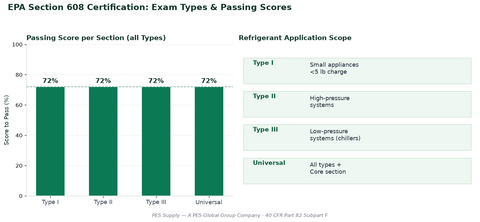
| Tech EPA 608 cert verification | Required | Required | Required |
| Refrigerant disposition (recovery/disposal) | Required | Required | Required |
A compliant service record for any covered system should capture the following on every service call, whether or not refrigerant was added:
- Date and time of service
- Facility name and address
- Equipment ID (asset tag) and nameplate refrigerant charge
- Refrigerant type serviced
- Technician name and EPA 608 cert number
- Service type (leak detection, recovery, charging, oil change, other)
- Refrigerant added (lb, from what cylinder serial number, source distributor)
- Refrigerant recovered (lb, into what recovery cylinder serial number, disposition)
- Leak detection performed (yes/no, method, findings)
- If leak found: location, repair action, follow-up test scheduled
- 12-month rolling leak rate (calculated after any addition)
- Non-leakage addition flag (if applicable, with justification)
- Tech signature and customer/facility manager signature
Most service management platforms can generate this form as a custom template. For facility managers running compliance across multiple contractors, standardizing this template across all servicing contractors is a top-priority operating discipline.
What is the current EPA penalty for a Section 608 violation?
Do I need to report every refrigerant leak to the EPA?
Does the leak-repair clock stop if I attempt a repair that fails?
What if a leak repair is technically infeasible within 30 days?
Are we required to switch to A2L refrigerants on existing systems?
How do I document that a system is empty (retired without leaking)?
Does the EPA audit small facility owners, or only large corporations?
Can I contract compliance to my HVAC service provider?
Federal EPA regulations set the floor. Several states -- notably California, Washington, Colorado, and New York -- add state-level requirements that increase the compliance burden for facilities in those jurisdictions.
California CARB regulations. The California Air Resources Board has its own refrigerant management program (RMP) that expands on 40 CFR Part 82. CARB requires annual reporting for facilities with >50 lb of refrigerant charge across covered equipment, mandatory automatic leak detection on refrigeration systems >200 lb, and specific low-GWP transition requirements ahead of the federal AIM Act timeline. Penalties are separate from and additive to federal penalties.
Washington HFC rule. Washington State has phased down high-GWP HFCs on an accelerated schedule vs the federal AIM Act. New commercial refrigeration equipment above certain charge thresholds must use <150 GWP refrigerants (essentially CO2 or hydrocarbon systems) starting in 2024. Existing equipment can continue with legacy refrigerants but reporting requirements are stricter.
Colorado GHG program. Similar to Washington's approach but with somewhat later effective dates. Colorado additionally requires reclaim tracking for facilities above certain thresholds.
New York HFC phasedown. Following California's approach with an accelerated timeline. Reporting requirements for large facilities are already in effect.
For facility managers with portfolio in these states, state-level compliance is a distinct workstream from federal compliance. Most compliance platforms (Trakref, Envizi, Verdantix) integrate state rules automatically.
Commercial property insurance underwriters have become increasingly attentive to refrigerant compliance over the past three years. The reason: refrigerant leaks are a growing source of business interruption claims, and refrigerant regulatory violations can void coverage for related losses.
When a commercial property is underwritten, most large insurers now request evidence of a documented refrigerant compliance program: equipment inventory with charge quantities, current leak-detection frequency, service contractor with 608 verification on file, and 3+ years of service records. Properties without this documentation face higher premiums or coverage exclusions on refrigerant-related losses.
Practical implication for facility managers: your insurance broker is a good advocate for the compliance investment. A well-documented compliance program often qualifies the property for a 5-15% premium reduction on the property policy, which typically offsets the compliance-program cost within 12-24 months.
Six patterns account for most compliance risk in commercial facility operations.
1. Undocumented full charge. The most common finding in EPA records requests is that the facility does not have documented full-charge quantities for its equipment. Without a documented full charge, leak rate calculations can't be verified, and the EPA assumes the worst case. Fix: pull nameplate data on every covered system and document in your equipment inventory. Where nameplate is missing, use manufacturer service manuals or contact the OEM.
2. Missing tech cert verification. Service records that don't include the technician's EPA 608 cert number are non-compliant. Fix: require your service contractor to include cert number on every ticket, and standardize the ticket format.
3. Non-leakage additions not distinguished. Refrigerant added during commissioning or after a component replacement is not leakage but often gets logged as if it were. Fix: add a mandatory "non-leakage justification" field to service tickets.
4. Follow-up leak tests not performed. Missed follow-up tests are the second most common finding after undocumented full charges. Fix: build follow-up tests into the leak-repair workflow as a mandatory step, not an option.
5. Records retention. Records deleted or lost after 12-18 months don't satisfy the 3-year minimum retention. Fix: cloud-based recordkeeping with automated retention policies.
6. Contractor-only recordkeeping. Records held only by the service contractor are not sufficient for owner compliance under 40 CFR 82.166. Fix: monthly digital copy of records provided to the facility manager.
An EPA records request under 40 CFR 82.166 is not a common event for most facility managers, but when it happens, preparation determines whether it takes days or weeks to respond. The request typically arrives via certified mail or email from an EPA regional office, includes a specific date range and equipment list, and gives 30-60 days to produce records.
The specific records the EPA requests: (1) full equipment inventory with charge quantities, (2) service records for each covered system in the date range, (3) leak detection reports, (4) evidence of servicing tech EPA 608 certification, (5) refrigerant purchase records showing source and quantity, (6) recovered refrigerant disposition. Absence of any of these creates a compliance gap.
A facility manager with a well-maintained program can respond to a records request in 3-5 business days by exporting from their compliance recordkeeping system. A facility manager without one typically takes 3-6 weeks and often produces incomplete records that draw further scrutiny.
Practical preparation: run an internal audit annually. Pull records for 3 random systems over the last 12 months and verify all seven required record types are present and complete. If any are missing, close the gap. This exercise costs 4-6 hours annually and dramatically reduces enforcement risk.
Compliance recordkeeping can be handled at three levels of sophistication: (1) manual spreadsheet, (2) service management platform with a 608 compliance module, or (3) dedicated compliance software.
Manual spreadsheet. Appropriate for facility managers with <10 covered systems and a single servicing contractor. Google Sheets or Excel with a service ticket log covers the requirements. Time investment is 30-60 minutes per week to enter service ticket data.
Service management platform. ServiceTitan, FieldEdge, Housecall Pro, and Jobber all offer 608 compliance modules or configurable custom fields. Appropriate for contractors managing compliance for customers -- the servicing contractor's platform doubles as the customer's compliance record. Cost is typically included in the base subscription; no additional software.
Dedicated compliance software. Trakref, Envizi, Verdantix, and a handful of specialized providers offer purpose-built refrigerant compliance platforms. Appropriate for facility managers with 30+ covered systems across multiple sites, or enterprises with ESG reporting obligations. Cost is $150-450/site/month.
For most mid-market facility managers, the service management platform path (or manual spreadsheet for smallest portfolios) provides sufficient compliance rigor at reasonable cost.
Set up a Section 608 compliance program with PES Supply
Digital compliance recordkeeping, cert verification for every servicing tech, and refrigerant purchase records auto-linked to your equipment inventory.
Register Now