HVAC Contractor Refrigerant Buying Guide: R-410A, R-134a, R-22 Bulk Pricing & Hazmat Shipping
EPA 608 cert gate, DOT hazmat routing, and pallet-tier contractor pricing for the four refrigerants that actually still ship in 2026.

Buying refrigerant for a contracting business in 2026 is nothing like buying it in 2018. The AIM Act phasedown has cut the U.S. HFC production baseline to 60% (2025) and headed to 40% by 2029, R-22 has been off the new-production list since 2020, and the EPA's Section 608 program now requires every technician who buys refillable cylinders to hold a live certification card that the seller has to verify at checkout. Sourcing R-410A, R-134a, R-22, or the new R-454B is no longer a matter of finding the cheapest cylinder online -- it is a matter of finding a hazmat-authorized distributor that will actually verify your cert, palletize your order, and ship it via a DOT-compliant carrier without triggering the $500 residential-delivery accessorials that eat contractor margin.
This buying guide covers the four refrigerants that still move freight in North America (R-410A, R-134a, R-22 reclaimed, and R-454B), the EPA 608 verification workflow every legitimate distributor is supposed to run, the DOT hazmat rules governing 30 lb and 125 lb refillable cylinders, and the pallet-tier pricing math that separates contractors who buy at $9.96/lb from contractors who buy at $18/lb through big-box outlets. PES Supply stocks each of the SKUs listed below in Louisville, KY warehouses that ship LTL nationwide with pre-negotiated hazmat rates through XPO, Estes, and Old Dominion.
Who this guide is for: Independent HVAC contractors, service company owners, facility maintenance directors, and refrigeration wholesalers who buy more than five 25-30 lb cylinders per year. If you buy one 25 lb cylinder every 18 months for an emergency service call, you are better off at your local supply house paying retail. If you buy a pallet a quarter, this is where the money is.
| Refrigerant | Cylinder size | PES contractor price (1 unit) | Pallet-tier price (40 cyl) | GWP | AIM Act status |
|---|---|---|---|---|---|
| R-410A (virgin) | 25 lb refillable | $249.00 / cyl ($9.96/lb) | $219.00 / cyl ($8.76/lb) | 2088 | Cap-restricted, phasedown active |
| R-134a (virgin) | 30 lb refillable | $229.00 / cyl ($7.63/lb) | $199.00 / cyl ($6.63/lb) | 1430 | Cap-restricted, MVAC continues |
| R-22 (reclaimed, AHRI 700) | 30 lb refillable | $279.00 / cyl ($9.30/lb) | $259.00 / cyl ($8.63/lb) | 1810 | No new production since 2020, reclaimed only |
| R-454B (virgin) | 25 lb refillable | $537.00 / cyl ($21.48/lb) | $495.00 / cyl ($19.80/lb) | 466 | Preferred 2025+ replacement for R-410A |
| R-407C (virgin) | 25 lb refillable | $222.50 / cyl ($8.90/lb) | $198.00 / cyl ($7.92/lb) | 1774 | Cap-restricted, drop-in for R-22 retrofits |
| R-32 (virgin) | 24.5 lb refillable | $318.00 / cyl ($12.98/lb) | $289.00 / cyl ($11.80/lb) | 675 | Mildly flammable, A2L classification |
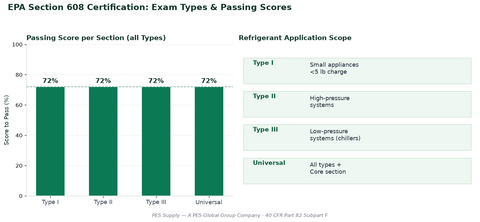
Under 40 CFR Part 82 Subpart F, no wholesaler can sell any HCFC or HFC refrigerant in containers larger than 2 lb without verifying the buyer's EPA Section 608 certification. The specific verification workflow varies by distributor -- some upload cert cards into a compliance vault, some log a manual verification form on file, some run the cert number through the U.S. EPA's own verification database -- but the compliance risk sits on the seller, not the buyer. If a distributor sells you a cylinder without pulling your cert on file, you still get your cylinder, but that distributor is at risk of a $57,617-per-day EPA administrative penalty under 40 CFR 82.166.
Practically, this means the first time you order from a new distributor you will be asked to upload a PDF or photo of your EPA 608 card. The card must show your name, cert type (I, II, III, or Universal), and cert number. Cards do not expire under current EPA rules -- the certification is lifetime -- but distributors will typically ask you to re-verify every 2-3 years or after a legal-entity change. If your card is issued under an old employer's name, the EPA still recognizes it, but many distributors require the card be in the ordering entity's name for their audit trail.
PES Supply uses a single portal upload at axis.pesdistribution.com that ties your cert card to your account permanently. You upload once, we verify once, and every subsequent refrigerant order ships without a re-verification loop. Contractors ordering above the pallet-tier threshold also receive a dedicated hazmat freight desk that handles carrier routing.
-
1
Register for a wholesale account and upload EPA 608 documentation
Complete a business account application including EIN, resale certificate, and a scanned copy of your EPA Section 608 certification card. Most distributors turn this around in 1-2 business days. PES Supply's Axis portal auto-verifies commercial applicants and issues net-30 terms after the third clean order.
-
2
Choose refillable vs disposable cylinder format
As of January 2025, DOT-39 disposable (non-refillable) cylinders are phased out for HFC refrigerants under EPA venting rules -- almost all new orders will ship in refillable DOT-4BA or DOT-4BW cylinders. This means you pay a cylinder deposit (usually $75-125 per 30 lb, refundable when the empty cylinder is returned via reverse LTL). Factor this into cash-flow planning: a 40-cylinder pallet locks up $3,000-5,000 in deposits until returned.
-
3
Size the order to hit a pallet-tier price break
Cylinder-count price breaks are non-linear. At PES the break-points are 1-5 cyl (list price), 6-15 cyl (5% off), 16-39 cyl (10% off), and 40+ cyl (full pallet, 12% off + freight-optimized routing). A single service truck rarely justifies a 40 cyl pallet, but a five-truck shop refilling monthly hits pallet economics fast.
-
4
Confirm hazmat freight routing and residential-delivery exposure
Refrigerants are UN1078 (R-410A, R-407C), UN3159 (R-134a), UN1018 (R-22), or UN3163 (R-454B) -- all Class 2.2 non-flammable except R-454B/R-32 which are Class 2.1 flammable. LTL carriers apply a hazmat surcharge of $42-65 per shipment plus a $195-340 residential-delivery accessorial if the ship-to is coded residential. Always ship to a commercial address with a loading dock or forklift, or PES will route to the nearest XPO or Estes terminal for will-call pickup with no accessorial.
-
5
Log cylinder serial numbers into your Section 608 recordkeeping
Under 40 CFR 82.166, contractors are required to log every cylinder received, its refrigerant type, weight, source, and disposition. PES ships every cylinder with an AHRI 700 purity certificate and the cylinder serial number pre-printed on the packing list -- this satisfies the intake portion of your recordkeeping automatically. Attach the packing list to your service management system's compliance folder or a Google Drive log.
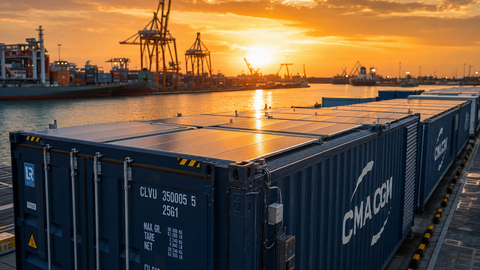
Every refillable refrigerant cylinder shipped in the U.S. moves under 49 CFR Part 173 as a Class 2 gas. That means the carrier must be a HM-232-authorized motor carrier with a valid hazmat endorsement on the driver's CDL, the shipment must be accompanied by a shipper's declaration and a placarded trailer, and the receiver must have a physical location capable of accepting hazmat freight. This eliminates FedEx Ground and UPS Ground from serving as primary carriers for pallet-tier orders -- those services will accept single-cylinder shipments under ORM-D exemptions, but the per-cylinder cost is punishing (see chart 8 in the freight guide).
The three carriers that dominate refrigerant LTL are XPO Logistics, Estes Express Lines, and Old Dominion Freight Line. All three offer standard hazmat handling at a flat surcharge (currently $42-65/BOL) plus fuel and any accessorials. Old Dominion's on-time delivery record (98.4% in 2025 per the SMC3 Blue Book) makes it the default for time-sensitive service company orders. PES Supply pre-negotiates rates with all three and quotes the lowest at cart. For pallet-tier orders shipping within 300 miles of Louisville, KY, next-day standard LTL delivery is the norm.
Contractors who need same-day pickup can use will-call at either the Louisville distribution center or via one of 62 XPO terminal cross-docks nationwide. Will-call adds zero freight cost, but you (or your driver) must present a valid EPA 608 card at pickup.
| Refrigerant | UN # | DOT hazard class | Placarding | Cylinder specification | Notes |
|---|---|---|---|---|---|
| R-410A | UN1078 | 2.2 non-flammable gas | Green 2.2 | DOT-4BA or 4BW refillable | Most common HVAC HFC; no venting allowed |
| R-134a | UN3159 | 2.2 non-flammable gas | Green 2.2 | DOT-4BA or 4BW refillable | MVAC and low-temp commercial; SNAP-approved uses |
| R-22 | UN1018 | 2.2 non-flammable gas | Green 2.2 | DOT-4BA or 4BW refillable | Reclaimed only; AHRI 700 purity required |
| R-454B | UN3163 | 2.1 flammable gas | Red 2.1 | DOT-4BA + explosion-proof handling | New A2L; requires ADA-compliant labeling |
| R-407C | UN3340 | 2.2 non-flammable gas | Green 2.2 | DOT-4BA or 4BW refillable | R-22 drop-in for retrofits |
| R-32 | UN3252 | 2.1 flammable gas | Red 2.1 | DOT-4BA + explosion-proof handling | A2L, growing in mini-split systems |
Contractor pricing on refrigerant isn't a discount -- it's a different economic model. Retail refrigerant priced through big-box outlets, marine chandleries, and online marketplaces carries a full-service markup, single-cylinder freight, residential handling, no cert verification, and no cylinder-return infrastructure. A 25 lb R-410A cylinder on Amazon runs $445-495 in September 2026 including freight; the same cylinder in a 6-pack order from a compliant distributor lands at $229 (48% below retail). At a 40-cylinder pallet order, the per-cylinder price hits $219 (56% below retail).
The additional lever is the cylinder deposit. Retail refrigerant sold in disposable cylinders builds the container cost into the unit price permanently. Refillable-cylinder contractor pricing charges a deposit that returns to your account when the cylinder is sent back via reverse LTL. Over a 12-month cycle, refillable deposits recycle 4-6 times, and the effective cash cost per pound converges to the raw refrigerant cost plus a modest handling margin.
The contractor-side implication: buying refrigerant through the pallet-tier and refillable-cylinder path saves 30-50% on refrigerant cost of goods, which typically compresses the tech billable hour recovery time on a service call from 2.4 hours to 1.6 hours before COGS breakeven.
Can I buy R-410A without an EPA 608 card?
Is R-22 still available in 2026?
What is R-454B and why is it more expensive?
Do you ship refrigerant to Alaska, Hawaii, or Puerto Rico?
What happens when a refillable cylinder is empty?
Can I mix refrigerant orders on a single pallet?
What is your lead time on a pallet order?
Refrigerant distribution in the U.S. is dominated by a handful of primary manufacturers (Honeywell, Chemours, Arkema, Daikin, Mexichem/Orbia) that produce virgin refrigerant at a small number of chemical plants in Louisiana, Texas, and Mexico. From there, the product flows through regional wholesale hubs to end-user distributors like PES Supply. Understanding where the primary and secondary distribution hubs are located changes the freight math significantly.
The four largest wholesale refrigerant hubs in the U.S. are Houston/Baton Rouge (chemical plant proximity), Charlotte NC (Southeast distribution), Chicago IL (Midwest distribution), and Reno NV (West Coast distribution). PES Supply's Louisville, KY warehouse sits at the intersection of the Chicago and Charlotte flows, which enables next-day LTL delivery to about 42% of the U.S. population within 400 miles.
Contractors located outside a 500-mile radius from a wholesale hub -- primarily Mountain West, Northern Plains, and Interior Alaska -- face a materially different freight economic profile. Denver contractors, for example, pay roughly $75-140 more per pallet than Louisville-area contractors on identical R-410A orders, and lead times run 3-5 business days instead of 1-2. For these markets, quarterly-cadence subscription orders make more sense than monthly, and will-call at a regional hub can save 40-60% on delivered freight cost.
The exception is R-22 reclaim. Because reclaimed R-22 comes from technician recovery operations rather than chemical plants, the supply is geographically distributed and often available at regional hubs at competitive pricing. Reclaimed R-22 out of Denver typically prices similar to reclaimed R-22 out of Louisville after freight, because the reclaim happens locally in both markets.
Not every contractor should optimize for pallet-tier pricing. The decision hinges on annual volume, cash flow, storage capacity, and cylinder deposit tolerance. Below is a rough decision framework based on shop size.
Owner-operator (1 truck, <300 lb refrigerant/year): Order refrigerant as needed at the standard contractor tier. Pallet-tier economics don't work because inventory sits too long and cylinder deposits tie up too much cash. Focus on getting a contractor account with net-30 terms and one-cylinder delivery at commercial address. Estimated annual freight: $600-1,000.
Small shop (2-4 trucks, 500-1,500 lb refrigerant/year): Order in 6-15 cylinder LTL shipments every 6-8 weeks. Just below pallet-tier but qualifies for the 10% cylinder-count break at PES. Keep 15-25 days of refrigerant on hand. Estimated annual freight: $1,200-2,400.
Mid-size shop (5-10 trucks, 1,500-4,000 lb refrigerant/year): Full pallet-tier orders quarterly, or subscribe to the PES Refrigerant Subscription Program at Bronze or Silver tier. Cylinder deposits stabilize around $6,000-12,000 in rolling float. Estimated annual freight (post-subscription): $1,800-3,600.
Large regional shop (10+ trucks, 4,000+ lb refrigerant/year): Subscribe at Gold or Platinum tier with monthly or bi-weekly delivery. Locked 12-month pricing hedges AIM Act step-downs. Cylinder deposit float becomes an operating rhythm rather than a working-capital constraint. Estimated annual freight (post-subscription): $3,200-6,500.
Five patterns account for most contractor overspend on refrigerant, in rough order of dollar impact.
1. Buying at big-box retail during service season. When a service tech runs out of R-410A on a Friday afternoon service call, the temptation is to grab a cylinder at Grainger or the local big-box retailer at retail markup. This is 60-80% more expensive than distributor pricing. The fix is inventory management: keep 5-7 days of average consumption on the truck.
2. Failing to track cylinder deposits. Refillable cylinders carry $75-125 in deposits that refund on return. Contractors who don't return empties are effectively converting refillable cylinder cost to disposable cost, adding $3-5/lb to real refrigerant cost. Set up a monthly cylinder-return routine.
3. Buying disposable when refillable is available. DOT-39 disposable cylinders (where still available) cost less at unit price but more per lb of usable refrigerant. Refillables are cheaper on a lifecycle basis after 2-3 return cycles.
4. Not verifying EPA 608 on new hires. A tech without a valid 608 card can't legally receive refrigerant. This becomes a problem when the shop discovers the new tech's cert is expired or in the wrong name -- typically at 4pm when trying to close a service call. Verify cert on hire.
5. Ignoring reclaim credits. Recovered refrigerant is worth $2-4/lb at reclaim. Shops that dispose recovered refrigerant as waste (or worse, vent it in violation of EPA rules) leave $1,200-3,000 per truck per year in unrecovered revenue.
The physical hazards of refrigerant handling extend beyond the compliance and freight discussion. Cylinders of any HVAC refrigerant contain gas under pressure (typically 200-350 psig at ambient temperature) and can present frostbite risk on direct liquid contact, asphyxiation risk in enclosed spaces, and (for A2L refrigerants) mild flammability risk. Truck-level handling protocols should be non-negotiable.
Cylinder securement. Every cylinder in transit must be secured in an upright position with the valve protected. The most common failure mode is a cylinder tipping over and striking the valve on a bumpy road, which can shear the valve off entirely. Purpose-built truck racks with tie-downs eliminate this risk. Retrofit shops often use plastic pallets with ratchet straps as a lower-cost alternative.
Personal protective equipment. Techs handling refrigerant should wear safety glasses (frostbite risk from liquid escape) and closed-toe leather work boots. Nitrile gloves for extended handling. For A2L work in confined spaces, additionally a portable LFL monitor.
Temperature control. Cylinder pressure rises rapidly with temperature. A cylinder sitting in a sealed service truck in 100°F summer heat can reach 350+ psig internal pressure. Trucks with mesh partitions or louvered venting reduce this risk. Never leave cylinders in a fully sealed cargo area on hot days.
End-of-shift storage. Cylinders should return to the shop at end of day and store in a ventilated, temperature-controlled space away from ignition sources. Don't leave cylinders in service trucks overnight in extreme temperatures.
AHRI 700: Air-Conditioning, Heating, and Refrigeration Institute Standard 700, the industry specification for the purity of reclaimed refrigerant. Refrigerant meeting AHRI 700 is legally reusable in field service; refrigerant failing must be destroyed. AIM Act: American Innovation and Manufacturing Act of 2020, the federal law establishing the HFC phasedown schedule administered by EPA. A2L: ASHRAE safety classification for a mildly flammable refrigerant with low toxicity, applied to R-454B, R-32, and R-1234yf. DOT-4BA/4BW: Department of Transportation cylinder specifications for refillable refrigerant cylinders. EPA 608: Section 608 of the Clean Air Act, the federal requirement that refrigerant handlers be certified. GWP: Global Warming Potential, a unit measure of a refrigerant's climate impact relative to CO2 over 100 years. HFC: Hydrofluorocarbon, the class of refrigerants including R-410A, R-134a, and R-32. HFO: Hydrofluoroolefin, a newer refrigerant class with much lower GWP, including R-1234yf. LFL: Lower Flammability Limit, the minimum concentration in air below which an A2L refrigerant will not ignite. Reclaim: The process of purifying recovered refrigerant to AHRI 700 for reuse. Recovery: The physical process of removing refrigerant from a system into a cylinder. Refillable cylinder: A DOT-4BA or 4BW cylinder designed for multiple use cycles; carries a deposit. Reserve stock: Refrigerant inventory held to buffer service demand.
Open a wholesale contractor account with PES Supply
Upload your EPA 608 card once, unlock pallet-tier pricing on every refrigerant SKU, and route hazmat freight through pre-negotiated LTL carriers.
Register Now