Watts to Kilowatts: Calculator, Formula & Chart
The W → kW conversion in one step — plus the kWh energy math that turns panel watts into system sizing.
Watts-to-kilowatts is the simplest conversion in the electrical trade — pure division by 1,000 — and also the one you will run most often, because the industry splits its vocabulary right at the 1,000-watt line. Individual panels, appliances, and charge controllers are spec'd in watts; arrays, inverters, and generators are spec'd in kilowatts. The calculator below converts instantly in both directions and adds the step most converters skip: the daily and monthly energy (kWh) that wattage represents. This is the sibling of our amps-to-watts guide — that one needs voltage; this one needs nothing but the number.
⚡ Watts ⇄ Kilowatts Converter
Type a value for the instant conversion — add hours per day to see the energy (kWh) that power level actually produces.
Formula: kW = Watts ÷ 1,000 · kWh/day = kW × hours
Instant results as you type. The energy estimate assumes the load or array runs at rated power for the hours you enter (e.g., 5 peak sun hours for solar).
Kilowatts = Watts ÷ 1,000 · Watts = Kilowatts × 1,000
"Kilo" is the SI prefix for one thousand, so the conversion never involves anything but the decimal point. 4,400 W → 4.4 kW. 0.8 kW → 800 W. There is no voltage term, no efficiency factor, no power factor — if you find yourself reaching for any of those, you are doing a different conversion (watts to amps needs volts; kW to kVA needs power factor).
The conversion that does need care is the next one over: power to energy. Kilowatts are a rate; kilowatt-hours are a quantity. kWh = kW × hours. A 6 kW array in 5.2 peak sun hours produces about 31.2 kWh per day — before the 15–25% real-world derate for temperature, soiling, and inverter losses that our solar system size calculator applies automatically.
A useful field habit: when a number arrives without a unit, infer the scale before trusting it. A vendor saying "the system is eleven four" means 11.4 kW, not 11.4 W; a datasheet line reading "Pmax: 550" under a panel drawing means 550 W, not 550 kW. Both mistakes have shown up in real purchase orders. The ÷1,000 conversion is trivial — the discipline is applying it to the right figure.
| Watts (W) | Kilowatts (kW) | What it typically is |
|---|---|---|
| 100 W | 0.1 kW | Small portable panel |
| 300 W | 0.3 kW | Legacy residential panel |
| 450 W | 0.45 kW | Modern residential panel (one module) |
| 1,000 W | 1 kW | Small portable generator |
| 1,500 W | 1.5 kW | Space heater / hair dryer (one circuit load) |
| 3,600 W | 3.6 kW | Level 2 EV trickle (16 A @ 240 V is 3.84 kW) |
| 5,000 W | 5 kW | Small residential solar array |
| 7,600 W | 7.6 kW | Common residential inverter rating |
| 10,000 W | 10 kW | Average-offset U.S. residential array |
| 11,500 W | 11.5 kW | Popular hybrid inverter class |
| 22,000 W | 22 kW | Whole-home standby generator |
| 100,000 W | 100 kW | Commercial rooftop / small ground mount |
Table 1 — Quick W→kW reference with real-world anchors.
Solar array sizing
Solar design is a continuous W↔kW walk. You start from annual kWh on the utility bill, convert to a kW target using local sun hours, then divide by panel watts to get a module count: a 10 kW target with 450 W panels is 10,000 ÷ 450 = 22.2, so 22 or 23 modules. Every step flips units. Our 25 kW array breakdown shows the same arithmetic at commercial scale, and the inverter sizing guide covers why a 10 kW DC array pairs with a 7.6–8.2 kW AC inverter (DC/AC ratio).
Generators and home loads
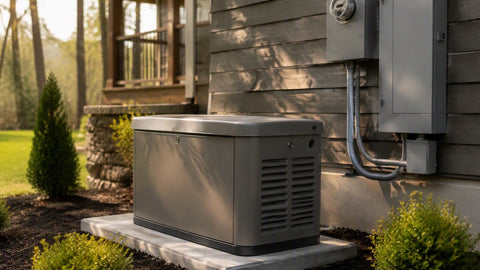
Generator shopping is watts-to-kW on every page: a "10,000-watt portable" and a "10 kW portable" are identical products. The sizing question — which generator covers your panel — is answered by adding appliance watts and dividing by 1,000; our generator sizing guide and load reference chart do that math for 30+ common loads.
Billing and incentives
Utilities bill in kWh, the federal tax credit (ITC) applies to system cost regardless of unit, but utility interconnection applications, net-metering caps, and many state incentive programs are denominated in kW-AC or kW-DC. Getting the prefix wrong on an interconnection form — submitting 7,600 instead of 7.6 — is a real and common paperwork rejection.
Example 1 — Panel count from a kW target
- Goal: 8 kW array. Panels: 440 W modules.
- Convert: 8 kW = 8,000 W.
- Count: 8,000 ÷ 440 = 18.2 → 18 panels (7.92 kW nameplate).
- Energy check: 7.92 kW × 5 peak sun hours × 0.80 system efficiency ≈ 31.7 kWh/day.
Example 2 — Appliance load audit for a generator
- Refrigerator 700 W + well pump 1,400 W + furnace blower 800 W + lights 300 W = 3,200 W running.
- Convert: 3,200 ÷ 1,000 = 3.2 kW running; apply ~2× surge for motor starts → ~6.5 kW class unit minimum.
- Result: an 8–10 kW standby covers it with margin.
Example 3 — Inverter datasheet cross-check
- Inverter spec: "Max continuous AC output: 11,400 W."
- Convert: 11,400 ÷ 1,000 = 11.4 kW — this is the 11.4 kW hybrid class.
- PV input limit 15 kW DC → acceptable DC/AC ratio of 15 ÷ 11.4 ≈ 1.32, inside the typical 1.1–1.5 design window.
| Device | Typical watts | kW | Circuit context |
|---|---|---|---|
| LED bulb | 9–15 W | 0.009–0.015 | — |
| Refrigerator | 150–700 W | 0.15–0.7 | 15/20 A dedicated |
| Microwave | 1,000–1,500 W | 1.0–1.5 | 20 A kitchen |
| Space heater | 1,500 W | 1.5 | 15 A max continuous |
| Window AC (10k BTU) | 900–1,200 W | 0.9–1.2 | 15 A |
| Electric dryer | 3,000–5,000 W | 3–5 | 30 A @ 240 V |
| EV Level 2 (32 A) | 7,680 W | 7.68 | 40 A @ 240 V |
| Electric range | 8,000–12,000 W | 8–12 | 50 A @ 240 V |
| Central AC (3 ton) | 3,500–5,000 W | 3.5–5 | 40–50 A @ 240 V |
Table 2 — Common loads in both units. Sum watts first, convert once at the end.
| Panel wattage | 10 panels | 20 panels | 24 panels | 30 panels |
|---|---|---|---|---|
| 400 W | 4.0 kW | 8.0 kW | 9.6 kW | 12.0 kW |
| 430 W | 4.3 kW | 8.6 kW | 10.32 kW | 12.9 kW |
| 450 W | 4.5 kW | 9.0 kW | 10.8 kW | 13.5 kW |
| 550 W | 5.5 kW | 11.0 kW | 13.2 kW | 16.5 kW |
| 600 W | 6.0 kW | 12.0 kW | 14.4 kW | 18.0 kW |
Table 3 — Module watts × count, expressed in array kW. Multiply the panel rating by the count, divide by 1,000.
| Category | Typical kW range | Shop |
|---|---|---|
| Portable generators | 1–12 kW | 3–6 kW portables |
| Home standby generators | 10–26 kW | 10–14 kW standby |
| Residential hybrid inverters | 5–15 kW | Hybrid inverters |
| Commercial string inverters | 30–125 kW | Commercial inverters |
| Utility-scale inverters | 150–350 kW+ | Utility inverters |
Table 4 — Knowing the kW class tells you which catalog shelf to shop.
Three terms that look interchangeable in a spec sheet are not. kW is real power — the rate of doing work right now. kWh is energy — kW sustained over time, and the unit your utility bills. kVA is apparent power — the total current burden a source must carry, including the reactive component that does no useful work. They connect through two simple relations: kWh = kW × hours, and kW = kVA × power factor. The watts-to-kilowatts conversion on this page touches none of that — it is a pure prefix shift inside one quantity — but the moment you step from "how big is the array" (kW) to "how much will it make" (kWh) or "what must the service carry" (kVA), those two relations take over.
A concrete pass through all three: a facility runs a 400 kW average load for 4,380 hours a year — that is 1,752,000 kWh of energy. Its service transformer must carry not 400 kW but 500 kVA at 0.8 PF. And the solar array quoted to offset the consumption is sized in kW-DC from the kWh target: 1,752,000 ÷ 1,400 kWh/kW-year ≈ 1,250 kW. One project, three units, zero interchangeable numbers.
Why DC and AC kilowatts both appear on solar quotes
Solar quotes list two kW figures on purpose. kW-DC is the sum of panel nameplates at standard test conditions; kW-AC is the inverter's continuous output rating, which caps what actually reaches the meter. A typical 10 kW-DC residential array pairs with a 7.6 kW-AC inverter — a 1.32 DC/AC ratio — because panels rarely hit nameplate and midday clipping costs less than a larger inverter. When comparing two quotes, normalize both to kWh/year estimates (production modeling) rather than comparing kW-DC sticker sizes.
Why the industry standardizes on kilowatts above 1,000 W
The convention is not arbitrary. Comparing a 7,600 W inverter against a 10,400 W array is cognitively harder than 7.6 kW against 10.4 kW — fewer digits, faster ratio math (10.4 ÷ 7.6 ≈ 1.37 DC/AC). Procurement documents, interconnection applications, and incentive paperwork all assume the kilowatt form above 1 kW, and mixing the forms inside one document is a reliable source of decimal errors. Adopt the habit: watts for components, kilowatts for systems, and convert at the boundary.
⚠ The four errors that keep showing up
1. Confusing kW with kWh. "My home uses 900 kW a month" is impossible — that is energy, so it is 900 kWh. kW is the speedometer; kWh is the odometer. Every utility bill is kWh; every inverter nameplate is kW.
2. Multiplying when you should divide. 4,500 W is 4.5 kW, not 4,500,000 kW. The kW figure is always 1,000× smaller than the watt figure.
3. Treating STC panel watts as delivered power. A 10 kW DC array delivers roughly 7.5–8.5 kW AC at solar noon after temperature and system losses — which is why the inverter is deliberately smaller than the array.
4. Adding kW and W in the same column. When auditing loads, convert everything to one unit before summing. 2 kW + 800 W is 2.8 kW — never "802."
How do you convert watts to kilowatts?
Divide the wattage by 1,000: kW = W ÷ 1,000. Five thousand watts is 5 kW; 450 watts is 0.45 kW. The prefix "kilo" means one thousand, so the decimal point simply moves three places to the left. To go the other way, multiply kilowatts by 1,000.
Is 1000 watts the same as 1 kW?
Yes, exactly. 1,000 W = 1 kW, just as 1,000 meters is 1 kilometer. The conversion is a pure unit-prefix change — no voltage, efficiency, or power factor is involved. A 1,500 W space heater and a 1.5 kW space heater are the same appliance described two ways.
What is the difference between kW and kWh?
kW is power — the rate at which energy flows at an instant. kWh is energy — power multiplied by time. A 5 kW solar array produces 5 kWh in one hour of full sun, or 25 kWh across a 5-peak-sun-hour day. Your utility bill charges for kWh; your inverter and array are rated in kW.
How many watts is a typical home solar system?
Most U.S. residential systems are 5,000–12,000 watts (5–12 kW). With modern 400–450 W panels, that is roughly 12–28 modules. The right size depends on your annual kWh consumption and local sun hours — our solar system size calculator does that math from your utility bill.
Why do some datasheets use watts and others kilowatts?
Watts are used for individual components (panels, appliances, charge controllers) and kilowatts for aggregated systems (arrays, generators, inverters). It is purely readability — writing 0.45 kW on a panel label or 11,400 W on an inverter would both be correct, just harder to scan. Converting between them is always ÷1,000 or ×1,000.
Does the watts-to-kW conversion differ for DC and AC?
The unit conversion is identical. What differs is that AC systems have power factor, so 10 kW of real AC power may require a 12.5 kVA source at 0.8 PF. DC solar nameplate watts (STC) also exceed real-world output by 15–25% after temperature and system losses — a 10 kW DC array typically pairs with a 7.6–8.2 kW AC inverter.
- Amps to Watts Conversion Guide
- How Many Watts to Power a Home
- kWh to Amps Guide
- Solar System Size Calculator
- How Big Is a 25 kW Solar Array?
- What Generator Size Do I Need?
- Generator Load Reference Chart
- Battery Backup Runtime Calculator
- String Inverter Sizing Guide
- Solar System Calculator
- Shop Solar Panels
- Shop Complete Solar Kits
- Shop Solar Inverters
- 10–14 kW Standby Generators
Ready to turn kilowatts into a bill of materials? Get a quote from Portlandia Electric Supply — panels, inverters, and complete kits from 5 kW to utility scale.