NEVI Compliance for EV Charging Deployments: The 2026 Field Guide
The National Electric Vehicle Infrastructure program pays for DCFC — but only if you hit every requirement in 23 CFR 680. Here is the compliance checklist, station-by-station.

The National Electric Vehicle Infrastructure (NEVI) Formula Program is a $5 billion federal program authorized by the Infrastructure Investment and Jobs Act of 2021 and administered by the Federal Highway Administration through 23 CFR Part 680, the NEVI Standards and Requirements Final Rule that took effect in February 2023. It funds public DC fast charging stations along designated Alternative Fuel Corridors (AFCs) — mainly the Interstate system — with each state receiving formula-based allocations to deploy stations at ~50-mile intervals.
The economics: NEVI funds up to 80% of eligible project costs, capped by state-specific limits (typically $600k–$2.5M per site). The private awardee funds the remaining 20%, operates the site for a minimum of five years, and must maintain 97% annual uptime. Fall out of compliance and the state can claw back the grant.
Every state has its own NEVI plan, procurement process, and awardee list — but the technical requirements come from the same federal rule. That is what this guide covers: the ten hard compliance requirements that every awardee, contractor, and distributor spec'ing a NEVI site must hit. Miss any one and the site fails commissioning.
Who this guide is for: awardees writing NEVI proposals, prime contractors bidding NEVI DCFC packages, and distributors like PES Supply spec'ing the BOM that goes into an awarded site.
1. Four DCFC ports @ 150 kW simultaneous
23 CFR 680.106(a): each NEVI station must have at least four CCS-capable DC fast charging ports, each rated at 150 kW minimum, all four capable of dispensing simultaneously at 150 kW. "Simultaneously" is the operative word. It is not enough to have four ports if power sharing drops each to 60 kW when all are in use. The site's electrical service, switchgear, and charger power cabinets must be sized for 600 kW simultaneous output.
Implications: minimum 800 kVA of connected service at 480V three-phase. Most rural highway sites do not have this; a utility service upgrade, primary run, and pad-mount transformer are line items on nearly every NEVI proposal.
2. CCS1 connectors (NACS optional as of 2024)
Every port must have a CCS1 (Combined Charging System, SAE J1772 Combo) connector as the primary interface. FHWA guidance issued in mid-2024 permits additional NACS (J3400) connectors alongside the mandatory CCS1, but CCS1 remains the compliance baseline. Do not deploy a NACS-only station — it is non-compliant.
Practically, most awardees now spec dual-connector dispensers: CCS1 + NACS side-by-side. Kempower S-Series, ChargePoint Express Plus, ABB Terra 184, BTC Power 200 kW, and Wallbox Supernova all offer dual-connector configurations.
3. OCPP 2.0.1 network protocol
The NEVI rule requires Open Charge Point Protocol (OCPP) 1.6-J or 2.0.1 for communication between the charger and the network operator, and OpenADR 2.0b or IEEE 2030.5 for demand-response with the utility. OCPP 2.0.1 is the future-safe pick: 1.6-J is legacy and lacks Plug&Charge support. Any charger locked to a proprietary protocol (some early ChargePoint firmware, some legacy Blink) is non-compliant.
4. 97% annual station uptime
23 CFR 680.116(b): each station must achieve 97% uptime, averaged annually, per port. That is only 262 hours (~11 days) of allowed downtime per port per year — including scheduled maintenance. Failure to meet this triggers a corrective action plan; repeat failure triggers grant repayment.
Impact on the BOM: redundant power modules (Kempower's modular cabinet approach helps), 4-hour on-site O&M SLA with a maintenance vendor, spare parts on-shelf, and a monitoring platform that tracks port-level uptime in real time. Most awardees contract a third-party O&M provider like ChargerHelp, EV Connect, or the charger OEM's own service arm.
5. Payment: contactless credit + Plug&Charge
Every port must accept at least contactless credit/debit card payment (tap-to-pay per EMV) and support ISO 15118 Plug&Charge autocharge. No membership or app-only payment is allowed. This kills the "closed network" model that dominated pre-2023 charging — you cannot require drivers to have a network subscription.
Hardware: dispensers need PCI-DSS-certified EMV payment terminals. Kempower, Wallbox Supernova, and ABB Terra all ship with integrated PAX or Nayax payment modules. Retrofitting payment modules onto older CCS chargers is possible but expensive ($3,000–$6,000/port).
6. ADA-compliant accessible route
At least one port per station must be ADA-accessible per the U.S. Access Board's proposed accessibility guidelines for EV charging (July 2024). Accessible route from designated accessible parking space, 60"× 96" access aisle, dispenser controls between 15"–48" reach range, and connector-cable weight under 15 lb managed with a retractor or holster.
Realistic accessible-stall spec: 132" wide × 216" long stall, striped accessible route to the dispenser, ADA-compliant signage (R7-8 + green EV overlay), and a Type B or Type C accessible-height dispenser mount. Kempower and ChargePoint offer accessible-height variants.
7. Buy America iron and steel
All iron and steel used in the project — permanently incorporated — must be produced domestically after February 2024, per the Buy America Build America (BABA) provisions. This includes rebar in the transformer pad, structural steel in the charger enclosures, conduit, boltdown pedestals, and bollards.
Waivers exist. FHWA has granted a temporary EVSE waiver for certain manufactured products (the electronics inside the charger), but pad-mount transformer housings, switchgear enclosures, and conduit are covered by the base rule. Every SKU on a NEVI BOM needs Buy America certification from the manufacturer. PES Supply maintains a BABA-compliant SKU flag on our commercial catalog for exactly this reason.
8. Located within 1 mile of a designated AFC exit
NEVI stations must be within 1 mile of an Alternative Fuel Corridor exit (with limited exceptions for community-benefit projects). AFCs are the Interstate system plus certain state highways designated by FHWA. Site selection outside this corridor disqualifies most projects.
9. 24/7 public access
Every port must be publicly accessible 24 hours a day, 365 days a year, with no membership required. That constrains site host selection — a truck stop, travel plaza, or dealership open only 8a–8p does not qualify unless the EV area remains open. Lighting to 5 foot-candles minimum in the charging area (per most state NEVI specifications) is required.
10. Five-year operations & maintenance plan
Awardees must operate and maintain the station at compliance level for a minimum of five years post-commissioning. Financial reserves for O&M, a contracted maintenance vendor, spare parts inventory, and quarterly uptime reporting to the state DOT are all required. Some states extend this to 6–8 years in their state NEVI plans.
| Model | Simult. 150 kW | CCS1+NACS dual | OCPP 2.0.1 | EMV payment | BABA path | Verdict |
|---|---|---|---|---|---|---|
| ChargePoint Express Plus 400 kW | ✓ modular | ✓ CCS1 + optional NACS | ✓ | ✓ integrated | ✓ with waiver | NEVI-eligible |
| Kempower S-Series 400 kW | ✓ dynamic pool | ✓ dual | ✓ | ✓ Nayax | ✓ with waiver | NEVI-eligible |
| ABB Terra 184 / HP 350 | ✓ 180 kW/port | ✓ dual | ✓ | ✓ optional | ✓ (US-assembled) | NEVI-eligible |
| BTC Power 200 kW | ✓ | ✓ dual | ✓ | ✓ integrated | ✓ (US-manufactured) | NEVI-eligible |
| Wallbox Supernova 180 kW | ◐ 180 kW single | ✓ dual | ✓ | ✓ integrated | ◐ (Spain-mfg, waiver) | Eligible w/ waiver |
| Tritium PKM150 | ✓ | ✓ dual | ✓ | ✓ integrated | Waiver pending | Eligible w/ waiver |
| EVgo Extreme Fast 350 | ✓ | ✓ | ✓ | ✓ | ✓ | NEVI-eligible |
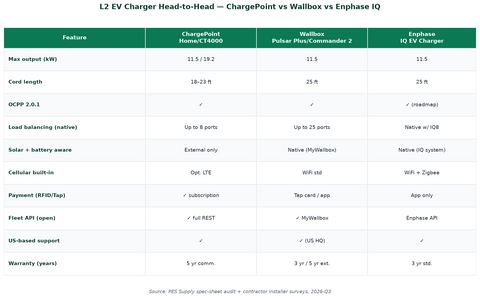
| Enphase IQ EV Charger (L2 only) | ✗ (7.7 kW) | ✗ (L2) | Roadmap | App only | N/A L2 | Not eligible (not DCFC) |
| Legacy Blink DC 50 | ✗ | ✗ CCS only | ◐ 1.6 | ◐ retrofit | ✗ | Not eligible |
| ChargePoint Express 250 legacy | ✗ single 62.5 | ✗ CCS only | ◐ | ◐ | ◐ | Not eligible without upgrade |
-
1
Site selection + AFC verification
Pull the state DOT's designated AFC map. Confirm your candidate site is within 1 mile of an AFC exit. Confirm 24/7 public access with the site host. Confirm utility service can be upgraded to 800 kVA within your project timeline — the utility informal service inquiry is a free 30-day check.
-
2
State NEVI proposal submission
Each state runs its own procurement. Standard package: site plan, one-line diagram, charger cut sheets with BABA certifications, O&M plan, financial pro forma, 5-year uptime commitment. States score on 5–10 criteria including price, deployment timeline, and operational history.
-
3
Utility interconnection application
File immediately after award. Primary-side upgrades take 6–14 months in most utility territories. Some awardees have discovered mid-project that their preferred DCFC power level exceeded utility capacity — always confirm the interconnect capacity before finalizing charger count.
-
4
Detailed engineering + permit design
Pull permits for electrical, land-use, and ADA compliance. NEVI requires PE-stamped drawings in most jurisdictions. Coordinate the ADA-accessible route and lighting spec at this stage — retrofitting them after concrete pour is expensive.
-
5
Construction with BABA-compliant materials
Every iron/steel component gets a BABA certificate. Maintain a materials log with the certificate PDF per SKU. State DOT auditors will spot-check. PES Supply pre-tags BABA-compliant SKUs so contractors do not scramble mid-project.
-
6
Commissioning + operational handoff
Level 1 commissioning tests each port to 150 kW with a real vehicle. Certify OCPP call-home, EMV payment flow, Plug&Charge autocharge, ADA controls. Register the site with the state uptime portal. Hand off to O&M vendor with the 5-year maintenance contract.
-
7
Ongoing uptime reporting + quarterly submissions
State DOTs typically require monthly or quarterly uptime + utilization reports through the operational period. Uptime is calculated per port, so hardware redundancy pays for itself here — a single-cabinet 4-port station has correlated downtime that erodes the 97% target quickly.
This requirement is the single most-underestimated NEVI compliance risk. Awardees repeatedly discover mid-construction that a specified charger or transformer is not BABA-compliant, forcing a re-spec at 30% budget overrun.
The rule: all iron, steel, manufactured products, and construction materials permanently incorporated in the project must be produced in the United States after February 2024, with limited waivers.
Manufactured products: FHWA issued a temporary EVSE waiver in February 2024 covering the electronic components inside DCFC cabinets — the semiconductors, power modules, and control boards — because domestic manufacturing capacity did not yet exist at scale. That waiver is set to expire and be renegotiated periodically. It does not cover the cabinet housing itself if it is iron or steel.
Iron and steel: no waiver. Every steel bollard, rebar cage, structural transformer pad steel, conduit strap, and pedestal bolt must be melted and manufactured in the US after Feb 14, 2024. Foreign steel with domestic secondary processing does not qualify.
Construction materials: covered categories include plastic and polymer-based products, glass, drywall, lumber, and fiber optic cable — most only "produced" in the US, not necessarily raw-materials-domestic. Check the current material list on the White House Made in America Office site before finalizing the spec.
PES Supply keeps a live BABA-compliant flag on our commercial catalog and requests domestic certifications from every manufacturer on our stocking list. When we quote a NEVI project, every line item has its BABA status called out — no surprises at final inspection.
97% annual uptime per port sounds easy until you do the math: 8,760 hours/year × 3% = 262.8 hours of allowable downtime. That is 11 days. A single unplanned outage lasting one week from an OEM parts delay wipes out most of the year's budget.
What real awardees do to hit this target:
- Modular power architecture: Kempower's dynamic power sharing and ABB's HP series use pooled power modules — losing one module drops total site capacity by 10–20% but does not take a port offline. Contrast with dispenser-per-cabinet architectures where a rectifier failure kills one port entirely.
- 4-hour on-site SLA: contract with a certified O&M vendor for guaranteed dispatch. ChargerHelp, EV Connect, EVCS, and the charger OEMs (ChargePoint Assure, ABB Care) all offer 4-hour metro / 8-hour rural SLAs at $2,500–$4,500/port/year.
- Spare parts on-shelf: keep at least one spare power module, one payment terminal, one cable/connector assembly, and one control board at the site or at a regional depot. OEM warranty parts take 2–6 weeks; you cannot afford that delay.
- Remote diagnostics: most modern DCFC platforms surface fault codes over OCPP. Automate ticket creation into your O&M vendor's dispatch queue — do not rely on driver reports.
- Preventive maintenance quarterly: connector wear, cable damage from vehicle strikes, filter/fan cleaning, torque verification on power terminations. All scheduled in the O&M plan.
The federal rule sets the floor. States write their own NEVI plans, procurement mechanisms, and additional requirements on top. Awardees repeatedly discover mid-project that their state's rules layer a Buy America construction-material list, a prevailing-wage requirement, or a stricter uptime penalty on top of the base federal rule. Skimming a few state variations that materially affect BOM and pricing:
- California (Caltrans + CEC): requires CALGreen construction materials, prevailing wage per Labor Code 1720, and stronger accessibility standards mapped to CBC 11B rather than only the Access Board guidelines. Expect 8–12% construction cost premium and 4–8 weeks additional design review.
- Texas (TxDOT): less stringent overlay — closer to base federal rule — but requires all awardees to be pre-qualified TxDOT vendors, which adds a 6–10 week pre-qualification cycle for first-time bidders.
- New York (NYSERDA + NYSDOT): stacks a Regional Greenhouse Gas Initiative (RGGI) reporting requirement on top of NEVI. Awardees track annual energy sourced from renewable generation and report to NYSERDA. Some awardees pair NEVI DCFC with on-site solar or REC purchases to satisfy this.
- Florida (FDOT): imposes hurricane-hardened enclosure specs — NEMA 4X minimum, wind-load rated to 150 mph in coastal counties, and pad-mount transformers with elevated bases in flood zones. Adds 5–8% hardware cost.
- Colorado (CDOT): strongest cold-weather spec — chargers must be certified for operation to -40°F with dispenser heaters, and required to demonstrate continuous 150 kW output at 0°F ambient during commissioning. Kempower and ABB are the two most-often-specified brands here.
Always read your state's NEVI plan appendix along with the federal rule. The dollar impact of state overlays typically runs 5–15% on hardware and 8–20% on soft costs (design, wages, reporting).
NEVI economics only pencil for awardees who plan realistically for the 20% match, the 5-year operating obligation, and the risk of underutilization in year 1. A quick worked example for a 4-port 150 kW site on a major Interstate corridor:
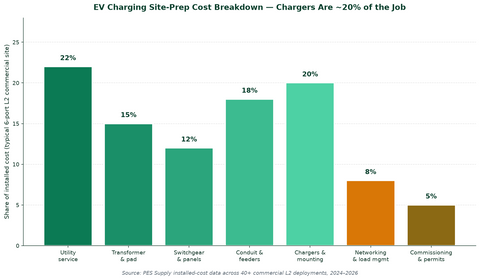
- Total project cost: $1.3M (typical range $900k–$1.6M). Split: ~$400k chargers, ~$350k electrical infrastructure, ~$250k civil/pad/permits, ~$150k soft costs, ~$150k contingency.
- NEVI grant: 80% × $1.3M = $1.04M (subject to state per-site cap; often less).
- Awardee match: $260k up-front cash.
- Utility rebate stack: $30k–$120k depending on service territory make-ready program.
- IRA §30C tax credit: 30% of eligible costs up to $100k/site.
- Net awardee investment year 0: ~$110k–$200k after stacking.
- Annual O&M: $28k–$45k (network fees, monitoring, quarterly PM, spare parts amortized).
- Energy cost: at 400 MWh/year sold at $0.42/kWh gross with $0.12/kWh cost = $120k gross margin/year.
- 5-year net cash flow: $340k–$460k over the operating period; payback typically year 3.
The critical risk factor: year-1 utilization. Rural corridors with low EV traffic take 12–24 months to build to design utilization. Awardees with tight cash flow can stall here. Every awardee should model a 12-month low-utilization scenario ($30k–$50k gross margin) and confirm the 5-year O&M reserve covers it.
Can I use L2 chargers to meet NEVI?
Can I install fewer than 4 ports and still get NEVI?
What happens if I miss 97% uptime one year?
Are Tesla Superchargers NEVI-compliant?
How does Buy America apply to my existing DCFC inventory?
Do I need OCPP 2.0.1 specifically or does 1.6-J qualify?
Where do I get the state NEVI plan and awardee list?
What's the typical NEVI awardee timeline from award to energized?
Get a NEVI-compliant BOM quote with BABA docs
Register for the PES Supply contractor portal. Upload your site plan and state NEVI award package — get a full BABA-flagged BOM quote with certifications for every iron/steel line item, plus BABA-eligible DCFC options and spare-parts kits.
Register Now