Commercial EV Fleet Electrification Buyer Guide: TCO, Charging Infrastructure, and Deployment Timeline
Fleet electrification is a TCO play, not a green play. Here is the full buyer guide — vehicle class economics, depot charging BOM, utility coordination, and the timeline math that decides whether the project pays back in year 3 or year 7.

Fleet managers do not electrify because it feels good. They electrify because the 5-year total cost of ownership crosses under diesel or gasoline TCO around the third year for most Class 1–4 fleets, and stays under from year 4 onward. Get the infrastructure right and the crossover accelerates. Get it wrong — undersized depot service, high-demand-charge tariff, no load management — and payback slips out to year 6 or 7 and the CFO cancels phase 2.
This guide is the version we hand to fleet buyers evaluating their first electrification pilot. It covers the whole decision stack: vehicle-class economics, depot charging architecture, utility rate strategy, telematics integration, and the go/no-go questions that decide whether a pilot becomes a full transition or a stranded asset.
Who this guide is for: fleet operations managers evaluating a first EV pilot, procurement teams writing depot infrastructure RFPs, CFOs stress-testing electrification pro formas, and electrical contractors specifying fleet depot charging.
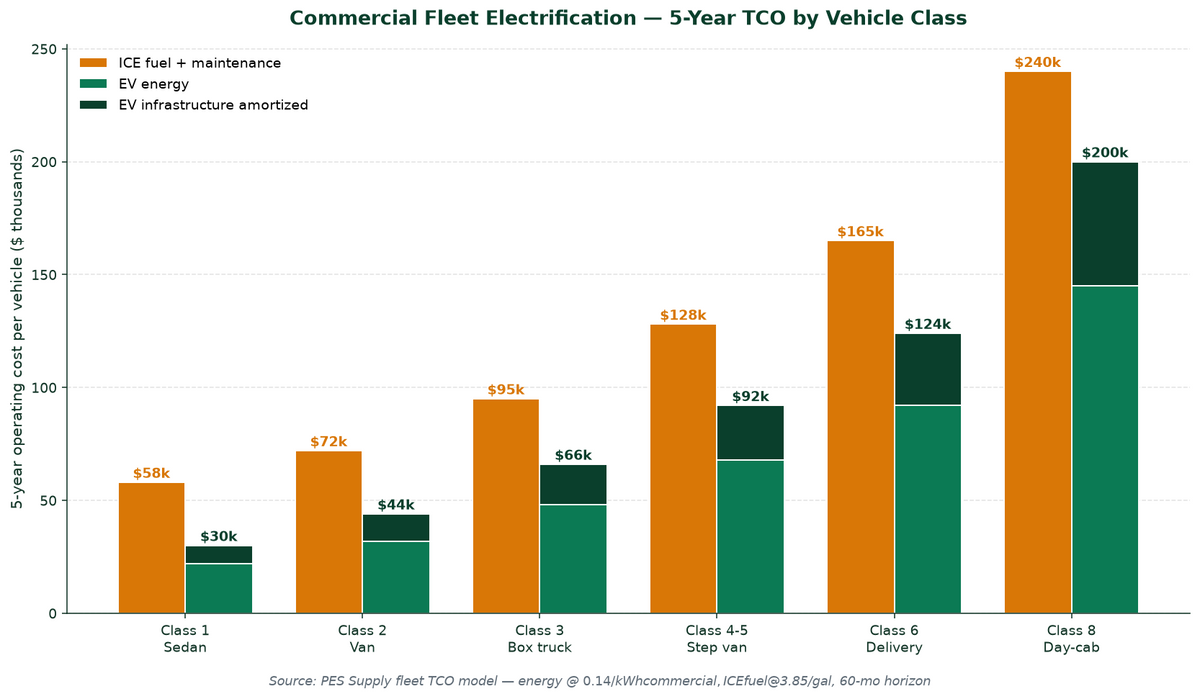
Not every fleet class electrifies profitably today. The math depends on daily miles per vehicle, dwell time at the depot (which sets charging power requirements), and the local electric-rate structure. Here is the shape of the 5-year TCO advantage per vehicle class:
- Class 1 sedan (Chevy Bolt, Tesla Model Y, Ford Mustang Mach-E fleet): $58k ICE vs $30k EV over 5 years. Advantage: $28k/vehicle. Payback: year 2.5. Slam dunk if daily miles are 40–150 and the depot can accommodate overnight L2. This is the category where 80% of fleet-transition ROI sits.
- Class 2 van (Ford E-Transit, Mercedes eSprinter, Rivian EDV): $72k ICE vs $44k EV. Advantage: $28k. Payback: year 3. Last-mile delivery, service vans, mobile technician fleets — same daily route, back to depot by 5 PM, plugged in overnight. Overnight L2 (11.5 kW) delivers 65 kWh in 6 hours — enough for 150+ miles of range on the following day.
- Class 3 box truck (Ford E-Transit 350, Chevrolet BrightDrop Zevo 600): $95k ICE vs $66k EV. Advantage: $29k. Payback: year 3. Route consistency matters more here. If routes vary from 60 to 250 miles/day, mid-shift DCFC becomes necessary and infrastructure cost climbs.
- Class 4–5 step van (Freightliner eM2 106, Ford F-750 EV, GM BrightDrop Zevo 600 XL): $128k ICE vs $92k EV. Advantage: $36k, but higher up-front vehicle cost stretches payback to year 3.5. Well-suited for parcel and beverage delivery in metro areas.
- Class 6 delivery / municipal (Freightliner eM2 106, Peterbilt 220EV): $165k ICE vs $124k EV. Advantage: $41k. Payback: year 4. Beverage, waste, and school-bus applications dominate. Depot-based, predictable duty cycle, high fuel spend against high electric-rate leverage.
- Class 8 day-cab (Volvo VNR Electric, Freightliner eCascadia, Kenworth T680E, Peterbilt 579EV): $240k ICE vs $200k EV. Advantage: $40k, but payback is year 4.5–5.5 depending on incentive stack. Regional drayage (150–250 miles/day, return to base) is the sweet spot. Long-haul remains uneconomic in 2026.
The general rule: the higher the daily fuel spend and the more predictable the duty cycle, the faster the payback. A Class 2 van doing 90 miles/day on the same 5-day-a-week route pays back its infrastructure premium in year 2. A Class 8 tractor with variable regional routes takes twice as long.
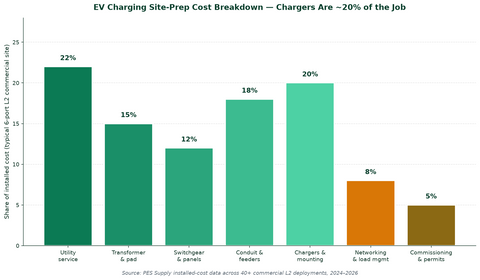
The vehicle economics look great in isolation. The depot infrastructure is where deployments blow up. A 20-van depot at 11.5 kW per van needs 230 kW of dedicated EV service. Overlay that on an existing 200A/480V service (~166 kVA usable) and the utility service must be upgraded. That upgrade — new transformer, primary run, switchgear — routinely adds $200k–$650k to the project depending on utility service territory and distance to primary.
Sizing the depot service correctly
Start with two numbers per vehicle: (1) daily kWh needed to recharge from the day's route, and (2) available dwell time. Divide (1) by (2) to get the required kW per port.
- Class 2 van @ 90 miles/day, 3 mi/kWh → 30 kWh/day. Dwell 6:00 PM–5:00 AM = 11 hrs. Required per port = 30/11 = 2.7 kW. That is a 30A L1 or a shared L2. Load-managed 40A L2 easily covers this.
- Class 3 truck @ 140 miles/day, 1.7 mi/kWh → 82 kWh/day. Dwell 8 hrs. Required per port = 10.3 kW. Full 48A L2 (11.5 kW).
- Class 6 truck @ 180 miles/day, 1.1 mi/kWh → 164 kWh/day. Dwell 10 hrs. Required per port = 16.4 kW. 80A L2 (19.2 kW) or shared 50 kW DCFC bank.
- Class 8 tractor @ 250 miles/day drayage, 0.7 mi/kWh → 357 kWh/day. Dwell 10 hrs. Required per port = 35.7 kW. Dedicated 50 kW DCFC per tractor, or a smart pooled DCFC system.
Notice how the required per-port kW jumps by ~10× from a Class 2 sedan to a Class 8 tractor. That is the entire reason depot infrastructure is not one-size-fits-all. A 20-Class-2 van depot needs 230 kW; a 20-Class-8 tractor depot needs 715 kW — three times the utility service.
The 3 depot architectures
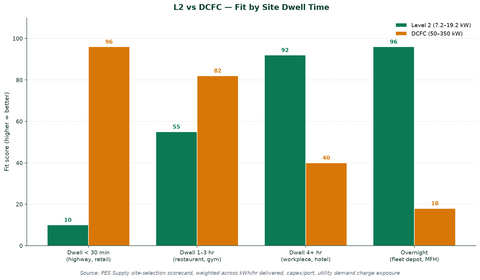
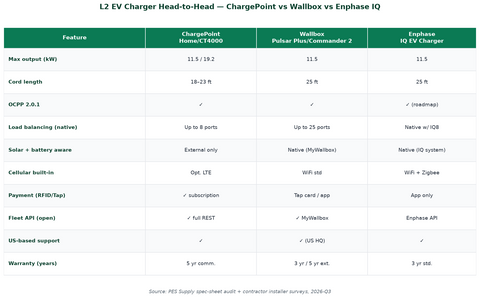
Overnight L2 (most common): best for Class 1–3, daily dwell 8+ hours, deterministic routes. Deploy 11.5 kW L2 ports (Wallbox Commander 2, ChargePoint CT4023, EVBox Iqon), one per vehicle, with load management. Capex: $6k–$14k/vehicle installed. This covers ~70% of commercial fleet transitions today.
Depot-based DCFC (mid-power): best for Class 3–5 with variable routes or shorter dwell. Deploy 50–75 kW DCFC (BTC Power 50 kW, ChargePoint Express 250 at low-power modes, Kempower shared cabinet). Capex: $30k–$70k/port. Typically 1 DCFC port serves 4–6 vehicles as they cycle in.
High-power DCFC (drayage / regional Class 8): 150–350 kW DCFC. Capex: $130k–$220k/port installed. Only makes sense for Class 8 or high-turn Class 6 depots. Utility service almost always requires a dedicated pad-mount transformer.
| Fleet size | Class mix | Depot service | Charger config | Total installed cost |
|---|---|---|---|---|
| 5 vans | Class 1–2 pilot | Existing 400A/208V + LM | 5× L2 11.5 kW | $45–70k |
| 10 vans | Class 2 delivery | Existing 400A/208V + LM or upsize | 10× L2 11.5 kW | $95–160k |
| 20 vans | Class 2–3 mixed | Upgrade to 600–800A/480V | 20× L2 11.5 kW + 1× 50 kW DCFC | $260–420k |
| 25 trucks | Class 4–6 delivery | New 500 kVA pad-mount xfmr | 25× L2 80A + 2× 100 kW DCFC | $550–850k |
| 50 vehicles | Mixed Class 2/6 hub | New 1000 kVA + primary upgrade | 40× L2 + 6× 100 kW DCFC | $1.4–2.1M |
| 30 tractors | Class 8 drayage depot | New 2500 kVA + dedicated primary | 30× 150 kW DCFC pooled | $3.8–5.2M |
The commercial electric rate schedule you land on determines whether the pro forma works. Two identical fleets on two different rate schedules see 30–50% swings in operating cost.
Demand charges are the enemy
Most commercial rates include a demand charge — a $/kW fee based on the highest 15-min power draw in the billing cycle. Typical rates: $8–$22/kW-month. A 20-van depot hitting 230 kW peak once during commissioning locks in $2,000–$5,000/month of demand charge for the entire billing period. Over a year, that adds $24k–$60k to opex.
Mitigation: load management. Deploy dynamic throttling so the depot never draws more than a preset ceiling — say 150 kW. Vehicles charge slower (all night instead of all done by midnight) but the demand charge drops proportionally. Savings on a 20-vehicle depot: $15k–$40k/year.
TOU (time-of-use) rates favor overnight charging
Most utilities offer TOU rates for commercial customers: cheap overnight ($0.06–$0.09/kWh), expensive on-peak ($0.16–$0.32/kWh). Fleet depots plugged in from 6 PM–5 AM naturally hit the cheap tier. Confirm the utility has an EV-specific TOU rate with off-peak windows extending to 5 or 6 AM — a few utilities set off-peak too narrow for full overnight recharge.
Special EV rate schedules
Many utilities have introduced dedicated EV rate schedules for commercial fleets. Some subsidize the demand charge entirely for the first 3–5 years to encourage adoption (PGE, Xcel, ConEd have variants of this). Some offer a "make-ready" program that funds part of the depot service upgrade — the utility installs the transformer and service, the fleet installs the chargers.
Storage arbitrage
For large depots (50+ vehicles), a co-located battery energy storage system (BESS) can shave demand charges by discharging during peak charging windows and recharging off-peak. A 500 kWh BESS pays back in 4–7 years purely on demand-charge arbitrage in high-demand-charge territories.
-
1
Route and duty-cycle analysis
Pull 6–12 months of telematics or dispatch data. Compute daily miles per vehicle, dwell time at depot, dwell time at customer sites, and route variability. Vehicles with tight 6-hour dwell + high daily miles are the constraint; the depot must be sized for these worst cases.
-
2
Vehicle selection matched to route
Match vehicle range to daily miles × 1.4 (winter derate factor). For Class 2 vans, this typically means the 90-kWh Ford E-Transit or Mercedes eSprinter for routes under 150 miles. For Class 6, the Peterbilt 220EV (220 kWh) or Freightliner eM2 106 (315 kWh). Do not undersize battery — range anxiety kills driver adoption.
-
3
Depot service study with utility
File an informal service inquiry with your utility for the depot's target future load. Confirm existing capacity, primary-side upgrade timeline, and interconnection cost. This is a free 30-day check that determines whether the depot needs a $200k service upgrade.
-
4
Infrastructure design — RFP to distributor
Distribute an RFP for the full depot BOM: switchgear, panels, feeders, conduit, chargers, load-management. PES Supply typically bids the full 60–120 line BOM against a single freight lane. Compare against 2–3 competitors to validate pricing.
-
5
Permits + construction
Standard commercial construction cycle: 8–12 weeks permits, 6–10 weeks construction for depots under 20 vehicles, 12–20 weeks for 50+. Coordinate charger delivery to the end of the cycle — receiving 30 charger pallets 8 weeks before install invites theft and damage.
-
6
Driver training + soft launch
Train drivers on plug-in procedure and route pre-planning. Run a 2-week soft launch with one route as pilot. Instrument every charging session with the OCPP backhaul so you have real-world energy data before phase 2.
-
7
Phase 2 expansion
Nearly every successful pilot expands. Design the phase-1 depot infrastructure with 40–60% capacity headroom so phase 2 is drop-in adds rather than a service upgrade. This is the single biggest reason to over-spec conduit, panels, and load-management licenses at pilot.
Fleets do the 5-vehicle pilot, prove the TCO, then hit the wall at 25 vehicles because the utility service cannot support the expansion without a $400k upgrade that was not in the pilot business case. Avoid this by designing infrastructure for the eventual production fleet size, not the pilot size.
What to over-size on the pilot:
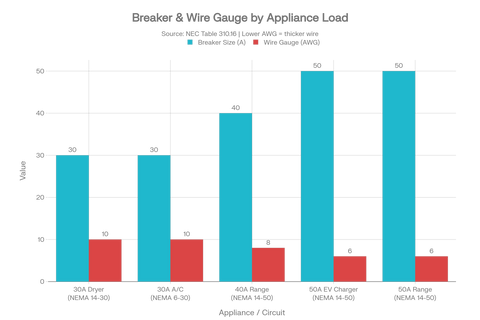
- Depot panel: spec a 800A or 1200A panel at the pilot phase even if the pilot only uses 200A. Empty spaces are cheap; retrofitting a bigger panel means shutting the depot down.
- Conduit runs: primary runs from the electrical room to the vehicle stalls should be 25–50% oversized. Adding one more feeder to a full conduit is a re-trench. Adding a spare 500 kcmil in an already-sized conduit is 30 minutes of pull.
- Load management license: most platforms license per port; buy the phase-2 count now. It is cheaper than an add-on activation later.
- Utility interconnect: apply for the phase-2 service size at the pilot. Utility does not care if you activate half the capacity now.
Every EV fleet is a telematics fleet, whether the operator planned it that way or not. Modern fleet EVs stream continuous state-of-charge, range-remaining, and location data through the OEM's connected-vehicle platform. Combined with the OCPP data stream off the depot chargers, the operator has real-time visibility into every vehicle's readiness for its next route.
Charge orchestration is the software layer that decides which vehicle plugs into which port and at what power. On a small fleet, drivers plug in and the system charges everything eventually. On a 20+ vehicle depot, orchestration matters because random plug-in order can hit demand-charge peaks or leave the wrong vehicles ready in the morning.
Common orchestration platforms:
- ChargePoint Fleet: integrated with ChargePoint charger network, adds route-based charge scheduling. Best for fleets already on ChargePoint hardware.
- AMPLY Power / bp Pulse Fleet: hardware-agnostic orchestration platform, sits between OCPP chargers and the fleet's route dispatch. Preferred by mixed-brand fleets.
- Zeem Solutions: full charging-as-a-service operator, orchestrates chargers, handles utility bills, and provides SLA-backed uptime. Turnkey option for fleets that want to outsource the entire infrastructure operation.
- ChargeLab / Ampcontrol: back-office network operators that provide OCPP-native orchestration with open APIs. Good middle ground between DIY and full outsourcing.
Orchestration also enables demand-response participation. Fleets in ConEd, PGE, SCE, Xcel, and SDG&E territories can enroll in DR programs that pay $50–$150/kW-year for the right to throttle charging during grid stress. On a 30-vehicle depot with 300 kW managed load, that is $15k–$45k annual revenue for participation.
The IRA-era incentive stack transforms fleet electrification economics. Every fleet CFO should map the applicable stack before committing to the pro forma.
Federal
- IRA §45W (Commercial Clean Vehicle Credit): up to $7,500 for Class 1–3 EVs, up to $40,000 for Class 4–8 EVs, per vehicle. Direct pay for tax-exempt entities. This is the flagship fleet incentive and materially changes payback on Class 6–8.
- IRA §30C (Alternative Fuel Refueling Property Credit): 30% of infrastructure cost, up to $100k per single item of property (charger + install). Available in eligible census tracts (roughly 2/3 of the US).
- USDA REAP grants: up to 50% of infrastructure cost for rural fleets. Non-competitive within eligible counties.
- DOE Clean Cities program: technical assistance and matching-grant programs in most metro areas.
State
- California CalCAP EV, HVIP, CORE: stacked incentives on both vehicles ($8,000–$150,000/vehicle depending on class) and infrastructure ($3,000–$100,000/site).
- New York Truck Voucher Incentive Program (NYTVIP): $85,000–$185,000/vehicle for Class 4–8 electric trucks.
- Massachusetts MassEVIP Fleets: $50,000/vehicle + $50,000/site.
- Various state-level EV tax credits, sales tax exemptions, and reduced registration fees.
Utility (make-ready and demand-response)
- Southern California Edison Charge Ready: up to 100% of make-ready infrastructure at fleet sites (utility installs the transformer, service, and stub-up to charger pad).
- Con Edison PowerReady: similar make-ready program in NYC metro.
- Xcel Energy Fleet EV Service Pilot: covers make-ready plus rebates for chargers.
- PGE EV Fleet Program: up to $9,000/port L2, $80,000/port DCFC.
Stacking these programs is legal and expected. A California fleet buying 20 Class 4 delivery vans + depot L2 can stack: §45W ($800k), CalCAP EV ($300k), CalCAP CVA ($100k), SCE Charge Ready make-ready ($400k), §30C infrastructure credit ($150k). Total stack: $1.75M on a $2.4M project. Awardee out-of-pocket after stack: $650k. Payback drops from year 4 to year 1.5.
What's the smallest fleet that makes economic sense to electrify?
Should I use my existing electrical contractor or an EV specialist?
Do fleet vehicles need to be OCPP-networked?
Can I mix vehicle brands on one depot?
How do I finance the infrastructure?
What's the biggest hidden cost?
How do I handle winter range loss?
How long from decision to first vehicle rolling on EV?
Get the full fleet electrification BOM + telematics roadmap
Register for the PES Supply contractor portal. Share your fleet size, daily routes, and depot service — get a full depot infrastructure quote (transformer through commissioning), vehicle-class recommendations, and utility rate strategy tailored to your service territory.
Register Now