Electrical Contractor NEC Code Compliance Library (NEC 2023)
The 40 NEC 2023 articles commercial electrical contractors reference on every job, with plain-language interpretation, common violation traps, and the exact conductors, breakers, and enclosures that satisfy each section.

Ninety percent of the failed commercial rough-in inspections we see trace back to nine NEC articles: 110 (general execution), 210 (branch circuits), 215 (feeders), 220 (load calculations), 240 (overcurrent protection), 250 (grounding and bonding), 310 (conductor ampacity), 408 (panelboards), and 430 (motors). Contractors know the code exists — they lose money because they cannot cite the specific section, exception, or table that governs the field decision in front of them.
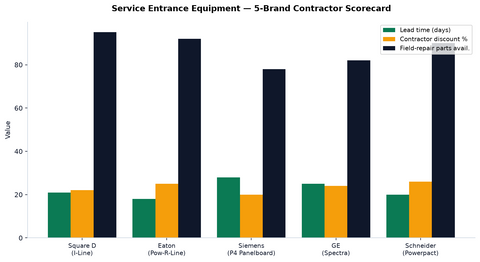
This library organizes NEC 2023 by the questions commercial electrical contractors actually type into their phones on the jobsite: what wire size, what breaker, what enclosure, what grounding, what working clearance. Each article below links to the Portlandia Electric Supply SKUs that satisfy the code — Square D, Eaton, GE, Siemens, and Schneider Electric — so you can bid, install, and pass inspection without a five-tab Chrome window on your phone.
The 2023 cycle brought material changes to GFCI coverage (210.8), surge protection (230.67), emergency disconnects (230.85), reconditioned equipment restrictions (110.21(A)(2)), and expanded EV charging load calculations (220.57). If your last refresher was on the 2020 cycle you have already failed a rough-in you did not know you were losing.
| Article | Subject | 2023 Change | PES-Stocked Compliance Product |
|---|---|---|---|
| 110.14(C) | Termination temperature rating | Reconditioned prohibition tightened | Copper THHN 90°C, Eaton BR breakers 75°C |
| 110.26 | Working space clearance | Equipment door swing clarified | 36", 42", or 48" per voltage / condition |
| 210.8(B) | GFCI in commercial | Expanded to 250V circuits | Square D QO-GFI, Eaton BR-GFCI |
| 210.19(A) | Branch conductor ampacity | 125% continuous still applies | THHN/THWN copper, PES stock |
| 215.2 | Feeder minimum size | 125% continuous + non-continuous | AL XHHW-2, PES bulk cable |
| 220.12 | General lighting load | Occupancy VA/ft² unchanged | Load calc via portal calculator |
| 220.87 | Existing-installation demand | Uses maximum demand + 25% | Recording ammeter method |
| 230.67 | Service SPD required | Now mandatory 1Ø dwellings | Eaton CHSPT2ULTRA, Square D HEPD80 |
| 230.85 | Emergency disconnect | Outside, readily accessible | Siemens EQ8QD-series meter/main |
| 240.24 | OCPD location | Not in bathrooms or above steps | Standard panelboard rules |
| 250.24 | Service GEC and neutral | MBJ + supplemental clarified | #4 CU or #2 AL GEC |
| 250.66 | GEC sizing | Based on service conductor size | PES bare CU stock 6-3/0 |
| 250.122 | EGC by OCPD size | Table 250.122 unchanged | Green THHN 14-4/0 |
| 310.16 | 75°C ampacity | Table renumbered from 310.15(B)(16) | THHN 12-500 kcmil |
| 408.4 | Panelboard directory | Machine-typed or legible manuscript | Every panel schedule |
Article 210 governs the wiring from the panelboard to the outlet or load. The three questions inspectors will ask you on every commercial job:
- Is the branch protected at its rated ampacity? 210.19(A)(1) requires the conductor to be sized for at least 125% of continuous load plus 100% of non-continuous. A 20 A continuous load needs a #10 THHN or larger, not a #12, even though the breaker is 20 A.
- Is GFCI protection provided where the 2023 cycle requires it? 210.8(B) now covers all 125-250V receptacles in commercial kitchens, garages, rooftops, near sinks, and outdoors. Class A GFCI protects at 4-6 mA of ground fault.
- Are receptacles installed at 210.52 spacing? Not more than 12 ft between outlets along any wall; every wall ≥ 2 ft counts. Commercial spacing is more permissive but the same math applies for dwelling-unit tenants.
Contractors who bid a commercial tenant fit-out on a $2/ft wire allowance without checking 210.19(A) for continuous loads (LED lighting is treated as continuous) lose ~$0.35/ft in copper because they have to re-pull #10 after failing rough-in.
Feeders (from service or subpanel to another panel) follow the same 125% continuous rule as branch circuits, but the trap is 215.3: overcurrent protection for the feeder must be sized to allow the feeder ampacity from Table 310.16 after adjustment for temperature and conduit fill. A 400 A feeder pulled through a hot attic in three 3/0 CU per phase becomes a 340 A feeder after adjustment factors — and now you cannot use a 400 A breaker upstream.
Use the PES wire-sizing calculator to run 215.2 with the ambient and fill factors before you bid; contractors who eyeball feeders from the 60°C column of Table 310.16 lose money.
| Occupancy | 220.12 VA/ft² | 220.14 Motors/Recepts | Demand Factor |
|---|---|---|---|
| Warehouse (bulk storage) | 0.25 | 180 VA/recept, first 10 kVA @ 100% | 100% first 10 kVA, 50% remainder |
| Office building | 3.5 | 180 VA/recept | Same |
| Retail store | 3.0 | 180 VA/recept | Same |
| School | 3.0 | 220.14 by fixture count | Same |
| Restaurant | 2.0 + kitchen | 220.56 kitchen equipment | Table 220.56 65-90% |
| Hospital | 2.0 + medical | Feeder demand + 25% | Life-safety branch separate |
| Industrial | 0.25 + motors | 430.24 sum of motor FLC + 25% of largest | Table 220.87 |
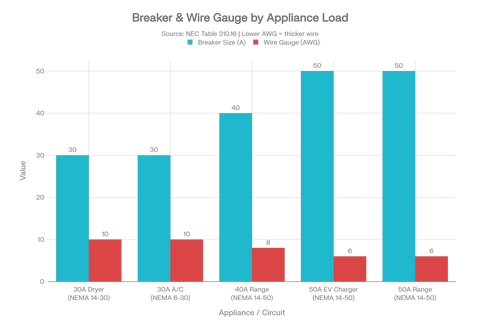
240.4(D) is the standard-conductor rule most contractors misapply: #14 max 15 A, #12 max 20 A, #10 max 30 A. The exceptions (240.4(D)(2)–(7)) permit higher OCPD only for specific loads — motor branch circuits (430), transformer secondary conductors (240.21(C)), and welder circuits (630).
The 2023 cycle keeps 240.21 (location of OCPD) but tightens the 10-foot and 25-foot tap rules by requiring the tap to terminate in a single overcurrent device sized per the tap ampacity. Contractors who ran a 10-foot tap from a bus feeder to a subpanel need to verify the panel breaker matches the tap conductor rating after 2023 adoption in their jurisdiction.
Ground fault current has one job: return to the source and open the overcurrent device. Article 250 covers five separate return paths that must all be sized, connected, and terminated correctly. The bond-heavy items:
- 250.24 — service grounded conductor size and connection to enclosure. Main bonding jumper (MBJ) is the ONLY neutral-to-ground bond in the entire system. Additional bonds cause objectionable current.
- 250.66 — grounding electrode conductor (GEC) sized from Table 250.66 based on the largest ungrounded service conductor: #6 CU for 2 AWG copper service, up to 3/0 CU for over 1100 kcmil service.
- 250.104 — bonding of metal piping and structural steel. Missed on 40% of commercial fits.
- 250.122 — equipment grounding conductor (EGC) sized from Table 250.122 based on the OCPD, NOT the phase conductor. A 400 A feeder needs a #3 CU EGC even if the phase conductors are 500 kcmil parallel.
- 250.148 — bonding EGCs together at every device box (splice or crimp, not the metal box).
PES stocks bare copper 6 AWG through 4/0 AWG for GEC runs and green-insulated THHN 14 AWG through 500 kcmil for EGCs. Order both sized to Table 250.122 before rough-in.
NEC 2023 renumbered the ampacity table from 310.15(B)(16) to 310.16. The columns did not change but the temperature-rating footnote at 110.14(C) still forces 75°C column use for 100 A and higher terminations — copper conductors sized on the 90°C column look great in the free-air world but fail at the terminal.
Portlandia stocks THHN/THWN-2 in copper 14-500 kcmil and aluminum XHHW-2 1-500 kcmil. The voltage-drop calculator also flags when Table 310.16 says one thing and 210.19(A) informational note 4 (3% voltage drop) forces you up a size.
408 governs panelboards (rated up to 1200 A) and switchboards (larger). The three sections contractors miss most:
- 408.36 — Panelboards must be protected on the supply side by an OCPD not larger than the panelboard rating. A 400 A panel fed from a 600 A switchboard requires a 400 A OCPD in-line.
- 408.36(A) exception 1 — Individual protection not required if the supply-side OCPD has an interrupting rating not less than that of the panelboard and no more than 6 sets of overcurrent devices in each panel.
- 408.30 — Every panelboard is rated for a specific maximum current and voltage. Exceeding this rating is common on retrofit projects where a < 200 A panel is fed from a 200 A breaker. The panel is now over-rated even if measured load is fine.
- 408.4(A) — Every circuit and modification requires a legible circuit directory. Handwritten in ink or machine-typed. AHJ inspectors often reject panels with pencil-written or missing directories.
Common inspection fails: 42-circuit maximum (408.55) violated by high-count aftermarket panels; 30 A max continuous per pole (408.36(A)) violated on continuous-load applications; unlisted panel handle-ties.
430 has ten parts. Contractors focused on branch circuits typically work in Parts II (conductors), IV (OCPD), V (overloads), and VI (motor control). The three fields most miscalculated:
Part II — Motor Circuit Conductors (430.22 to 430.29). Continuous-duty motor branch conductors sized at 125% of the Table 430.250 full-load current, NOT the motor nameplate. Table 430.250 gives design-average FLC for typical Design B motors: 27 A for a 20 HP 480V motor, 40 A for 30 HP, 52 A for 40 HP, and so on.
Part IV — Motor Branch-Circuit Short-Circuit and Ground-Fault Protection (430.51 to 430.58). Table 430.52 gives the maximum OCPD size: 250% of FLC for inverse-time breakers, 300% for instantaneous-trip breakers, 300% for dual-element fuses, 400% for time-delay fuses. Higher values from exception 1 (up to 400% inverse-time) permitted when necessary to start the motor.
Part V — Motor Overload Protection (430.31 to 430.44). Separate device (electronic overload relay, bimetal heater, or motor-protection relay integral to VFD) sized 115-125% of motor nameplate FLA — NOT Table 430.250 FLC. For Design B motors with 40°C rise, 115%; with 40+ °C rise, 125%.
Part VI — Motor Control (430.71 to 430.90). Disconnecting means within sight of the motor unless lockable. Motor controller rated for the motor HP or a NEMA-rated combination starter listing that combination.
NEC 517 governs health-care facilities. Contractors bidding hospital, ambulatory surgery center, or medical clinic work in Louisville (UofL Health, Baptist, Norton, Jewish, and their affiliates) must know:
- 517.19(A) — Patient bed locations require a minimum of eight branch circuits, four from the normal system and four from the essential electrical system.
- 517.29 — Type 1 essential electrical system (large hospital) has three branches: life safety, critical, and equipment. Each on a separate ATS with sub-10-second transfer.
- 517.30(C) — Alternate source (generator) required with fuel storage sized per NFPA 110: 96-hr Type 10 fuel for hospitals.
- 517.33 — Critical branch feeds patient-care areas. Task-illumination redundancy: minimum 2 receptacles per patient bed, at least one on the critical branch.
- 517.61 — Wet-procedure locations (isolated power systems) — the operating room isolated power supply.
- 517.63 — Line isolation monitors trip at 5 mA total hazard current on isolated power systems.
Health-care work requires KY-ME license and typically PE stamp above 400 A. Order essential-branch panelboards (Square D I-Line orange-tagged, Eaton Pow-R-Line H-frame) and isolated power panels (Isotrol IP-25, Post Glover 2-15) through PES commercial desk.
Article 690 (photovoltaic) and 706 (ESS) intersect with 705 (interconnected sources). NEC 2023 modifications commercial contractors should know:
- 690.12 — Rapid shutdown is now 30V at the PV array boundary within 30 seconds. Module-level shutdown (Tigo, Enphase IQ8, SolarEdge P-series) satisfies. Removed the string-level exception that was in older codes.
- 705.11 — Load-side interconnections (backfed breakers): 120% rule still applies — bus rating ≥ 100% of main OCPD + 100% of solar breaker, or aftermarket derating.
- 705.12 — Supply-side interconnections (line-side taps): permitted per 230.82(6). Preferred method for commercial retrofit above the main service disconnect.
- 706.7 — ESS system disconnect within sight of the ESS.
- 706.15 — Circuits from ESS to inverter, from inverter to point of interconnection, treated per 690 or 705 as applicable.
PES sister sites (Portlandia Solar, PES Distribution) handle solar and ESS scopes end-to-end for electrical contractors adding these to their portfolio.
Working clearances (NEC 110.26) are the single most common tenant fit-out fail in commercial spaces. The three dimensions:
Depth (110.26(A)(1)) — Table 110.26(A)(1) gives the required working depth in front of energized equipment based on voltage and condition. For 480V equipment in Condition 2 (grounded surface behind worker), depth is 3 ft 6 in. Condition 3 (exposed live parts on both sides) is 4 ft. This clearance must be clear of storage, fixtures, and other equipment.
Width (110.26(A)(2)) — 30 in wide OR width of equipment, whichever is greater. Measured from any point of equipment.
Height (110.26(A)(3)) — 6 ft 6 in above the floor OR the height of the equipment, whichever is greater. Wall-mounted air conditioning, sprinkler drops, and HVAC ductwork frequently violate this.
110.26(C) also requires access to the working space and entrance / egress requirements for large equipment. Failed rough-in inspections often trace to a shelving unit installed six inches inside the working depth after finish work.
NEC 250.50 requires the grounding electrode system (GES) to include ALL available electrodes at the service. The six eligible electrodes:
- Metal underground water pipe (250.52(A)(1)) — 10 ft in direct contact with earth, bonded within 5 ft of building entry.
- Metal frame of building or structure (250.52(A)(2)) — Effectively grounded per 250.52(A)(2).
- Concrete-encased electrode (Ufer) (250.52(A)(3)) — At least 20 ft of #4 rebar or 20 ft of 4 AWG bare copper encased in 2" of concrete, in direct contact with earth.
- Ground ring (250.52(A)(4)) — 20 ft of #2 AWG bare copper buried at least 30" deep.
- Rod and pipe electrodes (250.52(A)(5)) — 8 ft driven rod (5/8" copper-clad, 3/4" galvanized). Two rods spaced at least 6 ft apart to meet 25Ω requirement.
- Plate electrodes (250.52(A)(7)) — 2 sq ft area, minimum 1/4" thick if iron, 0.06" thick if copper, buried 30" deep.
All available electrodes must be bonded together with a 6 AWG or larger jumper (250.53(C)). The GEC (grounding electrode conductor) from Table 250.66 connects to the electrode system at any point.
Wire type selection is a NEC 310 topic that costs contractors on almost every commercial job. The eight types you actually stock:
- THHN/THWN-2 — Thermoplastic 90°C dry, 75°C wet. Copper or aluminum. Standard for branch and feeder in conduit.
- XHHW-2 — Cross-linked polyethylene 90°C wet or dry. Standard for feeders in conduit; better than THHN in wet locations.
- MC cable — Metal-clad (aluminum interlocked armor with THHN conductors inside). No conduit needed; permitted in most commercial. Restrictions in Article 330.
- MI cable — Mineral-insulated (copper-jacketed with magnesium oxide insulation). Fire-rated 2-hr; used for emergency circuits in high-rise.
- SER / SEU — Service entrance cable; used from meter to service panel.
- UF — Underground feeder; direct-burial rated.
- USE / USE-2 — Underground service entrance; direct-burial rated to 90°C.
- Low-voltage / Class 2 — CL2, CL3 per Article 725 for signal circuits.
PES stocks all of the above from Southwire, General Cable, Cerrowire, and Encore.
NEC 314.16 governs box fill — how many conductors are allowed in a device box. The formula counts:
- Each conductor larger than 14 AWG counts full value.
- Each conductor 14 AWG or smaller counts as one allowance from Table 314.16(B).
- Each cable clamp entering the box counts as one allowance (largest size).
- Each device / yoke counts as two allowances of the largest size.
- Each equipment-grounding conductor group counts as one allowance.
A 4" square box with a mud ring extension holding a duplex receptacle and 12 AWG THHN circuits accepts about 10 conductors. Contractors who don't check box fill on high-density device locations (typically kitchens, MDF/IDF rooms, and control panels) fail rough-in.
Junction box sizing per 314.28 for larger conductors (4 AWG and above): the box must be at least six times the trade diameter of the largest raceway for straight pulls, and eight times for angle pulls. Contractors sizing pull boxes by eyeball on 3" conduit runs violate this.
NEC 300 governs general wiring installation. The commercial contractor rules that matter:
- 300.4 — Protection from physical damage. Cables through studs need protection plates or 1.25" from stud edge; cables in bored holes 1.25" from nearest edge.
- 300.5 — Underground installations. Minimum burial depths: 18" for direct-burial cable (Type USE/URD/UF), 12" for cable in RMC/IMC/PVC conduit, 24" for direct-burial over 600V.
- 300.11 — Support of raceways: 5 ft from box, no more than 10 ft between straps on EMT/IMC/RMC (varying by size).
- 300.15 — Boxes required at splices, outlets, and pulls. No splices in raceway.
- 300.20 — All conductors of a circuit must be grouped together to prevent induced heating in ferrous raceways (particularly on parallel feeders).
- 300.22 — Wiring in ducts and plenums. Return-air plenums require plenum-rated cable (CMP, MC-rated, or MI) or metal raceway.
The wiring-method violations we see most often on rough-in inspection: staples driven too deep on NM cable, cables passing through more than one stud without protection plate, and underground cable buried at 8-10" (below the 12-18" minimum).
Low-voltage signal circuits (thermostats, doorbells, security, structured cabling) fall under Article 725. Three classes:
- Class 1 — Up to 600V; separated from power like any Class 1 wiring.
- Class 2 — Power-limited to prevent fire ignition and shock. Most low-voltage HVAC controls, doorbells, security. Cable types CL2, CL2P, CL2R.
- Class 3 — Power-limited but higher energy than Class 2. Nurse-call, some communication systems. CL3, CL3P, CL3R.
Separation rule (725.136): Class 2/3 conductors cannot be in the same enclosure or raceway as Class 1 or power circuits unless separated by a barrier or one of the cable types is rated as the other.
Plenum-rated (CL2P, CL3P, CMP) required in return-air plenums per 300.22. Riser-rated (CL2R, CL3R, CMR) required in vertical shafts. General-purpose (CL2, CL3, CM) permitted in other locations.
NEC updates on a three-year cycle: 2020, 2023, 2026 (due to publish October 2025 for 2026 effective date in states that adopt). Kentucky typically adopts on a 1-2 year delay after publication.
Contractors staying ahead of code changes should:
- Subscribe to Mike Holt Enterprises or IAEI journal for code-cycle-change summaries.
- Attend annual NECA National, IAEI Section, or IBEW code-update seminars.
- Track jurisdiction-specific amendments (Louisville Metro, KY BOH, individual counties).
- Maintain KY-EJ and KY-ME license renewal CEUs.
- Cross-reference every jobsite decision against NEC 2023 (or the currently-adopted cycle in the AHJ).
Portlandia hosts periodic code-update seminars for portal-registered contractors. Marcus Rendon PE and other in-house engineering staff also do on-site consulting for large commercial projects — a $150 hourly rate that pays back on any project > $50K.
Order NEC-2023 Code-Compliant Materials from PES Supply
Square D, Eaton, GE, Siemens, and Schneider Electric — stocked in Louisville, priced for contractors, shipped same-day for portal-registered accounts.
Register Now