Level 2 vs DCFC Charger Selection for Commercial Sites: The Dwell-Time Rule
The charger technology choice comes down to one variable — how long the vehicle sits at your site. Get dwell time right and every other decision follows.

Every EV charger technology decision reduces to one variable: how long is the vehicle at your site? Get dwell time right and every other decision — power output, connector, service upgrade, capex — follows.
- Dwell < 30 min: DCFC 150 kW+. L2 delivers under 6 kWh in 30 min = ~18 miles of range. Insufficient for a highway rest stop or grocery run.
- Dwell 1–3 hours: DCFC 50–150 kW or high-power L2 19.2 kW. This is the retail / restaurant / gym / hotel sweet spot where either technology can work economically.
- Dwell 4+ hours: L2 11.5–19.2 kW. Enough to add 45–80 kWh (~150–260 miles). Workplace, university parking, downtown parking lots.
- Dwell 8+ hours overnight: L2 6.6–11.5 kW. Enough to fully replenish any commercial vehicle. Multi-family housing, hotel, fleet depot.
Every other selection criterion — utility rate, capex, permit complexity, ADA layout — is downstream of this single choice. This guide walks the decision, the numbers behind each recommendation, and the cases where the rules bend.
Who this guide is for: site developers making their first EV infrastructure decision, commercial property managers weighing a retrofit, and contractors advising owners on which technology to bid.
Here is what each charger technology actually delivers in kWh (and range) per hour of charging:
- L1 (120V, 15A): ~1.4 kW → 5 miles of range/hour. Only useful for 12+ hour overnight dwell in edge cases (single-family driveway with a Level 1 outlet, mail-carrier fleets that dwell all night).
- L2 low (208V, 32A): 6.6 kW → ~22 miles/hour. Sufficient for overnight only.
- L2 mid (240V, 48A): 11.5 kW → ~38 miles/hour. Standard commercial L2. Refill 90 kWh in 8 hours.
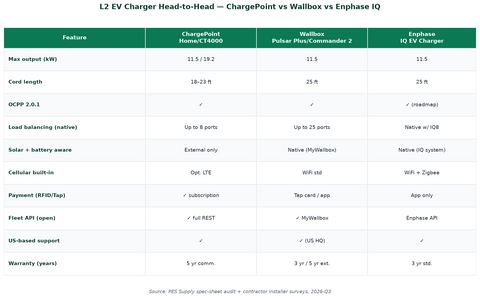
- L2 high (240V, 80A): 19.2 kW → ~64 miles/hour. Fleet-only ChargePoint CT4000 variant. Refill 90 kWh in 5 hours.
- DCFC low (400V, 50 kW): ~165 miles/hour. Modern EVs slow-charge above 80% SOC; realistic average during a 30-min session is 60–70% of nameplate. 20-min top-up delivers ~35 kWh.
- DCFC mid (500V, 150 kW): ~500 miles/hour peak, ~350 miles/hour average. 20-min top-up delivers ~90 kWh — meaningful highway travel.
- DCFC high (800V, 350 kW): Only newer 800V-architecture EVs (Hyundai IONIQ 5/6, Kia EV6/EV9, Porsche Taycan) can accept full 350 kW. Legacy 400V vehicles top out at ~170 kW even at a 350 kW station.
This is why the dwell rule works: with 30 minutes of dwell, only DCFC delivers useful range. With 4+ hours of dwell, L2 completes the job and costs 5–10× less per port to install.
L2 installed cost per port
- Single-family driveway L2: $1,500–$3,000 all-in (charger + panel work + permit)
- Commercial L2, single port: $4,000–$8,000 (charger + branch circuit + pedestal + permit)
- Commercial L2, dual-port pedestal: $6,000–$14,000 per pedestal (2 ports)
- Fleet depot L2 at scale: $6,000–$10,000 per port (drops with quantity and simpler infrastructure)
DCFC installed cost per port
- 50 kW DCFC single: $65k–$110k installed (charger + service + pad + switchgear + permit)
- 150 kW DCFC single: $130k–$220k
- 350 kW DCFC single: $180k–$320k
- NEVI-compliant 4-port 150 kW site: $900k–$1.6M full installed
The 20–30× multiplier from L2 to DCFC installed cost is why dwell time matters so much. A workplace parking lot with 8-hour employee dwell that installs DCFC is spending $200k where $60k would have delivered the same daily energy.
| Site type | Typical dwell | Recommended | Alternative | Why |
|---|---|---|---|---|
| Single-family home | 10–14 hr overnight | L2 40–48A | L1 for low miles | Overnight covers any daily use |
| Multi-family housing | 8–14 hr overnight | L2 32–48A shared | L2 with LM daisy chain | Shared circuits scale better |
| Workplace (office park) | 6–10 hr daytime | L2 32–48A | Higher-power for shorter shifts | Full day dwell fits L2 |
| Hotel | 8–14 hr | L2 48A | Adding one DCFC 50 kW | Overnight L2 for guest cars |
| Restaurant | 1–2 hr | DCFC 50–100 kW | High-power L2 19.2 kW | Not enough dwell for standard L2 |
| Retail (mall) | 1–3 hr | DCFC 100–150 kW | Mix of DCFC + L2 | DCFC drives foot traffic |
| Grocery store | 30–90 min | DCFC 150 kW | 50 kW acceptable | Under 1-hr dwell needs DCFC |
| Highway travel plaza | 15–45 min | DCFC 150–350 kW | Multiple 150 kW | Short dwell demands high power |
| Fleet depot (light-duty) | 8–14 hr overnight | L2 11.5 kW load-managed | Add 1 DCFC for backup | Overnight covers all vehicles |
| Fleet depot (medium-duty) | 8–10 hr overnight | L2 19.2 kW + shared DCFC | All DCFC if variable routes | Higher kWh per vehicle |
| Fleet depot (drayage/heavy) | 6–10 hr | DCFC 150 kW pooled | Higher-power L2 not sufficient | 300+ kWh/vehicle/night |
| Public parking lot | 2–8 hr variable | Mix: 20% DCFC, 80% L2 | All L2 if lot is 6+ hr avg | Mixed dwell needs both |
| University campus | 1–4 hr | Mix: L2 workplace, DCFC for visitors | All L2 for staff areas | Mixed uses same lots |
| Municipal / school fleet | 10–16 hr overnight | L2 11.5 kW | Higher-power L2 in cold climates | Long dwell, predictable |
| Curbside public | 1–4 hr | L2 11.5 kW | DCFC where sidewalks allow | L2 fits curbside pedestal easily |
Some sites have visitors with mixed dwell times. A hotel where guests stay overnight but the restaurant next door draws 1-hour visitors. A retail plaza where the anchor tenant is a grocery store (30-min dwell) alongside a movie theater (2.5-hour dwell). These sites benefit from a mixed deployment.
The standard hybrid mix:
- 1–2 DCFC dispensers (50–150 kW) at the entrance or high-visibility spot, catering to short-dwell visitors and the arriving/departing overnight traffic.
- 4–20 L2 ports in the standard parking area, catering to long-dwell visitors and overnight guests.
This mix gives the site coverage across the dwell spectrum. The DCFC handles pass-through drivers, the L2 handles the base of long-dwell parkers. Installed cost is often lower than an all-DCFC deployment for the same energy throughput because the L2 fleet takes the volume traffic while the DCFC handles peak-demand top-ups.
L2 sites are usually service-friendly
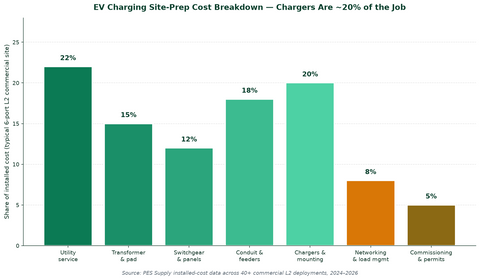
A 10-port L2 site with 11.5 kW/port needs 115 kW connected load. On a 400A/480V service (~330 kVA usable), this is comfortable coexistence with a small-to-medium commercial base load. Most retrofit L2 sites do not require a service upgrade if load management is deployed.
DCFC sites nearly always require upgrades
A single 150 kW DCFC needs 200 kVA of connected service. A 4-port NEVI site (600 kW simultaneous) needs 800 kVA. Very few commercial sites have that headroom. Add a 6–14 week utility service upgrade, a $30k–$120k transformer, and a $50k–$200k switchgear line item.
Demand charges hit DCFC hardest
DCFC peak draws are large and unpredictable. A single 150 kW dispenser at $18/kW-month demand charge = $2,700/month for one 15-minute peak. Two dispensers simultaneously = $5,400/month. Battery energy storage (BESS) buffered DCFC has become standard practice — the BESS discharges during peak charging, recharges from grid off-peak, keeping the demand charge below the site's tariff-adjusted setpoint.
L2 sites carry minor demand-charge impact
With load management, an L2 fleet depot easily coexists with existing commercial demand shapes. Overnight L2 charges during the utility off-peak window when demand charges are typically waived, keeping opex low.
-
1
Q1: What is the average dwell time of the target driver?
Not the maximum — the average. Pull anonymized dwell data from the site's existing parking system, mobile-panel data, or industry benchmarks. Under 45 min: DCFC. 1–3 hr: mixed or DCFC. Over 4 hr: L2.
-
2
Q2: What is the vehicle's target daily state-of-charge gain?
For fleet depots, this is deterministic — kWh needed per day from the route. For public sites, industry averages: highway travelers want 60% SOC gain in 20 min (DCFC essential); workplace commuters want 40% SOC gain over 8 hours (L2 sufficient); grocery shoppers want 15% SOC gain in 45 min (mid-power DCFC sufficient).
-
3
Q3: What is the site's existing electrical service headroom?
Pull the utility peak demand and compute headroom to the service capacity. Under 100 kW headroom = L2 with load management is the realistic path. Over 400 kW headroom = DCFC becomes feasible without a service upgrade. In between = mixed deployment with load management is the most flexible answer.
Edge 1 — Workplace with variable shift lengths
A hospital parking lot with 8-hour, 12-hour, and 3-hour shifts. Standard workplace L2 (11.5 kW) leaves the 3-hour shift underserved. Solution: 80% L2 for long shifts, 20% high-power L2 (19.2 kW) or low-power DCFC (50 kW) for short shifts.
Edge 2 — Cold climate fleet depot
Battery capacity derates 15–35% at -10°F. A depot in Minneapolis serving Class 3 trucks with a normally-adequate 10 kW/port L2 needs 12–14 kW/port to compensate for winter losses. Spec 19.2 kW L2 or add a shared low-power DCFC bank.
Edge 3 — Rural highway with long service distances
A rural DCFC site 12 miles from the nearest three-phase primary line. The utility interconnect quote comes back at $850k. Alternatives: (a) diesel-generator peaking hybrid, (b) large BESS + smaller service, (c) skip the site — some rural NEVI sites do not pencil.
Edge 4 — Curbside street parking
Sidewalk-mounted L2 is common in dense urban curbside deployments. Physical constraints usually rule out DCFC — the transformer and dispenser cabinet do not fit in a curbside utility zone. L2 pedestals designed for curbside (ChargePoint CT4023-CB, Wallbox Commander 2 curbside variant) handle this well.
Edge 5 — Solar-carport with EV
A commercial solar carport with under-canopy EV parking wants to consume PV directly rather than export. An 80 kW PV array pairs naturally with 4 L2 ports at 11.5 kW each (44 kW EV load, near-1:1 match with PV midday production). DCFC does not match this profile — a single 150 kW DCFC dwarfs the array and forces grid draw.
L2 and DCFC land on different permit tracks in most US jurisdictions, and the delta materially affects project timeline.
L2 permitting
Typical L2 install is a single electrical permit — new branch circuit, GFCI-protected, on an existing service. Review turnaround: 5–15 business days in most jurisdictions. Fee: $200–$800. Inspection: single visit at rough-in and final. For commercial workplace L2 with 4–12 ports, add ADA site plan review (typically 2–4 weeks).
DCFC permitting
DCFC triggers multiple permit tracks. Electrical (new service, primary equipment), civil (concrete pad, trenching, potentially a new easement for the utility line), fire (some AHJs treat DCFC cabinets as "hazardous energy" and require dedicated fire access), and often a full site plan review because DCFC is treated as a new commercial use. Review turnaround: 6–16 weeks. Fee: $3,000–$12,000. Inspection: 4–8 site visits over the construction period.
Add utility interconnection review on top. For a new pad-mount transformer install, the utility's engineering review can be 8–24 weeks by itself, running in parallel with municipal permits. NEVI-compliant sites often layer state DOT and FHWA reviews on top.
Practical scheduling impact: L2 project from decision to energized — 60–90 days. DCFC project decision to energized — 240–480 days. Plan accordingly. A hotel wanting EV charging "by Q4" is a Q4 L2 site or a next-year DCFC site.
Both L2 and DCFC connect to network operator platforms for monitoring, billing, and diagnostics. The software overhead differs meaningfully.
L2 network stack
Most L2 chargers ship with WiFi standard, cellular optional ($8–$12/port/month). OCPP 2.0.1 lets any charger talk to any network back-office. Data volumes are modest — a few KB per session. Session events fire at plug-in, plug-out, and roughly every 5 minutes during charging. A 20-port site generates ~200 MB/month of network traffic. Any small commercial firewall handles this trivially.
DCFC network stack
DCFC chargers stream more data — continuous cell voltage, temperature, and power module status. Data volumes are 20–100 MB per session. Modern DCFC also participates in ISO 15118 Plug&Charge, requiring PKI certificate management. Network operators handle most of this in their back-office, but the site owner needs a reliable 10–25 Mbps uplink and IPv4/IPv6 dual-stack. Rural DCFC sites frequently deploy dual cellular (Verizon + AT&T) with automatic failover to keep the 97% uptime target.
Payment processing
Public L2 typically accepts app-based payment or RFID card via the network operator. DCFC additionally accepts contactless credit/debit (EMV tap) per the NEVI federal rule and most state programs. That EMV terminal is PCI-DSS certified hardware and adds $600–$1,200 per dispenser plus monthly transaction fees.
Ongoing software cost
Typical network operator subscription: $12–$28/port/month for L2, $50–$180/port/month for DCFC (higher because of the volume of telemetry and higher billing complexity). Over 5 years, this stacks up: a 6-port L2 site pays $4,300–$10,000; a 4-port DCFC pays $12,000–$43,000. Factor into pro forma.
Isn't DCFC always better because it's faster?
What if my drivers demand fast charging?
Can I upgrade L2 to DCFC later?
How does 19.2 kW L2 compare to 50 kW DCFC?
What voltage should the service be?
Can I share a DCFC between multiple sites?
Does the ADA parking requirement differ between L2 and DCFC?
What network is best for public charging vs private fleet?
Get a dwell-time-optimized site design
Register for the PES Supply contractor portal. Share your target site, dwell pattern, and vehicle mix — we return a matched L2/DCFC recommendation with a full BOM, utility service impact, and capex estimate.
Register Now