NEC 2026 Preview: Key Code Changes Solar Installers Need to Prepare For
Reading time: ~6 min read
The 2026 edition of the National Electrical Code (NEC) represents one of the most significant revisions in recent memory. With a sweeping reorganization underway, new articles for high-voltage systems, and targeted changes to PV rapid shutdown requirements, solar installers and electrical contractors need to understand what is changing and when their jurisdiction may adopt the new code. This preview covers the key developments as of mid-2025.
The 2026 cycle reorganization is the part that will actually slow you down—not because the physics changed, but because the section numbers your muscle memory knows are being cited differently in plan review comments. When the reviewer writes a correction notice referencing a renumbered section, you want to answer in hours, not days. This is the working map our design team keeps next to the code book:
| Topic | Where It Lives (2026 Cycle) | What Changed in Practice | Preparation Action |
|---|---|---|---|
| Rapid shutdown | 690.12 (with TIA refinements) | 80 V / 30 s inside-boundary enforcement tightened; initiation device and labeling clarified | Spec listed MLPE; pre-print the full 690.56 label kit |
| Ground-fault / arc-fault protection | 690.5, 690.11 | GFCI and SPGFCI language harmonized; AFCI listing expectations raised | Verify inverter AFCI listing documents are in the submittal package |
| DC disconnects | 690.13, 690.15 | Disconnect location and equipment-grouping rules restated | Review disconnect placement rules before layout |
| Grounding & bonding | 690.41–690.47, Art. 250 | Terminology cleaned up; equipment grounding continuity emphasized | Audit EGC sizing with the grounding guide |
| EV charging | Article 625 | Dedicated circuits per charging space; load management recognized; GFCI expanded | Bid EVEMS on multi-charger jobs from day one |
| Energy storage | Article 706 | Fire suppression, spacing, and documentation expectations expanded | Loop the fire marshal in before rough-in on ESS jobs |
| Load calculations | Art. 220 | Dwelling load calc methods updated around electrification loads | Rebuild your load-calc template before the next service-upgrade quote |
None of these rows should surprise a working installer—but each one has already generated a red tag somewhere in a state that adopted early. The pattern we see: the failure is never the physics, it is the paperwork and the labeling. Fix the documentation pipeline and the hardware mostly takes care of itself.
The stacked 125% factors of NEC 690.8 did not change, but plan reviewers working the new edition are checking arithmetic that used to slide. Run every string through this exact sequence and keep the worksheet in the permit package:
| String Isc | ×1.56 (690.8 Adjusted) | Min Cu Conductor (90°C, NEC 310.16) | Max OCPD (NEC 240.6) | Field Note |
|---|---|---|---|---|
| 11 A | 17.2 A | 14 AWG (25 A) | 20 A | Small-format residential modules |
| 14 A | 21.8 A | 12 AWG (30 A) | 25 A | Standard residential strings |
| 16 A | 25.0 A | 12 AWG (30 A) | 25 A | High-current residential; no margin on 14 AWG |
| 19 A | 29.6 A | 10 AWG (40 A) | 30 A | Commercial 500W-class modules |
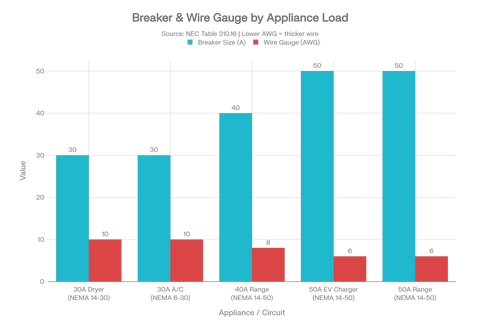
Two habits make this table bulletproof in review. First, show the temperature derating explicitly—the 90°C column is the starting point, and the wire ampacity chart plus NEC Table 310.15(B)(1) factors finish the job. Second, round the OCPD up only within NEC 240.6 standard ratings, which the standard breaker sizes chart lists in full. If the conductors run in raceway, the conduit fill chart keeps the upsized wire legal.
How we prepped our own pipeline for 2026
- The template purge. I spent one Saturday last fall rebuilding our proposal and permit templates: every reference to old section numbers flagged, every load calc rebuilt, every label schedule updated. Painful weekend. It has already saved us two correction cycles on early-2026 submittals.
- The spec-sheet firewall. Our procurement team now requires the AFCI listing document and rapid-shutdown certification with every inverter quote request, before pricing is even discussed. When the AHJ adopted mid-year, our submittal packages were already complete—competitors were scrambling for paperwork while we were scheduling inspections.
- The 80-volt education. I sat our crew leads down with the rapid shutdown limits and a multimeter on a de-energized test rig. Watching a properly listed MLPE string collapse to under 80 volts in seconds makes the rule real in a way a code paragraph never does. Nobody on my crews designs around string-level shutdown anymore.
When your jurisdiction formally flips to 2026, the installers who prepared will simply keep building. Track adoption, train the crew, fix the templates—then read our companion piece on the top NEC 2026 changes now in effect and keep the NEC compliance guide bookmarked for inspection day.
Preparation beats prediction. You cannot control when your state flips to the 2026 edition, but you can control whether that Tuesday morning is a non-event or a scramble. This is the sequence we ran internally, and the one I recommend to every contractor in our electrical contractor network:
| Window | Action | Owner | Done When |
|---|---|---|---|
| Days 1–14 | Audit current submittal templates against the new section numbering; rebuild the load-calc worksheet | Design lead | One test submittal passes internal review with zero legacy references |
| Days 15–30 | Collect listing documents (AFCI, rapid shutdown, UL 1741) for every standard SKU | Procurement | A complete listing binder exists for the standard BOM |
| Days 31–60 | Train field crews on the 30 V / 80 V rapid shutdown limits and the new label set | Operations | Every lead passes a hands-on commissioning drill |
| Days 61–75 | Meet the AHJ and fire marshal; confirm transition policy and ESS inspection sequence | Owner / PM | Written confirmation of the adopted edition and transition rules |
| Days 76–90 | Dry-run a full permit package under 2026 rules on one live project | Whole team | Package submitted with zero correction notices |
Ninety days is enough. The contractors who struggle through a code-cycle transition are never the ones with bad electricians—they are the ones whose paperwork, templates, and supplier documentation lagged the calendar by one quarter. Run the plan, keep the NEC compliance guide open while you do, and the adoption date becomes a footnote instead of a fire drill.
Code cycles are won or lost in the field, not the office. A perfect design package means nothing if the crew on the roof installs to last cycle's habits. When our jurisdiction signaled adoption, I built a half-day training block around the changes that actually touch an installer's hands, and it paid for itself on the very first inspection under the new rules. Here is the curriculum, because it transfers to any shop:
- Rapid shutdown, hands-on (60 minutes). De-energized demo rig, a multimeter, and the 30 V / 80 V limits written on a whiteboard. Every installer triggers the initiation device, watches the string voltage collapse, and times it. Nobody forgets a number they have measured themselves. Finish with the labeling walk: every placard in the 690.56 set, where it goes, and who signs off that it is installed.
- Conductor and OCPD math (45 minutes). The 1.56× multiplier, worked live on the string sizes your crews actually install. Hand every lead the quick table from this article, laminated. The goal is not turning installers into engineers—it is making sure a 19 A Isc module never lands on 14 AWG because "that's what we had on the truck."
- Documentation discipline (30 minutes). Photograph the torque marks, the labels, the disconnect locations, and the initiator. The closeout package wins inspections before the inspector arrives. Assign one person per job to own it.
- ESS and EV touchpoints (45 minutes). The Article 706 and Article 625 changes hit the most common upsells. Crews need to know when a battery triggers the fire marshal walkthrough and when a charger circuit needs load management, so those questions surface at the site survey—not at rough-in.
Half a day of training costs less than one re-inspection fee, and it compounds: every job after adoption day goes smoother because the crew already speaks the new section numbers. If you do nothing else from this article, schedule the training before your AHJ's adoption date, not after.
According to NFPA's NEC 70 code development page, the NEC Correlating Committee and Code-Making Panels 1–18 are executing a comprehensive reorganization that began with the 2023 edition. The 2026 edition continues this restructuring, with the goal of completing the reorganization in the 2029 edition.
For solar contractors, the most visible structural changes include:
- Article 220 relocation: Branch-Circuit, Feeder, and Service Load Calculations has been reorganized and moved to Chapter 1 as new Article 120.
-
High-voltage articles: Five new articles were added to Chapter 2 to consolidate all requirements for installations over 1000 volts AC and 1500 volts DC — directly relevant to large-scale PV systems:
- Article 265: Branch Circuits Over 1000V AC / 1500V DC
- Article 266: Feeders Over 1000V AC / 1500V DC
- Article 267: Outside Branch Circuits and Feeders Over 1000V AC / 1500V DC
- Article 268: Services Over 1000V AC / 1500V DC
- Article 270: Grounding and Bonding of Systems Over 1000V AC / 1500V DC
- Chapter 7 restructure: New articles 720–723, 742, and 750 consolidate limited-energy system requirements, with all grounding requirements for limited-energy systems now located in one place.
This reorganization means that contractors working on utility-scale solar projects — which increasingly operate at DC voltages exceeding 1500V — will find requirements consolidated in dedicated articles rather than scattered across the code.
The most directly PV-relevant change in the 2026 NEC comes through Tentative Interim Amendment (TIA) 1835, which revises Section 690.12(C) on rapid shutdown initiation devices. According to EC&M's coverage of the proposed TIAs, the key requirements are:
-
Initiation devices must be readily accessible and consist of one or more of the following, as specified in the rapid shutdown equipment instructions:
- Service disconnecting means
- PV system disconnecting means
- Listed switches
- For one- and two-family dwellings, initiation devices, where required, shall be located at an outdoor location.
This change strengthens firefighter safety by ensuring that rapid shutdown can be initiated from an accessible, outdoor location on residential properties. Installers should verify that their rapid shutdown system designs place initiation devices in compliant locations.
Ensure your rapid shutdown systems meet the latest code — shop our safety disconnects and electrical accessories with delivery in 7-10 business days.
Outdoor Outlet GFCI Requirements — Section 210.8(F)
The 2026 NEC expands GFCI protection for outdoor outlets. Outlets rated 60 amperes or less are now required to have ground-fault circuit-interrupter (GFCI) protection. A new Exception No. 3 permits the use of a listed Class C special purpose ground-fault circuit-interrupter (SPGFCI) to protect listed HVAC equipment. These devices are listed to UL 943C.
This is particularly relevant because Exception No. 2 — which previously provided an alternative for HVAC equipment — expires on September 1, 2026. Contractors installing or servicing HVAC equipment alongside solar installations should plan for the transition to SPGFCI protection.
TIA 1843: GFCI Between Power Conversion Equipment and Motors
TIA 1843 adds a new Section 430.132, which states that ground-fault circuit interrupters and special purpose ground-fault circuit interrupters shall not be installed between power conversion equipment output terminals and the motor. This TIA applies to both the 2023 and 2026 editions, addressing a configuration that could cause nuisance tripping or equipment malfunction in systems using power conversion equipment.
While Article 690's core DC disconnect requirements remain structurally similar to the 2023 edition, the reorganization and public comment process introduced clarifications. Per the NEC public comment record, key provisions include:
- Marking DC PV circuits: Permanent, readily visible labels indicating the highest maximum DC voltage in PV systems shall be provided at the DC PV system disconnecting means or PV system electronic power conversion equipment.
- PV system disconnect identification: The PV system disconnect must indicate whether it is in the open (OFF) or closed (ON) position and must be marked "PV SYSTEM DISCONNECT" or equivalent.
- Lockable enclosures: The door or hinged cover for the PV system disconnect must be locked or require a tool to open.
- Overcurrent device marking: Overcurrent protective devices used in PV system DC circuits shall be marked "Photovoltaic" or "PV."
These labeling requirements ensure that first responders and maintenance personnel can quickly identify and isolate PV system components. Contractors should stock compliant labeling materials and verify that all installed disconnects carry the required markings.
Find compliant DC disconnects and labeling accessories in our catalog.
The fundamental PV circuit sizing methodology in Article 690 remains consistent with prior editions, but contractors should be aware of the following provisions as they prepare for 2026 NEC adoption:
- Maximum PV system DC circuit voltage (Section 690.7) is the highest voltage between any two conductors of a circuit, used for selecting conductors, cables, and equipment.
- Current calculation: For PV systems rated below 100 kW, the maximum PV system circuit current is 125% of the sum of the short-circuit current ratings of PV modules connected in parallel (Section 690.8(A)(1)(a)(1)).
- Conductor ampacity: PV circuit conductors must have an ampacity of at least 125% of the current as determined by Section 690.8(A), with an exception for assemblies listed for operation at 100% of their rating.
These requirements underscore the importance of proper wire sizing in PV source and output circuits. Undersized conductors remain one of the most common inspection findings on solar installations.
While not PV-specific, changes to dwelling unit load calculations in the reorganized Article 120 (formerly Article 220) will affect how contractors size services and feeders for residential solar installations:
- The total volt-amperes per square foot for general lighting and receptacles in dwelling units was reduced from 3 VA/ft² to 2 VA/ft², reflecting increased energy efficiency in lighting and equipment.
- However, new Section 120.13 requires branch circuit load to be calculated at 3 VA/ft² to avoid a reduction in the number of branch circuits — meaning the change primarily affects service sizing, not circuit count.
- New Section 120.5(E) removes the requirement that continuous loads be calculated at 125%, a change that may simplify load calculations for solar-backed-up circuits.
These changes may reduce calculated service sizes for new residential construction, which could affect the available capacity for adding solar plus storage systems.
The NEC is typically adopted on a state-by-state basis, with adoption cycles ranging from immediate to several years after publication. As of mid-2025, the NFPA Standards Council was processing the six proposed TIAs, with a comment closing date of July 22, 2025. The table below summarizes the key TIAs affecting solar and electrical contractors:
| TIA Log No. | NEC Edition | Reference | Subject |
|---|---|---|---|
| 1835 | 2026 | 690.12(C) | Rapid shutdown initiation devices — must be readily accessible; outdoor location for dwellings |
| 1843 | 2023 & 2026 | 430.132 (new) | GFCI/SPGFCI prohibited between power conversion equipment and motors |
| 1846–1849 | 2026 | 500.30, 501.15, 505.30, 506.30 | Bonding requirements in hazardous (classified) locations |
TIA 1835 is the only PV-specific proposal in this batch, but all six, if issued by the NFPA Standards Council, will appear in the first printing and online version of the 2026 edition.
Contractors should take the following steps to prepare:
- Review the 2026 NEC when it becomes available, focusing on Article 690 changes and the new high-voltage articles (265–270) for utility-scale projects.
- Update rapid shutdown designs to ensure initiation devices are readily accessible and, for residential projects, located outdoors.
- Plan for GFCI/SPGFCI transition on HVAC equipment before the September 1, 2026 deadline for Exception No. 2 expiration.
- Verify labeling compliance on all PV disconnects and DC circuit markings.
- Coordinate with your AHJ to understand local adoption timelines and any amendments.
PES Supply carries the components you need to stay code-compliant. Browse our full selection of safety disconnects, wiring and cables, electrical accessories, and solar panels from 169 authorized brands. Standard delivery is 7-10 business days.
What NEC edition should I design to for 2026 projects?
Design to NEC 2023 if your AHJ has adopted it, but specify equipment that also meets NEC 2026 requirements (80V rapid shutdown, enhanced AFCI, BESS fire suppression). This future-proofs your installation and avoids costly retrofits when your jurisdiction upgrades.
How do I know if my AHJ has adopted NEC 2026?
Contact your local building department or check the NFPA's NEC adoption map. As of mid-2026, about 12 states are in various stages of NEC 2026 adoption. States typically adopt the NEC 1-2 years after publication through their legislative or administrative rulemaking process.
What happens if I permit under NEC 2023 and the AHJ adopts NEC 2026 mid-project?
Most jurisdictions grandfather projects that have already received a permit. However, if your permit expires before completion, you may need to re-submit under the new code. Check your permit's expiration date and the AHJ's transition policy.
Should I stock up on equipment before NEC 2026 adoption?
Stock the paperwork, not the warehouse. Qualify your standard inverter, MLPE, and disconnect SKUs against the new listing requirements now so your BOM is ready, but avoid panic-buying hardware — code-compliant product lines from major manufacturers are already shipping. The real lead time risk is in submittal documentation and plan review queues, not physical inventory.
Does the NEC 2026 reorganization change any actual wiring rules?
Mostly no — the reorganization renumbers and regroups sections for clarity, but the physics of conductor sizing, overcurrent protection, and grounding remain the same. The substantive changes are concentrated in rapid shutdown enforcement, ESS fire protection, EV charging infrastructure, and AFCI listing expectations. Learn the new numbering so plan review comments do not stall your projects.
Ready to build your system? PES Supply stocks 50,000+ SKUs from 169 authorized brands, with delivery in 7-10 business days. Here are the products mentioned in this article:
- BR Solar Group BR-M310W
- Conext Insight Home
- DU221RB Safety Disconnect
- BR Solar Group BR-M315W
- Conext XW Conduit Box
Browse all electrical · Browse all circuit breakers · Browse all surge protection